Specify the channels, loads and controls before choosing the amplifier.
A PA power amplifier manufacturer should help translate a venue's speaker plan into a workable amplification schedule: which channel drives each area, what load it sees, how it receives audio, and how the system is commissioned. Comparing maximum wattage before answering those questions can leave an installer with enough total power but the wrong outputs or controls.
This guide focuses on hotels, conference facilities and multi-function venues with several listening areas. It explains how to prepare a specification that supports an accurate quotation and a straightforward handover.
1. Define the PA system architecture first
PA means public address, but the term covers different electrical systems. A conference hall with low-impedance loudspeakers is not specified in the same way as a building-wide 70 V or 100 V distributed speaker network.
For a distributed system, confirm the required line voltage, speaker transformer taps and total connected load. For a low-impedance system, confirm each amplifier channel's nominal and minimum load. An ordinary low-impedance output is not automatically a direct 70 V or 100 V output.
The FEDAXY models discussed below have published low-impedance ratings. Treat them as candidates for that architecture; request written confirmation before proposing any constant-voltage configuration.
Also separate everyday announcements and entertainment audio from any required emergency voice system. An amplifier's general audio specification does not establish approval for an emergency application.
2. Turn room names into a channel schedule
A zone is an area requiring its own audio behavior; an amplifier channel is an electrical output. One stereo zone may need two channels. Several loudspeakers may share a channel if they need the same signal and the resulting load is acceptable.
Before requesting a multi-zone PA amplifier, record whether each area needs an independent source, level, mute, equalization or delay. These requirements determine the signal processor and routing as well as the number of power channels.
| Output | Speaker area | Audio requirement | Check before selection |
|---|---|---|---|
| Channel 1 | Main hall, left | Left program feed | Speaker load, output requirement and gain |
| Channel 2 | Main hall, right | Right program feed | Match the intended left/right operating settings |
| Channel 3 | Rear fill area | Mono hall feed with separate delay | Required summing, delay range and final load |
| Channel 4 | Small foyer | Independent program and level | Separate source route and speaker power limits |
This example needs four power outputs, but four outputs alone do not provide the required functions. The rear fill needs an appropriate mono feed and delay; the foyer needs a separate source path. Check the exact input count, routing matrix and processing available on the proposed equipment.
If the venue later divides the hall into two rooms, shared speaker circuits may prevent independent operation. Include movable partitions and planned extensions in the initial channel schedule.
Have a speaker list or room layout?
Send the zones, speaker models and intended controls to FEDAXY to discuss a suitable amplifier configuration.
Discuss My PA Channel Plan →3. Match output power to each channel's actual load
Calculate the connected impedance
For identical nominal loads connected in parallel, divide one loudspeaker's nominal impedance by the number connected. Two 8-ohm loudspeakers in parallel represent a nominal 4-ohm load. This is a planning calculation: a loudspeaker's impedance varies with frequency, so its minimum impedance and the manufacturer's wiring guidance still matter.
Do not divide the amplifier's total advertised wattage equally among rooms. Compare the published output at the load on each channel, then confirm the conditions behind that figure: frequency range, distortion limit, supply voltage, test duration and number of channels driven.
Keep loudspeaker ratings and limiter settings together
Continuous, program and peak loudspeaker ratings describe different limits. Use the loudspeaker manufacturer's recommended amplifier range and protection settings rather than applying one power multiplier to every system.
An amplifier with substantial output capability may require carefully configured limiting when it drives smaller speakers. A low front-panel level setting is not a documented substitute for the required protection. Conversely, insufficient clean output can leave speech or music peaks clipped before the intended audience level is reached.
Bridge mode also changes the channel allocation and permitted load. Confirm the specific bridge rating and wiring; do not treat it as a free power upgrade that leaves the original outputs available.
4. Choose where the processing belongs
An integrated DSP amplifier can reduce separate equipment, while an external processor can coordinate several amplifiers and sources. The better arrangement depends on the venue's routing, controls and maintenance plan.
Ask for the actual DSP functions and limits. For the example above, confirm independent output delay, the required mono summing, equalization, high-pass filtering and suitable limiting. Also confirm whether settings can be saved, restored and protected from casual changes. The label "DSP" does not prove that every required function is available.
Gain structure deserves its own check. The processor's output capability, the amplifier's input sensitivity and its gain setting must work together. Record the approved settings so that a replacement unit can be commissioned consistently. Biamp's technical guidance on input and output levels similarly emphasizes matching signal voltages between connected devices.
For a network audio proposal, separately verify audio transport, control software, network requirements and fallback behavior. A network connector or integrated DSP does not by itself establish Dante support.
5. Compare FEDAXY platforms against the schedule
Guangzhou Fedaxy Audio Equipment Co., Ltd. supplies professional power amplifiers in several architectures. The following published configurations provide starting points for a discussion about low-impedance installation projects.
| Model | Published configuration | Question for your project |
|---|---|---|
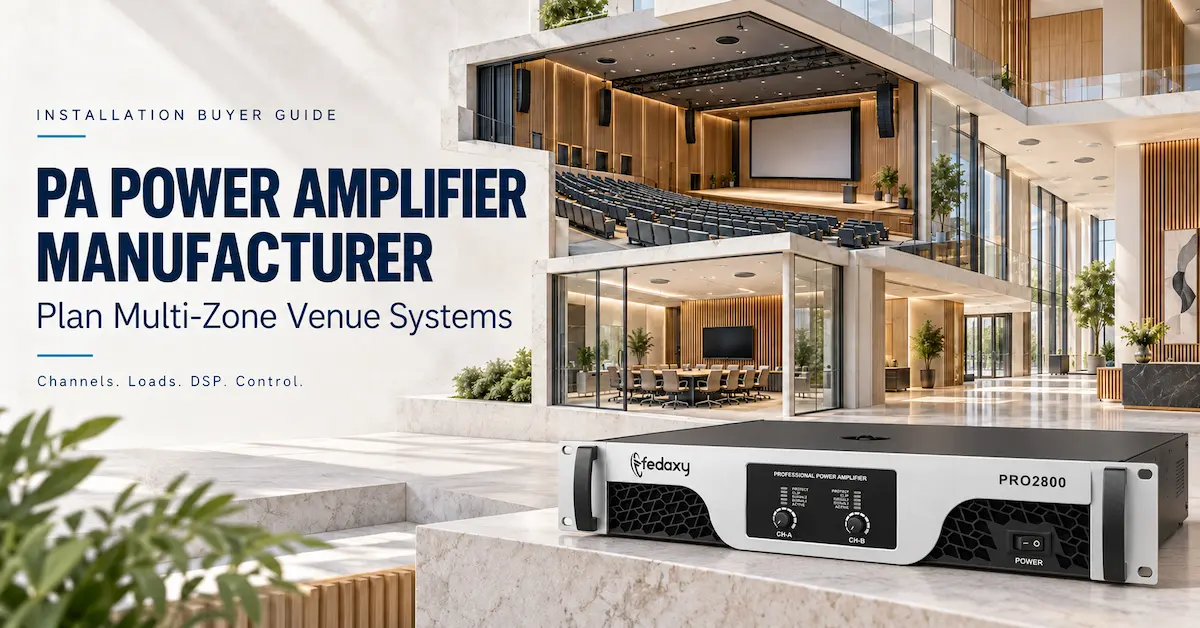
| PRO2800 | Class H; 2 channels; 2U; 2 x 800 W at 8 ohms | Does a two-channel arrangement fit the speaker circuits and external processing? |
| DE41300 | Class TD; 4 channels; 1U; 4 x 1300 W at 8 ohms | Can four outputs serve the required loads within the rack's cooling and power limits? |
| DP41500 | Class TD with DSP; 4 channels; 1U; 4 x 1500 W at 8 ohms | Does its exact DSP configuration meet the input, routing, protection and control requirements? |
Figures above are FEDAXY's published product specifications, not independent measurements or a system recommendation. Confirm the supplied version, test conditions and all-channel operation. Request a lower-output configuration where the loudspeaker schedule calls for one.
Compare the wider FEDAXY amplifier range if these configurations exceed or fall short of the project requirements. Matching the application matters more than selecting the highest number in the catalog.
6. Check the rack as an operating environment
A compact amplifier saves rack height, but the installation still needs room for cables, ventilation and service access. Record the usable rack depth, door clearance, air inlet conditions and exhaust path. Check the combined heat load when processors, amplifiers and other equipment share an enclosed cabinet.
For a conference room, request fan-noise information at the expected operating condition. A rack close to microphones or seated listeners can make cooling noise relevant even when the sound system is idle.
Give the PA power amplifier manufacturer the actual local supply voltage and frequency. Ask for the exact supplied model's voltage range, power consumption, inrush information and connection requirements. Loudspeaker output wattage alone does not determine the mains circuit requirement; the electrical designer needs the manufacturer's operating data.
Finally, consider how much of the venue stops working if one chassis is unavailable. A four-channel amplifier concentrates several outputs in one unit. Multiple smaller amplifiers may offer a different service arrangement, but any backup or changeover scheme must be explicitly designed and verified.
7. Agree on acceptance before installation day
A useful acceptance plan describes observable results. Agree on who performs each check, where it takes place, and which records must accompany handover.
- Identify the equipment: record model, serial number, supply version, configuration and relevant software or firmware version.
- Verify the output schedule: confirm each speaker circuit, polarity, load and physical output label.
- Check routing: prove that each source reaches only the intended areas and that local level and mute controls behave correctly.
- Commission processing: set gain, filtering, delay and limiting against the loudspeaker data and acoustic requirements.
- Observe normal operation: run the agreed program material for the agreed duration and record relevant thermal or protection behavior.
- Test recovery: confirm approved settings after a controlled restart and preserve configuration backups.
FEDAXY's product pages describe five QC inspections and an eight-hour aging test. Ask what load, signal, ambient conditions and pass criteria apply to the ordered model. Factory testing and on-site commissioning answer different questions; both should have a defined scope.
Request the applicable product documents for the destination market and supplied configuration. General certificate images do not establish that every version is covered.
Request a configuration with the evidence you need
Include the operating load, rack conditions and acceptance requirements when asking FEDAXY for specifications and a quotation.
Request Specs and a Project Quote →8. Send an RFQ that avoids configuration gaps
A short, complete RFQ is more useful than a request for the "best PA amplifier price." Use this checklist to make competing proposals comparable.
- Venue: room uses, independent zones, operating hours and planned expansion.
- Loudspeakers: models, quantities, wiring, ratings and final load per channel.
- Signal paths: sources, required inputs, output routing, delay and local controls.
- Installation: mains supply, rack space, cooling and noise constraints.
- Order: quantity, destination, required documentation, sample needs and target delivery date.
- Handover: acceptance checks, settings backup, manuals, spare strategy and support requirements.
Ask the supplier to mark exclusions and optional items. A quote may cover the amplifier chassis while leaving the processor, controller, network accessories or commissioning outside the price. MOQ, lead time, customization scope and shipment arrangements should be confirmed for the specific order.
9. Compare the installed cost and service plan
For fixed installations, compare the cost of a functioning system: amplifiers, processing, rack hardware, power distribution, cabling, configuration and handover. An apparent saving on the amplifier can disappear if additional equipment or repeated site visits are needed.
For distributors supplying repeat venue projects, standardize the approved configuration and documentation. Record acceptable substitutions, settings files, labels and who authorizes changes. FEDAXY publicly offers customization services; confirm the scope and approval process before treating a customized version as interchangeable with a standard model.
Clarify warranty coverage, fault reporting, spare parts and return arrangements in the quotation. Review FEDAXY's company information alongside the model documents, then base the purchase decision on the proposed configuration and agreed support terms.
Frequently Asked Questions
Can one four-channel amplifier run four independent zones?
Only if the complete system provides the required independent input routing, processing and controls, and each channel supports its connected load. Four power outputs do not automatically provide four independently selectable program sources.
Does a PA amplifier automatically support 100 V speakers?
No. Confirm an explicitly supported constant-voltage output or an engineered interface. Low-impedance wattage ratings alone do not establish compatibility with a 100 V speaker line.
Should an installation use integrated or external DSP?
Choose according to routing, control, processing limits and maintenance needs. Integrated DSP may reduce separate hardware; an external processor may better coordinate several sources and amplifiers. Verify the proposed signal path before ordering.
What documents should accompany the amplifier?
Request the current model specification, connection instructions, applicable compliance documents, agreed test records and warranty terms. For a configured system, retain the output schedule and approved settings as well.
What if the speaker model has not been selected?
Request a preliminary discussion rather than a final amplifier specification. Provide the venue use, zones and performance objectives, then finalize the amplifier schedule after speaker selection and load calculations.
Conclusion
Choosing a PA power amplifier manufacturer becomes easier when the project brief defines the actual installation. Start with the speaker architecture and zone schedule, match each output to its load, verify the processing and controls, and agree on acceptance and support.
For a FEDAXY quotation, send the speaker list, channel plan, supply details and rack conditions. That gives the discussion a practical starting point and helps identify configuration gaps before equipment reaches the venue.
Plan your venue's amplifier configuration
Share your project requirements with FEDAXY and request a proposal matched to your speaker circuits and control needs.
Send My PA Project Requirements →