A reliable Class D power amplifier supplier should help you do more than purchase the first shipment. If you manage a professional audio distribution business, a rental fleet, or a rollout covering multiple venues, you need a repeatable way to select configurations, maintain technical consistency, forecast spare units, document approvals, and reorder equipment without unexpected changes.
That is the key difference between buying an individual amplifier and building a dependable procurement program. A low introductory price is useful, but it cannot compensate for mismatched loudspeaker loads, an undocumented firmware change, unavailable replacement units, or a late shipment that holds up an installation.
Quick answer: Select a supplier by matching the amplifier to your speaker and signal architecture, verifying model-specific published specifications, agreeing on a controlled product configuration, and documenting how orders, inspections, replacements, and future revisions will be handled. For repeat purchasing, the approved product definition and service process matter as much as headline wattage.
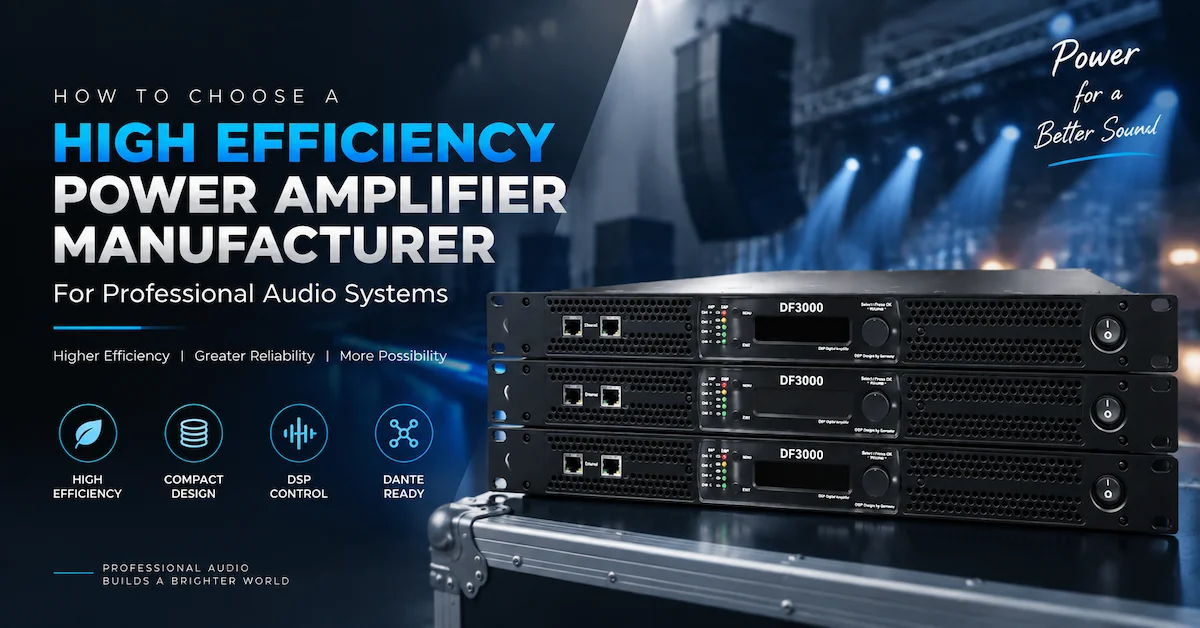
Guangzhou Fedaxy Audio Equipment Co., Ltd. (FEDAXY) offers 1U Class D amplifiers in two-channel and four-channel formats, including DSP and Dante-enabled options. This guide uses those models as sourcing examples while distinguishing published manufacturer information from commercial arrangements that buyers should negotiate individually.
Explore FEDAXY Class D Amplifiers Discuss a Multi-Venue Procurement Plan
1. What Makes Repeat-Order Class D Amplifier Sourcing Different?
A first purchase answers a limited question: can this model work in one proposed system? A repeat-order program asks a broader set of questions. Can the same performance, appearance, interfaces, documentation, and system configuration be delivered again when the next venue opens or the rental fleet expands?
Consider three common purchasing situations. A distributor may introduce a four-channel Class D model to several regional dealers, then need compatible replacement stock months later. A system integrator may commission twenty rooms using the same amplifier settings and expect the next twenty rooms to sound and behave consistently. A touring supplier may standardize its racks so spare units can be swapped quickly between events.
All three buyers are purchasing operational continuity, not simply a set of amplifiers. A suitable supplier relationship therefore includes a product baseline, a controlled change process, a documented inspection plan, realistic commercial terms, and an identifiable route for technical support.
This article focuses specifically on rollout and replenishment management. It complements, rather than repeats, a first-sample audit: once a sample is approved, procurement teams still need a system that protects the approval through subsequent shipments.
2. Which Buyers Benefit Most—and When Is This Approach Unnecessary?
A structured supplier program is especially valuable for regional professional audio distributors, AV system integrators, KTV and hospitality project contractors, large rental inventories, and private-label audio brands. These buyers need stable product identities across projects and purchasing cycles.
It may be excessive for a one-time small installation with no expected expansion, provided that the equipment is compatible, adequately documented, and supported. Conversely, buyers of 70V/100V distributed audio systems should not assume that a conventional low-impedance Class D rack amplifier is an appropriate substitute. That architecture requires its own equipment evaluation.
| Buyer type | Main operating challenge | Procurement priority |
|---|---|---|
| Audio importer or distributor | Supporting dealers after the first shipment | Stable SKU definitions, documentation, warranty workflow |
| Multi-venue AV integrator | Delivering the same system across many sites | Standardized channel assignments and configuration records |
| Rental and touring company | Replacing or expanding rack inventory | Interchangeable models, rack airflow, spare-unit planning |
| Hospitality and entertainment contractor | Repeating room layouts under deadlines | Approved loudspeaker matching, installation templates, supply timing |
| Professional audio brand | Differentiated products without uncontrolled revisions | OEM scope, branding approval, firmware and hardware change control |
The strongest purchasing plan with a Class D power amplifier supplier starts with your operational problem. A distributor's priority may be batch consistency; a rental company's may be fault recovery; a fixed-installation contractor's may be predictable commissioning time. Supplier evaluation should reflect that distinction.
3. Start With a Venue-Level System Specification, Not a Supplier Price List
Before requesting quotations from a Class D power amplifier supplier, prepare one system specification that can be reused across the procurement team. This prevents different stakeholders from comparing products that are not functionally equivalent.
The brief should describe the loudspeakers, their nominal impedance, the manufacturer's recommended amplifier operating range, the number of independently processed outputs, and the expected operating duty. Also identify whether the signal arrives from analog outputs, an external DSP, or a Dante-enabled audio network.
A useful venue specification also records power supply conditions, rack dimensions, airflow routes, ambient temperature expectations, maintenance access, and the installation schedule. If an amplifier will be used with subwoofers or other demanding loads, include the intended load configuration and operating limitations.
| Specification field | Example information to provide | Purchasing decision affected |
|---|---|---|
| Loudspeaker schedule | Model, quantity, impedance and manufacturer guidance | Output requirement and load suitability |
| Channel map | Left/right, fill, monitor, subwoofer or zone outputs | Two-channel versus four-channel choice |
| Signal architecture | Analog, external DSP, integrated DSP or Dante | Required amplifier feature set |
| Cabinet arrangement | Number of racks, units per rack, cable paths | Physical installation and airflow |
| Mains power | Nominal voltage, distribution and available circuits | Electrical compatibility |
| Service model | Local integrator, central technician or rental workshop | Spare units and troubleshooting procedures |
| Rollout plan | Pilot site, subsequent sites and expected order waves | Inventory and delivery scheduling |
Use a single revision-controlled document for this specification. When a venue differs from the standard layout, record the exception explicitly rather than allowing silent substitutions.
4. Choosing Two Channels or Four: Design Around the Speaker Schedule
Two-channel and four-channel amplifiers serve different system designs. Neither is inherently superior. The correct choice is the one that meets the channel map, load requirements, wiring plan, and operational expectations.
Four-channel amplifiers can support several independent speaker groups in one chassis. For integrators with repeated zones, this may simplify rack planning and reduce the number of individual units. However, four channels are only useful if the speaker schedule, signal routing, and protection requirements match the design.
Two-channel amplifiers may be preferable where only two high-output speaker groups are needed or where a fleet is standardized around a straightforward left/right configuration. A two-channel layout can also align with certain low-frequency or stage-system plans, subject to verified load capability.
Do not calculate procurement value from chassis count alone. A system with fewer amplifiers may still require more complex signal distribution, higher power infrastructure, or a different maintenance procedure.
For repeat orders, maintain a channel allocation drawing showing each amplifier's model, channel number, speaker load, and processor output. The drawing should travel with the approved bill of materials and commissioning records.
5. FEDAXY Class D Models: A Practical Supplier Comparison
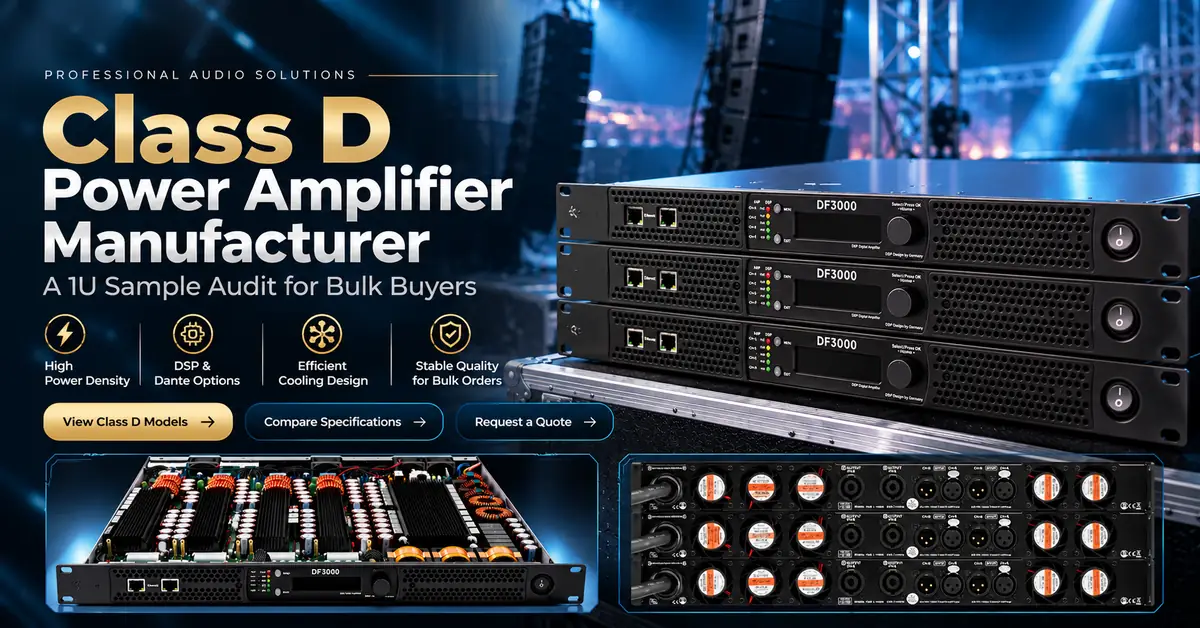
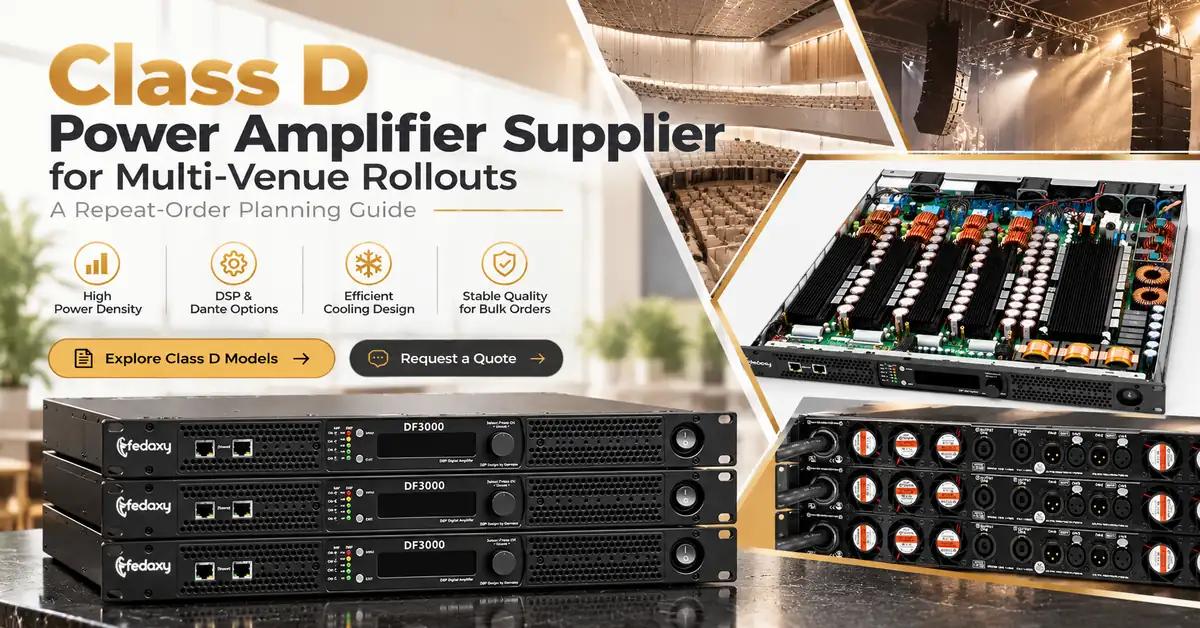
FEDAXY publicly lists four Class D amplifier products. All four are described as 1U platforms; the portfolio provides two-channel and four-channel variants, while the DF and DT models are specifically presented with integrated DSP and Dante networking.
| FEDAXY model | Channels | Chassis | Published output at 8Ω | Published DSP / Dante positioning | Possible procurement role |
|---|---|---|---|---|---|
| DF3000 | 4 | 1U | 4 × 3000W | DSP and Dante | Multi-channel installations requiring digital integration |
| DT4200 | 2 | 1U | 2 × 4200W | DSP and Dante | High-output two-channel networked configurations |
| D43000 | 4 | 1U | 4 × 3000W | Not listed as built-in features | Multi-channel designs using existing external processing |
| D24200 | 2 | 1U | 2 × 4200W | Not listed as built-in features | Compact two-channel systems using external processing |
These are manufacturer-published 8Ω ratings, not independent continuous-output test results. Measurement method, loaded-channel conditions, operating duration and project compatibility must be confirmed before approval.
The DF3000 and D43000 share the same published 8Ω channel count and output headline, but this does not mean that they are operationally interchangeable: one is explicitly described with integrated DSP and Dante, while the other should be treated as a distinct configuration until its interface and processing functions are verified.
Likewise, DT4200 and D24200 have the same published 8Ω headline, but that alone does not establish the same network architecture, software control, or procurement cost. The D24200 public page also contains inconsistent 4Ω figures between its short description and parameter table. Ask for the corrected current datasheet and do not use that 4Ω figure as a contractual requirement until clarified.
6. How DSP and Dante Affect Multi-Site Standardization
Built-in DSP is relevant to repeatable deployments because signal processing may be part of the approved system configuration. When supported by the exact model, functions such as filtering, crossover, delay, gain management and limiting can reduce reliance on separate processing hardware. Buyers must verify which functions are actually available; a DSP label does not guarantee a particular feature or user interface.
Dante is a networked audio technology developed by Audinate. It can carry digital audio over appropriately designed IP networks. For a rollout, that can influence cable planning, device discovery, synchronization and the responsibilities shared between AV and IT teams. It does not remove the need for deliberate network design.
For a Dante-equipped amplifier program, document the intended network topology, channel subscriptions, supported clocking behavior, firmware versions and management access. If the design uses managed switches or segmented networks, the supplier and integrator should establish compatibility requirements before deployment.
A practical configuration package may include the approved software version, DSP preset files, channel names, input routing, network settings, limiter rationale and an installation checklist. Store it with the project documentation rather than leaving it only on an individual technician's laptop.
For networks at multiple venues, make sure each location has an independently validated configuration. A preset copied into a system with different loudspeakers or load conditions may be inappropriate even when the amplifier model is identical.
7. Verify Output Ratings Before Building a Standard Product List
Published wattage can help shortlist amplifiers, but the number is meaningful only when its measurement conditions are known. A professional quotation should distinguish the load impedance, test signal, duration, distortion criterion, supply conditions and number of simultaneously driven channels.
For example, a four-channel model advertised at 4 × 3000W into 8Ω provides a useful starting point, but the value should not be interpreted as a guarantee of unrestricted continuous full-band output from all four channels under every electrical and thermal condition.
IEC 60268-3:2018, Sound System Equipment—Part 3: Amplifiers, is a recognized reference for amplifier characteristics and measurement methods within its stated scope. Buyers may use its terminology to formulate consistent technical questions, without assuming that a manufacturer has tested a product to that standard unless evidence is supplied.
Impedance deserves equal attention. An amplifier may publish 2Ω capability, but wiring multiple loudspeakers in parallel reduces the equivalent load. For two equal nominal 8Ω speakers wired in parallel, the nominal equivalent is 4Ω. Real speaker impedance varies with frequency, so the nominal number is not a complete description of the electrical load.
Ask whether the proposed model supports the actual loudspeaker wiring and intended duty. Document any bridge-mode use, the required wiring rules and the limits stated by the manufacturer. Do not substitute a published peak or bridged figure for an independently verified system requirement.
The best supplier response is a model-specific technical answer, not a generic promise that the amplifier can run any speaker.
8. Electrical Design, Components and Thermal Management: What Buyers Should Inspect
Class D amplifiers contain more than an output-stage label. Their system performance also depends on the power supply, switching components, filter networks, control circuitry, protection logic, cooling path, connectors and mechanical assembly. Differences in these areas can influence serviceability and consistency between production batches.
A purchasing review should identify the actual product architecture rather than assume that every amplifier from one factory uses the same components. FEDAXY's Class D product descriptions emphasize a switching power supply, intelligent cooling, and multiple electrical protection functions. The published specification tables identify front-to-back fan-assisted airflow.
For fixed installations, front-to-back ventilation requires rack planning. Hot exhaust must not be trapped against a closed rear panel or redirected into another unit's intake. For touring racks, check whether cases, dust filters and cable looms obstruct the designated airflow path.
Buyers should also review mains connectors, output connectors, protective grounding arrangements, labeling, and access for servicing. For destination markets with different power infrastructure, obtain confirmation of the exact shipped voltage configuration and relevant electrical documentation.
A technical review can ask for a current block diagram, relevant component descriptions, assembly inspection points and operating instructions. It should not require a supplier to disclose proprietary circuit details unrelated to the acceptance criteria. The goal is to establish evidence of a controlled design and suitable support—not to collect impressive but irrelevant component claims.
9. Configure an Approved Product Baseline for Repeat Orders
A repeat-order program needs a defined baseline: the precise product that the buyer has approved for a given use. Without one, two shipments carrying the same model name may still differ in ways that matter to the installation team.
The baseline can contain the model and SKU, hardware revision, power-supply version, DSP or network firmware, approved accessories, packaging artwork, operating manual, labels, cable or connector conventions, and sample inspection record. Not every supplier uses the same revision-identification system, so agree on the method during negotiations.
A change-control clause should state which changes require prior notice and which require buyer approval. Examples include an updated network module, a replacement fan type, an altered connector arrangement, a materially different output-stage component, modified firmware behavior or new packaging dimensions.
A change is not automatically negative. Engineering revisions may improve performance or replace unavailable parts. The procurement risk arises when a material change is introduced without documentation, compatibility analysis or a suitable approval path.
| Baseline item | Recommended control | Buyer benefit |
|---|---|---|
| Product identity | Fixed model/SKU and revision record | Consistent purchasing reference |
| Output specification | Agreed measurement conditions | Comparable technical acceptance |
| DSP and firmware | Approved versions and preset archive | Predictable commissioning |
| Mechanical interfaces | Connector, mounting and airflow drawings | Reduced installation rework |
| Packaging | Approved labeling and accessory list | Easier warehousing and distribution |
| Change notification | Defined notice and reapproval process | Lower substitution risk |
This is a recommended buyer-supplier process, not a claim that every FEDAXY standard order currently includes formal revision-control services. Such requirements should be specified in the quotation or purchase agreement.
10. Use Factory Quality Control to Support Batch Consistency
Product-level quality inspection and batch-level consistency are related but different tasks. A unit can pass functional testing while still creating commercial problems if cartons are mislabeled, accessories change, the wrong firmware is shipped, or a purchase-order configuration is mixed between batches.
FEDAXY states on its website that it applies five rounds of quality control, eight-hour aging tests and 6S production management. It also describes incoming-material inspection, assembly inspection, and final performance checks. These are supplier-published descriptions; a purchaser should request relevant evidence for the model and order under discussion.
For a volume order, define what the factory checks and what the buyer or appointed inspector will verify. Typical receipt-inspection categories include quantity, serial or batch identification, appearance, connector type, mains marking, firmware identification, included accessories, packaging damage, and a defined functional sample.
The sampling approach should reflect shipment size, failure consequences, inspection cost and contractual acceptance criteria. An arbitrary sample size is not a substitute for a risk-based inspection plan. For critical deployments, the buyer may require additional documented testing or an independent inspection service.
When defects arise, the support process should record the symptom, serial or batch information, operating conditions, diagnostic findings and agreed remedy. Repeated failures should trigger analysis across the affected batch rather than isolated replacement conversations.
11. Plan Lead Times, Stock Buffers and Order Waves Realistically
Multi-venue procurement with a Class D power amplifier supplier is a scheduling problem as well as an equipment problem. The first shipment might supply a pilot installation, but later waves need to align with construction access, rack assembly, transportation, customs clearance, commissioning and customer handover.
Separate factory production lead time from the complete project delivery timeline. Production, pre-shipment inspection, export handling, freight, customs clearance, local transport and installation represent different activities with different dependencies.
Ask the supplier to provide a quotation-specific production schedule and to identify which terms depend on component availability or customization. Public website statements should not be treated as a guaranteed lead time for every order.
For forecasting, a basic replenishment calculation is useful: planned order quantity = forecast project demand + desired safety stock − available usable stock − confirmed incoming stock. This is an inventory planning formula, not a factory production guarantee.
For example, if an integrator expects to use 30 amplifiers across upcoming sites, holds 4 approved spare units, already has 8 usable units on hand and 6 units in confirmed transit, it would plan a further 20 units to reach the desired position. Those numbers are illustrative, not a FEDAXY order case or recommended universal buffer.
Avoid fixing a safety-stock percentage without considering project criticality, replacement lead time, historical failure data, freight route and the availability of compatible substitutes. A rental company may need swap-ready stock; a contractor with scheduled deployments may need a smaller but tightly timed buffer.
12. Spare Parts, Warranty and After-Sales: Make Them Commercially Specific
A wholesale Class D amplifier supplier should be assessed on what happens after the shipment arrives. This is especially important when equipment is installed across distant venues and the local technicians do not have immediate access to the original factory.
Before signing a repeat-order agreement, confirm who receives fault reports, how technical diagnosis is handled, where units are repaired, whether advance replacement is possible, how return freight is allocated, and which spare parts or replacement units are available.
FEDAXY promotes warranty support on its public website, but buyers should request the written warranty applicable to the exact model, destination market and commercial contract. A headline warranty duration does not establish what failures are covered, whether labor is included, or how transport charges will be handled.
Ask the supplier to define practical response channels, required fault information, service documentation and the escalation route for repeated problems. If your business operates its own repair center, discuss permitted service work and whether technical training or parts support can be agreed upon.
A useful after-sales plan protects the end customer, the local distributor and the factory by making responsibilities explicit before there is a problem.
13. OEM/ODM Options for Brands and Distributor Networks
Some buyers need a standard Class D amplifier under their own distribution program. Others require approved branding, panel appearance, packaging or documented configuration differences. Those requirements should be evaluated separately from the performance baseline.
FEDAXY publicly offers OEM/ODM-related services, including logo, front-panel and packaging options and selected engineering customization. The permitted scope, minimum order quantity, price effects and engineering work must be confirmed for the chosen product.
For a private-label program, prepare an artwork package and identify the manufacturer name, branding marks, safety labels, user documentation, serial-label requirements and packaging languages. Agree on artwork approval and responsibility for ensuring that market-facing claims match the approved product.
If an OEM request changes the electrical design, DSP software or network functionality, treat it as an engineering variant requiring technical approval. The standard model's test records and compliance documentation should not automatically be applied to a materially modified version.
Distributors should also discuss how replacement units will be identified and whether the approved branding can be maintained across future orders. This is particularly relevant when dealers need consistent front panels and cartons for their existing product lines.
14. Compare Total Landed Cost, Not Just Unit Price
A Class D power amplifier supplier's quoted price is only one part of the economic decision. Buyers should evaluate total landed cost and the operational cost of owning the equipment over the intended period.
The landed-cost calculation may include product price, packaging upgrades, inland freight, export handling, international shipping, cargo insurance, import duties and local logistics. Local taxes should be modeled in the appropriate way for the buyer's jurisdiction rather than assumed to be a permanent cost in every case.
Ownership costs can include rack hardware, power distribution, configuration labor, spare inventory, maintenance, replacement shipping, downtime and technical support. Integrated DSP or Dante may reduce certain external equipment requirements in a compatible system, but they may also require more network planning or technician training.
| Cost factor | Low-price quotation may overlook | Practical comparison method |
|---|---|---|
| Amplifier | Different channel or DSP specification | Normalize to an approved configuration |
| Freight | Different carton dimensions and transport terms | Compare the same delivery destination and Incoterm |
| Installation | Extra processors, cabling or rack work | Estimate complete system bill of materials |
| Commissioning | Different software and setup procedures | Record labor per repeatable site layout |
| Saved | Long replacement cycle or incompatible stock | Price an agreed spare strategy |
| Service | Unclear repair responsibilities | Confirm written warranty and support terms |
Do not accept speculative percentage savings without a defined project comparison. A defensible purchasing decision is based on the cost structure of your own system and commercially supported quotations.
15. Supplier Evaluation Scorecard for a Rollout Program
A structured scorecard allows engineering, purchasing and operations staff to compare each Class D power amplifier supplier without treating the lowest price as the only objective. The following weighting is an illustrative internal evaluation method, not a measured FEDAXY score or an industry certification.
| Evaluation dimension | Suggested weight | Evidence to request |
|---|---|---|
| Technical fit and model documentation | 25% | Load data, current datasheet, architecture confirmation |
| Product consistency and change control | 20% | Revision identification, approval and notification process |
| Quality assurance and traceability | 20% | QC plan, aging evidence, inspection and defect process |
| Delivery and replenishment | 15% | Order schedule, capacity discussion, shipment milestones |
| After-sales and spares | 10% | Warranty terms, diagnostic process, replacement policy |
| Commercial terms and landed cost | 10% | Formal quotation, payment, Incoterm and packaging details |
Adjust the weighting according to your business. For mission-critical fixed installations, technical fit and recovery procedures may deserve greater emphasis. For distribution replenishment, product consistency and predictable logistics may be equally important.
Require supporting documents for any top score. A manufacturer may genuinely have strong capabilities without making them public, but procurement should distinguish proven evidence from claims requiring confirmation.
16. A Five-Stage Purchase and Rollout Workflow
Stage 1 — Define and shortlist. Send the venue system specification, rollout schedule, target quantity and market requirements. Ask for one or two technically suitable model choices rather than a general catalogue dump.
Stage 2 — Approve the configuration. Confirm electrical specifications, channel routing, DSP or Dante features, physical connections and any branding requirements. Record the approved sample and revision. Sample testing remains important, but this stage is about freezing what can be reordered.
Stage 3 — Commercialize the agreement. Negotiate quote validity, standard and customized MOQ, payment terms, shipping basis, expected lead time, warranty, change notification and service responsibilities. FEDAXY notes that smaller standard-product orders and OEM/ODM projects can be discussed; exact terms must be confirmed in writing.
Stage 4 — Release pilot and rollout waves. Link each purchase order to the approved configuration and quantity forecast. Define pre-shipment checks, packing requirements, shipping documents and receiving inspection.
Stage 5 — Review performance and replenish. Collect installation feedback, fault records, configuration issues, actual lead-time experience and inventory consumption. Use those observations to improve subsequent orders without changing the approved baseline informally.
This process is particularly useful when several stakeholders are involved: the end customer, purchasing manager, supplier representative, engineering integrator and local maintenance team. Everyone can refer to the same approved configuration and decision history.
17. Common Supplier-Selection Mistakes That Cause Rework
Comparing wattage without conditions. Two published figures are not comparable unless the load and measurement methodology are understood. Require conditions relevant to the real system.
Assuming every Class D model includes DSP. Confirm which functions and interfaces are part of the exact product, especially when comparing otherwise similar amplifier families.
Ignoring the network team. Dante systems require appropriate network design and configuration. Agree on responsibilities before commissioning, not after an audio routing failure.
Mixing product revisions in the same rollout. Track critical hardware and firmware changes. Decide whether mixed revisions are acceptable and document the decision.
Ordering no replacement stock. A zero-spare plan may be unsuitable for remote venues or time-critical events. Base spares on operational consequences and realistic replacement arrangements.
Treating a warranty headline as a service agreement. A usable warranty specifies coverage, responsibilities and the process for obtaining support.
Publishing unsupported market claims. Importers should verify the required product documents for their destination. A supplier's general statements about certification do not establish that each configuration has identical market approvals.
The common cause is insufficient definition at the beginning of the purchase. Good documentation reduces the number of expensive questions that appear only after equipment is installed.
18. Why Discuss a Repeat-Order Program With FEDAXY?
Guangzhou Fedaxy Audio Equipment Co., Ltd. is based in Panyu, Guangzhou, China. The company describes more than 15 years of R&D and manufacturing experience and provides a portfolio spanning Class D, Class TD, Class H and Class AB professional amplifiers.
For buyers focused on compact Class D designs, its public 1U catalogue provides two-channel and four-channel choices, including DF3000 and DT4200 platforms positioned with DSP and Dante. That allows a procurement discussion to begin with the required channel architecture and network functions rather than a generic amplifier category.
FEDAXY also describes in-house design, manufacturing, technical consultation, OEM/ODM support and multi-stage quality control. These supplier-published capabilities are a useful basis for an initial inquiry; purchasing teams should request product-specific evidence and negotiate the commercial details needed for their project.
A strong inquiry does not need to be long. State how many sites or racks are planned, what loudspeakers are involved, which processing functions are required, your approximate purchasing waves and the destination market. That gives the supplier enough context to recommend a realistic starting configuration.
Review FEDAXY Professional Audio Solutions | Send Your Project Brief for a Bulk Quote
Frequently Asked Questions About Class D Power Amplifier Suppliers
1. What is the difference between a Class D power amplifier supplier and a manufacturer?
A manufacturer produces or assembles the equipment and may provide engineering and factory support. A supplier is the business from which you purchase; it may be the manufacturer, an authorized distributor or another commercial seller. For repeat orders, confirm which organization controls the approved product configuration and provides after-sales support.
2. What should a wholesale Class D amplifier quotation include?
It should identify the exact model, approved configuration, quantity, unit price, trade terms, shipment basis, payment requirements, expected lead time, packaging, warranty terms and available technical documentation. Optional DSP, Dante or customization requirements should be identified explicitly.
3. Are two-channel and four-channel 1U amplifiers interchangeable?
Not necessarily. They may differ in routing, channel independence, total system demand, load suitability and interface features. Choose according to the speaker schedule and processor architecture rather than rack height or total published wattage alone.
4. Which FEDAXY Class D models are listed with DSP and Dante?
The DF3000 and DT4200 are presented with integrated DSP and Dante. Before procurement, confirm supported functions, software, network settings and current firmware details for the shipped configuration.
5. Can the same amplifier configuration be reordered six months later?
It may be possible, but repeatability should be established commercially. Ask for product revision identification, notice of material changes and an agreed approval procedure. Do not assume that the same model name guarantees identical internal hardware or firmware forever.
6. How much spare Class D amplifier inventory should a distributor keep?
There is no universal percentage. Calculate the buffer from expected demand, failure consequences, supplier replacement time, freight variability and the availability of compatible substitutes. Keep spares aligned with approved hardware and firmware where necessary.
7. What is the advantage of Dante in a multi-venue audio rollout?
Dante can support digital audio transport over a designed IP network and may simplify certain routing architectures. Benefits depend on network infrastructure, device compatibility, clocking, configuration management and staff expertise. It does not eliminate the need for IT-aware system design.
8. What quality-control documentation should accompany bulk orders?
Depending on the contract, buyers may request a packing list, batch or serial identification, functional inspection results, approved revision information and any agreed test or inspection records. Determine required documents before production rather than at customs clearance.
9. Can a Class D power amplifier supplier support OEM or private-label orders?
Some suppliers can. FEDAXY advertises OEM/ODM support, including selected branding and configuration services. Ask which modifications are available for the specific Class D model and whether they affect MOQ, lead time, testing or documentation.
10. How do I start a multi-venue Class D amplifier order with FEDAXY?
Prepare a concise project brief with speaker models and impedance, channel map, DSP/Dante requirements, mains voltage, venue type, initial quantity, forecast reorder waves, destination country and service expectations. Submit it through the FEDAXY contact page for a model discussion and quotation.
Conclusion
Selecting a Class D power amplifier supplier for a multi-venue rollout is ultimately a decision about consistency. The right product must match the loudspeakers, but the right purchasing process must also preserve the approved configuration, clarify revisions, coordinate delivery waves and establish a practical path for service and replenishment.
FEDAXY's publicly listed Class D range includes the four-channel DF3000 and D43000 and the two-channel DT4200 and D24200, all positioned in compact 1U formats. DF3000 and DT4200 additionally feature the manufacturer's stated DSP and Dante options. These models provide useful starting points for professional distributors and system integrators comparing channel counts and integration requirements, subject to model-specific technical verification.
Before placing an initial or repeat bulk order, document the channel and load plan, approve the exact product configuration, agree on QC and commercial expectations, and forecast the spare and replenishment needs of your real projects. Those steps can reduce avoidable rework and make each future venue deployment easier to manage.
Ready to plan a standardized Class D amplifier purchase? Share your speaker schedule, target application, quantity, desired configuration and rollout timeline with FEDAXY to discuss suitable models, current specifications, sample arrangements and bulk pricing.
Explore FEDAXY Class D Products Request a Project-Based Quotation