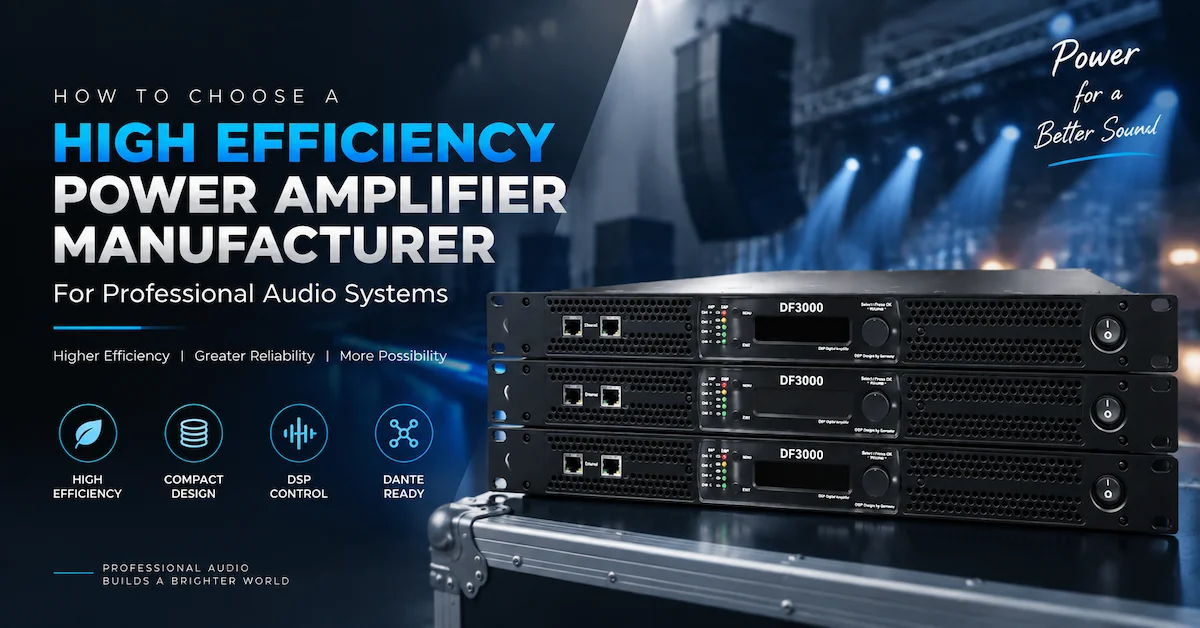
Why Choosing a High Efficiency Power Amplifier Manufacturer Requires More Than Comparing Wattage
A professional audio amplifier purchase is rarely decided by one specification. For distributors, rental companies and system integrators, the amplifier becomes part of a larger business system that includes installation efficiency, transportation cost, customer satisfaction, maintenance requirements and repeat-order stability.
When buyers search for a high efficiency power amplifier manufacturer, they are usually looking for more than an amplifier with lower power consumption. They want a supplier that can provide stable output performance, reliable production quality, suitable product platforms and technical support throughout the product lifecycle.
A high efficiency amplifier should help solve several practical problems:
- Reducing unnecessary heat inside racks
- Improving power density for professional installations
- Supporting long operating hours
- Simplifying system integration
- Lowering transportation and maintenance pressure
- Providing consistent performance across repeated orders
For example, a touring company may need compact amplifiers that allow more channels in the same rack space. A commercial audio integrator may focus on stable operation in fixed installations. A distributor may care about product consistency, documentation and after-sales support. An OEM brand may need customization without affecting product reliability.
Therefore, choosing a manufacturer should start from the complete product ecosystem instead of a single power number.
A reliable high efficiency power amplifier manufacturer should be able to explain:
- How efficiency is achieved
- How heat is managed
- How output is tested
- How production consistency is controlled
- How different applications require different amplifier platforms
Fedaxy provides multiple professional amplifier categories, including Class D power amplifiers, Class TD amplifiers, Class H amplifiers and DSP amplifier solutions for professional audio applications.
What Does High Efficiency Mean in Professional Power Amplifiers?
Efficiency Is a System Performance Factor
In professional audio, efficiency is not simply a laboratory number. It affects how the entire sound system operates.
An amplifier converts electrical energy into audio output. During this process, some energy becomes useful output while some energy becomes heat.
A higher efficiency design can influence:
- Rack temperature
- Cooling requirements
- Equipment room design
- Power distribution planning
- Long-term operating cost
However, efficiency cannot be evaluated separately from output capability.
A low-power amplifier may consume less energy but fail to provide enough headroom for the loudspeaker system.
A very powerful amplifier may provide sufficient output but create unnecessary thermal challenges if the system design is not appropriate.
The correct selection principle is:
Choose an amplifier that delivers the required output with efficient power management under the real operating conditions.
This means buyers should evaluate:
- Required SPL
- Loudspeaker sensitivity
- Speaker impedance
- Number of channels
- Operating hours
- Rack environment
- Cooling conditions
Why Efficiency Matters for Different Buyers
Distributors
Distributors need products that are easy to recommend and support.
A more efficient amplifier platform can provide advantages such as:
- Easier installation guidance
- More flexible product positioning
- Reduced customer complaints related to overheating
- Better suitability for different markets
However, distributors should avoid selling efficiency as an isolated feature. Customers need to understand how the amplifier fits their application.
A nightclub, theater, touring system and conference room may require different amplifier solutions.
Rental Companies
Rental companies evaluate equipment differently.
Their concerns usually include:
- Rack space
- Weight
- Transport efficiency
- Setup speed
- Reliability during repeated events
A compact high efficiency amplifier may allow more channels in one rack, but the supplier should still provide information about:
- Output capability
- Cooling direction
- Protection behavior
- Service process
System Integrators
Integrators need predictable engineering information.
They need to know:
- Whether the amplifier matches the loudspeaker load
- Whether the thermal design fits the installation environment
- Whether the product can be maintained after handover
A manufacturer that only provides marketing specifications creates additional engineering work.
Understanding Different Amplifier Technologies Before Choosing a Manufacturer
A professional buyer should understand that “high efficiency” can appear in different amplifier architectures.
The main platforms used in professional audio include:
- Class D
- Class TD
- Class H
- Class AB
Each technology has different design considerations.
Class D Amplifiers: Efficiency and Rack Density
Class D amplifiers are widely used in modern professional audio because they can achieve high power output with compact designs.
Common reasons buyers consider Class D platforms include:
- High efficiency
- Reduced heat generation
- Compact rack formats
- High channel density
For applications where rack space is limited, Class D amplifiers can be attractive.
Examples include:
- Touring systems
- Rental packages
- Multi-zone commercial audio
- Large distributed systems
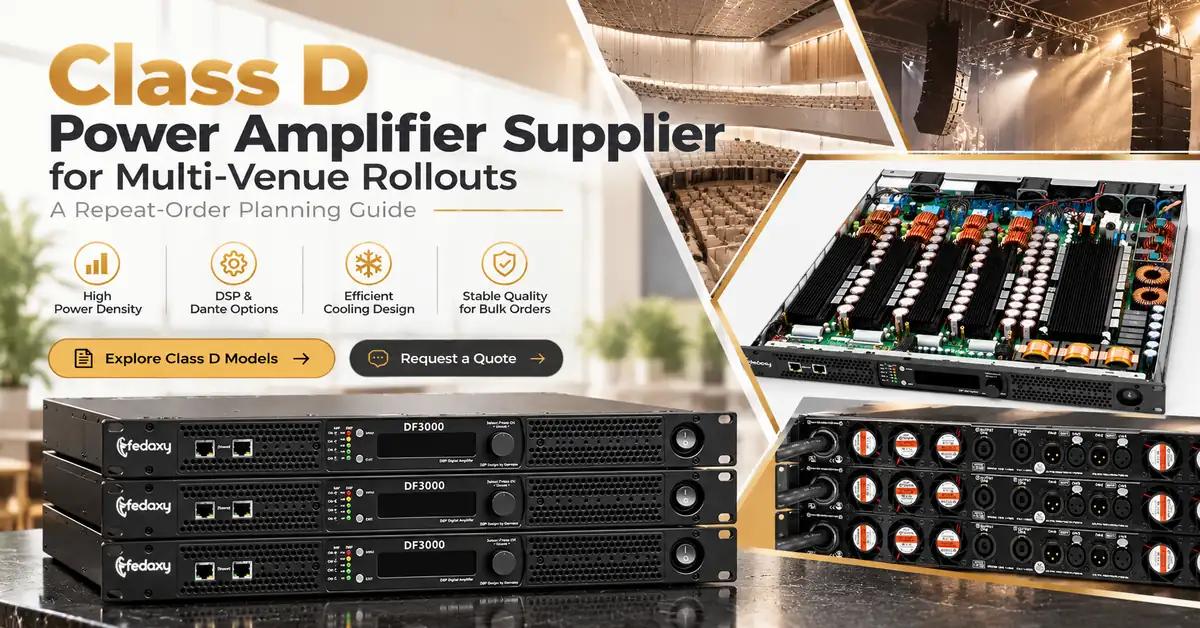
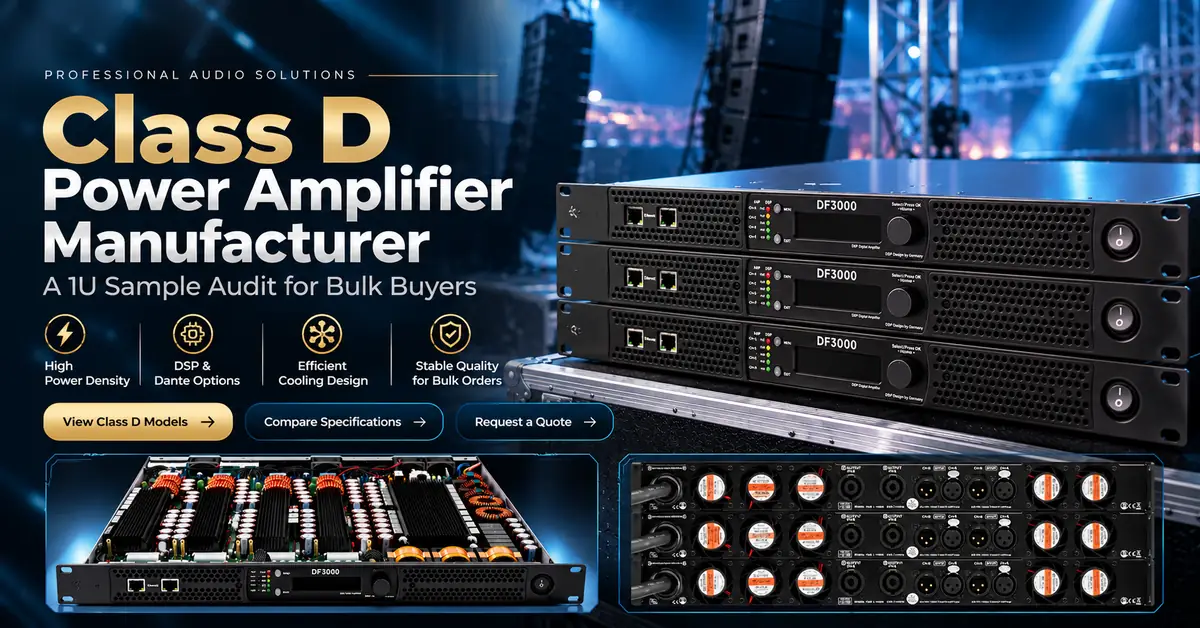
Fedaxy provides Class D amplifier products for professional audio applications requiring different output levels and configurations.
However, buyers should evaluate more than the amplifier class.
Important questions include:
- What is the output under real load conditions?
- How does the amplifier perform at 4Ω or 2Ω?
- What cooling method is used?
- What protection functions are included?
- What documentation is available?
Class TD Amplifiers: High Output Professional Platforms
Class TD amplifiers are often considered for professional applications requiring strong output capability and practical installation formats.
Potential advantages include:
- High power capability
- Professional rack integration
- Multi-channel configurations
- Suitability for touring and installation systems
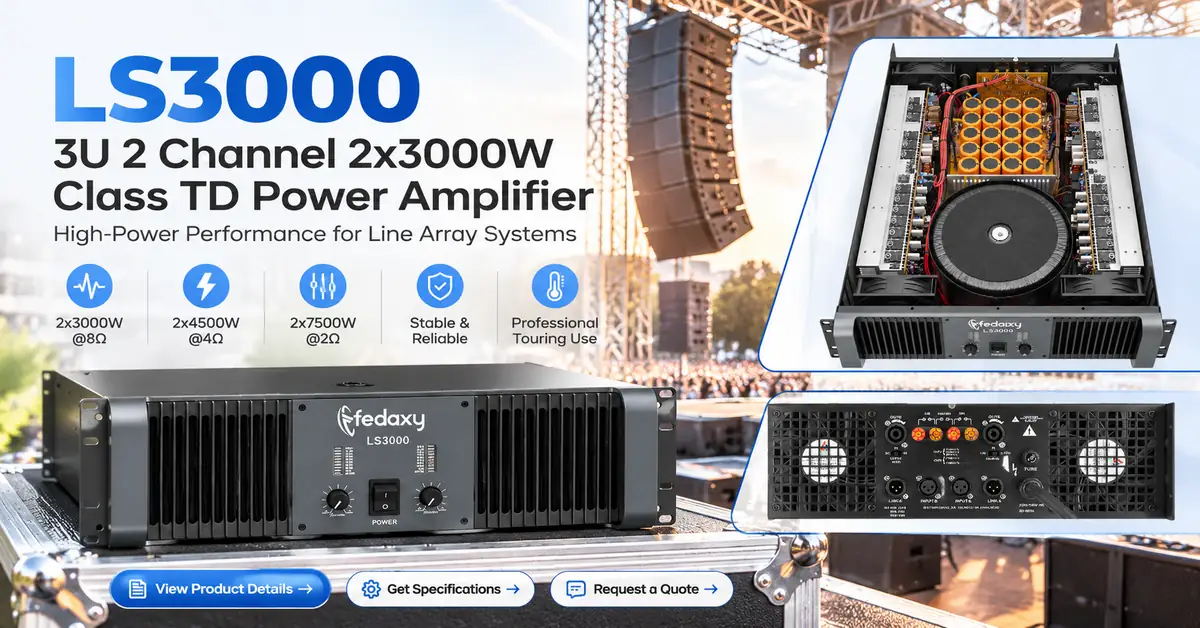
Fedaxy offers Class TD amplifier solutions for applications requiring professional output performance.
For buyers evaluating a Class TD supplier, the important factors include:
- Output specifications
- Channel configuration
- Power supply design
- Thermal management
- Protection system
- Production consistency
A Class TD label alone does not guarantee a specific performance level.
Two amplifiers using the same topology may behave differently because of:
- Component selection
- Circuit design
- Cooling structure
- Manufacturing process
Class H Amplifiers: High Output and Thermal Considerations
Class H amplifiers use different supply voltage levels depending on signal requirements.
They are often considered for applications where higher output capability is needed.
Typical applications include:
- Large venues
- Theater systems
- Stage systems
- High-output professional audio
Fedaxy provides Class H amplifier products for professional audio environments.
When evaluating Class H amplifiers, buyers should review:
- Output capability
- Rack requirements
- Heat management
- Long-duration operation
- Service accessibility
Class AB Amplifiers: Traditional Professional Audio Applications
Class AB remains an established amplifier architecture.
Some buyers continue selecting Class AB platforms because of:
- Familiar service experience
- Traditional circuit design
- Specific application requirements
However, efficiency, heat and installation requirements should still be considered during system planning.
The correct amplifier choice depends on the application rather than simply selecting the newest technology.
How to Evaluate Efficiency Specifications Before Choosing an Amplifier Manufacturer
Many buyers searching for a high efficiency power amplifier manufacturer focus on efficiency claims because efficiency directly affects operating cost and system design. However, efficiency data must always be understood together with output power, load conditions and operating environment.
A manufacturer may publish high efficiency values, but buyers should ask:
- Under what output level was efficiency measured?
- Was the amplifier operating at full output or typical program levels?
- Was the measurement performed with all channels active?
- What was the mains voltage condition?
- How does efficiency change under different impedance loads?
Without these conditions, efficiency numbers are difficult to compare between suppliers.
A professional amplifier evaluation should include multiple technical factors:
| Evaluation Item | Why Buyers Should Check |
|---|---|
| Output power | Determines whether the amplifier matches the loudspeaker system |
| Efficiency | Influences heat generation and energy consumption |
| Thermal design | Determines long-term operating stability |
| Power supply structure | Affects reliability and output capability |
| Protection system | Reduces equipment damage risks |
| Mechanical design | Influences installation and serviceability |
A reliable high efficiency power amplifier manufacturer should explain the relationship between these factors instead of promoting efficiency as a standalone marketing point.
Why Thermal Management Is Critical for High Efficiency Amplifiers
Heat Is One of the Biggest Challenges in Professional Audio Systems
Professional amplifiers often operate under demanding conditions.
Examples include:
- Touring events running several hours continuously
- Nightclubs operating every night
- Theater systems running multiple performances
- Stadium systems requiring high output levels
During these applications, heat management becomes a key factor.
A high efficiency amplifier can reduce unnecessary energy loss, but the final thermal performance still depends on:
- Internal component layout
- Cooling structure
- Fan system
- Chassis design
- Installation environment
For example, two amplifiers may have similar output ratings, but one may perform better in a closed rack because of better airflow management.
What Buyers Should Ask About Cooling Design
Before selecting a manufacturer, ask:
Airflow Direction
Professional racks often require predictable airflow.
Important questions:
- Is airflow front-to-back?
- Can multiple amplifiers be installed together?
- Does the rack design block exhaust airflow?
Fan Control
Fan behavior affects both reliability and user experience.
Buyers should understand:
- When fans increase speed
- How noise levels are controlled
- Whether fan replacement is practical
Thermal Protection
A good amplifier should provide protection before overheating causes permanent damage.
Typical protection functions include:
- Over-temperature protection
- Over-current protection
- Short-circuit protection
- DC output protection
Fedaxy product platforms include professional protection designs across different amplifier categories. Buyers should confirm the protection functions and operating conditions for the exact model selected.
Power Supply Design: A Key Factor When Evaluating Manufacturers
The power supply is one of the most important parts of a professional amplifier.
A manufacturer with strong amplifier capability should understand how power supply design affects:
- Output stability
- Low-frequency performance
- Thermal behavior
- Long-term reliability
Different amplifier platforms may use different supply approaches.
For example:
- Compact Class D models often focus on efficiency and power density.
- Higher-output Class H systems may require different power management strategies.
- Touring systems may prioritize a balance between output, weight and transport requirements.
A buyer should avoid judging a manufacturer only by amplifier appearance.
The important questions are:
- How is the power supply tested?
- How are critical components controlled?
- How are production changes managed?
- How is reliability verified before shipment?
How to Match Amplifier Efficiency With Real Audio Applications
A high efficiency amplifier is valuable only when it matches the application.
Different buyers have different priorities.
Touring and Rental Sound Systems
Rental companies often need:
- Compact rack solutions
- High channel density
- Fast deployment
- Reliable replacement procedures
For touring applications, a compact amplifier can reduce:
- Rack height
- Transportation volume
- Setup time
However, buyers should also evaluate:
- Connector compatibility
- Preset management
- Spare strategy
- Service process
Fedaxy provides professional touring amplifier solutions for different professional audio environments.
Large Venue Audio Systems
Large venues such as:
- Stadiums
- Arenas
- Theaters
- Performance centers
usually require:
- High output capability
- Stable operation
- Multi-channel management
- Long-term reliability
In these applications, efficiency helps reduce heat accumulation and improve rack planning, but the amplifier still needs to match the loudspeaker system.
Commercial Audio Installations
Commercial projects include:
- Hotels
- Restaurants
- Conference centers
- Entertainment venues
- Educational facilities
These customers often prioritize:
- Stable operation
- Easy maintenance
- Documentation
- Long product availability
A professional supplier should provide information that helps integrators complete installation and future service.
How Distributors Should Evaluate a High Efficiency Power Amplifier Manufacturer
For distributors, choosing a manufacturer is a long-term business decision.
The wrong supplier may create problems such as:
- Inconsistent product batches
- Difficult warranty handling
- Missing technical documents
- Delayed replacement support
- Customer complaints
A distributor should evaluate manufacturers from several perspectives.
Product Range and Platform Coverage
A strong manufacturer should provide enough product options for different applications.
For example:
A distributor may need:
- Compact Class D amplifiers
- Multi-channel DSP amplifiers
- High-output Class TD models
- Class H amplifiers for large systems
- OEM customization options
A broad product platform allows distributors to serve different customer groups without managing too many unrelated suppliers.
Fedaxy provides multiple amplifier categories, including:
Technical Documentation Support
A professional manufacturer should provide:
- Product specifications
- User manuals
- Wiring information
- Product drawings
- Test information
- Certification documents
Documentation is especially important for B2B buyers because distributors need to support their own customers.
A product without clear documentation creates additional sales and technical costs.
Production Quality Control
A high efficiency power amplifier manufacturer should have a clear production control process.
Important areas include:
Incoming Material Inspection
Verify:
- Components
- Circuit boards
- Connectors
- Power-related parts
Assembly Control
Check:
- Wiring
- Soldering
- Mechanical assembly
- Grounding
Performance Testing
Evaluate:
- Output performance
- Channel operation
- Protection behavior
- Signal response
Aging Testing
Long-duration testing helps identify early failures before products reach customers.
Fedaxy publicly describes QC procedures and aging testing as part of its manufacturing process. Buyers should confirm the exact testing scope and records for the selected model and order.
How OEM Buyers Should Evaluate Custom Amplifier Manufacturers
OEM customers have different requirements from standard buyers.
They may need:
- Custom logo
- Front panel design
- Packaging
- Product naming
- Connector changes
- DSP configuration
- Market-specific versions
However, customization should be controlled carefully.
A professional OEM process should include:
Requirement Confirmation
Define:
- Target application
- Product specification
- Market requirements
- Quantity expectations
Engineering Review
Confirm:
- Electrical design limitations
- Mechanical changes
- Software requirements
- Testing requirements
Sample Approval
Before mass production:
- Approve appearance
- Verify performance
- Confirm documentation
- Record revision information
Production Control
Maintain:
- Approved sample
- Specification files
- Version records
- Quality requirements
Fedaxy supports professional audio customization solutions. OEM customers can discuss project requirements through the Fedaxy contact page.
How to Compare High Efficiency Amplifier Platforms Before Making a Purchase Decision
A professional buyer should not select a power amplifier only by comparing output numbers.
A complete evaluation should consider:
- Efficiency
- Output capability
- Channel configuration
- Rack format
- Cooling requirements
- DSP requirements
- Application environment
- Supplier support
A high efficiency power amplifier manufacturer should be able to recommend different platforms according to different system requirements instead of offering one product for every application.
For example:
A touring company may prioritize:
- Compact rack size
- Low transportation weight
- Fast deployment
A theater project may prioritize:
- Stable output
- Low noise
- Multi-zone control
A nightclub installation may prioritize:
- High output capability
- Long operating hours
- Thermal stability
A distributor may prioritize:
- Product range
- Documentation
- Warranty support
- Repeat-order consistency
Therefore, platform selection should begin with application requirements.
Class D vs Class TD vs Class H: How Buyers Should Choose
Class D Amplifier Selection Considerations
Class D amplifiers are often selected when buyers need:
- High efficiency
- Compact design
- High channel density
Typical applications include:
- Touring racks
- Rental systems
- Commercial installations
- Multi-channel systems
A buyer evaluating a Class D platform should check:
- Output under actual impedance
- Heat generation
- Protection functions
- Rack installation requirements
Fedaxy offers different Class D amplifier solutions for professional audio applications.
Class TD Amplifier Selection Considerations
Class TD amplifiers are commonly considered for professional systems requiring strong output performance.
They may be suitable for:
- Touring systems
- Large venues
- Professional installation projects
When selecting a Class TD amplifier, buyers should focus on:
- Continuous output capability
- Channel distribution
- Power supply design
- Thermal performance
Fedaxy provides Class TD amplifier platforms designed for professional audio applications.
Class H Amplifier Selection Considerations
Class H amplifiers are often considered when systems require higher output capability.
Common applications include:
- Theater sound systems
- Stage systems
- Large commercial audio projects
Buyers should evaluate:
- Required output level
- Rack space
- Cooling environment
- Long-term operating conditions
Fedaxy provides Class H amplifier products for professional audio systems.
How to Evaluate Amplifier Specifications Correctly
Many purchasing mistakes happen because specifications are compared without checking conditions.
A professional comparison should include:
| Specification | Buyer Questions |
|---|---|
| Output power | Under what impedance and test condition? |
| Channel number | Are all channels tested simultaneously? |
| Frequency response | What measurement range is used? |
| THD | What distortion level applies? |
| Signal-to-noise ratio | What reference condition is used? |
| Cooling | How is heat removed during operation? |
| Protection | How does the amplifier respond to faults? |
Why Output Power Alone Does Not Define Amplifier Quality
A common mistake is selecting the amplifier with the highest wattage.
However, a larger power rating does not always mean a better system.
For example:
A high-output amplifier may require:
- More electrical capacity
- Larger rack space
- Better ventilation
- More careful load management
A lower-output amplifier may perform better when:
- The speaker system requires less power
- The installation space is limited
- Reliability and efficiency are higher priorities
The correct amplifier should provide appropriate headroom.
It should avoid:
- Continuous clipping
- Excessive thermal stress
- Incorrect impedance loading
How to Evaluate a Manufacturer's Engineering Capability
A reliable high efficiency power amplifier manufacturer should demonstrate engineering capability beyond product sales.
Important evaluation areas include:
Product Development Capability
Ask:
- Does the supplier develop amplifier platforms internally?
- Can they support different application requirements?
- Can they modify products for OEM projects?
A manufacturer with engineering capability can better support complex projects.
Testing Capability
Professional amplifier testing may include:
- Output testing
- Protection testing
- Thermal testing
- Aging testing
- Functional testing
Testing should not only confirm that a product works.
It should confirm that products remain consistent between batches.
Manufacturing Control
A professional factory should control:
- Component selection
- Assembly process
- Product inspection
- Version management
For distributors and OEM customers, manufacturing consistency is often more important than a single excellent sample.
Supplier Communication Ability
Technical communication is a major difference between suppliers.
A strong supplier should ask questions such as:
- What speakers will be connected?
- What impedance will the amplifier drive?
- How many channels are required?
- What is the operating environment?
- Is DSP required?
- Is the product for rental, installation or resale?
A supplier that immediately recommends a model without understanding the system may create future problems.
What Should Buyers Include in an RFQ for High Efficiency Amplifiers?
A detailed RFQ allows manufacturers to provide better recommendations.
The following information should be included:
| RFQ Information | Purpose |
|---|---|
| Application type | Determines suitable amplifier platform |
| Speaker model | Ensures compatibility |
| Speaker quantity | Defines channel requirements |
| Impedance | Determines load condition |
| Required output | Helps select power level |
| Rack requirements | Determines mechanical compatibility |
| Voltage requirement | Ensures correct version |
| DSP requirement | Defines control options |
| Quantity forecast | Supports commercial planning |
| OEM requirement | Defines customization scope |
Example RFQ Information
Instead of writing:
Need a powerful amplifier for a large venue.
A better request would include:
We need a four-channel amplifier for a touring system. Each channel will drive two 8Ω loudspeakers in parallel. The destination voltage is 230V / 50Hz. The rack space is limited to 2U. DSP control and preset management are required. Annual demand is approximately 100 units.
This information allows the supplier to recommend a more suitable product.
How Fedaxy Supports Professional Audio Buyers
Fedaxy provides amplifier platforms covering different professional audio requirements.
The product range includes:
- Class D amplifiers
- Class TD amplifiers
- Class H amplifiers
- DSP amplifiers
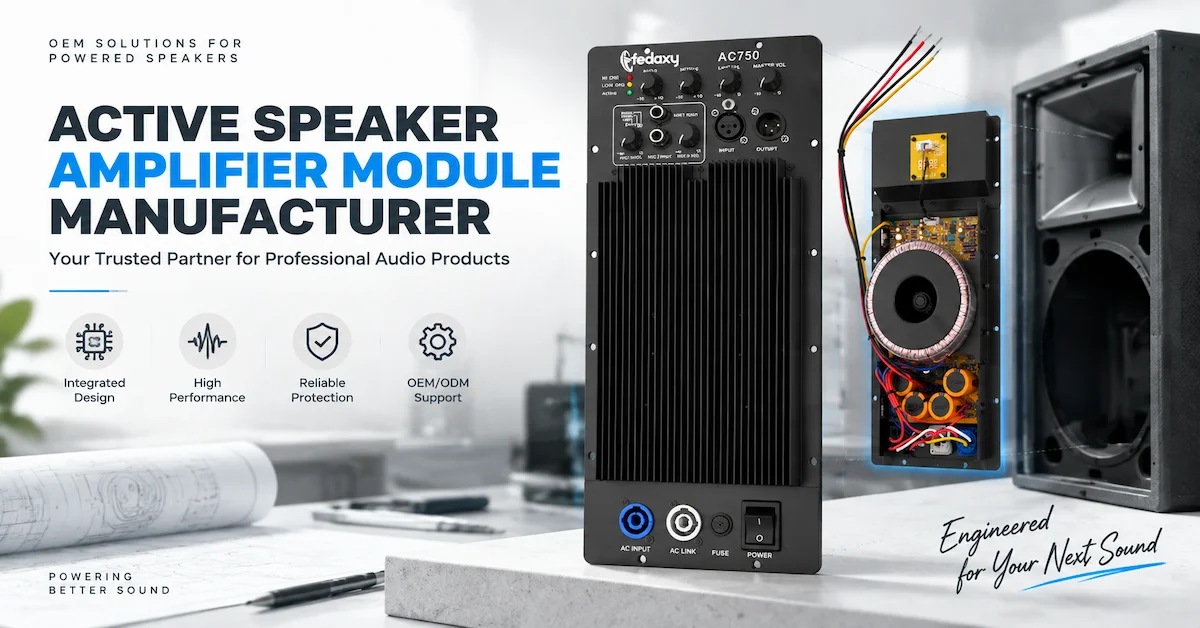
- Active amplifier modules
Different customers can evaluate different solutions depending on their applications.
For example:
Rental and Touring Applications
Customers may focus on:
- Rack density
- Weight
- Deployment speed
- Channel flexibility
Theater and Large Venue Applications
Customers may focus on:
- Output stability
- Multi-zone control
- Thermal management
Commercial Installation Applications
Customers may focus on:
- Reliability
- Documentation
- Long-term support
OEM Applications
Customers may focus on:
- Custom design
- Branding
- Packaging
- Configuration control
Buyers can review Fedaxy professional audio solutions through the solutions page.
How to Reduce Purchasing Risk When Working With a New Amplifier Supplier
Selecting a new manufacturer involves risk.
Common risks include:
- Specification inconsistency
- Different production batches
- Missing documents
- Poor communication
- Difficult warranty handling
A structured evaluation process can reduce these risks.
Step 1: Review Technical Documents
Request:
- Datasheets
- Manuals
- Product drawings
- Test information
- Certification documents
Step 2: Evaluate Samples
Before bulk purchasing, test:
- Output performance
- Load compatibility
- Thermal behavior
- Protection response
- Mechanical quality
Step 3: Confirm Production Standards
Discuss:
- Quality inspection process
- Production changes
- Component replacement procedures
- Batch consistency
Step 4: Confirm After-Sales Support
Clarify:
- Warranty period
- Spare parts
- Repair process
- Technical communication method
A reliable supplier relationship depends on the entire process, not only the first shipment.
Fedaxy High Efficiency Amplifier Platform Comparison for Different Applications
A professional buyer should select an amplifier platform based on the complete application requirement.
There is no universal amplifier model that is ideal for every project.
The correct choice depends on:
- Required output power
- Number of channels
- Speaker configuration
- Installation environment
- Rack space
- Control requirements
- Long-term service plan
Fedaxy provides different amplifier platforms that allow buyers to match products with different professional audio requirements.
Class D Platform for High Density and Efficient Rack Design
Class D amplifiers are commonly evaluated when buyers need:
- Compact chassis
- High output density
- Multiple channels
- Reduced heat generation
Typical applications:
- Touring systems
- Rental equipment
- Commercial installations
- Distributed audio systems
For buyers looking for efficient rack solutions, the Fedaxy Class D amplifier series provides different configurations for professional audio applications.
When evaluating Class D products, buyers should confirm:
- Output conditions
- Impedance capability
- Cooling design
- Protection system
- Power supply requirements
Class TD Platform for Professional High Output Systems
Class TD amplifiers are often selected for applications requiring strong output capability and professional installation flexibility.
Typical applications include:
- Touring sound systems
- Large venues
- Professional entertainment projects
- Commercial audio systems
The Fedaxy Class TD amplifier series includes different channel configurations designed for professional applications.
Buyers should compare:
- Channel quantity
- Rack height
- Output capability
- Thermal design
- Control requirements
A high output amplifier should always be matched with the loudspeaker system instead of selected only according to maximum wattage.
Class H Platform for Large Output Applications
Class H amplifiers are often considered when projects require higher output capability.
Applications may include:
- Theater systems
- Stage sound
- Large commercial venues
The Fedaxy Class H amplifier series provides different professional amplifier configurations.
When selecting Class H platforms, buyers should evaluate:
- Venue size
- Loudspeaker requirements
- Operating hours
- Rack environment
- Cooling conditions
DSP Amplifier Platform for System Control
Modern professional audio systems increasingly require better control.
DSP amplifier solutions can help integrate:
- Equalization
- Crossover
- Delay
- Limiting
- Preset management
DSP integration can reduce external equipment requirements.
However, buyers should confirm:
- Software compatibility
- Preset backup method
- User access control
- Firmware management
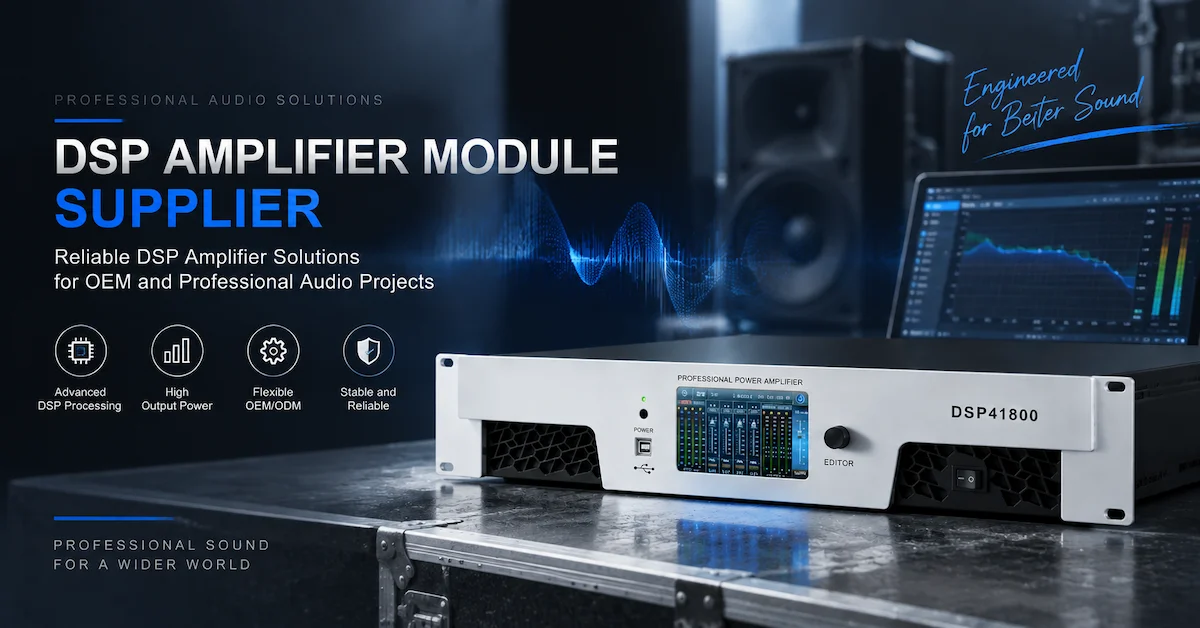
Fedaxy provides DSP amplifier solutions for applications requiring integrated audio processing.
How OEM Buyers Should Select a High Efficiency Power Amplifier Manufacturer
OEM customers usually have different priorities from standard buyers.
They are not only purchasing an amplifier.
They are building a product that represents their own brand.
A reliable OEM supplier should support:
- Product customization
- Stable manufacturing
- Technical communication
- Production consistency
- Documentation support
Define Customization Requirements Clearly
Before starting an OEM project, buyers should define:
Product Configuration
Including:
- Amplifier platform
- Channel configuration
- Output requirements
- Input/output interfaces
Appearance Requirements
Including:
- Logo
- Front panel design
- Product color
- Label information
Packaging Requirements
Including:
- Carton design
- User manual language
- Accessories
Technical Requirements
Including:
- DSP settings
- Firmware version
- Voltage requirements
- Regional compliance
A clear specification document reduces misunderstandings during production.
Sample Approval Process
A professional OEM process should include:
Engineering Review
The manufacturer reviews:
- Electrical requirements
- Mechanical changes
- Production feasibility
Sample Production
The buyer evaluates:
- Product appearance
- Performance
- Installation compatibility
Final Approval
The approved sample becomes the production reference.
Important documents should include:
- Specification sheet
- Approved drawings
- Firmware version
- Packaging details
Production Consistency Is Critical for OEM Projects
For distributors and brands, the first sample is not enough.
The real challenge is:
Can the manufacturer produce the same product repeatedly?
Important questions:
- Are components controlled?
- Are production changes recorded?
- Are replacement parts managed?
- Are quality inspections documented?
A reliable high efficiency power amplifier manufacturer should provide a clear process for managing product consistency.
Supplier Evaluation Checklist Before Placing an Order
Before selecting an amplifier manufacturer, buyers can use the following checklist.
| Evaluation Area | Questions to Ask |
|---|---|
| Product capability | Does the supplier provide suitable amplifier platforms? |
| Technical support | Can engineers review the application requirements? |
| Documentation | Are manuals and specifications available? |
| Quality control | Are production inspections performed? |
| Testing | Are performance and aging tests completed? |
| Customization | Can OEM requirements be managed? |
| Delivery | Are lead time and packaging clearly defined? |
| Service | Is warranty and spare support available? |
Technical Questions Buyers Should Ask Manufacturers
A professional RFQ should include technical questions.
Examples:
Output Performance
- What is the rated output at 8Ω?
- What is the output at 4Ω?
- Is 2Ω operation supported?
- Are all channels tested simultaneously?
Thermal Performance
- What cooling method is used?
- What is the airflow direction?
- How does the amplifier behave during long operation?
Protection
- Does the amplifier include thermal protection?
- How does short circuit protection work?
- How does the system recover after protection activation?
Production
- How is quality inspected?
- How are production changes controlled?
- How are failed units handled?
Why Documentation Matters for B2B Amplifier Purchasing
Many buyers underestimate documentation.
However, professional audio projects require accurate information.
Important documents include:
- Product datasheet
- User manual
- Installation guide
- Wiring diagram
- Technical drawing
- Warranty document
For distributors, documentation helps:
- Train sales teams
- Support customers
- Reduce installation errors
For integrators, documentation helps:
- Complete system design
- Prepare commissioning
- Maintain equipment
How to Build a Long-Term Partnership With an Amplifier Manufacturer
A supplier relationship should continue after the first purchase.
Long-term cooperation depends on:
Technical Communication
Both sides should communicate about:
- Product improvements
- Market feedback
- Customer requirements
Product Planning
Distributors may need:
- New power levels
- New configurations
- Updated designs
A manufacturer with engineering capability can support future product development.
Service Cooperation
Long-term support should include:
- Spare parts availability
- Technical response
- Product information updates
A professional supplier relationship reduces business risk.
Why Fedaxy Can Be Considered for Professional Amplifier Projects
Fedaxy positions itself as a professional audio amplifier manufacturer providing multiple amplifier platforms for global markets.
The company product range includes:
- Class D amplifiers
- Class TD amplifiers
- Class H amplifiers
- Class AB amplifiers
- DSP amplifier products
- Active amplifier modules
Different product platforms allow buyers to evaluate solutions based on application requirements.
For example:
- Rental companies may focus on compact and flexible amplifier platforms.
- Large venue integrators may focus on high output and multi-channel solutions.
- Distributors may focus on stable product families and documentation.
- OEM customers may focus on customization and production consistency.
Buyers can review Fedaxy company information through the About Us page.
Information Buyers Should Prepare Before Contacting a Manufacturer
A complete project brief allows faster communication.
Recommended information:
Project Information
- Application type
- Market region
- Installation or rental purpose
Audio System Information
- Speaker brand
- Speaker model
- Speaker quantity
- Impedance
- Required output
Product Requirements
- Channel number
- Rack size
- DSP requirement
- Branding requirement
Commercial Information
- Quantity
- Target delivery date
- Packaging requirements
- OEM requirements
Send these details through the Fedaxy contact page to help the supplier provide a more accurate recommendation.
What should buyers check first when selecting a high efficiency power amplifier manufacturer?
The first step is not comparing prices. Buyers should confirm whether the manufacturer understands the actual application requirements.
Important information includes:
- Speaker model
- Speaker quantity
- Impedance
- Required output level
- Channel requirements
- Installation environment
- Operating duration
- DSP or control requirements
A reliable manufacturer should be able to recommend a suitable amplifier platform based on the system requirement instead of simply providing the highest-power product.
The supplier should explain:
- Why a specific amplifier is recommended
- What load conditions apply
- What limitations exist
- What documents support the recommendation
This approach reduces the risk of selecting an amplifier that looks powerful but does not match the actual audio system.
What makes a power amplifier manufacturer suitable for professional audio applications?
A professional manufacturer should provide more than manufacturing capability.
Important factors include:
Engineering Support
The supplier should understand:
- Audio system design
- Speaker matching
- Power requirements
- Thermal management
- Installation limitations
Product Stability
Professional customers need:
- Consistent production
- Stable specifications
- Controlled revisions
- Reliable replacement support
Documentation Capability
A supplier should provide:
- Technical specifications
- Product manuals
- Installation information
- Testing information
For B2B buyers, documentation is part of the product value.
Is a higher efficiency amplifier always the better choice?
Not necessarily.
Efficiency is important, but it should be considered together with:
- Output capability
- Reliability
- Application requirements
- Installation environment
For example:
A touring company may prioritize compact size and reduced rack weight.
A large venue may prioritize output capability and long-term stability.
A commercial installation may prioritize reliability and easy maintenance.
The best amplifier is the one that balances efficiency with the actual system requirements.
What is the difference between Class D, Class TD and Class H amplifiers?
The difference mainly relates to amplifier design approaches.
Class D Amplifiers
Often considered for:
- High efficiency
- Compact designs
- High channel density
Class TD Amplifiers
Often evaluated for:
- Professional output capability
- Touring applications
- Multi-channel systems
Class H Amplifiers
Often considered for:
- High-output applications
- Large venues
- Theater and stage systems
However, amplifier selection should not depend only on the topology name.
Buyers should also evaluate:
- Output specifications
- Cooling design
- Protection
- Application suitability
Fedaxy provides different amplifier platforms through its professional amplifier product categories.
How can distributors evaluate amplifier supplier reliability?
Distributors should evaluate the supplier from a business perspective.
Important areas include:
Product Range
Can the supplier provide products for different customers?
For example:
- Compact amplifiers
- High-output models
- DSP solutions
- Multi-channel products
Production Capability
Can the supplier maintain:
- Product consistency
- Stable quality
- Repeat production
Commercial Support
Does the supplier provide:
- Product documents
- Marketing materials
- Technical assistance
- Warranty support
A distributor's reputation depends on the supplier's ability to support customers after the sale.
What information should be included in an amplifier RFQ?
A professional RFQ should include enough technical information for accurate evaluation.
Recommended information:
| Category | Information |
|---|---|
| Application | Touring, theater, commercial installation, rental |
| Speaker system | Brand, model, quantity |
| Load | Impedance and wiring method |
| Power requirement | Required output level |
| Channel requirement | Two-channel, four-channel or other configuration |
| Installation | Rack size, ventilation conditions |
| Control | DSP, network or external processor requirements |
| Commercial | Quantity, delivery market, customization |
A complete RFQ allows the manufacturer to provide a more accurate proposal.
Can a high efficiency power amplifier manufacturer provide OEM solutions?
Yes, but buyers should clearly define customization requirements.
OEM projects may include:
- Logo customization
- Packaging
- Front panel design
- Product naming
- Configuration adjustment
However, electrical changes require additional evaluation.
Before production, both sides should confirm:
- Approved specifications
- Sample requirements
- Testing requirements
- Production revision control
Fedaxy supports professional audio customization requirements. OEM customers can discuss project details through the Fedaxy contact page.
How should buyers test amplifier samples before bulk orders?
Sample testing should simulate the real application.
Recommended checks include:
Electrical Testing
Verify:
- Output performance
- Channel operation
- Load compatibility
Thermal Testing
Check:
- Heat generation
- Fan behavior
- Long-duration operation
Functional Testing
Evaluate:
- Input/output operation
- Protection response
- DSP functions if available
Documentation Review
Confirm:
- Product version
- Specification accuracy
- Accessories
- Warranty information
A successful sample test creates a reference point for future production.
What documents should buyers request from a power amplifier supplier?
Important documents include:
- Product datasheet
- User manual
- Technical drawing
- Wiring information
- Test information
- Warranty terms
- Certification documents
For distributors and integrators, complete documentation reduces installation problems and improves customer support.
How does supplier support affect the total cost of an amplifier project?
The lowest purchase price does not always create the lowest project cost.
Additional costs may include:
- Installation problems
- Technical support time
- Warranty issues
- Replacement delays
- Customer complaints
A reliable supplier helps reduce these hidden costs through:
- Accurate specifications
- Technical communication
- Stable production
- After-sales support
Therefore, supplier evaluation should consider total project value rather than unit price alone.
What should buyers ask Fedaxy before purchasing professional amplifiers?
Buyers should provide:
- Application scenario
- Speaker information
- Required output
- Channel configuration
- Voltage requirements
- Rack limitations
- DSP requirements
- Quantity forecast
Then ask Fedaxy for:
- Recommended models
- Technical specifications
- Testing information
- Production details
- Commercial terms
A complete discussion creates a stronger foundation for a long-term partnership.
Conclusion
Choosing the right high efficiency power amplifier manufacturer requires a complete evaluation of technology, manufacturing capability and application support.
Professional buyers should not select an amplifier only because it has a high output number or attractive price. A suitable amplifier manufacturer should understand the relationship between efficiency, power delivery, thermal management, reliability and real-world installation requirements.
For distributors, the right supplier provides stable products, technical documents and long-term support. For rental companies, the right amplifier platform improves deployment efficiency and reduces operational risk. For system integrators, the right manufacturer provides accurate technical information that helps complete reliable audio systems. For OEM brands, the right partner provides controlled customization and consistent production.
Fedaxy provides professional amplifier platforms including:
- Class D amplifiers
- Class TD amplifiers
- Class H amplifiers
- DSP amplifiers
- Active amplifier modules
Different applications require different solutions. A compact touring system may require high channel density and efficiency. A large venue may require higher output capability and thermal stability. A commercial audio installation may require reliability and long-term service support.
Before selecting a supplier, buyers should prepare their system information, including speaker requirements, impedance, channel planning, operating environment and customization needs.
By evaluating technical capability, production control, documentation, testing procedures and support services, buyers can select a high efficiency power amplifier manufacturer that supports not only the first purchase, but also future business growth.
To discuss your amplifier requirements, send your project details through the Fedaxy contact page.
You can also explore Fedaxy professional amplifier solutions through the product catalog.