A rental company does not buy an amplifier in isolation. It buys a rack position, a transport weight, a setup time, a service process and a level of confidence that the same configuration will work on the next job. That is why a 1U power amplifier for rental sound systems should be selected from the complete operating brief rather than from a headline wattage number.
The short answer is this: choose a 1U amplifier only after you know the speaker load, the number of cabinets per channel, the minimum impedance, the rack’s airflow, the local mains supply and the way the system will be serviced between events. A compact chassis can reduce truck space and lifting effort, but it also concentrates heat and leaves less room for a careless wiring decision. The right model is the one that meets the real load, can be checked quickly by a technician and can be reordered with the same approved specification.
Fedaxy is Guangzhou Fedaxy Audio Equipment Co., Ltd., a professional power amplifier manufacturer based in Panyu, Guangzhou, China. Its public company information describes more than 15 years of R&D and production experience, Class D, Class TD, Class H and Class AB amplifier platforms, ISO9001, CE, RoHS and CB references, 5 rounds of QC inspection, an 8-hour aging test, 100% copper transformers, real rated wattage output and a 3-year warranty. These are published company claims. For a rental fleet, the exact model, test conditions, production revision, packaging and commercial terms should still be confirmed in the RFQ.
Why rental companies look at 1U first
A 1U chassis occupies one standard rack unit. That sounds like a simple mechanical detail, but it affects almost every part of a rental operation.
A smaller chassis can leave space for signal processors, network switches, power distribution, wireless receivers or spare equipment. It can reduce the weight of a flight case and make a two-person lift easier. When a rental company is preparing several similar racks, one saved rack unit across every package can change the size of the case, the number of cases in the truck and the time required at the venue.
The benefit is not automatic. A 1U power amplifier for rental sound systems may have a dense power supply, several channels and a front-to-back cooling path. If the rack is packed tightly, the amplifier may operate in warmer air than it did on a showroom bench. If a technician connects a lower impedance than the quotation assumed, the current demand can rise sharply. The buyer must therefore treat rack space and thermal headroom as linked decisions.
For a rental fleet, the practical questions are:
Before anything else, the buyer specifying a 1U power amplifier for rental sound systems should define the package that the rack must support most often, not the largest number printed in a catalogue.
- How many amplifier channels are needed for the most common cabinet packages?
- Will the amplifier drive the approved load when all channels are used?
- Does the rack allow the manufacturer’s required intake and exhaust clearance?
- Can the unit be removed, tested and replaced without rebuilding the entire case?
- Will the same model, front panel, connectors and firmware be available for repeat orders?
- Can a technician identify a protection event quickly during a live changeover?
- Does the total package remain within the flight-case and transport limit?
The answers are more useful than comparing two catalogue pages that use different output test conditions. That discipline keeps a 1U power amplifier for rental sound systems tied to a real cabinet plan and a real technician workflow.
What the buyer should define before requesting a quote
The best RFQ for a rental amplifier is short enough for a sales team to read and detailed enough for an engineer to approve. Start with the loudspeaker package, not with a preferred brand or amplifier class.
Record the cabinet model, nominal impedance, minimum impedance if published, driver arrangement, cabinet count per channel and the intended wiring. Add the continuous and program ratings supplied by the loudspeaker maker. If the system includes subwoofers, front fills, monitors or line-array elements, show how those loads will be distributed across the rack.
Then describe the working environment. A festival rack may run for several hours in a warm outdoor enclosure. A corporate event rack may be powered for a shorter period but assembled and dismantled repeatedly. A club installation may run nightly and be difficult to access after handover. A rental company may use one platform for all three, but the acceptance criteria should reflect the most demanding use.
RFQ input checklist
| RFQ field | What to provide | Why the supplier needs it |
|---|---|---|
| Speaker model | Brand, model, driver count and cabinet quantity | Confirms the intended load and application |
| Channel plan | Cabinets per channel, stereo/bridge mode and spare channels | Prevents a single-channel assumption from being used for a full rack |
| Impedance | Nominal, minimum and final wired impedance | Determines current demand, output and protection limits |
| Power target | Continuous and program ratings from the speaker maker | Helps define usable headroom and limiter settings |
| Rack format | 1U requirement, rack depth, flight-case clearance and connector access | Confirms mechanical fit and service access |
| Mains supply | Country, voltage, frequency, plug and distribution arrangement | Checks compatibility and operating margin |
| Processing | External DSP, internal DSP, Dante, crossover and limiter needs | Identifies whether the amplifier must include control functions |
| Duty cycle | Event length, expected level, ambient temperature and changeover frequency | Informs cooling, aging and service planning |
| Commercial scope | Sample quantity, forecast, destination and target date | Separates a sample request from a repeat fleet order |
| Evidence | Required test fields, serial records, certificates and packing documents | Makes approval measurable and repeatable |
A buyer who leaves these fields blank may receive a fast quotation, but the quote will contain assumptions. Those assumptions often reappear later as heat, noise, protection trips or an unsuitable connector layout.
How to choose channel count for a rental rack
Channel count should follow the way the rental company builds packages. A two-channel amplifier is easy to understand and can be useful where each channel carries a high-output main or subwoofer. A three-channel model can be useful in a system that needs two main channels and one additional low-frequency or monitor feed. A four-channel model can reduce the number of chassis in a mixed rack, especially when the individual cabinet loads are moderate and the output is available at the required impedance.
A high channel count is not automatically better. The buyer should check whether all channels can operate at the requested level, whether the power supply is shared, and whether the manufacturer publishes an all-channel condition. A single-channel figure may look impressive while a complete four-channel rack requires a different thermal or mains plan. For a 1U power amplifier for rental sound systems, channel count is valuable only when the channels can be used safely and repeatedly in the same fleet package.
For rental stock, standardization has a commercial advantage. If technicians already know the connector positions, gain controls, protection indicators and fan direction, they can prepare a replacement rack more quickly. Standardization also reduces the number of spare parts and shortens the learning curve for temporary staff.
A useful channel decision can be written as:
- List the most common cabinet package.
- Calculate the final impedance for every channel.
- Decide whether the package needs two, three or four amplifier channels.
- Check the all-channel output at the intended load.
- Leave a documented spare-channel or spare-unit plan.
- Repeat the check for the largest package the fleet will support.
This method avoids buying a four-channel amplifier simply because four channels are available, or buying a two-channel unit that leaves the rack short of useful capacity.
1U Class D and Class TD options
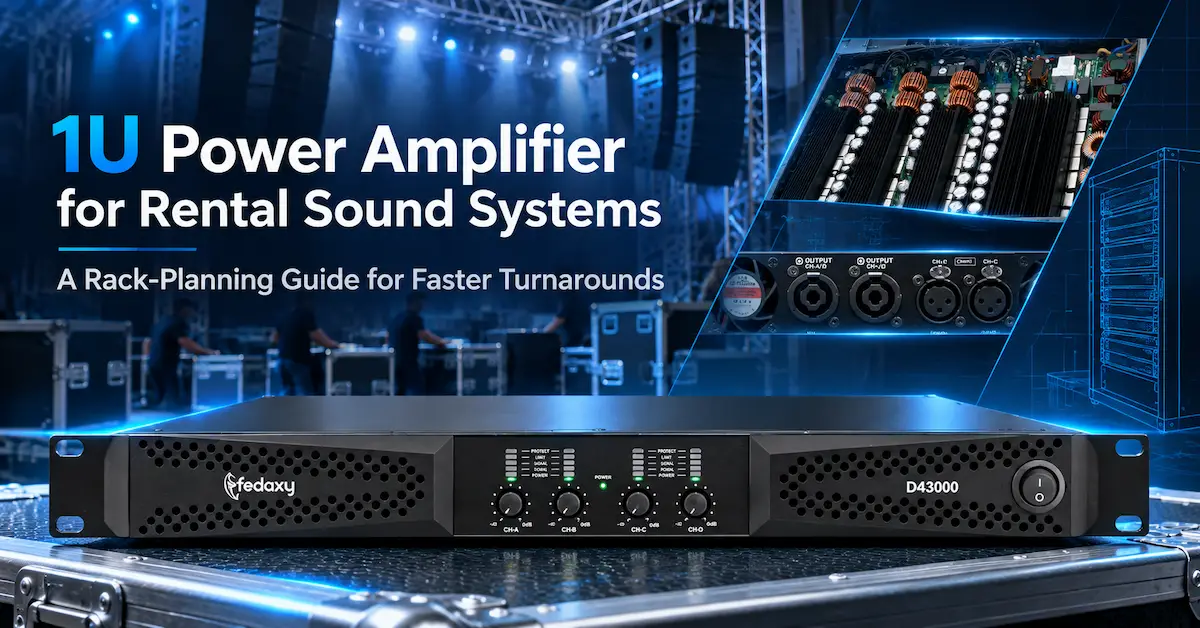
Class D is often considered when the rental buyer prioritizes rack density, transport weight and efficiency. Fedaxy’s public D Series includes 1U models, including the D43000 family. The D43000 product page lists 4x3000W at 8Ω, 4x5000W at 4Ω and 4x6500W at 2Ω, with 4-channel/1U construction. The same page lists a 20Hz–20kHz frequency response at ±1dB, THD below 0.05%, a signal-to-noise ratio above 110dB and a front-to-back intelligent fan cooling system. These values belong to the published product specification and must be checked against the exact production configuration.
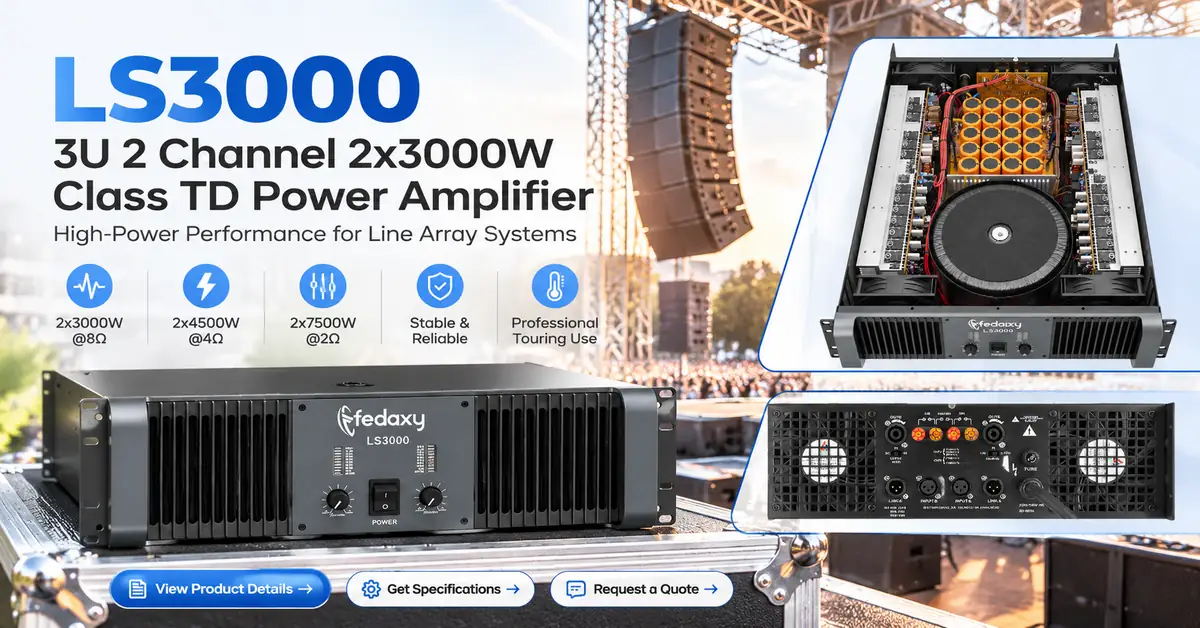
Class TD can be attractive when the rental company wants a compact chassis with strong output and a familiar professional-audio workflow. The Fedaxy DE Series includes 1U models with different channel counts. The DE21300 page lists 2x1300W at 8Ω, 2x1950W at 4Ω and 2x3250W at 2Ω in a 2-channel/1U chassis. The DE31300 page lists a 3-channel configuration, while the DE41300 page lists 4x1300W at 8Ω, 4x1950W at 4Ω and 4x3250W at 2Ω.
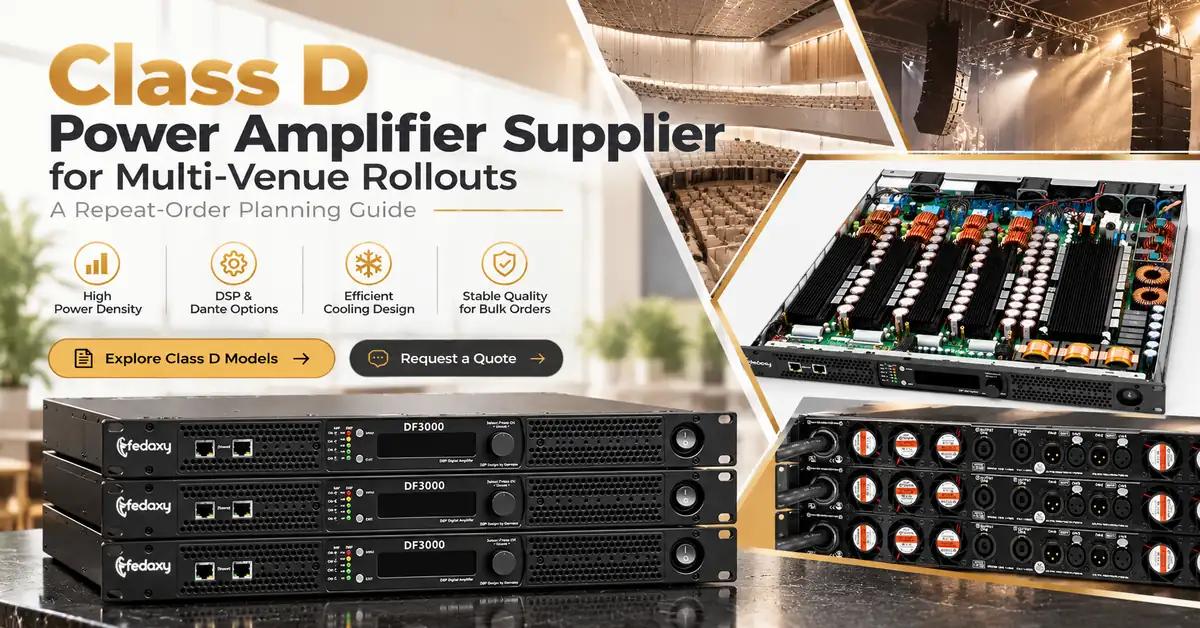
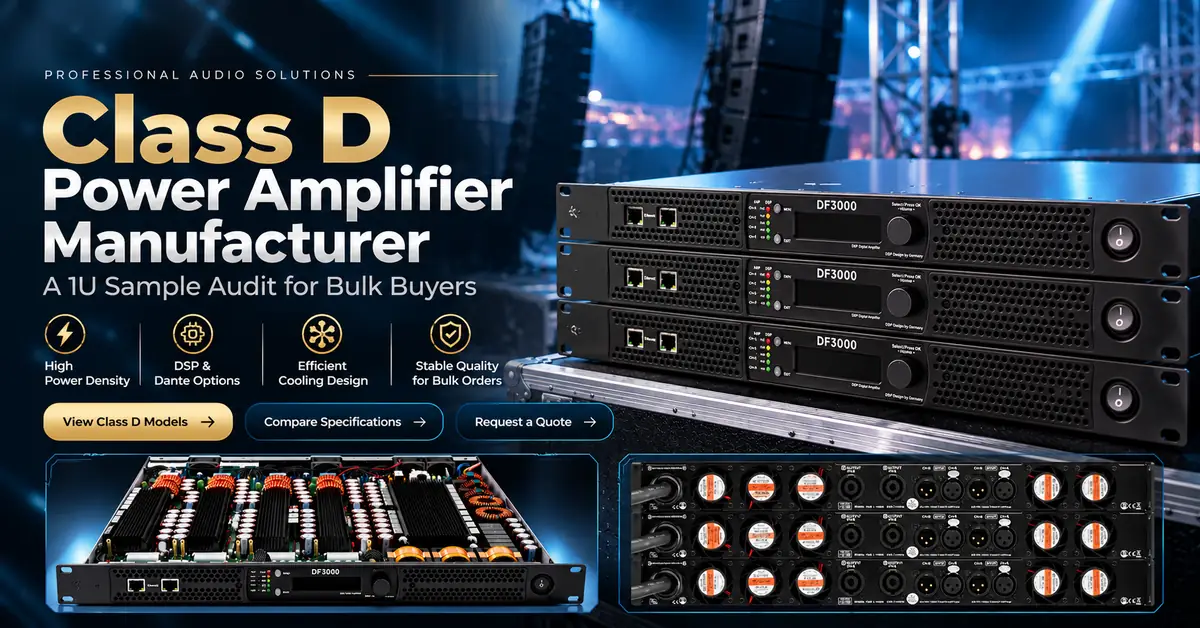
The buyer should not treat the model names as a complete selection rule. The correct choice depends on the cabinets and the package design. A four-channel 1U amplifier may reduce chassis count, but a two-channel model may provide a better fit for a high-output stereo package. If the system needs processing, Fedaxy also publishes 1U DSP or Dante options such as DF3000 and DT4200. The supplier should confirm the exact software, network and preset workflow before a fleet standard is approved.
Model comparison for a first rental shortlist
The table below is a starting point for an RFQ, not a substitute for a model-specific quotation. Published power figures should be compared at the same impedance and with the same test conditions. If a rental package uses a different load, ask the factory to confirm the approved operating range.
| Model or family | Published format | Published power reference | Where it may fit | Questions to confirm |
|---|---|---|---|---|
| DE21300 | Class TD, 2-channel, 1U | 2x1300W @ 8Ω; 2x1950W @ 4Ω; 2x3250W @ 2Ω | Two-channel rental racks, bars, clubs and compact systems | All-channel condition, minimum load, rack depth and spare strategy |
| DE31300 | Class TD, 3-channel, 1U | 3x1300W @ 8Ω; 3x1950W @ 4Ω; 3x3250W @ 2Ω | Packages needing two main channels plus one additional feed | Channel allocation, bridge use, cooling and connector layout |
| DE41300 | Class TD, 4-channel, 1U | 4x1300W @ 8Ω; 4x1950W @ 4Ω; 4x3250W @ 2Ω | Dense rental racks and multi-zone sound packages | Output with all channels, fan noise and thermal limits |
| D43000 | Class D, 4-channel, 1U | 4x3000W @ 8Ω; 4x5000W @ 4Ω; 4x6500W @ 2Ω | High-output professional racks and larger installation or touring packages | Mains demand, protection behavior, case airflow and approved cabinet count |
| DF3000 | Class D, 4-channel, 1U with DSP and Dante | Published family output up to 4x3000W @ 8Ω | Networked rental systems needing integrated processing | Software, presets, Dante network design and support responsibilities |
| DP41500 | Class TD, 4-channel, 1U with DSP | 4x1500W @ 8Ω; 4x2250W @ 4Ω; 4x3750W @ 2Ω | Compact systems needing DSP with a mid-range power profile | DSP workflow, preset lock, firmware revision and channel limits |
| DT4200 | Class D, 2-channel, 1U with DSP and Dante | 2x4200W @ 8Ω; 2x7800W @ 4Ω; 2x8500W @ 2Ω | High-output two-channel racks with networked control | Exact application, mains capacity, thermal data and software compatibility |
The wording “up to” is intentional for a family. A buyer should request the exact model sheet and not assume that every model in a series shares the highest value. The RFQ should also state whether the published number is stereo power, bridge power, program power or another test condition.
Impedance and headroom: the part that protects the rental fleet
Impedance is not a decorative value in a catalogue. It determines how much current the amplifier must deliver and how much heat the system can create. Two nominal 8Ω cabinets wired in parallel present approximately 4Ω to one channel. Four similar cabinets may bring the nominal calculation toward 2Ω, subject to the cabinet and cable arrangement.
A 2Ω specification is not permission to connect any 2Ω load. Ask for the minimum approved impedance, the number of channels operating, mains voltage, thermal restrictions and protection behavior. Also confirm whether the speaker maker permits the intended amplifier headroom and what limiter settings will be used.
Headroom should be decided with the loudspeaker maker or system engineer. A rental company may prefer a larger amplifier for a subwoofer package, but the limiter must be configured to protect the driver. Another package may be limited by the mains circuit, rack ventilation or flight-case layout rather than by the amplifier’s maximum output.
A practical acceptance note should include:
- cabinet model and quantity;
- final wired impedance;
- amplifier output at that impedance;
- all-channel test condition;
- limiter threshold and preset revision;
- mains voltage and frequency;
- ambient or rack conditions used during evaluation;
- protection and recovery behavior;
- connector and cable arrangement.
This record gives the rental company a repeatable setup. It also gives the supplier a clear boundary if a future buyer asks for a different cabinet package.
Cooling, airflow and protection in a compact rack
A 1U chassis has less physical room for heat to spread before it reaches the airflow path. The rack designer should confirm intake and exhaust direction, fan control, clearance behind the case and the position of other heat-producing devices. Do not place a power amplifier against a sealed panel or directly behind a device that exhausts hot air into its intake.
Fedaxy product pages describe front-to-back intelligent fan cooling on several 1U models. That is useful information for rack planning, but the rental company still needs to confirm the actual case design. A flight case with a closed rear panel, a cable bundle blocking the exhaust or a filter that is never cleaned can change the thermal result.
Protection functions should be discussed in operational terms. The published product pages refer to power-on buffering, overheating protection, short-circuit protection and output DC protection. Ask how the front panel indicates each condition, whether the channel recovers automatically, whether output is muted or limited, and what information the service technician should record.
For a rental fleet, protection is also a workflow issue. A technician needs to know whether a fault follows the cabinet, the cable, the amplifier channel or the mains distribution. Marking the rack with the approved wiring diagram and a short fault-check sequence can reduce the time spent replacing a healthy amplifier.
DSP and Dante: when integrated control pays off
Integrated DSP can reduce the number of boxes in a rental rack and make a package easier to duplicate. It may provide crossover, EQ, delay, limiter and preset recall inside the amplifier. Dante can move digital audio over the network and may simplify signal distribution for corporate events, installed venues and larger touring systems.
The benefit depends on the way the rental company works. If every event uses a different control platform, an internal DSP can create a support burden unless presets are locked and documented. If the fleet already uses a networked workflow, a DSP and Dante model may reduce wiring and speed up commissioning.
Before approving a DSP or Dante amplifier, request:
- software name and supported operating systems;
- preset backup and restore method;
- access levels for technicians and clients;
- firmware revision and change-control policy;
- Dante channel count and network requirements;
- sample-rate and clocking information;
- behavior if the network is disconnected;
- factory support process for a damaged or corrupted preset.
Fedaxy’s public catalog identifies DF3000 and DT4200 as DSP and Dante products. The site also lists DP41500 as a DSP model. The exact network and software details should be confirmed directly for the model and revision being quoted.
Quality evidence a rental buyer can actually use
A rental company needs more than a general statement that a factory has “strict quality control.” It needs evidence that can be connected to the unit in the case.
Fedaxy’s published information describes five rounds of QC inspection before shipment, an 8-hour aging test, 100% copper transformers, real rated wattage and a 3-year warranty. The product pages also describe material inspection, PCB assembly checks, performance testing, safety inspection and final inspection. These statements provide a useful starting checklist for a supplier conversation. This evidence is especially relevant when a 1U power amplifier for rental sound systems will be moved, installed and powered under changing site conditions rather than left in one controlled rack.
Ask the manufacturer to explain which checks happen at incoming inspection, which happen after assembly and which happen before packing. Request the fields that will appear on a test record: model, serial number, revision, output condition, frequency, THD, protection checks, date and inspector or station reference. The goal is not to collect paperwork for its own sake. The goal is to make the approved sample traceable to the production units.
For a first rental order, the buyer can request:
- A production sample or approved engineering sample.
- The exact specification sheet for the quoted model.
- A serial-numbered test record.
- A packing list and carton dimensions.
- Photos of the front panel, rear connectors and labels.
- Confirmation of the warranty and service process.
- A written statement of any component or firmware revision.
- A record of the accepted load and test conditions.
No document can replace a listening test and a practical load test, but a documented process makes the result easier to repeat.
Rental fleet economics: look beyond unit price
The cheapest amplifier is rarely the cheapest rental asset. A better comparison includes the number of rack units used, the weight of the case, the number of channels available, the time required to build a package, the cost of spare units and the probability of a service interruption.
A compact amplifier may allow a smaller case or more complete systems in a truck. A four-channel model may replace two two-channel chassis, but only if its output and protection fit the loads. A DSP model may remove external processors, but only if the team can manage the presets and network. A higher-output unit may be unnecessary for a small corporate package and expensive to power. The commercial question is whether the 1U power amplifier for rental sound systems lowers the cost of each usable package without creating more service work.
Use a total-cost worksheet with these lines:
- amplifier purchase price;
- freight and export packing;
- rack or flight-case modification;
- power distribution and connector changes;
- technician setup time;
- spare-unit requirement;
- expected service and replacement parts;
- software or network training;
- warranty handling;
- cost of a failed event or delayed handover.
This approach supports a commercial decision without pretending that one model is best for every rental business.
How to qualify a supplier before a fleet order
A supplier comparison should cover the company, the product and the service process. That is the minimum comparison for any 1U power amplifier for rental sound systems that is intended to become a repeat fleet standard.
First, confirm the entity. Fedaxy identifies itself as Guangzhou Fedaxy Audio Equipment Co., Ltd. in Panyu, Guangzhou, China, and describes integrated design, production, sales and technical support. For a buyer, this matters because the person answering a technical question should have a route to engineering and production.
Second, confirm the product scope. Fedaxy publishes Class D, Class TD, Class H and Class AB amplifiers, plus DSP, Dante and active-module options. A broader portfolio can help a rental company standardize across different packages, but it also makes exact model selection more important.
Third, confirm repeatability. Ask whether the approved sample, front panel, connector layout, firmware, label and packaging can be recorded against the purchase order. If the rental company plans private labeling, ask how logo, front-panel and packaging changes are controlled.
Fourth, confirm service. Ask who handles fault diagnosis, how spare parts are identified, and what information should accompany a warranty request. A supplier that can explain the process clearly is easier to work with during a busy season.
OEM and private-label requirements for rental brands
Some rental companies also sell branded systems or want the amplifier to match their own rack identity. In that case, the project becomes more than a standard product purchase.
Fedaxy’s public pages describe OEM, ODM, OBM, OIM and SKD cooperation, including logo customization, front-panel design, packaging design, configuration adjustment and project-based amplifier solutions. The buyer should separate standard factory capability from project-specific engineering work.
A private-label RFQ should identify:
- brand logo and approved artwork;
- front-panel color, model name and control labels;
- connector type and position;
- mains voltage, plug and regional requirements;
- DSP preset ownership and revision process;
- carton, manual and warranty-card language;
- serial-number format;
- sample approval steps;
- expected first order and annual forecast;
- change-control procedure.
Do not approve a private-label sample only from photographs. Check the unit in the actual case, connect the intended speakers, review the labels under stage lighting and confirm that the service team can identify the model from its serial number.
Applications and environments
A 1U power amplifier for rental sound systems may be used in several environments, but each one changes the selection emphasis.
Concert and festival production: prioritize output at the actual cabinet load, all-channel behavior, cooling, protection and fast case changes. The rack may be transported often and run for long periods.
Corporate AV and conference events: prioritize low noise, compact cases, predictable signal routing, quick setup and clear operator controls. DSP or Dante may be useful where the venue network is already managed.
Clubs and bars: prioritize nightly reliability, controlled low-frequency output, service access and the ability to replace a unit without changing the complete installation.
KTV and entertainment venues: prioritize multi-channel allocation, compact rack depth, thermal stability, protection and a product family that can be repeated across rooms.
Theater and performing-arts systems: prioritize low noise, accurate processing, documented presets, stable output and a service plan that respects scheduled performances.
Mobile DJ and event packages: prioritize weight, connector simplicity, fast wiring and a model that a small crew can lift and install safely.
The application list does not choose the amplifier for you. It tells you which questions should carry more weight in the RFQ.
Common buying mistakes
The first mistake is choosing by maximum wattage. The number may be measured at a different impedance, with a different duration or on a single channel.
The second is ignoring the rack. A 1U chassis still needs airflow, cable clearance and a service path. A case that looks tidy in a drawing can become hot when every connector and cable is installed.
The third is assuming that a 2Ω label means any 2Ω wiring is acceptable. The cabinet count, cable arrangement, mains supply and all-channel condition must be confirmed.
The fourth is buying DSP without defining control ownership. If the preset can be edited by every temporary operator, the package may become less consistent, not more.
The fifth is approving a sample without locking the revision. The next batch may have a different label, connector, firmware or component unless the purchase file records the approved configuration.
The sixth is treating warranty as the entire service plan. A rental company also needs fault information, spare parts, response channels and a method for identifying the failed unit.
The seventh is asking for a price before sending the cabinet schedule. A supplier can quote quickly, but the buyer may later discover that the requested model was selected for an assumed load.
A purchase-ready acceptance plan
Before the first fleet order, define what “approved” means.
At the document stage, verify model, channels, rack height, voltage, connectors, output conditions, impedance limits, cooling direction, protection functions, DSP or Dante requirements, label artwork and packaging.
At the sample stage, install the amplifier in the intended case. Run the actual speaker package or an approved load. Check the front panel, connectors, fan behavior, noise, protection indication and preset recall. Record the test conditions.
At the production stage, ask for serial-numbered records and confirmation that the approved revision is being used. Inspect the first production units before packing if the order size justifies it.
At handover, keep the final wiring diagram, limiter settings, network notes, test record, spare-parts list and service contact with the rack documentation. This turns the purchase into an operating system that a technician can support.
FAQ for rental sound system buyers
Is a 1U power amplifier always better than a 2U amplifier?
No. A 1U model can save rack space and transport weight, but the correct choice depends on output, cooling, channel count, service access and the intended load. A 2U model may be more suitable for a different power or thermal requirement.
What is the main benefit of a 1U rental amplifier?
The main benefit is density. More amplifier channels can fit in a smaller case, which may reduce transport volume and setup time. The buyer must balance that benefit against airflow, mains capacity and service access.
Should a rental company choose Class D or Class TD?
Neither class is automatically best. Class D is often considered for efficiency and compact high-power designs. Class TD may suit a different output, chassis or service requirement. Compare the exact model at the intended impedance and duty cycle.
Is 2Ω operation important for rental systems?
It can be important when the rental package uses several cabinets per channel, but the load must be approved for the exact model. Confirm wiring, current, cooling, protection and all-channel conditions before using a 2Ω configuration.
Do I need DSP inside the amplifier?
Not always. Integrated DSP can reduce external equipment and make repeatable presets easier, while an external processor may fit a rental company’s existing workflow better. Define who will own crossover, EQ, delay and limiter settings.
What should I ask a 1U power amplifier manufacturer for?
Ask for the exact output table, test conditions, load limits, protection behavior, cooling requirements, sample process, QC records, warranty terms, packaging information and repeat-order revision control.
How many amplifier channels should a rental rack have?
Match the channel count to the common speaker package. Two, three and four-channel formats can each make sense. The decision should be based on cabinet allocation, impedance, output and the need for spare capacity.
What Fedaxy models should be shortlisted first?
The public catalog includes DE21300, DE31300 and DE41300 Class TD 1U models, D43000 and DF3000 Class D 1U models, DP41500 DSP and DT4200 DSP/Dante. The right shortlist depends on the RFQ data.
Can Fedaxy support private-label rental amplifiers?
Fedaxy’s public pages describe OEM, ODM, OBM, OIM and SKD cooperation, including logo, front-panel and packaging design. Confirm the engineering scope, sample process, forecast and revision requirements for the selected model.
How can I request a quotation that the factory can answer accurately?
Send the cabinet model, quantity per channel, final impedance, power target, channel count, rack format, mains voltage, DSP or Dante requirements, destination, sample quantity and target schedule.
Conclusion
A 1U power amplifier for rental sound systems should earn its place in the rack through measured fit, not through a large number on a product page. The buyer needs to connect the cabinet load, channel plan, impedance, headroom, cooling, DSP workflow, transport limits, quality evidence and service process before approving a fleet standard.
Fedaxy gives rental companies a practical starting point: a Guangzhou manufacturing base, published Class D and Class TD 1U families, DSP and Dante options, documented model-level output figures, five rounds of QC inspection, an 8-hour aging test, 100% copper transformers, real rated wattage and a 3-year warranty. The next step is specific to your fleet. Send the cabinet schedule, final wiring, required channels, voltage, rack conditions, quantity and destination so the factory can recommend a defensible configuration.