How do you qualify an amplifier module manufacturer before placing an OEM order?
Before placing a volume order, ask the amplifier module manufacturer to supply an identifiable sample and approve it in the actual speaker. Keep its drawing and electrical data with the results. Reorders should refer to that approved version, with service terms agreed before payment.
Imagine a purchasing team developing a two-way stage monitor for a 230 V market. The woofer is already selected. The cabinet tooling is paid for, so the rear opening cannot move. The buyer’s immediate thought is to order samples; the engineer’s is to see what will fit that opening.
The engineer cannot answer that request yet. Plate dimensions and filter arrangement are still unknown, and so is the version the quotation will cover. Haggling over unit cost will not settle any of those questions.
FEDAXY's AC750 gives this discussion something definite to examine. We will use its catalogue figures, not pretend that a sample has been tested for this article. The imagined monitor is a way to work through a purchase decision; it is not a FEDAXY customer case.
For the broader platform choice, see FEDAXY's active-speaker module selection guide. Here the concern is narrower: what should happen between finding a plausible product and approving a production order?
FEDAXY and the quoted assembly
FEDAXY's company profile names Guangzhou Fedaxy Audio Equipment Co., Ltd. and places the business in Panyu, Guangzhou, China. Its company page describes design and production alongside sales and technical service, and lists Class D, TD, H and AB platforms. OEM and ODM support is advertised there too. The amplifier module manufacturer profile establishes the starting point for a supplier discussion.
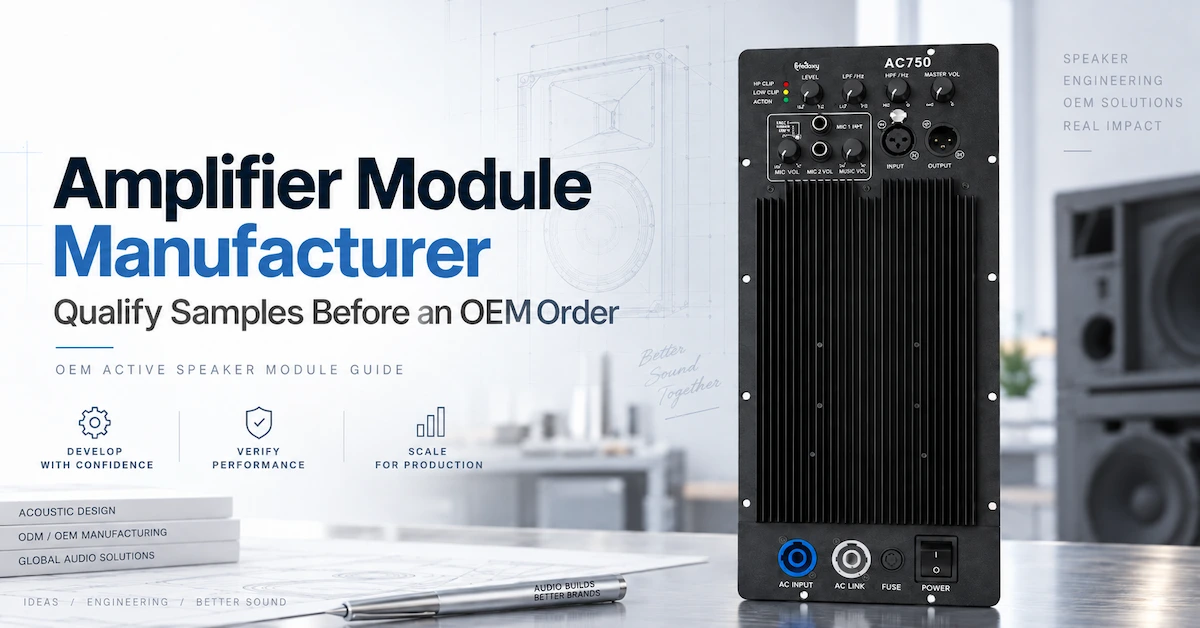
Our hypothetical monitor needs an active speaker amplifier module: an assembly to install in the cabinet. A rack amplifier would be a different purchase. Attach the drawing for that paid-for rear opening.
Ask for the delivered assembly to be itemized in the quote. Keep the items your own speaker factory will source beside that list. Ask where processing belongs, too. The price comparison needs those answers before anyone can work out what the speaker factory must add.
An attractive family description should not quietly become the ordering specification. For example, if a sales reply mentions processing, the buyer needs to know the actual functions included in this version. Are they fixed? Adjustable? Supplied elsewhere? That question costs little to ask before payment and can be expensive to uncover later.
Put the drawing beside the driver files
The monitor brief is where the practical constraints become visible. A sketch showing only an empty cabinet would omit the brace behind the rear opening. The connector may clear the brace while its cable bend does not. Send the installation view, not just the outside dimensions.
The woofer file deserves a closer look than its “8 Ω” label. Its impedance curve shows what that label cannot: how the load varies across frequency. Send that curve where available, plus the operating band and the basis of the driver’s power rating.
The inquiry is now about this cabinet and these drivers. The impedance curve gives the supplier load information that a request for “professional quality” would leave out.
| Brief item | Useful information to send | Decision it supports |
|---|---|---|
| Drivers | Models, impedance curves, ratings and operating bands | Channel capability and protection settings |
| Signal chain | Source level, processor, routing and required controls | Gain structure and interface compatibility |
| Enclosure | Drawing, rear-plate space, internal depth and orientation | Fit, sealing, cooling and service access |
| Market | Countries, mains supply and intended user environment | Electrical variant and compliance planning |
| Demand | Sample quantity, pilot quantity and forecast assumptions | Quotation and production planning |
| Acceptance | Required measurements and pass criteria | Comparable samples and a clear approval record |
In our example, the rear opening is fixed. Connector position might still be negotiable. Put those two facts in different lines so the quotation does not price unnecessary development. Also show the cabinet lying in its monitor position; the drawing should describe how the product will actually work.
The application description can be plain English. Mention speech, music, expected duty and the acoustic target rather than guessing a bigger wattage to cover uncertainty. A forecast needs similar honesty.
Use a dated brief. Mark provisional drivers and processors, and distinguish a forecast from an order.
The AC750 table: useful figures, unanswered questions
FEDAXY identifies AC750 as a two-channel Class H amplifier module. These are catalogue figures we read on October 12, 2026. No sample measurements from this article are included in the table.
| Parameter | AC750 published specification |
|---|---|
| Output at 8 Ω | 500 W + 100 W |
| Output at 4 Ω | 750 W + 140 W |
| Channels | 2 |
| Catalogue LF and HF bands | Two bands appear in the listing: LF 20–100 Hz and HF 100 Hz–20 kHz. |
| THD | Below 0.05%, as published. |
| Published S/N ratio | S/N exceeds 110 dB. |
| Input sensitivity | 1 V |
| Input impedance | For balanced input: 20 kΩ. For unbalanced input: 10 kΩ. |
| Catalogue damping factor | Above 500, according to the AC750 listing. |
| Channel separation (crosstalk) | The listed crosstalk figure is greater than 35 dB. |
| Slew rate | Slew rate is given as 20 V/μs. |
| Functions listed as protection | The four named functions are power-on buffer, overheating, short-circuit protection and output-DC protection. |
| Mains input | For the listed AC supply: 200–240 V and 50–60 Hz. |
| Shipping pack (not the panel cutout) | 535 × 215 × 215 mm is the packing size. |
| Weight of the packed shipment | Gross, including packaging: 8.5 kg. |
For our 230 V monitor, the sample request can quote the listed range. If the destination changes to 120 V, ask the factory which version it can supply; this page does not establish universal-mains operation.
The shipping dimensions are another easy trap. They describe packing, not a plate opening. Our buyer with finished cabinet tooling still needs the installation drawing before ordering.
The LF/HF row needs a reply before drivers are connected. Its labels cannot tell the buyer how a compression driver will be protected below its recommended operating band. Leave the catalogue values as printed and discuss the filters before the acoustic trial.
What would make the power figures comparable?
When comparing these quotes, start with the test record: its load, mains, distortion limit and run time. Record whether one channel was driven or both were working. Until those fields match, the two wattage figures are answering different questions.
On a worksheet, put 8 Ω in the load column and 500 W in the target column. Assume a resistor for this exercise. From P = V²/R, the voltage is √4,000, approximately 63.2 V RMS; dividing by 8 gives about 7.9 A RMS. Those are calculated values, not readings taken from AC750. The resistor assumption must stay with them, because a real driver’s impedance curve is not a straight eight-ohm line.
Ask whether the distortion entry was obtained at the stated output power. Keep the answer with the rating conditions before describing the finished speaker.
For the measurement method, refer to TI’s measurement notes. These address measurement methods, not the AC750’s measured performance or its parts list.
The next inquiry can attach one proposed setup: load, signal, mains and ambient conditions, plus the channel loading. Ask where the output limit is drawn. Save the setup alongside the readings. Someone opening the file later should be able to identify the resistance and channel arrangement without looking for the original email.
Put the brief clipping run and the warm-cabinet run on separate lines of the sample plan. The first seeks an output boundary; the second follows operation after heat has built up.
I would leave room beside the sample's identifier for a restart observation.
By this point, our hypothetical team has a much better email to send. The question is no longer “Is this powerful enough?” It is “Here are our drivers, cabinet and test conditions; which version can you supply, and what should we verify on the samples?”
Confirm the filter arrangement before connecting the drivers
For a woofer and compression-driver cabinet, I would put a query beside the AC750 response row. It reads LF: 20–100 Hz; HF: 100 Hz–20 kHz. Does that describe the signal delivered to each driver? The listing alone leaves that unresolved.
“HF” on this table is no licence to run a compression driver down to 100 Hz. Its usable range depends on the driver, the horn and the manufacturer's limits. Those limits still govern the speaker design.
The engineering inquiry can be quite specific: does this row describe fixed filters, one available configuration, the measurement method, or a table entry needing correction? Channel transfer functions would settle more than another general assurance about sound quality. A sketch showing full-range channels or separately filtered bands, with the proposed crossover marked, would give FEDAXY something specific to assess.
There is a similar gap around processing. The public listing reviewed here does not verify adjustable DSP, user-accessible crossover settings or downloadable firmware. A visible control cannot establish those features. If the cabinet depends on delay, equalization, driver-specific limiting or stored presets, name those functions in the inquiry. Which ones can this assembly actually provide?
For driver data, the Audio Engineering Society's AES2-2012 standard overview is a useful reference. Its scope includes frequency response, impedance, distortion and power handling for professional loudspeaker drive units. Referencing that scope here makes no AES2 testing claim for AC750 or the finished speaker.
Before listening tests, draw the signal path. An external processor and the module's own filters may act on the same band. Their combined response needs measuring, along with the gain controls and protection features actually in use. Otherwise, a later change of processor setting can invalidate an apparently approved result.
A suitable amplifier module for active speakers gives the cabinet project a starting point. The confirmed routing and measured speaker response determine whether that starting point works.
Match sensitivity to the entire gain structure
A purchasing table often gives input sensitivity a single cell. In the speaker, that number connects the source level to clipping, limiting and driver protection.
AC750 lists 1 V input sensitivity. For which output, channel, load and knob position—and does 1 V mean RMS? A limiter threshold cannot be set from that entry alone.
For illustration, take 500 W into an ideal 8 Ω load. From the power and resistance, output voltage comes to about 63.2 V RMS. If 1 V RMS at the input produced that output, voltage gain would be 63.2 (roughly 36 dB). This follows from the previous section's output-voltage calculation. It is not a verified AC750 gain specification.
If the upstream processor can deliver several times that input voltage, the amplifier could reach its output limit while the processor still has headroom. The combination may work perfectly well. However, the limiter and accessible gain controls now decide how much signal reaches the amplifier. A later gain adjustment could change the protection margin without causing any obvious equipment fault.
For the sample record, include maximum source output, nominal level, intermediate gain and physical control positions. Measure the complete chain. Where users can adjust a control after calibration, the protection arrangement must account for its range; otherwise, a controlled service setting is needed.
Noise belongs in this configuration check too. An input-terminated bench measurement is useful, but it does not describe hiss at the normal listening distance or hum with the intended mixer, processor and cables attached.Startup behavior also deserves observation with that equipment connected.
Keep the routing diagram and settings beside the results. A note saying “approved sound” gives the next production batch little to work from.Recorded levels and control positions make the comparison repeatable after a supplier or component revision.
Check the mechanical drawing and material evidence
Get the rear-plate drawing—holes, cutout, insertion depth and clearances—while the enclosure can still change.
The packing size in the AC750 listing will help plan a shipment. It is neither a rear-plate drawing nor the required opening.Likewise, gross weight cannot stand in for assembly net weight when selecting fasteners or assessing handling and transport loads.
Try the fit with connectors and cable bends present. An empty cabinet may offer ample clearance, yet the production harness can bring a connector against a brace. Assembly-tool access and a workable removal path matter just as much: the service technician will face the same space after the speaker leaves the factory.
A board photograph gives some sense of layout. Laminate grade, capacitor series and semiconductor maker remain unverified; appearance cannot establish them. Inspect insulation and protective connections against the approved documents.
During the fit trial, take time over connector alignment and labels, sharp edges, accessible screws and consistency of visible parts. Then remove the module and fit it again. Does anything catch, or require an awkward tool angle? Sealing deserves attention too. Leakage or moved damping material may change cabinet response; include both in the acoustic record.
Evaluate heat inside the speaker you will ship
Cooling fins are visible; the complete thermal path usually is not. Approval depends on heat leaving the intended installation while the speaker maintains its output and reliability targets.
Class H uses supply-rail management. The name alone says little about cabinet temperature because the load, output demand, operating conditions and heat path also matter. A generic efficiency percentage helps only when the compared measurements use matching conditions.
For an energy balance, input power minus delivered output gives losses to account for. Useful numbers for a complete assembly require defined measurements and signal. This guide has no tested AC750 heat figure to insert into that calculation.
Install the sample in the proposed enclosure for thermal qualification. A repeatable record includes ambient temperature, cabinet orientation, signal, output conditions, duration and identified sensor locations. Mark the sensor positions on a photo or drawing agreed with the engineering team. “Near the heatsink” leaves too much room for interpretation on the next test.
What happens between idle and maximum output is worth measuring as well. Depending on the architecture and rail state, losses may follow a different pattern there. A single high-output run cannot show whether another operating point causes trouble.
Repeated overheating trips would hardly be an acceptable show. Watch for output changes before shutdown, record how recovery works, and examine the speaker's behavior after prolonged operation while it is still warm. FEDAXY may keep a temperature limit or sensor threshold confidential. Then agree what measurable behavior will count as acceptable.
What clearance will the rear panel have in use? An equipment alcove or a stage monitor surrounded by materials raises similar questions. Put those placements in the test brief.
FEDAXY can explain its assembly; you supply the cabinet details. Work out the thermal plan together. A separate module bench report still leaves the cabinet installation to be evaluated.
Turn the sample order into an approval experiment
A sample must answer the outstanding purchasing questions. The order should therefore identify the supplied configuration, accompanying documents and checks completed before dispatch.
FEDAXY's FAQ says samples are available for testing and acoustic evaluation. Check upfront sample and freight charges, and whether this quotation allows a refund or deduction. The quotation needs the applicable terms. No single verified sample price is established here.
Before installation, take receipt photos, note identifiers and retain packaging information. Compare the delivered interfaces with the drawing while they are visible. Later, cables and cabinet work may obscure exactly what arrived.
Electrical function comes first, on a suitable test setup controlled by qualified personnel. Cabinet integration follows with the intended drivers and signal chain. Then repeat critical checks under changed conditions, such as a warm cabinet or a normal power restart. This sequence links the incoming assembly to the speaker the buyer plans to sell.
| Stage | Evidence to keep | Example acceptance question |
|---|---|---|
| Receipt and identity | Photos, identifiers, supplied documents | Is this the quoted configuration? |
| Electrical evaluation | Setup, loads, measurements and instrument details | Does it meet the agreed electrical limits? |
| Mechanical integration | Drawing checks and installation photos | Can production assemble and service it reliably? |
| Acoustic evaluation | Driver configuration and measured response | Does the speaker meet its performance target? |
| Thermal operation | Conditions, temperatures and output behavior | Does it remain acceptable in the intended enclosure? |
| Final review | Exceptions, changes and signed approval record | What exactly is approved for the pilot order? |
Separate observations from acceptance criteria. “The panel felt hot” offers little basis for comparison. Temperature measured at a named location under recorded conditions supports a decision. Keep the listening notes, including a comment such as “powerful sound,” alongside the measurements. The brief's output, response and distortion criteria still need their own evidence.
If a check fails, start the discussion with the setup and result. An unexpected filter, incorrect load or gain setting could explain a result that initially looks like a product fault. Record the agreed correction, repeat the affected checks and review whether the change invalidates earlier approvals.
Finally, establish whether the sample represents production. Hand modifications and temporary components need identifying. They may demonstrate a workable concept, while the pilot batch must demonstrate the controlled assembly you intend to purchase.
Look for factory records that connect to the product
Consider an illustrative AC750 purchase for a new speaker cabinet. This is a buying example, not a FEDAXY customer case. Start the file with the quoted configuration; “AC750” may leave revisions unresolved.
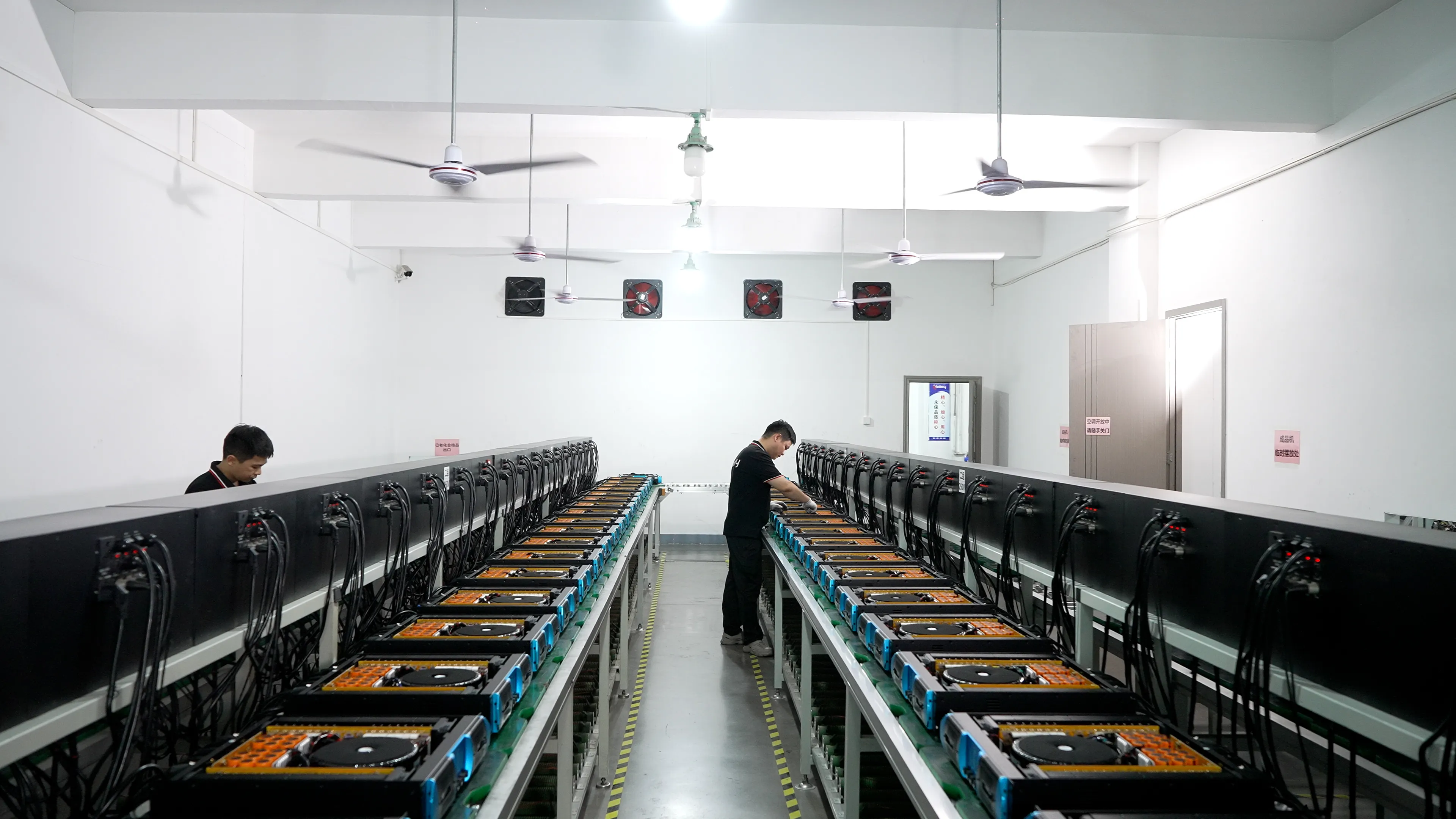
FEDAXY's website describes five QC inspection rounds and eight-hour aging tests. Which rounds cover the offered module? Record the answer beside the quote. The aging procedure needs its operating conditions too. An eight-hour duration says little about what the assembly was doing during those hours.
At the next step, purchasing requests an example of the record that would accompany or identify its batch. Incoming-part checks, assembly inspection and final measurements belong to different stages. Which result releases the completed module? Which identifier would let the factory retrieve that result after shipment?
A results sheet naming only a product family leaves a gap: were these readings taken from the sample you're evaluating? The supplier's answer should tie the readings to that unit.
The repair history is where I'd slow down. Next to a failed reading, write: “After the repair, what gets tested again?” Get the procedure from the factory. Write down which records arrive with repeat orders and which the factory keeps.
Verify certificate scope at module and finished-speaker level
In the same illustrative purchasing file, a certificate cannot be approved by its logo. The buyer opens the document and looks for the applicant, named models, issuing body and test scope.An amplifier module manufacturer may publish documents that cover some products without covering the proposed assembly.
FEDAXY's company and FAQ pages advertise ISO9001, CE, RoHS and CB. The displayed EMC and RoHS documents reviewed for this guide name rack-amplifier model groups. AC750 was not in those displayed schedules. These images therefore do not establish AC750-specific coverage.
That leaves a precise follow-up: which documents support this quoted module and destination market? If the response refers to a product family, purchasing needs the supporting explanation and paperwork. Save them against the same hardware configuration as the quotation; a change to the mains arrangement or enclosure interface can affect the review.
The finished speaker is a separate review. Its wiring, accessible parts and enclosure enter the compliance discussion too. A qualified compliance specialist or lab can review the complete speaker, including any change in electromagnetic behavior.
Which product does the certificate logo actually cover? Settle that before approving the speaker artwork.
Put the OEM changes in writing
The illustrative buyer now wants its logo on the plate and a change to the speaker's operating behavior. The logo can be approved from an artwork proof; changing how the speaker operates means going back to the sample.
For a custom amplifier module, split the enquiry into branding, mechanical interfaces, electrical requirements and operating behavior. FEDAXY describes support for appearance, circuit or parameter tuning, logos, manuals, accessories and packaging. Does that list cover the particular module you want? Get the options confirmed in the quote.
If the mounting arrangement fits, perhaps artwork is the only visible change the project needs. The supply and driver band are separate questions. Where either falls outside the standard specification, describe the mismatch to the supplier and wait for its technical response before ordering the branded sample.
Put separate questions on the approval form: “Is this drawing accepted?” “Has this prototype demonstrated the requested function?” “Is this the production sample we are approving?” A signed drawing leaves the latter two questions open.
For changed filter or gain settings, check whether the transfer-function and speaker-protection readings still describe the module being ordered. Engineering can identify what must be measured again. With a changed plate, ask where heat leaves the assembly and whether a technician can reach the service connections.
Give the approved variant a shared code or revision reference. A reorder simply naming AC750 could leave the requested modification ambiguous.
Compare AC750 and AC550 without inventing missing details
The AC750 page also lists AC550 output figures. A buyer can use them to begin a comparison, while recognizing that this guide did not independently verify a separate AC550 detail listing.
| Published item | AC750 | AC550 as shown on the AC750 page |
|---|---|---|
| Output at 8 Ω | 500 W + 100 W | 350 W + 100 W |
| Output at 4 Ω | 750 W + 140 W | 550 W + 140 W |
| Separate detailed review for this guide | AC750 listing reviewed | Not independently verified |
| Current order availability | Confirm in quotation | Confirm in quotation |
| Complete installation suitability | Requires system approval | Requires its own documents and system approval |
For our illustrative cabinet project, a requirement within the lower LF figure would make AC550 worth discussing. That is as far as the table takes the decision. It establishes no lower price, smaller plate, lower heat output or identical control arrangement. Obtain a current AC550 datasheet and drawing before assigning it those advantages.
Equally, AC750's higher LF rating needs a reason in the speaker brief. The driver, supply, cooling and limiter settings determine usable system output. Once the acoustic target is met, extra catalogue power may add little to that particular cabinet.
Price the approved installation, not just the loose assembly
Return to the illustrative buyer's cost sheet. The quoted module price occupies one cell. Freight, applicable import costs, harnesses, mounting hardware and packaging changes occupy others. Leave space for the buyer's own factory work as well: fitting the assembly and checking the completed speaker before release.
One supplier's offer might fit the existing rear panel; another might require a replacement panel and longer assembly work. In that situation, the second offer still has unanswered cost cells. Fill them from the relevant quotations and labor estimate before calling either module cheaper for the project.
The development bill goes in its own column; recurring costs go beside the order volume.
Service brings another set of blanks to the sheet. “Spare assembly available?” “Replacement possible locally?” “What information must accompany a fault report?” FEDAXY's website advertises a three-year warranty for the company.Which faults are excluded? Does the return freight fall to the buyer? Get the current terms with the quote.
Project cost = delivered modules + integration items + development and verification + production inspection + planned service support.
An unanswered cost cell stays open.Zero would turn missing information into a saving. No verified failure rate is available here to justify a calculated warranty allowance.
Give the amplifier module manufacturer the requested deliverables, accepted configuration and exclusions with the RFQ. Price negotiation then refers to the assembly this speaker project would buy.
What does “delivery in four weeks” actually mean?
Four weeks is an illustrative quotation, not a FEDAXY delivery commitment. It sounds easy to put on a production calendar, until someone asks when the four weeks begin. After payment? After the buyer approves the artwork? After engineering releases a drawing? Those answers can put the shipment on quite different dates.
There is a second date to sort out: the end of the quoted period. Factory readiness, dispatch and arrival are three separate events. If the cabinet launch depends on an arrival date, a factory dispatch estimate leaves transport still to be arranged.
FEDAXY's public FAQ describes small minimum quantities for standard models. For OEM work, the quantity depends on configuration, appearance and packaging. It doesn't give a numerical MOQ applicable to this project. Nor does the information reviewed here establish a fixed sample or production lead time. Get those terms in the current quotation.
A standard sample and a customized prototype deserve separate lines in that quotation. So do a pilot batch and repeat production. One may be waiting for artwork while another needs a mechanical drawing.
Two prices, two different answers
Here's how I would read a hypothetical pair of quotations. The cheaper offer doesn't identify the mains version. The other supplier asks for the driver documents and states the proposed supply.
Some answers belong to the module supplier. Others need your complete speaker. A mounting drawing can settle a hole position.Measuring heat inside the intended cabinet is a separate job. Whoever evaluates the sample can pass those findings, and the approved version number, to the person negotiating production prices.
A practical RFQ conversation
The following buyer messages are hypothetical. Brackets mark details to replace with your actual project information. FEDAXY's ability to supply each requested function requires confirmation.
Buyer: “We're developing [speaker type] for [application]. It will be sold in [countries] and needs [mains supply]. Please [recommend a standard model, clarify filtering, quote samples or review custom development].”
Supplier question: “Which drivers and operating bands are involved?”
Buyer: “The LF driver is [model, nominal impedance, rating and operating band]. The HF driver is [model, nominal impedance, rating and minimum recommended operating frequency]. Their documents are attached.”
Supplier question: “What is happening before the amplifier input?”
Buyer: “Our source or processor is [details], and the required routing and filtering are [details]. We need [gain controls, limiting, equalization or other functions]. Please identify what your proposed assembly includes and what would require another configuration.”
Supplier question: “How much room is available?”
Buyer: “Drawing [revision] shows the cabinet space. Could you send the outline, panel cutout and mounting pattern for this module? We'll also need the clearance figures.”
Buyer, on the quotation: “What would [quantity] samples cost, with the version spelled out in the quote? Include the available measurement records, sample terms and expected dispatch milestone. We'll evaluate electrical output, thermal behavior, acoustic response and service access in our complete enclosure.”
“Our pilot quantity is [quantity]; the repeat forecast is [quantity and assumptions]. What minimum quantity applies? Are development and packing included in the price? How long is the quote valid? Please send the warranty and spare-unit terms too. For [destination markets], which model-specific compliance documents can you provide? We'd also like to agree how you will tell us about hardware or component changes before another batch ships.”
For AC750, ask how the published LF/HF response entry relates to your proposed driver operating bands.
Questions buyers ask before ordering amplifier modules
Where does the amplifier module manufacturer's responsibility end?
The order specifications are the starting point. Who matches the drivers? Who signs off the cabinet integration and finished-speaker tests? Who supplies the market documents? Those jobs require agreement between the buyer and supplier; the description “OEM” leaves too much unsaid.
Can AC750 go into any two-way powered speaker?
The HF entry is one reason to pause. A driver whose safe operating band begins higher cannot simply be connected on the strength of the “two-way” description. Clarify the filtering. Supply, channel capability and mechanical fit also have to match before evaluating the assembly in your speaker.
Will the wattage tell me how loud the finished speaker is?
You'd still be missing the driver, cabinet and protection behavior. Wattage describes an electrical rating. To establish acoustic output for the intended application, evaluate the completed speaker and record the conditions. A wattage comparison on its own won't supply that result.
Is adjustable DSP verified for AC750?
Adjustable DSP and firmware functions remain unverified in the public AC750 information reviewed here. Put the specific request in the quotation: “Can this version provide our presets, delay, equalization and limiting?” A visible control isn't sufficient evidence of the processing behind it.
What should accompany a professional audio amplifier module inquiry?
For a professional audio amplifier module, send driver documents, load information, operating bands, signal source, supply, cabinet drawings, application and quantities. Explain how you intend to accept the sample as well. Otherwise the supplier may recommend a configuration based on a different understanding of the job.
Can AC750 be ordered as a universal-mains powered speaker amplifier module?
For AC750, the published supply row reads 200–240 V, 50–60 Hz. It doesn't establish universal mains. Purchasing a powered speaker amplifier module for another supply environment calls for a confirmed version and its applicable documents before sample approval or a compatibility claim.
Is there a verified MOQ for a customized FEDAXY order?
No numerical project MOQ has been verified here. The FAQ distinguishes standard models from OEM work. Describe the circuit, appearance and packing changes when asking about minimum quantities, and distinguish samples from pilot and repeat-production orders.
What does an aging-room photograph tell the buyer?
It shows the process setting pictured. It doesn't establish your unit's result. For that, request identifiable records with relevant test conditions. A cabinet-integrated assembly also needs evaluation in the finished speaker. Keep those two bodies of evidence traceable to the assemblies and conditions involved.
What belongs in the file before a volume order?
The version approved during sampling, its datasheet and drawings, the test results, commercial terms and applicable compliance documents. Include the agreed change-notification and service arrangements. That gives purchasing the actual basis of the approval, rather than a model name remembered from an email.
How should a new OEM project begin?
Start with the things you can't change: the supply, driver operating bands or available cabinet space. Send those alongside the speaker brief. For the parts of the design still open, say which alternatives you're considering. That lets the conversation settle feasibility before a sample purchase.
Company and source details
Prepared for FEDAXY on October 12, 2026. Product values and photographs come from FEDAXY's public AC750 listing and company pages. This is source-based purchasing guidance; it does not report an engineer-reviewed AC750 test campaign.
Company: Guangzhou Fedaxy Audio Equipment Co., Ltd.
Location: Panyu, Guangzhou, China
Email: faye@fedaxy.com
Phone: +86 13416126252
Read the company profile or sample and OEM FAQ, or contact FEDAXY with your project brief.
Conclusion
A useful supplier approval identifies the assembly you are buying and the evidence supporting that choice. With AC750, clarify the published filter bands, supply range and rating conditions before assessing the module in your speaker. Keep the cabinet, thermal and compliance checks attached to the version intended for production.
Send FEDAXY your driver data, cabinet drawing and target market for a recommendation and quotation.