Why Choosing the Right Active Speaker Amplifier Module Manufacturer Matters
Developing an active speaker product requires more than selecting a powerful amplifier board and installing it inside a cabinet.
For speaker brands, OEM customers and audio manufacturers, the amplifier module becomes one of the most important components that determines:
- Output performance
- Sound system stability
- Thermal reliability
- Product lifespan
- Production efficiency
- Customer satisfaction
A reliable active speaker amplifier module manufacturer should not only provide an amplifier module with a suitable wattage rating. The supplier should understand the relationship between amplifier performance, loudspeaker design, enclosure structure, power supply requirements and final product application.
Many buyers make the mistake of choosing modules based only on:
- Output power
- Product appearance
- Unit price
However, an active speaker is a complete electro-acoustic system.
The amplifier module must work together with:
- Speaker drivers
- Cabinet volume
- Crossover design
- Power supply
- Cooling structure
- DSP settings
- User application
A module that performs well in a laboratory environment may not deliver the expected result after being installed inside a compact speaker enclosure.
Therefore, professional buyers should evaluate amplifier module suppliers from an engineering perspective.
The key questions include:
- Can the module match the speaker system?
- Can the supplier support customization?
- Can the module maintain stable performance during long operation?
- Does the manufacturer provide technical documentation?
- Can production remain consistent after thousands of units?
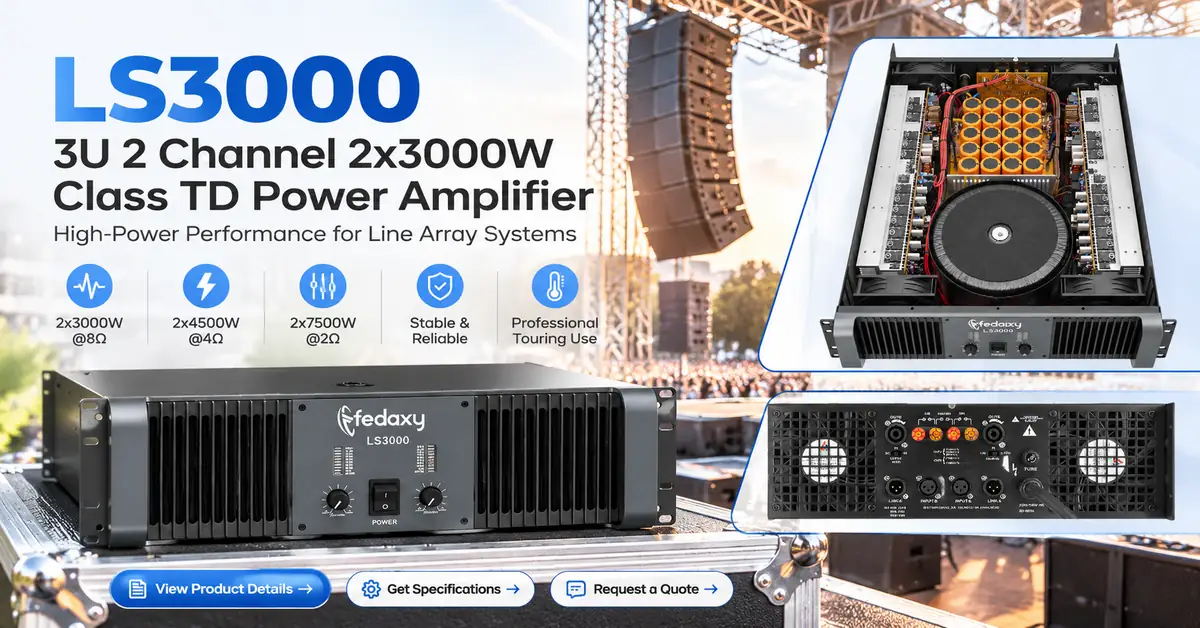
Fedaxy provides professional audio amplifier solutions including Active Module products, designed for applications requiring integrated amplifier solutions inside powered speakers.
What Is an Active Speaker Amplifier Module?
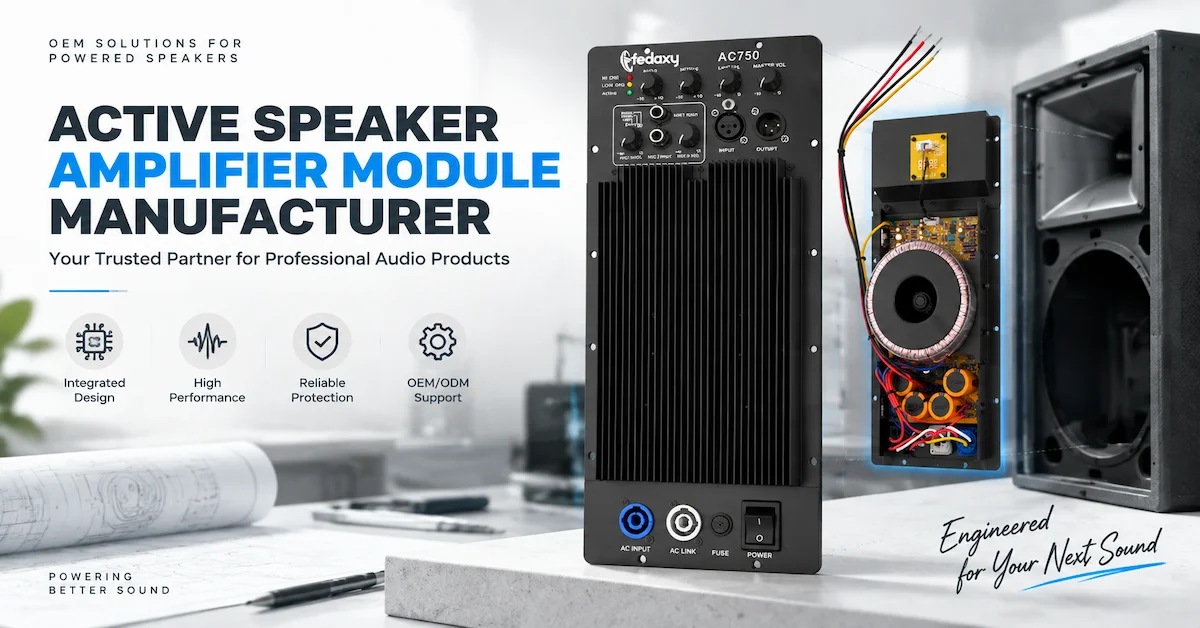
An active speaker amplifier module is an integrated amplification solution designed to be installed directly inside a powered loudspeaker system.
Unlike traditional external rack amplifiers, an active module is installed together with the speaker cabinet.
A typical active speaker amplifier module may include:
- Power amplification circuit
- Input interface
- Signal processing functions
- Protection circuits
- Power management
- Control interface
The purpose is to allow speaker manufacturers to create complete powered speaker products without designing the entire amplifier system from the beginning.
For OEM speaker brands, this approach can reduce:
- Development time
- Engineering workload
- Production complexity
- Testing requirements
However, selecting the right module requires careful evaluation.
A supplier should understand not only amplifier technology but also the final speaker application.
Who Needs an Active Speaker Amplifier Module Manufacturer?
Powered Speaker Brands
Speaker brands often need customized amplifier solutions for their own product lines.
Their requirements may include:
- Specific output power
- Custom appearance
- Different input interfaces
- Brand labeling
- DSP adjustment
- Packaging customization
For these customers, the supplier is not simply a component provider.
The supplier becomes part of the product development process.
OEM and ODM Audio Manufacturers
OEM buyers usually require:
- Stable supply
- Production consistency
- Technical cooperation
- Custom specifications
A professional OEM amplifier module manufacturer should help customers move from product concept to mass production.
The process usually involves:
- Requirement discussion
- Technical evaluation
- Sample development
- Testing
- Production approval
- Mass manufacturing
Audio System Integrators
Integrators may select active modules for:
- Commercial audio products
- Installation projects
- Custom speaker systems
Their focus is often:
- Reliability
- Installation convenience
- System compatibility
- Long-term maintenance
Distributors
Distributors need products that are easy to sell and support.
Important factors include:
- Clear specifications
- Stable quality
- Documentation
- Product availability
- Supplier communication
A distributor selling powered speaker solutions needs confidence that the amplifier module supplier can support future customer requirements.
Key Factors When Selecting an Active Speaker Amplifier Module Manufacturer
Match Module Power With Speaker Requirements
The first step is not choosing the largest output module.
The first step is understanding the speaker system.
Buyers should confirm:
- Speaker driver specifications
- Continuous power rating
- Peak power requirements
- Impedance
- Frequency range
- Cabinet design
The amplifier module must provide enough power headroom while avoiding unnecessary stress on the speaker components.
A common mistake is selecting a module based only on amplifier output.
For example:
A higher-power module may create:
- More heat
- Higher cost
- Larger power supply requirements
A lower-power module may fail to provide enough dynamic range.
The correct choice is the balance between:
- Output capability
- Speaker protection
- Efficiency
- Product positioning
Evaluate Thermal Design Inside the Speaker Cabinet
Thermal management is one of the biggest challenges for active speaker development.
Unlike rack amplifiers, active modules operate inside speaker cabinets where airflow can be limited.
The supplier should consider:
- Module placement
- Heat sink design
- Fan requirements
- Cabinet ventilation
- Long operating duration
A module that works well on an open test bench may perform differently after installation.
Professional buyers should request:
- Thermal testing information
- Recommended installation method
- Cooling requirements
For commercial powered speakers, thermal reliability directly affects product reputation.
Confirm DSP and Signal Processing Requirements
Modern powered speakers increasingly require DSP functions.
Depending on the application, buyers may need:
- Equalization
- Crossover
- Limiting
- Delay
- Preset management
DSP can improve system performance by allowing manufacturers to optimize the amplifier module for a specific speaker design.
However, buyers should confirm:
- Available DSP functions
- Configuration method
- Preset storage
- Firmware management
Not every amplifier module with DSP has the same processing capability.
The supplier should clearly define the available functions.
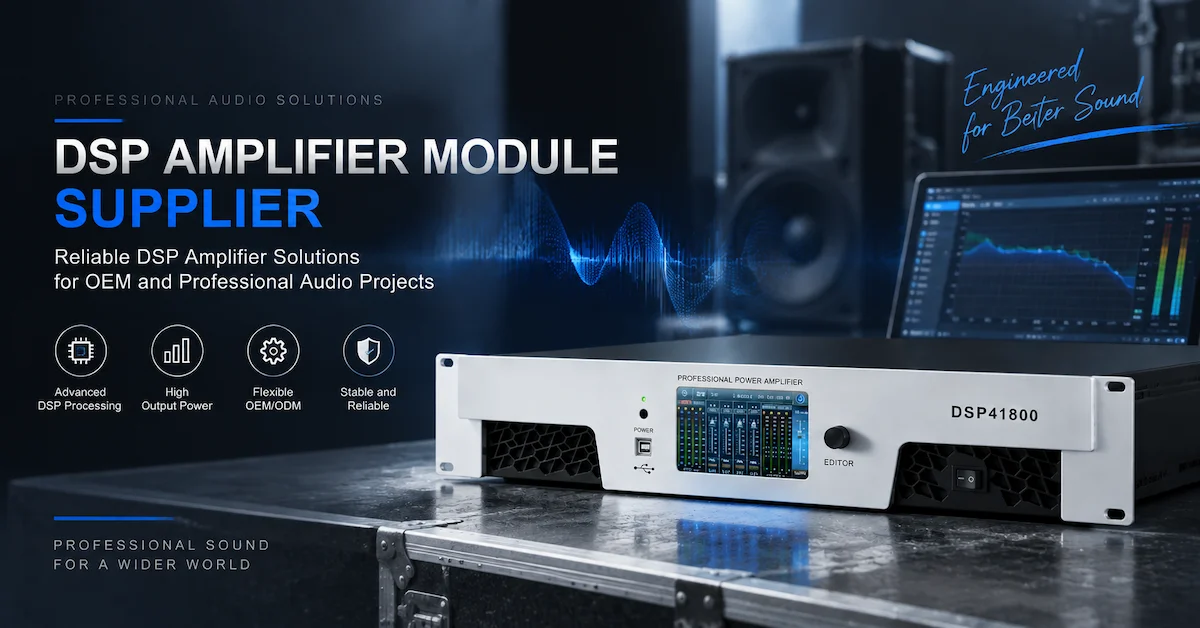
Fedaxy also provides DSP amplifier solutions for professional audio applications requiring integrated processing.
继续输出 Part 2(保持同一篇文章结构,正文继续 H2/H3/H4,无 H1、无分割线,仅使用 Fedaxy 站内链接)。
How OEM Buyers Should Evaluate an Active Speaker Amplifier Module Manufacturer
For OEM speaker brands, selecting an amplifier module supplier is not only a technical decision. It is also a product development decision.
The amplifier module affects:
- Product performance
- Manufacturing efficiency
- Production cost
- Market positioning
- Customer experience
A supplier that only provides a standard module may not solve the actual challenges faced by an OEM brand.
A stronger manufacturing partner should understand:
- Speaker application requirements
- Product positioning
- Mechanical integration
- Electrical compatibility
- Production requirements
Evaluate Engineering Support Capability
Before cooperation, buyers should understand whether the supplier can provide engineering support.
Important questions include:
- Can the supplier recommend a suitable module based on the speaker design?
- Can engineers review power requirements?
- Can they support prototype testing?
- Can they adjust the solution based on feedback?
A professional active speaker amplifier module manufacturer should participate in the development process rather than simply shipping components.
For example, a compact portable speaker may require different amplifier characteristics compared with a high-output professional powered speaker.
The module selection may change depending on:
- Cabinet size
- Speaker driver type
- Usage environment
- Target market
- Required output level
Check Customization Capability
Different speaker brands often require different configurations.
Common customization requirements include:
Electrical Customization
Examples:
- Output power adjustment
- Input configuration
- Voltage version
- Protection settings
Mechanical Customization
Examples:
- Module size
- Mounting position
- Connector layout
- Panel design
Software Customization
Examples:
- DSP presets
- Equalization settings
- Limiter parameters
- User interface configuration
A capable supplier should define which modifications are possible and which changes require additional engineering validation.
For OEM projects, unclear customization boundaries can create problems during mass production.
Confirm Prototype and Sample Approval Process
A professional development process should include sample evaluation.
The sample stage allows buyers to confirm:
- Actual performance
- Installation compatibility
- Heat behavior
- Audio characteristics
- Product reliability
A recommended process includes:
Initial Specification Confirmation
Both parties confirm:
- Output requirements
- Speaker configuration
- Application environment
- Mechanical requirements
Prototype Evaluation
The buyer checks:
- Sound performance
- Module installation
- Control functions
- Thermal behavior
Final Approval
The approved sample becomes the reference for production.
Important records include:
- Approved specification
- Product drawings
- Firmware version
- Testing requirements
This prevents differences between the approved sample and future production batches.
Active Speaker Amplifier Module Selection: AC Series Example
Fedaxy provides active amplifier module solutions designed for powered speaker applications.
The Active Module product category includes amplifier module solutions for integrated speaker designs.
AC750 Active Amplifier Module
The AC750 is designed for powered speaker integration.
According to the product information, it provides:
- Two-way active module design
- Class H amplifier architecture
- Integrated amplifier solution
This type of product can be considered for speaker manufacturers looking for an internal amplification platform instead of building a complete amplifier system.
Potential evaluation areas include:
- Speaker cabinet compatibility
- Output requirements
- Power supply conditions
- Installation method
Product link:
AC550 Active Amplifier Module
The AC550 provides another option for powered speaker applications.
Compared with higher-output modules, different versions may better match:
- Smaller speaker systems
- Different market positioning
- Alternative output requirements
OEM buyers should compare:
- Output capability
- Physical dimensions
- Thermal requirements
- Target speaker application
Product link:
Why Active Speaker Module Integration Requires More Than Amplifier Selection
An amplifier module is only one part of the powered speaker system.
The final product performance depends on integration between:
- Loudspeaker driver
- Enclosure design
- Amplifier module
- DSP tuning
- Power supply
- Protection settings
A module supplier should understand this relationship.
For example:
A speaker manufacturer developing a portable PA speaker may prioritize:
- Lightweight design
- Battery efficiency
- Compact size
A professional stage speaker manufacturer may prioritize:
- High output
- Long operation
- Thermal stability
The same amplifier module may not be suitable for both products.
Production Quality Control for Amplifier Module Manufacturers
For OEM buyers, production consistency is one of the most important supplier evaluation factors.
A reliable manufacturer should control the process from incoming components to final shipment.
Incoming Material Inspection
Components that influence amplifier reliability should be controlled.
Examples:
- Electronic components
- Power components
- Connectors
- PCB materials
Poor component consistency can create problems during mass production.
Assembly Process Control
Important manufacturing factors include:
- PCB assembly quality
- Soldering quality
- Wiring accuracy
- Mechanical assembly
For amplifier modules, small assembly differences can influence:
- Thermal performance
- Electrical stability
- Product lifespan
Performance Testing
Before shipment, products should be tested according to defined standards.
Testing may include:
- Power output
- Channel operation
- Signal response
- Protection function
- Noise performance
The exact testing process should be confirmed with the supplier according to the product model.
Aging Testing
Long-duration testing can help identify early failures.
For OEM buyers, aging testing is especially valuable because:
- Production quantities are larger
- Replacement costs are higher
- Customer expectations are higher
A supplier should be able to explain:
- Testing duration
- Testing conditions
- Failure handling process
How to Reduce Risk When Selecting an Amplifier Module Supplier
Choosing a supplier involves more than comparing unit prices.
A lower-priced module may create additional costs through:
- Engineering modifications
- Quality problems
- Customer complaints
- Production delays
A professional evaluation should include:
Technical Evaluation
Check:
- Module specifications
- Compatibility
- Installation requirements
- Testing information
Commercial Evaluation
Check:
- MOQ
- Lead time
- Packaging
- Payment terms
- Warranty
Long-Term Cooperation Evaluation
Check:
- Communication efficiency
- Product update process
- Spare support
- Engineering response
A reliable supplier should help reduce uncertainty throughout the product lifecycle.
What Information Should Buyers Provide Before Requesting a Quote?
A complete inquiry allows faster and more accurate recommendations.
Buyers should provide:
Speaker Information
Include:
- Speaker type
- Driver configuration
- Impedance
- Continuous power requirement
- Peak power requirement
Product Information
Include:
- Application
- Market position
- Target customers
- Product size limitations
Technical Requirements
Include:
- Required output power
- Input method
- DSP requirements
- Voltage requirement
- Connector preference
Commercial Requirements
Include:
- Expected quantity
- Sample requirement
- Production schedule
- Branding needs
A detailed RFQ helps the manufacturer recommend a suitable module instead of providing a generic product list.
继续输出 Part 3(保持同一篇文章结构,正文继续 H2/H3/H4,无 H1、无分割线,仅使用 Fedaxy 站内链接)。
How to Compare Active Speaker Amplifier Module Suppliers Before Cooperation
Choosing an active speaker amplifier module manufacturer is a long-term product decision.
A supplier comparison should not focus only on:
- Unit price
- Output power
- Delivery time
Professional buyers should evaluate the supplier from multiple dimensions:
- Engineering capability
- Product stability
- Manufacturing control
- Customization support
- Communication efficiency
- Long-term cooperation ability
A lower purchase price may look attractive at the beginning, but poor technical support or unstable production can increase the total product cost.
Compare Product Compatibility Before Comparing Prices
The first supplier evaluation step is product compatibility.
A suitable amplifier module should match:
- Speaker driver
- Cabinet structure
- Power requirements
- Application environment
Buyers should ask:
- Is the module designed for this speaker type?
- Does the output match the driver capability?
- Is the thermal design suitable for the enclosure?
- Are protection settings appropriate?
For example, a compact portable speaker and a professional stage speaker may require completely different amplifier module solutions.
The supplier should understand the final product, not only the amplifier specifications.
Compare Technical Support Capability
Technical support is especially important for OEM customers.
During product development, buyers may face:
- Installation problems
- Performance adjustments
- Thermal issues
- DSP tuning requirements
- Production changes
A reliable supplier should be able to communicate with engineering teams and provide practical solutions.
Important questions:
- Who provides technical support?
- How quickly can engineering feedback be provided?
- Are product documents available?
- Can the supplier support prototype improvements?
For OEM brands, engineering communication often determines project efficiency.
Compare Manufacturing Stability
A good sample does not always guarantee good mass production.
Before placing a large order, buyers should understand:
- Production process
- Quality inspection method
- Component control
- Product consistency
Important questions:
- How are production changes managed?
- How are defective products handled?
- Are production records maintained?
- Is the approved sample used as the production reference?
A professional supplier should have a clear process from prototype approval to mass production.
Compare Customization Capability
Different audio brands often require different solutions.
A capable active speaker amplifier module supplier should support different customization levels.
Standard Product Customization
Examples:
- Logo
- Packaging
- Label information
Technical Customization
Examples:
- Output configuration
- Connector selection
- DSP adjustment
- Protection settings
Product Development Support
Examples:
- New product development
- Engineering cooperation
- Prototype optimization
Buyers should clarify customization scope before starting cooperation.
Common Mistakes When Selecting an Active Speaker Amplifier Module Supplier
Many OEM buyers make mistakes during supplier selection.
Understanding these risks can improve purchasing decisions.
Choosing Only by Output Power
Output power is important, but it is not the only factor.
A higher-power module may create:
- More heat
- Higher cost
- Larger power requirements
The correct module should match the speaker design.
Ignoring Thermal Design
A module installed inside a speaker cabinet has limited cooling space.
Ignoring thermal conditions may cause:
- Performance reduction
- Component stress
- Shorter product lifespan
Thermal evaluation should happen during the development stage.
Selecting a Supplier Without Testing Samples
A product specification cannot replace actual testing.
Before mass production, buyers should evaluate:
- Installation
- Sound performance
- Heat behavior
- Protection functions
- Long-term operation
Not Defining Product Revision Control
For long-term OEM cooperation, revision control is essential.
Buyers should record:
- Approved sample
- Product specifications
- Firmware version
- Mechanical drawings
- Packaging details
Without revision control, future production may become inconsistent.
OEM Development Workflow for Active Speaker Amplifier Modules
A professional OEM process usually includes several stages.
Stage 1: Requirement Discussion
The buyer provides:
- Speaker application
- Product positioning
- Target market
- Performance requirements
The supplier evaluates:
- Suitable module platform
- Technical feasibility
- Development requirements
Stage 2: Technical Confirmation
Both sides confirm:
- Output requirements
- Interface design
- Installation method
- DSP requirements
- Protection settings
Stage 3: Prototype Development
The supplier prepares samples.
The buyer evaluates:
- Audio performance
- Mechanical compatibility
- Thermal behavior
- User experience
Stage 4: Sample Approval
The approved sample becomes the production reference.
Documents should include:
- Technical specifications
- Drawings
- Test requirements
- Revision information
Stage 5: Mass Production
Production should follow:
- Approved specifications
- Quality standards
- Inspection procedures
Stage 6: After-Sales Support
Long-term cooperation requires:
- Technical communication
- Spare support
- Product updates
- Problem-solving process
How Active Speaker Brands Can Improve Product Development Efficiency
Working with an experienced amplifier module manufacturer can reduce development pressure.
Benefits include:
Reduced Engineering Workload
Instead of developing the complete amplifier system internally, speaker brands can focus on:
- Acoustic design
- Industrial design
- Market development
Faster Product Launch
A mature module platform can shorten:
- Prototype development
- Testing cycles
- Production preparation
Better Production Consistency
A specialized manufacturer can provide:
- Standardized processes
- Quality control
- Production experience
Why Fedaxy Active Module Solutions Are Suitable for OEM Evaluation
Fedaxy provides professional amplifier solutions for different audio applications.
The active module category is designed for powered speaker integration.
The Fedaxy Active Module product range can be evaluated by:
- Speaker manufacturers
- OEM brands
- Audio system developers
For customers developing powered speakers, the main evaluation points include:
- Output capability
- Module integration
- Thermal management
- Product customization
Fedaxy also provides other amplifier platforms including:
This allows customers to evaluate different amplifier architectures according to their product requirements.
Active Speaker Amplifier Module Supplier Evaluation Checklist
Before selecting a supplier, buyers can use this checklist.
| Evaluation Area | Questions |
|---|---|
| Product compatibility | Does the module match the speaker design? |
| Output performance | Does the power level meet requirements? |
| Thermal design | Can the module operate reliably inside the cabinet? |
| DSP capability | Are required processing functions available? |
| Customization | Can the supplier support OEM requirements? |
| Production | Can quality remain consistent in mass production? |
| Documentation | Are technical files available? |
| Support | Is engineering assistance available? |
What Buyers Should Prepare Before Contacting Fedaxy
A complete project brief improves communication efficiency.
Prepare:
Product Information
- Speaker type
- Speaker size
- Driver configuration
- Application
Technical Information
- Required output power
- Impedance
- DSP requirements
- Input interface
- Voltage requirements
Business Information
- Target quantity
- Market region
- OEM requirements
- Expected timeline
Buyers can submit project details through the Fedaxy contact page for further discussion.
继续输出 Part 4(FAQ + Conclusion),保持同一篇文章结构:
- 正文继续 H2/H3/H4
- 无 H1
- 无分割线
- 仅使用 Fedaxy 站内链接
- 最后一节 Conclusion
Frequently Asked Questions About Active Speaker Amplifier Module Manufacturers
What should I check when choosing an active speaker amplifier module manufacturer?
The first thing to check is whether the manufacturer understands the complete powered speaker application.
A suitable supplier should evaluate:
- Speaker driver requirements
- Cabinet design
- Required output power
- Thermal environment
- DSP requirements
- Production expectations
The amplifier module is not an independent component. It must work together with the complete speaker system.
A professional supplier should provide technical recommendations instead of only providing a product catalog.
Why do speaker brands choose amplifier modules instead of developing their own amplifier systems?
Many speaker brands choose amplifier modules because they can reduce product development complexity.
Using a professional amplifier module supplier can help reduce:
- Engineering workload
- Development time
- Testing requirements
- Production risks
Instead of developing:
- Power circuit
- Protection system
- Amplifier design
- Thermal solution
internally, brands can focus more resources on:
- Acoustic tuning
- Industrial design
- Marketing
- Product positioning
However, the selected supplier must have sufficient technical capability to support integration.
How do I select the correct power level for an active speaker amplifier module?
The correct power level depends on the complete speaker system.
Buyers should consider:
- Speaker impedance
- Driver capability
- Cabinet size
- Application environment
- Required output level
A higher power module is not always better.
The ideal module should provide:
- Enough output headroom
- Stable operation
- Suitable thermal performance
- Protection for the speaker system
The supplier should evaluate the speaker requirements before recommending a module.
What customization options can an active speaker amplifier module manufacturer provide?
Customization depends on the supplier's engineering capability.
Common customization options include:
Mechanical Customization
- Mounting design
- Module size
- Connector position
- Panel structure
Electrical Customization
- Output configuration
- Voltage version
- Interface requirements
DSP Customization
- EQ settings
- Crossover configuration
- Limiter parameters
- Product presets
Before starting an OEM project, buyers should confirm which changes are available and whether additional testing is required.
How important is thermal design for active speaker amplifier modules?
Thermal design is extremely important because the amplifier module operates inside the speaker enclosure.
Compared with external rack amplifiers, internal modules usually have more limited airflow.
Poor thermal design may result in:
- Reduced performance
- Component stress
- Protection activation
- Shortened product lifespan
Buyers should request:
- Installation recommendations
- Cooling requirements
- Thermal test information
The module should be evaluated under realistic speaker operating conditions.
Should an active speaker amplifier module include DSP?
It depends on the product requirements.
DSP can provide advantages such as:
- Speaker tuning
- Crossover adjustment
- EQ optimization
- Limiter control
- Preset management
For branded powered speakers, DSP can help create a consistent product experience.
However, buyers should confirm:
- Available DSP functions
- Configuration method
- Software support
- Preset management process
Not every DSP module provides the same level of control.
Fedaxy provides DSP amplifier solutions for applications requiring integrated audio processing.
What documents should I request from an amplifier module supplier?
Professional buyers should request:
- Product specification sheet
- Installation instructions
- Electrical drawings
- Interface information
- Testing information
- Warranty details
For OEM customers, additional documents may include:
- Approved sample records
- Revision information
- Packaging specifications
- Production references
Complete documentation helps prevent problems during manufacturing and future support.
How should I test an amplifier module sample before mass production?
Sample testing should simulate the final product environment.
Recommended tests include:
Performance Testing
Check:
- Output performance
- Signal quality
- Channel operation
Integration Testing
Check:
- Module installation
- Speaker compatibility
- Interface connection
Thermal Testing
Check:
- Temperature rise
- Cooling performance
- Long-duration operation
Reliability Testing
Check:
- Protection response
- Continuous operation
- Restart behavior
The approved sample should become the reference for future production.
What makes a reliable OEM amplifier module supplier?
A reliable supplier should provide:
- Engineering support
- Stable production
- Clear documentation
- Consistent quality
- Effective communication
For OEM brands, the supplier relationship continues after the first shipment.
Future cooperation may involve:
- Product updates
- New models
- Market requirements
- Technical improvements
A long-term supplier should be able to support business growth.
Can Fedaxy provide active speaker amplifier module solutions for OEM projects?
Fedaxy provides professional amplifier solutions including active amplifier modules for powered speaker applications.
Buyers can evaluate the Fedaxy Active Module category based on:
- Speaker requirements
- Output needs
- Integration requirements
- Customization expectations
For OEM cooperation, customers can discuss product requirements through the Fedaxy contact page.
What information should I send before requesting an amplifier module quotation?
A complete inquiry should include:
- Speaker application
- Speaker driver information
- Cabinet design information
- Required output power
- Impedance
- DSP requirements
- Input requirements
- Quantity forecast
- Target market
The more complete the information, the more accurate the supplier recommendation will be.
Conclusion
Choosing the right active speaker amplifier module manufacturer is an important decision for speaker brands, OEM customers, distributors and audio system developers.
A successful powered speaker product requires more than a suitable amplifier wattage. The amplifier module must match the speaker design, thermal environment, application requirements and production goals.
A reliable supplier should provide:
- Technical understanding
- Product customization support
- Stable manufacturing capability
- Clear documentation
- Consistent quality control
- Long-term cooperation support
For OEM speaker brands, selecting the correct amplifier module supplier can reduce development risks and improve product reliability. For distributors and integrators, a dependable supplier can provide stronger product confidence and easier customer support.
Fedaxy provides professional amplifier solutions including:
- Active speaker amplifier modules
- DSP amplifier products
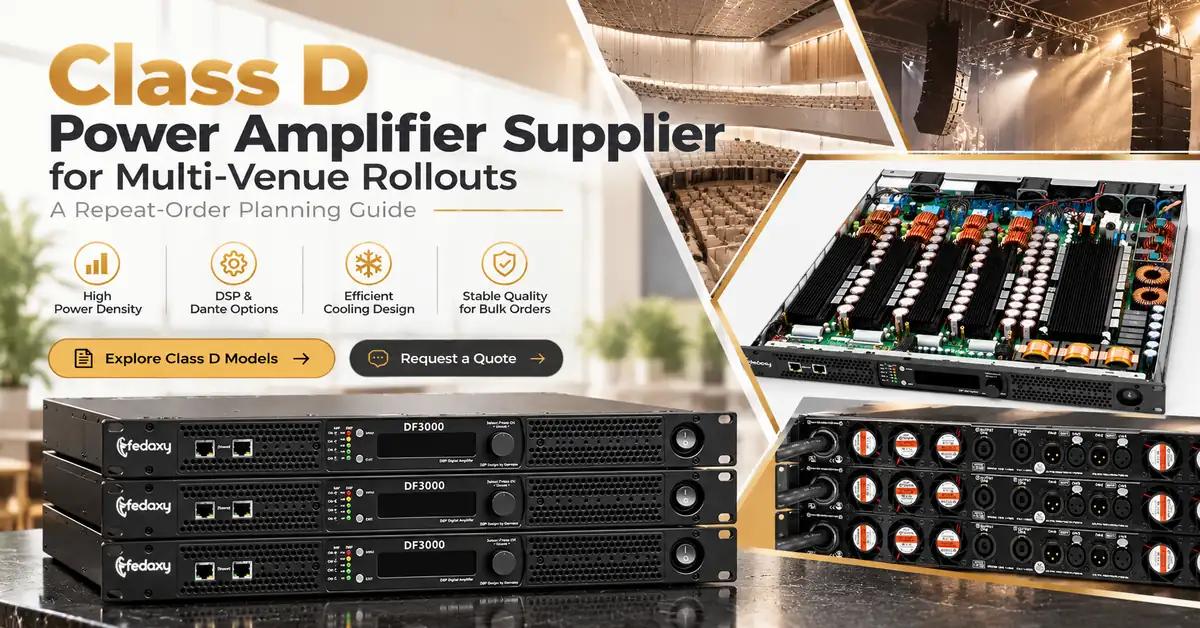
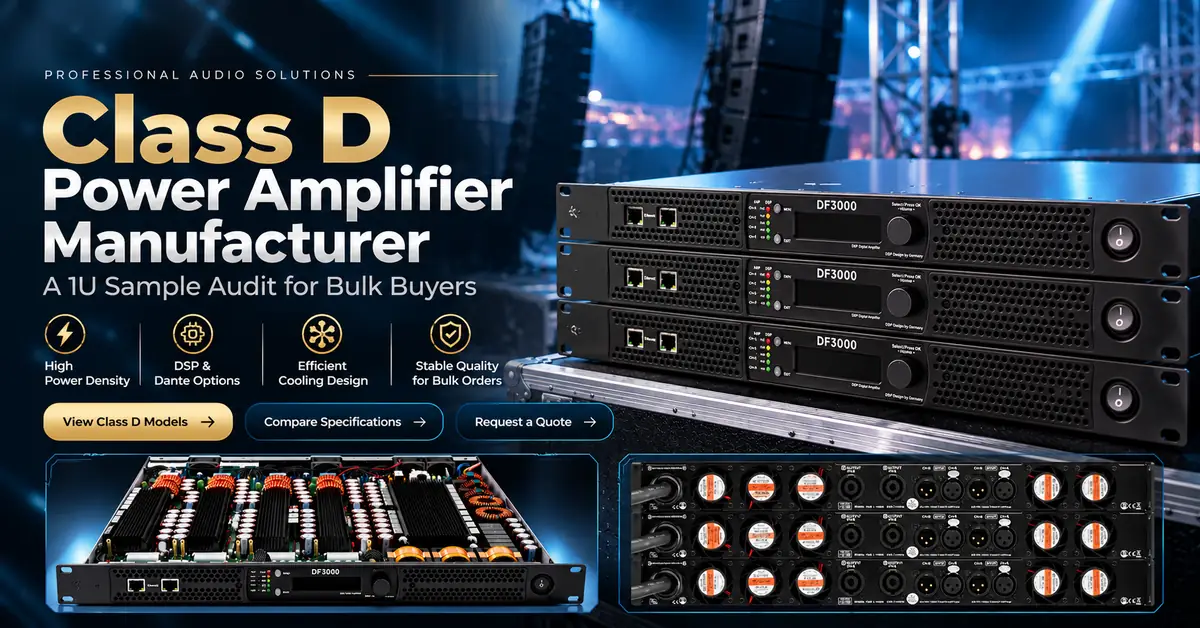
- Class D amplifier platforms
- Class TD amplifier platforms
- Class H amplifier platforms
Different audio products require different amplifier solutions. A portable powered speaker, professional stage speaker and commercial audio system may have completely different requirements.
Before selecting an amplifier module, buyers should prepare their speaker specifications, application requirements and customization expectations. This allows the manufacturer to recommend a solution based on engineering needs rather than only product availability.
Explore Fedaxy Active Module solutions or contact Fedaxy through the official inquiry page to discuss your powered speaker development project.