Why 4-Channel Power Amplifiers Matter in Professional Audio
Professional audio projects increasingly require more than simple two-channel amplification.
Line arrays, touring racks, multi-zone installations, stadium sound systems and other complex applications may need several amplifier channels operating within the same rack.
A 4 channel power amplifier manufacturer can provide a higher-density solution by combining four independent amplification channels into one chassis.
For B2B buyers, the value is not simply “four channels instead of two.” A suitable four-channel amplifier can help improve:
- rack-space efficiency
- channel allocation
- system scalability
- cable management
- installation efficiency
- equipment management
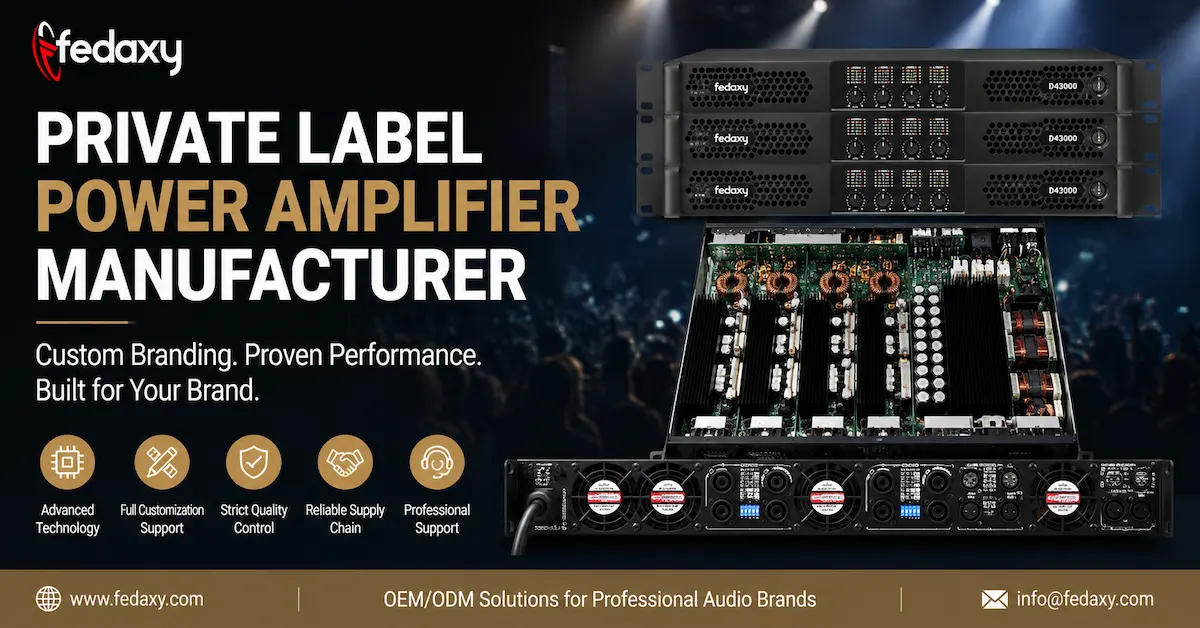
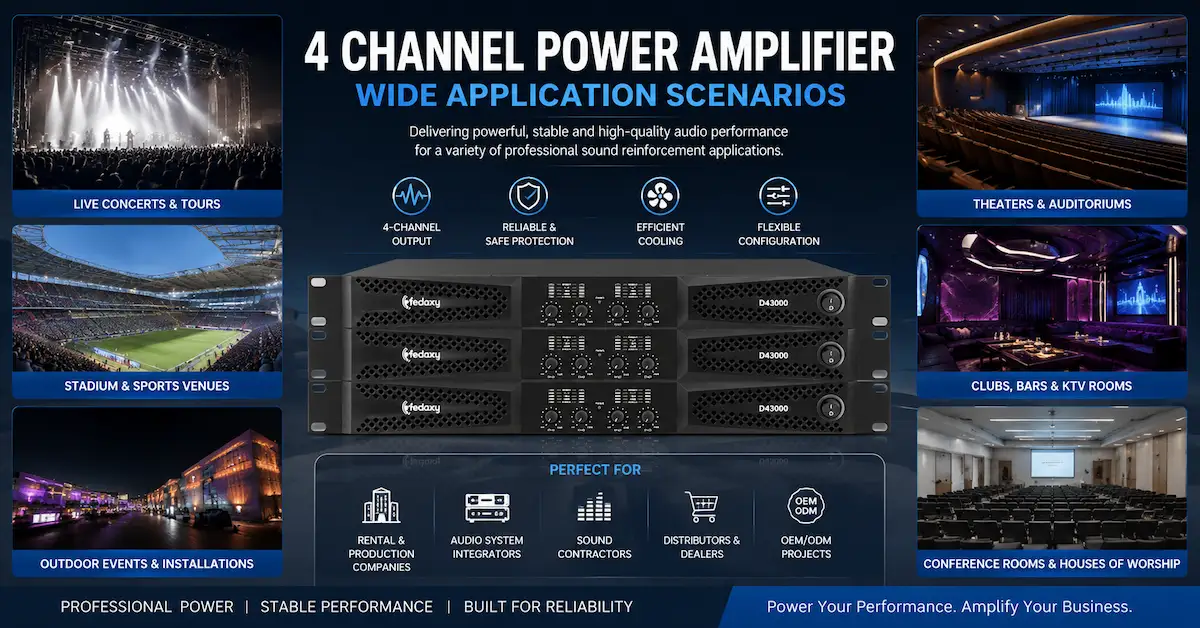
Fedaxy's current product range includes multiple four-channel platforms, including the D43000 4-channel Class D amplifier, DP41500 4-channel DSP amplifier and DSP41800 4-channel Class TD DSP amplifier.
Quick Answer: How Should You Choose a 4 Channel Power Amplifier Manufacturer?
The right manufacturer should be evaluated across power capability, channel architecture, impedance performance, thermal management, protection, DSP functionality, quality control, customization and supply support.
Before requesting a quotation, professional buyers should prepare:
- Speaker model and rated power
- Nominal impedance
- Number of speakers per channel
- Required amplifier channels
- Required output power
- Bridge-mode requirements
- DSP or external processor requirements
- Target market and voltage
- Estimated order quantity
- Branding or OEM/ODM requirements
The most suitable amplifier is not necessarily the model with the highest wattage. It is the model that provides the right output under the actual load while maintaining reliable operation.
Who Should Buy a 4 Channel Power Amplifier?
Four-channel amplifiers are particularly relevant to B2B buyers managing professional audio systems.
| Buyer Type | Typical Requirement | Main Purchasing Concern |
|---|---|---|
| Audio brands | Differentiated amplifier products | Product platform and customization |
| Distributors | Multiple models for resale | Price, reliability and supply |
| System integrators | Complete sound-system deployment | Power,impedance and compatibility |
| Touring companies | High-density amplifier racks | Power density and reliability |
| Rental companies | Flexible multi-channel systems | Durability and serviceability |
| Installation contractors | Fixed commercial projects | Configuration and long-term stability |
| Stadium contractors | Large multi-zone systems | Channel count and output capacity |
This is why choosing a manufacturer rather than simply purchasing a generic amplifier can be important for long-term projects.
When Is a 4-Channel Amplifier Better Than a 2-Channel Model?
The decision depends on system architecture.
A four-channel amplifier becomes particularly useful when different speaker sections need independent amplification.
4-Channel Configuration
A four-channel amplifier can support:
- multiple speaker zones
- bi-amped systems
- line array sections
- multi-channel touring racks
- distributed audio systems
Potential benefits include fewer amplifier chassis and more efficient rack utilization.
2-Channel Configuration
Two-channel amplifiers may remain suitable for:
- simple stereo systems
- smaller installations
- dedicated subwoofer channels
- applications with limited channel requirements
The correct decision should therefore be based on the number of independent loads rather than simply choosing the amplifier with more channels.
Fedaxy's existing content also identifies four-channel architecture as valuable for line arrays, bi-amped systems and touring racks because it can reduce rack units, cabling and transportation requirements.
Key Specifications to Check Before Buying
A professional purchasing team should never evaluate a four-channel amplifier based on one specification.
Output Power
Output power should be evaluated at the actual speaker impedance.
For example, Fedaxy's DSP41800 is specified at:
| Load | Stereo Output |
|---|---|
| 8Ω | 4 × 1800W |
| 4Ω | 4 × 3150W |
| 2Ω | 4 × 4500W |
| 8Ω Bridge | 2 × 5400W |
These ratings show why buyers should compare amplifier performance according to the intended load rather than only looking at the maximum power number.
Impedance Capability
Professional audio systems may operate at:
- 8Ω
- 4Ω
- 2Ω
Lower impedance operation generally requires stronger current capability and effective thermal management.
The manufacturer should clearly specify the supported load and corresponding output power.
Frequency Response and Distortion
Important specifications include:
- frequency response
- THD
- signal-to-noise ratio
- damping factor
- input impedance
- crosstalk
The DSP41800, for example, is specified with a 20Hz–20kHz frequency response, THD below 0.05%, S/N ratio above 110dB and damping factor above 500.
4-Channel Power Amplifier Technology Options
A professional 4 channel power amplifier manufacturer may offer different amplifier architectures.
The best choice depends on the application.
Class D 4-Channel Amplifier
Class D technology is suitable when buyers prioritize:
- high efficiency
- high power density
- compact rack design
- reduced heat generation
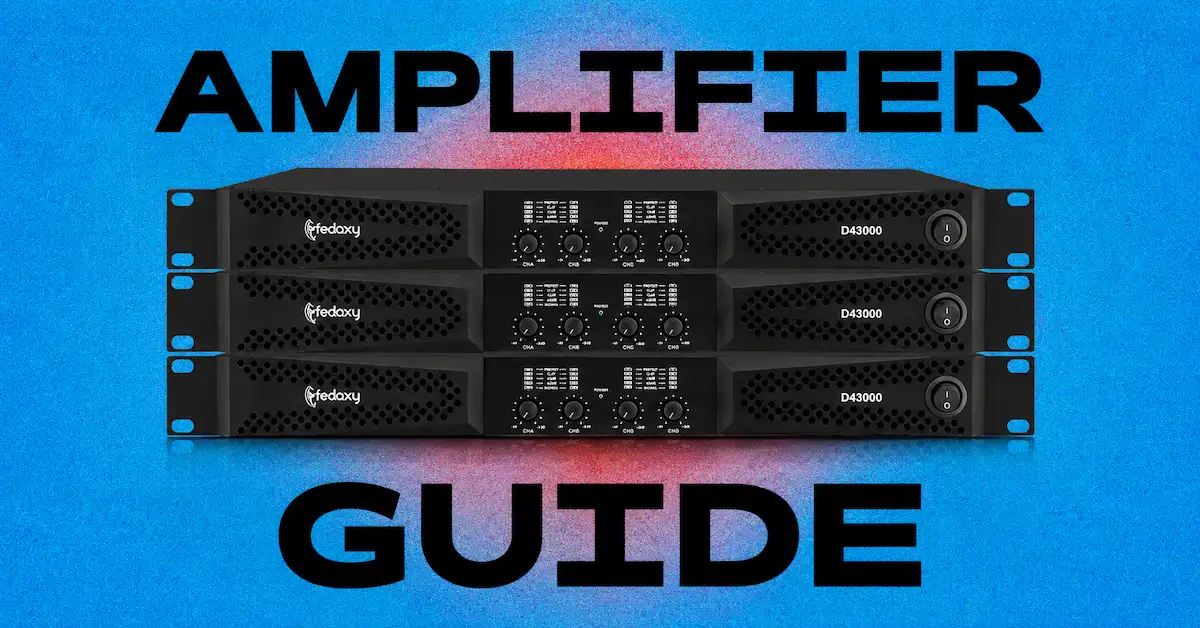
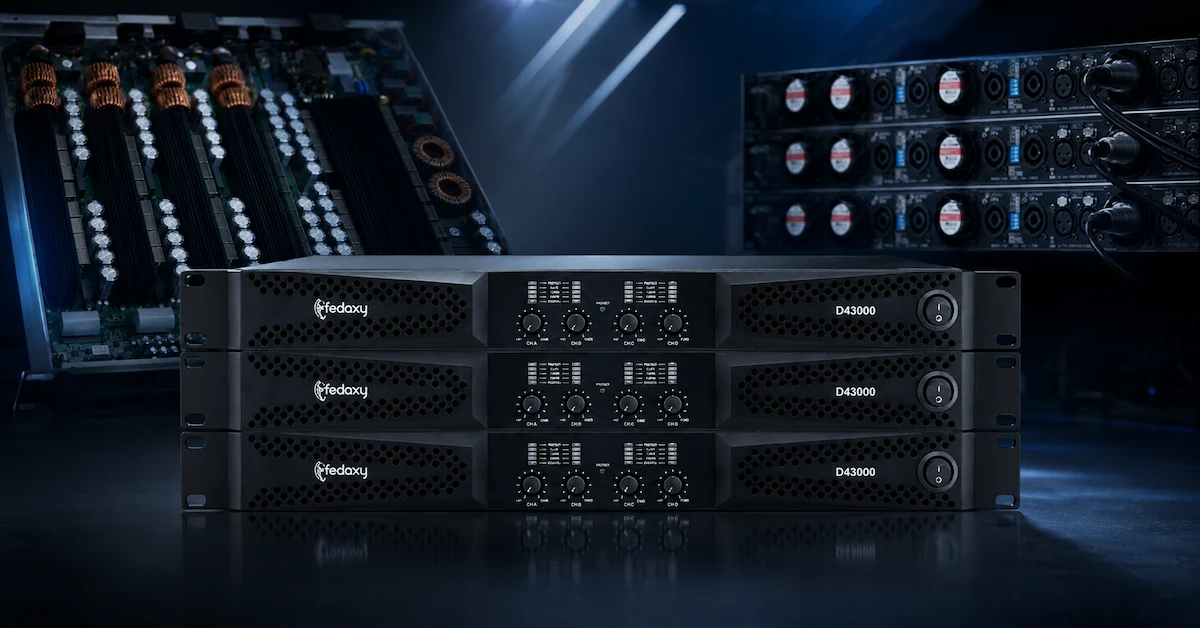
Fedaxy's D43000 is a four-channel Class D platform with a 1U rack design and is positioned for professional audio applications.
This architecture can be particularly attractive for:
- touring
- line arrays
- rental systems
- compact professional racks
Class TD 4-Channel Amplifier
Class TD technology can be appropriate for applications requiring substantial output capability and professional system performance.
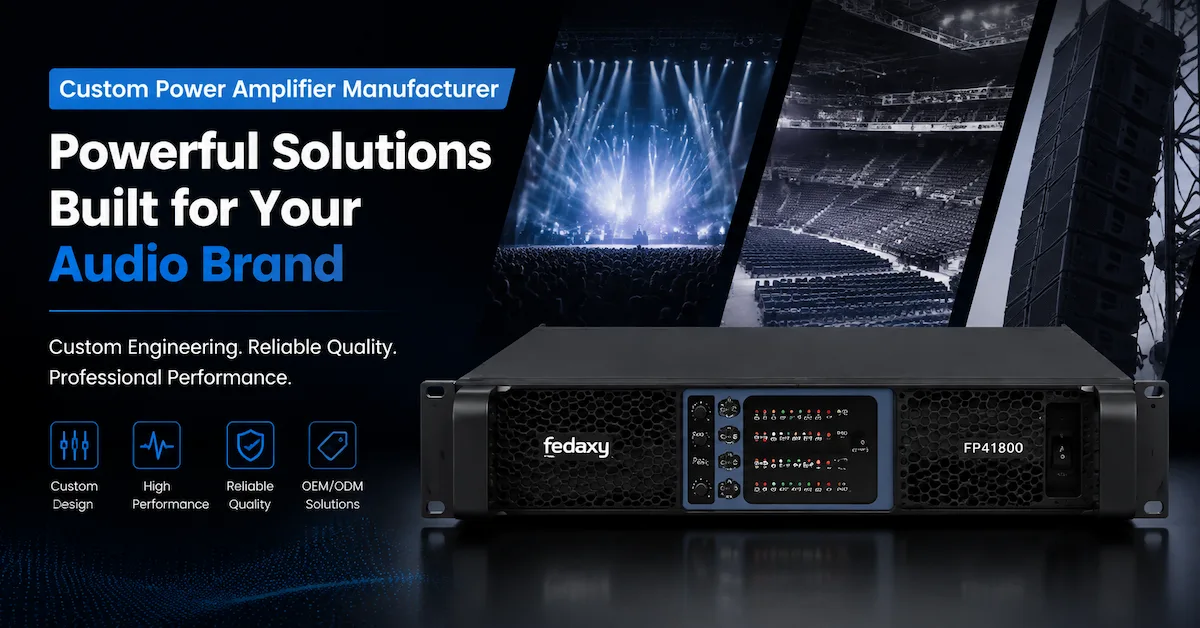
Fedaxy's DSP41800 combines a four-channel architecture with Class TD amplification and integrated DSP. It is positioned for touring performances, concerts, cinemas, KTV rooms and professional sound systems.
4-Channel DSP Amplifier
DSP integration adds digital signal-management functions.
Common functions include:
- EQ
- crossover
- delay
- limiter
- signal routing
- presets
This can reduce the need for separate external processing equipment in suitable system configurations.
Fedaxy's DP41500 provides a compact four-channel DSP platform, while the DSP41800 offers a higher-output four-channel Class TD DSP configuration.
4-Channel Amplifier Model Comparison
For buyers comparing professional platforms, the following comparison can help organize the selection process.
| Model | Technology | Channels | Rack Format | Key Positioning |
|---|---|---|---|---|
| D43000 | Class D | 4 | 1U | High-density professional amplification |
| DP41500 | DSP Amplifier | 4 | 1U | Compact DSP system integration |
| DSP41800 | Class TD + DSP | 4 | 2U | Higher-output professional DSP system |
These models serve different project requirements rather than competing only on output power. Fedaxy's current product catalog lists all three among its professional amplifier platforms.
What Makes a Professional 4-Channel Amplifier Reliable?
Reliability is determined by the complete engineering system.
Power Supply Design
The power supply needs to support the amplifier's expected output and operating conditions.
Important considerations include:
- power stability
- current capability
- transformer or switching supply design
- component quality
Fedaxy identifies 100% copper transformers and real rated wattage among the quality features of its DSP41800 platform.
Thermal Management
Four channels operating at high output can generate significant heat.
A professional amplifier should therefore have an appropriate cooling architecture.
The DSP41800 uses four intelligent fans with front-to-back airflow.
This type of airflow design can be important for rack-mounted equipment where multiple amplifiers may operate together.
Protection System
A professional amplifier should provide protection appropriate to its operating environment.
Relevant functions may include:
- overheating protection
- short-circuit protection
- DC output protection
- power-on protection
- abnormal-load protection
The DSP41800 includes power-on buffer, overheating, short-circuit and DC output protection.
Materials and Components Buyers Should Consider
For professional audio equipment, component selection affects reliability and long-term operating stability.
A supplier evaluation should consider:
- transformer quality
- power devices
- capacitors
- PCB design
- connectors
- cooling fans
- chassis construction
The exact component specification should be confirmed against the selected model and project requirements.
For OEM buyers, component changes should also be evaluated carefully because changing one component can affect thermal behavior, output performance, certification and long-term reliability.
Manufacturing and Quality Control
A professional amplifier supplier should be able to explain how the product is tested before shipment.
Fedaxy states that its amplifiers undergo five rounds of QC inspection and an eight-hour aging test. The company also identifies electrical performance testing, precision assembly and standardized production as part of its manufacturing and quality-control process.
Incoming Component Inspection
Quality control begins with incoming materials.
Typical checks include:
- component specifications
- PCB quality
- power components
- connectors
- mechanical parts
Assembly Inspection
Assembly quality can affect:
- electrical stability
- thermal performance
- vibration resistance
- long-term reliability
Electrical Performance Testing
A professional testing process should verify:
- output power
- frequency response
- distortion
- signal quality
- protection functions
Aging Testing
Aging testing helps identify potential stability issues before shipment.
For B2B buyers, this is especially important when amplifiers will be installed in:
- touring systems
- commercial venues
- stadiums
- rental fleets
- long-duration installations
Certifications and Market Requirements
Certification requirements depend on the destination market and exact product configuration.
Fedaxy states that its professional amplifier products are certified with ISO9001, CE, RoHS and CB.
However, buyers should confirm the applicable certification documents for the specific model, voltage configuration and destination market before placing an order.
This is particularly important for importers and distributors who need to comply with local electrical and product requirements.
OEM and ODM Services for 4-Channel Amplifiers
For established audio brands, buying an off-the-shelf amplifier may not provide enough differentiation.
A 4 channel power amplifier manufacturer with OEM/ODM capability can support product development around the buyer's market requirements.
Product Appearance Customization
Potential customization may include:
- brand logo
- model number
- front panel
- product labeling
- chassis appearance
Configuration Customization
Depending on the platform, buyers may discuss:
- output power
- channel configuration
- impedance requirements
- connector configuration
- voltage requirements
DSP Customization
For DSP models,customization may include:
- EQ presets
- crossover settings
- delay
- limiter parameters
- application-specific presets
Packaging and Documentation
OEM projects may also include:
- branded packaging
- user manuals
- labels
- product documentation
Fedaxy states that it supports OEM, ODM, OBM, OIM and SKD cooperation, including logo customization, front-panel design, packaging design and product configuration adjustment.
This makes OEM/ODM particularly relevant for distributors and audio brands that want to develop their own amplifier product range.
How the OEM Development Process Should Work
A structured development process reduces project risk.
Step 1: Requirement Analysis
The manufacturer should first understand:
- application
- speaker system
- power requirement
- channel count
- impedance
- target market
- estimated quantity
Step 2: Platform Selection
The manufacturer can then recommend a suitable amplifier platform.
For example:
- Class D for high efficiency and compact systems
- Class TD for demanding high-output applications
- DSP platforms for integrated signal processing
Step 3: Engineering Confirmation
Engineering should confirm:
- circuit architecture
- thermal design
- power supply
- connectors
- chassis
- DSP configuration
Step 4: Prototype
A prototype should be evaluated for:
- electrical performance
- physical design
- system compatibility
- DSP functions
Step 5: Testing and Approval
Testing should cover the agreed specifications before mass production.
Step 6: Mass Production
After approval, production can proceed according to the confirmed specification and quality-control plan.
Capacity, MOQ and Lead Time: What Buyers Should Ask
Commercial details should be confirmed on a project-by-project basis.
Instead of asking only:
“What is your MOQ?”
a B2B buyer should provide:
- selected model
- quantity
- customization requirements
- packaging requirements
- target market
- desired delivery date
MOQ and lead time can vary depending on whether the project uses a standard model or requires customized components, appearance, packaging or DSP configuration.
For long-term purchasing, buyers should also evaluate whether the manufacturer can maintain consistent specifications across repeat orders.
Cost and Risk Factors
The cheapest four-channel amplifier is not necessarily the lowest-cost solution.
Total procurement cost can include:
- product price
- shipping
- packaging
- installation
- maintenance
- replacement parts
- downtime
- system compatibility
A low-cost amplifier that requires frequent replacement can create a higher lifecycle cost.
Avoid Comparing Only Maximum Wattage
Two amplifiers may have similar headline wattage but very different:
- thermal performance
- protection
- DSP capability
- component quality
- output stability
Confirm Actual Operating Conditions
Always provide:
- speaker impedance
- number of cabinets
- channel load
- expected operating duration
- ambient conditions
This allows the manufacturer to evaluate whether the selected amplifier is appropriate.
4-Channel Amplifier Buying Checklist
Before selecting a manufacturer, use this checklist:
| Evaluation Area | What to Confirm |
|---|---|
| Application | Touring, line array, stadium, installation or commercial audio |
| Channels | 2CH vs 4CH vs larger systems |
| Output | Power at 8Ω,4Ω and 2Ω |
| Bridge | Whether bridge mode is required |
| DSP | EQ, crossover, delay, limiter and presets |
| Cooling | Fan type and airflow direction |
| Protection | Thermal, short circuit and DC protection |
| Components | Power supply,PCB and key components |
| QC | Inspection and testing procedures |
| Aging | Whether aging testing is performed |
| Certification | Requirements for destination market |
| OEM | Logo, chassis, configuration and packaging |
| Supply | Repeat-order consistency |
| Commercial | MOQ, lead time and shipping terms |
A supplier that can answer these questions clearly is easier to evaluate than one that only provides a product catalog.
Why Choose Fedaxy as Your 4 Channel Power Amplifier Manufacturer?
For professional audio buyers, the manufacturer should provide more than a catalog of amplifier models.
Fedaxy describes itself as a professional power amplifier manufacturer headquartered in Panyu, Guangzhou, with more than 15 years of R&D and production experience. Its current portfolio covers Class D, DSP, Class TD, Class H and Class AB amplifier technologies.
The company's current four-channel platforms provide different approaches to professional system design:
- D43000 — 4-channel Class D platform
- DP41500 — 4-channel DSP platform
- DSP41800 — 4-channel Class TD DSP platform
Fedaxy also states that more than 90% of its products are exported to overseas markets, including Europe, America, Asia and Africa.
For buyers, this combination of product-platform coverage, engineering, QC and OEM/ODM support can be useful when building a professional amplifier product line rather than purchasing a single unit.
Explore Fedaxy's 4-channel and professional amplifier products
When Should You Contact a 4-Channel Amplifier Manufacturer?
You should consider contacting a manufacturer directly when your project involves:
- bulk purchasing
- distributor requirements
- private-label products
- OEM/ODM development
- customized DSP settings
- special voltage requirements
- custom front-panel design
- multiple amplifier models
- long-term supply planning
Instead of asking for a generic quotation, send the manufacturer your speaker specifications and application requirements.
A useful RFQ should include:
Application:
Touring / Stadium / Line Array / Theater / Commercial Installation
Speaker:
Model / Rated Power / Impedance / Quantity
Amplifier:
4-channel / Required Power / Bridge / DSP
Market:
Country / Voltage / Certification Requirements
Commercial:
Quantity / Packaging / Branding / Target Delivery
This gives the engineering and sales team enough information to recommend a suitable platform.
Request a 4-channel amplifier project quotation from Fedaxy
FAQ
What is a 4 channel power amplifier manufacturer?
A 4 channel power amplifier manufacturer designs and produces professional amplifiers with four independent output channels and may provide engineering, customization, testing, OEM/ODM and production services.
Why choose a 4-channel amplifier instead of a 2-channel amplifier?
A four-channel amplifier can provide higher channel density and more flexible speaker allocation. It can be particularly useful for line arrays, multi-zone systems, touring racks and complex installations.
What should I check when choosing a 4 channel power amplifier manufacturer?
Check output power, impedance capability, channel configuration, cooling, protection, component quality, testing, certification, customization and long-term supply capability.
What applications use 4-channel power amplifiers?
Common applications include live sound, touring, line arrays, stadium systems, theaters, commercial installations and other professional sound reinforcement systems.
Is a 4-channel amplifier suitable for line array systems?
It can be suitable when its output power, impedance capability, channel configuration and protection match the line array system. The speaker configuration should be confirmed before selecting the amplifier.
Can a 4-channel power amplifier support 2Ω loads?
Some models are designed and rated for 2Ω operation. Buyers should confirm the exact manufacturer's specifications for the selected model and intended operating conditions.
Can a 4-channel amplifier be customized for OEM projects?
Yes. Depending on the platform, customization can include branding, front-panel design, packaging, product configuration and DSP-related settings.
What is the difference between Class D and Class TD 4-channel amplifiers?
Class D is commonly attractive for efficiency, compact size and power density, while Class TD platforms can be selected for demanding professional audio applications requiring substantial output capability.
What is the difference between DP41500 and DSP41800?
Both are four-channel DSP amplifier platforms, but they use different configurations.DP41500 is a compact 1U DSP platform, while DSP41800 is a 2U Class TD DSP platform designed for higher-output professional applications.
What quality tests should a professional amplifier manufacturer provide?
Buyers should look for component inspection, assembly inspection, electrical performance testing, protection testing, thermal testing and aging testing. Fedaxy states that its amplifiers undergo five rounds of QC testing and an eight-hour aging test.
Can Fedaxy provide OEM and ODM amplifier services?
Yes. Fedaxy states that it supports OEM, ODM, OBM, OIM and SKD cooperation, including logo, front-panel, packaging and configuration customization.
What information should I provide when requesting a quotation?
Provide your application, speaker model, rated power, impedance, required amplifier channels, target output, DSP requirements, destination market, quantity and customization requirements.
Conclusion
Choosing the right 4 channel power amplifier manufacturer is a system and supply-chain decision, not simply a wattage comparison.
Professional buyers should evaluate:
- four-channel architecture
- output power at the actual impedance
- Class D or Class TD technology
- DSP requirements
- cooling performance
- protection functions
- component quality
- QC and aging testing
- certification requirements
- OEM/ODM capability
- MOQ and lead time
- long-term supply consistency
Fedaxy provides multiple four-channel amplifier platforms, including Class D, DSP and Class TD DSP solutions, together with OEM/ODM support and professional manufacturing capabilities.
For distributors, audio brands, system integrators and professional sound contractors, the best next step is to provide the speaker configuration and project requirements rather than requesting a generic amplifier quotation.
View Fedaxy's professional amplifier range
Contact Fedaxy for a customized 4-channel amplifier solution