What Should You Expect From a Private Label Power Amplifier Manufacturer?
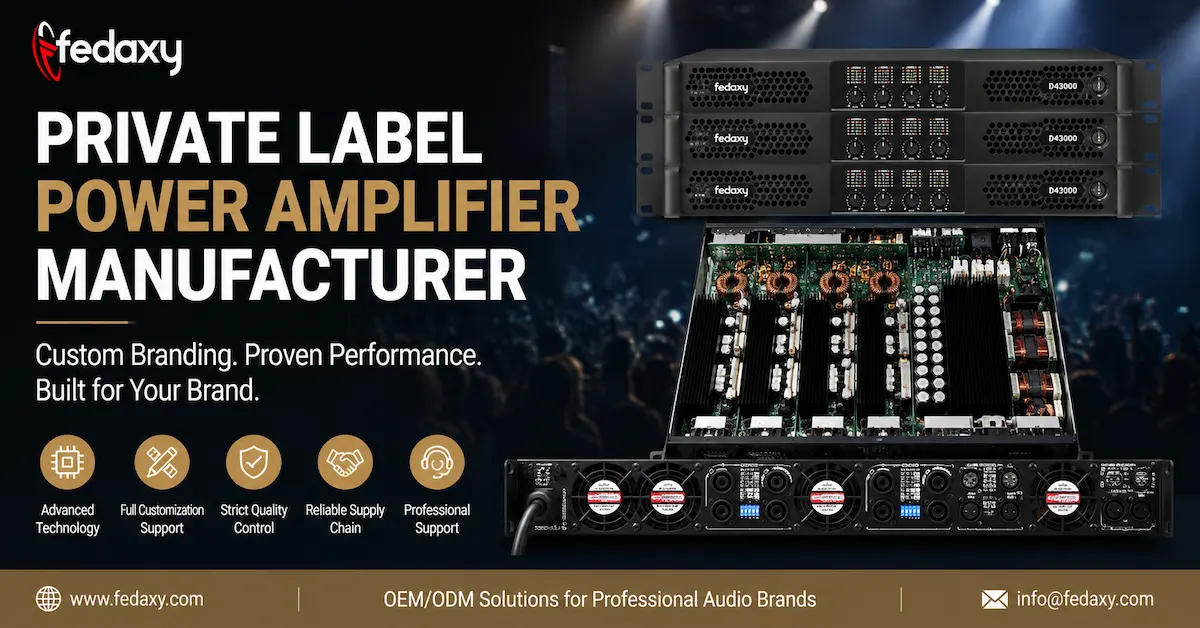
A private label power amplifier manufacturer should do more than place a customer's logo on a standard amplifier.
For professional audio brands, distributors and importers, a successful private label project should combine a proven amplifier platform with clearly defined branding, configuration, quality-control and supply requirements.
Depending on the project, private label customization may involve:
- brand logo
- model naming
- front panel appearance
- packaging
- user documentation
- voltage requirements
- connector configuration
- output and channel configuration
- DSP-related settings
- application-specific product positioning
The goal is to create a power amplifier that can be sold under the buyer's own brand while still maintaining consistent professional audio performance.
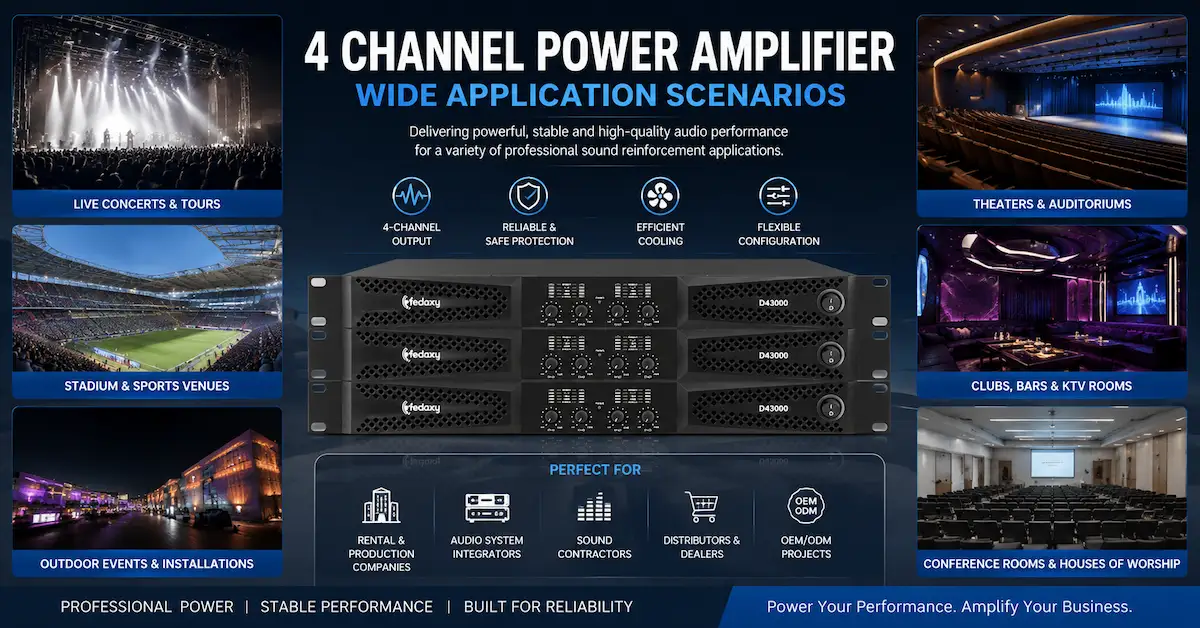
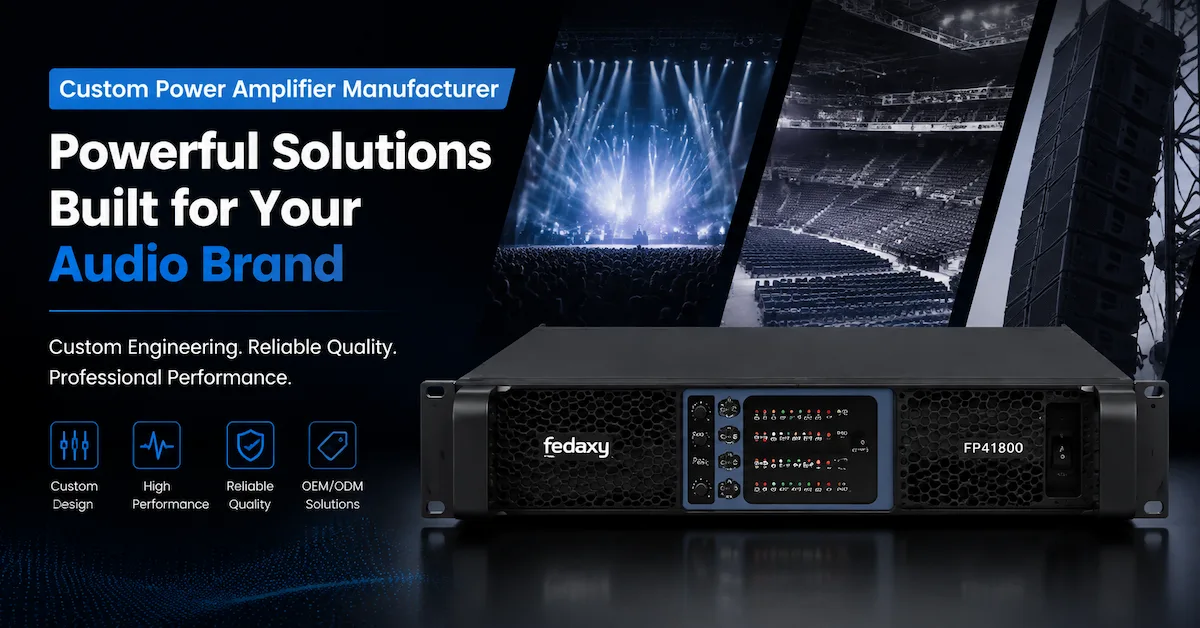
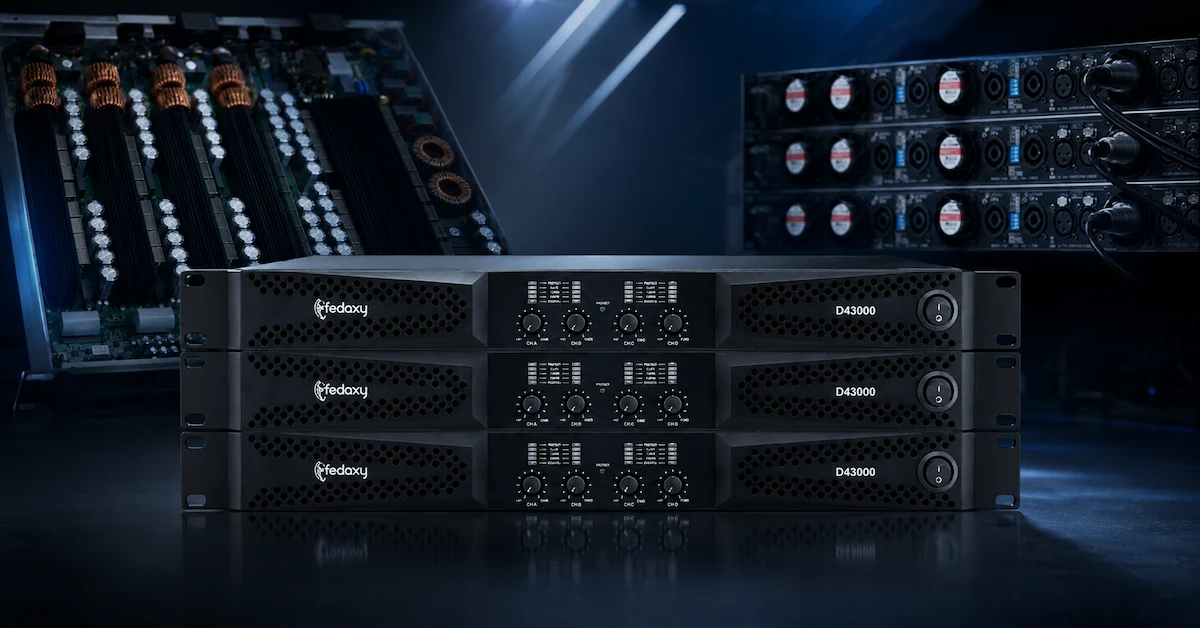
Fedaxy manufactures professional amplifier platforms covering Class D, Class TD, Class H, Class AB and DSP technologies. Buyers can review the available professional power amplifier products before defining a private label project.
Why Professional Audio Brands Choose Private Label Amplifiers
Launching a completely new amplifier architecture from the ground up requires engineering resources, testing equipment, component sourcing and production infrastructure.
Private label cooperation gives brands another route.
Instead of developing every hardware platform independently, a buyer can start from an existing professional amplifier platform and customize the product around its market strategy.
This is especially relevant for:
- established audio brands expanding their product range
- distributors creating an exclusive local brand
- importers seeking differentiated amplifier models
- system integrators developing branded equipment packages
- professional audio startups entering specific regional markets
Build a Recognizable Product Line
Selling the same unmodified amplifier as multiple competitors makes differentiation difficult.
Private label development can help create a more consistent brand identity through:
- custom front panel presentation
- model family naming
- matching packaging
- brand-specific product documentation
- selected configuration differences
The amplifier therefore becomes part of a wider product portfolio rather than a generic sourced item.
Reduce Initial Product Development Complexity
A private label program can reduce the amount of engineering work required compared with a completely new amplifier design.
The buyer can focus more attention on:
- market positioning
- distribution
- sales channels
- local technical support
- customer development
while the manufacturer manages the production and technical platform.
Respond to Different Market Requirements
Professional audio markets are not identical.
One market may prioritize lightweight Class D amplifiers for touring, while another may need robust Class TD products for entertainment venues or high-output sound reinforcement.
Regional requirements can also differ in:
- mains voltage
- connectors
- packaging
- product naming
- documentation
- channel configuration
A capable private label partner should evaluate these requirements before production rather than treating every market as the same.
Private Label vs OEM vs ODM Power Amplifiers
These terms are often used interchangeably, but they can represent different levels of customization.
| Cooperation Type | Typical Scope | Best For |
|---|---|---|
| Private Label | Existing platform with branding and selected configuration changes | Brands seeking faster market entry |
| OEM | Product manufactured according to customer specifications or defined requirements | Brands requiring deeper product control |
| ODM | Manufacturer participates more deeply in product design and development | Brands developing differentiated amplifier platforms |
Private label is generally the most straightforward when a suitable amplifier platform already exists.
OEM or ODM may be more appropriate when a project requires major changes in:
- electrical architecture
- mechanical structure
- DSP functions
- power configuration
- internal components
- application requirements
The correct cooperation model should therefore be chosen according to development depth, not simply by terminology.
What Can Be Customized in a Private Label Power Amplifier?
Customization should begin with the product requirements rather than appearance alone.
Branding and Front Panel
Common branding requirements may include:
- customer logo
- model number
- front panel layout
- labeling
- product identification
These elements help create consistent visual recognition across a brand's amplifier range.
Packaging and Documentation
Private label products may also require:
- branded cartons
- labels
- product manuals
- specification sheets
- regional documentation
For distributors, packaging quality is part of the finished product experience and should be defined before mass production.
Voltage and Regional Requirements
Products sold across different markets may need different mains requirements.
A buyer should confirm:
- target country or region
- nominal mains voltage
- frequency requirements
- plug or power-connection expectations
Voltage should never be treated as a last-minute packaging detail because it affects product suitability and safety.
Connector Configuration
Professional audio products may use different input and output arrangements depending on the target system.
Private label requirements can include confirmation of:
- input connectors
- speaker outputs
- signal routing requirements
- rear-panel labeling
The exact connector configuration should match the intended professional audio application.
Power and Channel Configuration
A buyer may require:
- 2-channel amplifier
- 4-channel amplifier
- different power levels
- different impedance support
- bridge-mode capability
These decisions should be based on the speaker system and market use case.
A manufacturer should not recommend a model based only on the highest advertised wattage.
Choosing the Right Amplifier Technology for a Private Label Project
Different amplifier classes serve different product strategies.
Class D Private Label Power Amplifiers
Class D technology is widely used where efficiency and power density are important.
Key advantages include:
- high electrical efficiency
- compact chassis options
- lower heat generation
- high output relative to rack space
- reduced transportation weight
Typical applications include:
- touring systems
- line arrays
- rental audio
- commercial installations
- high-density amplifier racks
For brands targeting modern professional sound applications, Class D is often a strong platform to evaluate.
Class TD Power Amplifiers
Class TD amplifiers are commonly considered for demanding professional audio environments where high output and strong dynamic performance are important.
Typical applications include:
- concerts
- stadium audio
- entertainment venues
- touring systems
- large sound reinforcement systems
A brand targeting these markets should compare output capability, cooling and load requirements carefully.
DSP Power Amplifiers
DSP amplifiers combine power amplification with digital signal processing.
Depending on the platform, relevant processing functions may include:
- EQ
- crossover
- delay
- limiter
- channel routing
- speaker protection
For private label brands, DSP can increase product differentiation because the amplifier becomes part of the loudspeaker-management system rather than only providing power.
However, DSP requirements should be defined before ordering. Buying a DSP amplifier without a clear processing strategy often results in unused functions or inconsistent system presets.
Class H and Class AB Platforms
Class H and Class AB technologies can still be relevant depending on:
- target market
- sound-system architecture
- product positioning
- buyer preferences
A manufacturer with several amplifier technologies gives private label customers more flexibility when building a complete range.
What Specifications Should a Private Label Buyer Confirm?
A serious private label project should have a specification sheet before production begins.
At minimum, confirm:
| Specification | Why It Matters |
| Output power | Defines speaker-driving capability |
| Impedance | Determines compatible system loads |
| Channel count | Affects rack density and application |
| THD | Helps evaluate distortion performance |
| Signal-to-noise ratio | Relates to noise performance |
| Cooling | Influences continuous operating stability |
| Protection | Helps protect amplifier and system |
| Voltage | Must match target market |
| Connectors | Must fit system architecture |
| DSP | Determines processing requirements |
| Branding | Defines private label presentation |
Technical specifications should be reviewed under clearly defined operating conditions.
For example, a power number without a corresponding impedance provides incomplete information.
Why 2Ω, 4Ω and 8Ω Ratings Matter
Professional amplifiers may operate with different loudspeaker loads.
An amplifier that performs well at 8Ω is not automatically suitable for continuous operation at 2Ω.
As impedance decreases, amplifier current demand generally increases.
This places more stress on:
- power supply
- output devices
- cooling system
- protection circuits
Private label buyers targeting touring, line array or large venue applications should therefore confirm whether the selected platform supports the required load conditions.
Do not build marketing specifications around 2Ω operation unless the amplifier is specifically designed and rated for that application.
How to Evaluate a Private Label Power Amplifier Manufacturer
The product is only one part of the sourcing decision.
The manufacturer itself should also be evaluated.
Engineering Capability
Ask whether the supplier can explain:
- amplifier architecture
- power supply design
- thermal management
- DSP functions
- impedance capability
- protection behavior
A manufacturer should be able to answer technical questions rather than only provide a price sheet.
Product Platform Range
A broader amplifier range can make it easier for a brand to build a complete product family.
Useful technology coverage may include:
- Class D
- Class TD
- Class H
- Class AB
- DSP amplifiers
Fedaxy provides these professional amplifier categories through its product portfolio.
Manufacturing and Quality Control
Private label products carry the customer's brand name, so inconsistent quality directly affects the buyer's reputation.
A manufacturer should have structured procedures for areas such as:
- incoming component inspection
- PCB and assembly inspection
- electrical performance testing
- output power verification
- protection testing
- aging testing
- final inspection
Fedaxy states that its production process includes multiple quality-control stages and aging testing. More information about its manufacturing background is available on the Fedaxy About Us page.
Certification and Market Requirements
Certifications should be evaluated according to:
- target market
- product type
- importer requirements
- local regulations
Fedaxy lists certifications and quality-system information including ISO9001, CE, RoHS, CB, EMC and LVD-related compliance information on its website.
Buyers should still confirm which documents apply to the exact selected product and destination market.
Long-Term Supply Support
Private label products often remain in a distributor's catalog for several years.
A buyer should therefore consider:
- platform continuity
- communication efficiency
- component consistency
- production repeatability
- technical support
- warranty policy
Supplier continuity matters because replacing an established amplifier platform can affect manuals, packaging, stock, service and customer expectations.
Private Label Power Amplifier Development Process
A structured process reduces misunderstandings before production.
Step 1: Define the Target Market
Start with:
- customer type
- country or region
- main application
- selling price position
- expected product category
This determines what the amplifier actually needs to do.
Step 2: Define Technical Requirements
Prepare:
- target power
- impedance
- channel count
- DSP requirements
- voltage
- connectors
- intended speaker systems
The more complete the brief, the easier it is for the manufacturer to recommend an appropriate platform.
Step 3: Confirm Branding Requirements
Define:
- logo
- model naming
- panel design
- packaging
- documentation
Branding artwork should be finalized before mass production.
Step 4: Product Evaluation
Before a larger order, the selected configuration should be evaluated for:
- technical compatibility
- function
- appearance
- market suitability
The exact sampling or prototype process depends on the product and customization level.
Step 5: Testing and Approval
Confirm the required verification procedures.
These may include:
- output performance
- audio performance
- protection functions
- thermal behavior
- aging testing
Step 6: Mass Production and Final QC
After specifications and branding are approved, the product can move into production.
Final inspection should confirm both technical performance and private label details.
Common Mistakes in Private Label Amplifier Sourcing
Choosing Only by Price
A low unit price does not compensate for inconsistent performance, unreliable supply or poor technical support.
Compare total procurement risk, not only purchase price.
Focusing Only on Wattage
High advertised wattage does not automatically mean better performance.
Check:
- impedance
- continuous output conditions
- cooling
- distortion
- protection
Starting Branding Before Technical Selection
The amplifier platform should be selected before spending too much time on visual design.
A beautiful front panel cannot correct an unsuitable power or impedance configuration.
Not Defining the Target Speaker System
Private label amplifiers should be selected around the systems customers actually use.
Provide the manufacturer with speaker power and impedance information whenever possible.
Ignoring Regional Voltage Requirements
Products intended for different countries must be evaluated for the correct electrical environment.
Over-customizing the First Product
Brands entering a new market may benefit from starting with a proven platform and selected branding changes before moving into deeper ODM development.
This can reduce engineering complexity and product-launch risk.
What Information Should You Send to a Private Label Manufacturer?
A useful RFQ should include more than:
“Please send your best price.”
Instead, provide:
- target amplifier technology
- intended application
- required power
- speaker impedance
- channel count
- target market
- mains voltage
- connector requirements
- DSP requirements
- branding requirements
- expected quantity
This gives the manufacturer enough information to evaluate the correct product platform.
Brands planning a private label project can contact Fedaxy with these specifications for product evaluation.
Private Label Amplifier Selection by Buyer Type
| Buyer Type | Main Requirement | Recommended Focus |
| Audio brand | Differentiated product line | Branding, technology, product consistency |
| Distributor | Competitive regional products | Product range, price structure, supply continuity |
| Importer | Reliable repeat orders | QC, compliance, logistics support |
| System integrator | Application-specific performance | Power, impedance, DSP |
| Rental company | Durable high-output products | Cooling, weight, protection |
| Startup brand | Lower development complexity | Proven platform and selected customization |
The right private label platform depends on the business model as much as on the technical specification.
FAQ
What is a private label power amplifier manufacturer?
A private label power amplifier manufacturer produces professional amplifiers that can be sold under a customer's own brand, usually with customized branding, model naming, packaging and selected product configurations.
What is the difference between private label and OEM power amplifiers?
Private label projects commonly start with an existing amplifier platform and add branding or selected configuration changes. OEM projects may involve deeper customer-specific technical requirements.
Can I put my own logo on a professional power amplifier?
Yes, depending on the manufacturer's customization program. Logo placement, front-panel design, product labels and packaging should be confirmed before production.
Can a private label amplifier have custom DSP settings?
DSP-related customization may be possible depending on the amplifier platform and project requirements. Buyers should define crossover, EQ, limiter, delay and routing requirements clearly.
Which amplifier class is best for private label professional audio products?
There is no single best class. Class D is attractive for efficiency and power density, Class TD can suit high-output professional applications, while DSP platforms provide integrated processing. The choice depends on the target market.
Can private label amplifiers be customized for 2Ω, 4Ω or 8Ω systems?
The selected amplifier must be designed and rated for the required impedance. Buyers should confirm the actual load and operating conditions before selecting a model.
Does Fedaxy support private label amplifier projects?
Fedaxy supports OEM/ODM and customized amplifier requirements including branding-related and product-configuration options. Exact private label requirements should be confirmed according to the selected product and project.
What is the MOQ for private label power amplifiers?
MOQ depends on the product platform and customization requirements. Fedaxy's public website does not specify one universal MOQ, so buyers should request project-specific information.
How long does private label amplifier production take?
The schedule depends on the selected platform, customization depth, approval requirements and production plan. A project-specific timeline should be confirmed before ordering.
What should I send when requesting a private label amplifier quotation?
Provide the application, target power, impedance, channel count, target market, voltage, DSP needs, branding requirements and expected order quantity.
Conclusion
Choosing a private label power amplifier manufacturer requires more than comparing catalog prices or adding a logo to an existing product.
Professional audio brands should evaluate:
- amplifier technology
- engineering support
- output and impedance capability
- customization scope
- quality control
- certifications
- supply continuity
- technical communication
The right private label power amplifier manufacturer should help the buyer select an appropriate platform first, then build branding and configuration requirements around the actual application.
Fedaxy provides professional amplifier platforms covering Class D, Class TD, Class H, Class AB and DSP technologies, with OEM/ODM and customized solutions for audio brands, distributors and professional sound companies.
To discuss a private label product line, custom amplifier configuration or professional audio project, review the Fedaxy amplifier range or contact Fedaxy with your target specifications.