A nightclub amplifier should be selected from the room, loudspeaker loads and operating routine backward. Club owners, integrators and distributors can use the worksheet logic below: fill it in, challenge it, and prove the rack before opening night.
Short answer for a busy club
A suitable Class TD amplifier for nightclub sound systems must do more than reach a large wattage number. It needs verified output into the club's actual loudspeaker impedance, enough channels for independently controlled zones, limiter settings tied to the loudspeaker data, stable cooling during long high-output sessions, and protection behavior that has been tested rather than assumed.
For many clubs, a four-channel chassis is useful for dance-floor tops, delays, VIP areas or booth monitoring. Subwoofers may justify a separate two-channel high-output model. The final choice should follow a channel-and-load schedule, not a generic rule that every nightclub needs the same amplifier.
- Map: each loudspeaker, cable run, nominal impedance and zone.
- Calculate: the resulting channel load and realistic power target.
- Confirm: output test conditions, mains version, cooling direction and protection.
- Program: crossover, EQ, delay, gain structure and limiters.
- Prove: the completed rack under realistic program material and venue temperature.
Why is nightclub duty different from ordinary installed sound?
A club can look like a small installation on a drawing and behave like a demanding live system after midnight. Bass-heavy program material carries a high average energy content. Dance-floor loudspeakers may run near their planned level for hours, while door openings, smoke, packed bodies and changing temperature alter the acoustic and thermal conditions. The operator also wants immediate impact without audible strain when the room fills.
The business has several audio environments inside one address. The dance floor needs controlled punch and even coverage. The bar needs intelligible speech and music without exhausting staff. The entrance may need a delayed fill. A VIP area often requires independent level control. The DJ booth needs reliable monitoring and fast fault isolation. Treating all of these as one volume control creates operational arguments and usually wastes amplifier channels.
A reliable nightclub sound system power amplifier therefore has to fit a system design, not just a shopping list. Before comparing products, define how the venue runs on a quiet weekday, a sold-out weekend and during a fault. That operating story is as important as the loudspeaker brand.
Five stresses that deserve a written check
- Low-frequency duty: repeated bass transients plus sustained electronic content.
- Long sessions: ventilation that works for a brief demo may fail in a closed rack after several hours.
- Mixed impedances: parallel cabinets can pull a channel below the intended load if the schedule is wrong.
- Uneven zones: one channel may work far harder than the others, despite identical headline ratings.
- Multiple operators: undocumented presets and casual gain changes can undo an otherwise sound design.
What does Class TD mean in practical buying terms?
Class TD is a professional amplifier topology commonly used where buyers want high output, familiar analog behavior and a practical rack format. Still, "TD" on the badge tells you very little about efficiency, sound quality, low-impedance behavior or service life by itself. Most of the result hides elsewhere: in the supply, output stage, airflow, component margins, protection choices and the discipline of the assembly line.
That distinction matters. Two products described as Class TD can behave differently on the same subwoofer bank because their mains supply, channel sharing, limiter interaction and thermal design differ. A buyer evaluating a professional Class TD nightclub amplifier should request model-specific evidence instead of extending a claim about the topology to every product wearing the label.
Use Class TD as the start of the conversation. Then ask: What is the published output into 8, 4 and 2 ohms? Were all channels driven? At what mains voltage and test duration? What is the acceptable load in normal and bridged modes? How does the unit protect itself from short circuit, overheating, DC and abnormal supply? What airflow direction does the rack require? These questions reveal more than an argument over amplifier classes.
Do not compare wattage without its measurement conditions
Start with a zone and channel schedule
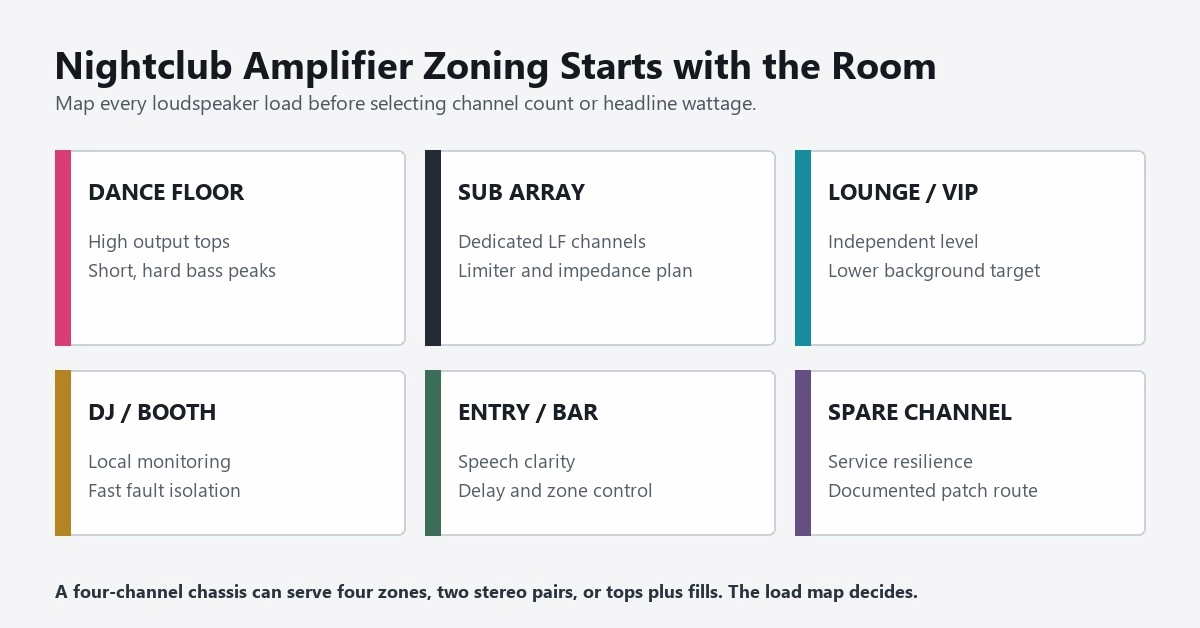
Walk the room with the loudspeaker plan open. Give every cabinet a zone name, model, nominal impedance, wiring method, cable length and intended frequency band. Add the target operating level and whether independent control is required. The result can be a simple spreadsheet, but it should be clear enough for an installer who did not attend the design meeting.
Now assign amplifier channels. A 4 channel Class TD power amplifier may run left and right dance-floor tops on channels A and B, with bar and VIP zones on C and D. In another club, the same four channels may feed four mono delays. Neither assignment is automatically better. Channel independence, spare capacity and how the operator controls the room should decide.
Document a spare strategy as well. A nightclub that earns most of its weekly revenue during two busy evenings needs a practical recovery route. A spare channel, spare chassis or preplanned patch method can reduce downtime. The most useful option depends on service access, inventory and how quickly staff can identify the failed section.
| Zone | Loudspeaker role | Typical control need | Questions before channel assignment |
|---|---|---|---|
| Dance floor | Main tops or arrays | High output, linked L/R control | Coverage, cabinet count, impedance, limiter data |
| Sub array | Low-frequency system | Dedicated crossover and limiting | Wiring, load per channel, crest factor, ventilation |
| Bar / entry | Fills and speech support | Independent level and delay | Cable length, zoning, speech clarity target |
| VIP / lounge | Lower-level music | Restricted local adjustment | Maximum level, wall control, preset permissions |
| DJ booth | Monitor loudspeakers | Fast mute and fault isolation | Operator access, local gain, backup path |
How should loudspeaker impedance and channel load be calculated?
Start from the loudspeaker manufacturer's nominal impedance and approved wiring options. On one real load sheet, two matching 8-ohm boxes paralleled on channel A were written as "8 / 2 = 4 ohms." The four-box option became "8 / 4 = 2 ohms" and was reviewed separately for heat and current. When cabinet impedances differ, stop using that shortcut and calculate the reciprocal sum for every branch.
Nominal impedance is not a flat resistance. A loudspeaker's impedance changes with frequency and may dip below the number printed on the label. Long or undersized loudspeaker cable adds resistance and power loss. For this reason, calculation is followed by verification: review the impedance curve where available, use the amplifier maker's permitted load, check cable sizing, and measure the completed circuit with appropriate test equipment.
A low impedance Class TD amplifier for clubs is not permission to connect cabinets until the arithmetic happens to reach a low number. Operation at 2 ohms can raise current demand and thermal stress. Ask whether the published rating applies to the intended channel count, mains voltage, frequency range and duty. If a 4-ohm design satisfies the room, the extra margin may be more valuable than the last theoretical watt.
A worked channel example
Suppose one dance-floor channel serves two identical 8-ohm top cabinets wired in parallel. The nominal result is 4 ohms. The designer then checks the cabinet's recommended amplifier range, sensitivity, maximum level, coverage and limiter guidance. A power target is chosen with headroom for clean peaks, but the limiter is set to protect the loudspeaker. The amplifier is not selected by multiplying cabinet program ratings and chasing the largest nearby number.
For subwoofers, repeat the process separately. Low-frequency drivers can place a different duty on the amplifier and mains supply. If four cabinets would create a 2-ohm channel but two 4-ohm channels are available, compare both wiring plans. The second may improve thermal margin, cable current distribution and fault isolation even if it uses more channels.
When does a four-channel amplifier make sense?
Four-channel amplifiers improve rack density and give the system designer more zoning options. They are often a strong fit for fills, compact top cabinets and venues that need several independent areas in one rack. One chassis also reduces duplicated front-panel space and may simplify inventory.
The tradeoff is concentration. If one chassis carries four critical zones, a single service event affects more of the room. Power-supply architecture and channel interaction therefore deserve attention. Confirm whether the supply is shared or divided, how the model behaves with uneven channel loading, and whether one hard-working bass channel changes the available margin elsewhere.
Two-channel high-output units remain useful for dedicated subwoofer work. They can keep low-frequency duty separate from speech and fill channels, make troubleshooting simpler, and allow a club to scale bass without replacing the entire rack. The right system may use both formats: four-channel models for zones and tops, plus two-channel models for the sub array.
Which Fedaxy Class TD models fit common nightclub roles?
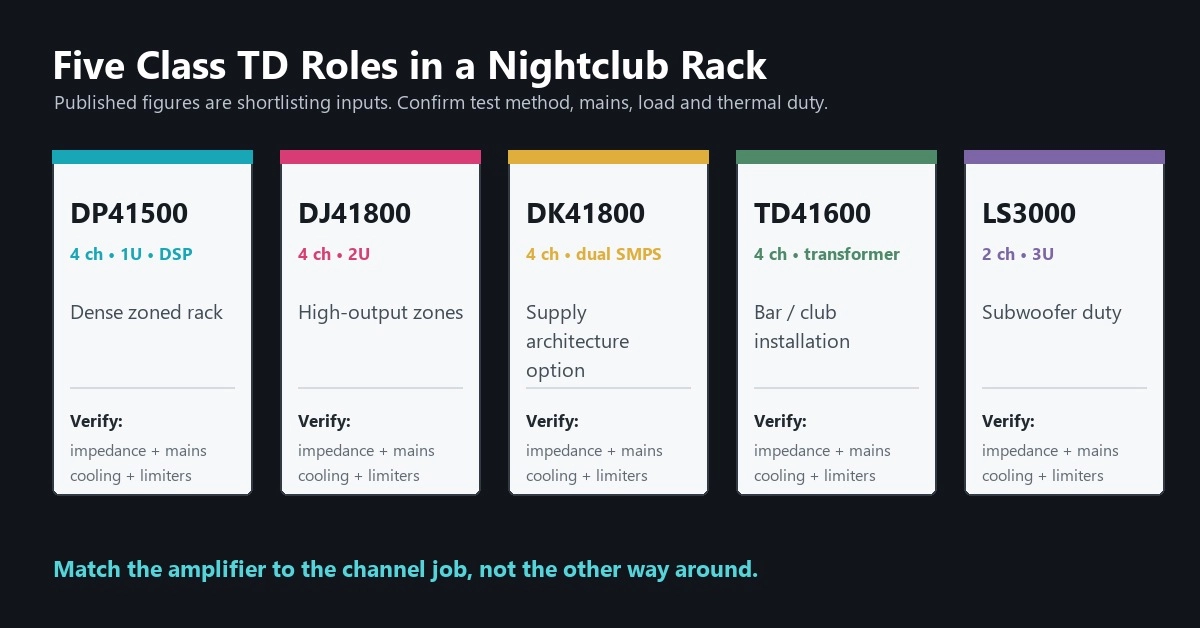
The following comparison uses figures published on Fedaxy product pages. It is a planning aid, not a substitute for the current model data sheet and order confirmation. Ask Fedaxy to confirm output test conditions, available mains version, simultaneous loading, bridged operation, thermal limits and any product revision that affects the project.
| Model | Format and published output | Nightclub role to evaluate | Buyer should confirm |
|---|---|---|---|
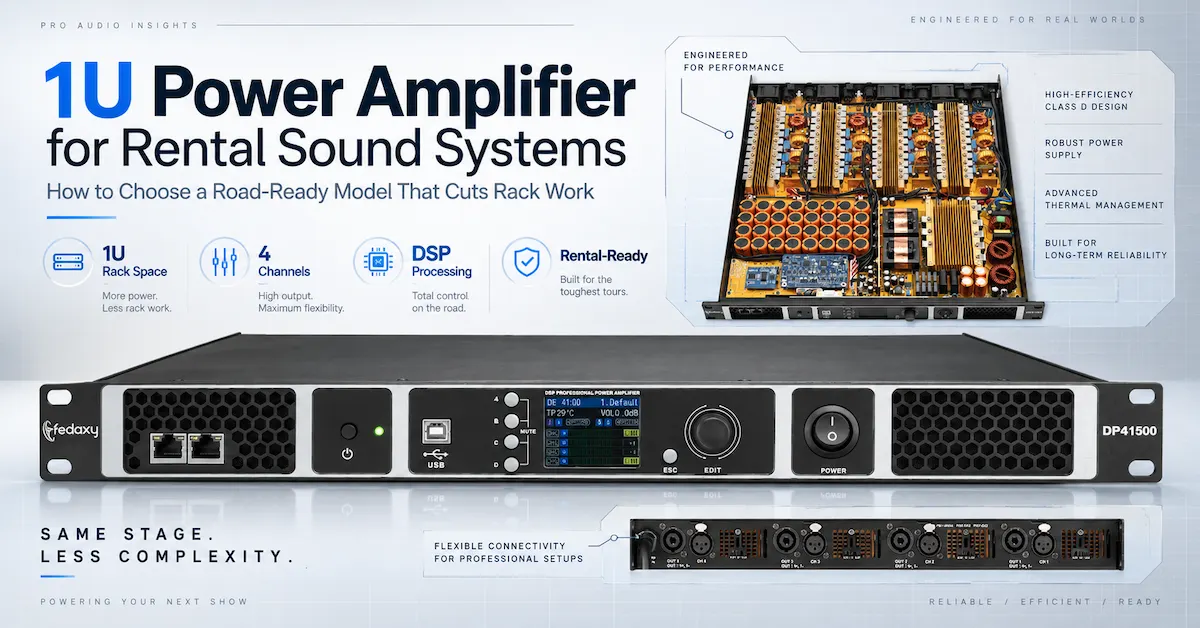
| DP41500 | 1U / 4 channels / DSP. Published per channel: 8 ohm - 1500 W; 4 ohm - 2250 W; 2 ohm - 3750 W | Processed zones, tops and fills where rack space is tight | Try the DSP workflow; verify limiter control, mains version, fan noise and service access |
| DJ41800 | 2U / 4 channels / single switching supply. Published per channel: 8 ohm - 1800 W; 4 ohm - 3150 W; 2 ohm - 4500 W | Four high-output club zones in a conventional 2U layout | Ask about all-channel duty, supply sharing, protection and front-to-back cooling clearance |
| DK41800 | 2U, 4 channel; same published output tiers as DJ41800; dual switching supply | Projects comparing supply architecture and zone resilience | Channel grouping, mains current, weight, service parts and project-specific advantage |
| TD41600 | 2U / 4 channels / dual transformers. Published per channel: 8 ohm - 1600 W; 4 ohm - 2400 W; 2 ohm - 4000 W | Bar or club installation, including tops and separately controlled areas | Listed supply is 200-260 V. Match it to the site and review weight, inrush and distribution |
| LS3000 | 3U / 2 channels. Published per channel: 8 ohm - 3000 W; 4 ohm - 4500 W; 2 ohm - 7500 W | A separate amplifier job for the low-frequency array | Bring the sub wiring plan; verify cable current, mains demand, heat run and limiter values |
All wattage and architecture descriptions above are Fedaxy's published product claims as reviewed for this guide. Confirm the exact purchase specification in writing.
How to read this table without overbuying
Begin with the lowest-risk topology for the room. If a four-channel model supplies all required zones at 4 ohms with suitable headroom, there may be no reason to force the design to 2 ohms. If subwoofer demand dominates, separate the low-frequency channels and evaluate LS3000 or another dedicated model. If built-in processing reduces external rack equipment, DP41500 deserves a workflow test, not just a paper comparison.
The phrase high power Class TD amplifier for clubs should describe a verified system capability. It should not be shorthand for the largest number on the page. A smaller, correctly loaded and properly limited amplifier can outperform a larger unit installed with poor ventilation, weak mains or mismatched processing.
How should an amplifier be selected for nightclub subwoofers?
Subwoofer selection begins with acoustic output and coverage, then moves through cabinet impedance, wiring and electrical demand. It is not enough to say that bass needs more watts. The designer must know how many cabinets share a channel, the loudspeaker maker's recommended processing, the intended bandwidth, the expected program material and the venue's operating level.
A Class TD amplifier for nightclub subwoofers should be evaluated with the actual subwoofer bank. Confirm polarity and cabinet wiring before any high-level run. Set high-pass and low-pass filters from system data. Establish gain structure, then calculate limiter thresholds from the amplifier gain and loudspeaker voltage limits. Finally, test for audible distress, limiter behavior, thermal stability and mains sag under representative material.
Peak power, thermal power and limiter purpose are not the same thing
Short transients demand voltage headroom. Sustained bass creates heat in both driver and amplifier. A limiter can protect against one kind of stress while missing another if attack, release and threshold are wrong. Use the loudspeaker manufacturer's thermal and excursion guidance whenever available. Do not copy a limiter preset from a different driver simply because both cabinets are called 18-inch subwoofers.
Clipping indicators are a last warning, not a nightly target. A clean design has room for peaks without relying on constant clip limiting. If operators routinely drive the system into protection, investigate the acoustic target, loudspeaker quantity, gain structure and user controls. A bigger amplifier may not solve a coverage or policy problem.
What DSP settings belong in the nightclub commissioning file?
The commissioning file should contain input routing, polarity, crossover filters, equalization, delay, channel labels, limiter parameters, amplifier gain and preset version. Keep a readable PDF or spreadsheet beside the native processor file. Picture the service call two years from now: the original laptop is gone, yet the new technician can still see why channel C has 18 ms of delay and which preset belongs to the VIP room.
Put the cabinet data and an actual room measurement on screen before touching EQ; a remembered curve from another job is no starting point. Choose crossover filters that suit the boxes, measure the sub-to-top alignment at relevant positions, and delay fills so they support the main arrival instead of making a second beat. Broad, repeatable behavior may justify EQ. A narrow room null usually does not justify a heroic boost.
Useful handover rule
Store one approved preset in the amplifier or processor, one on the venue service computer and one in the integrator's project archive. Give each file the venue name, zone revision and date. A file called "final2-new" is not a service plan.
How much electrical and cooling planning does a club rack need?
Audio output power and wall-plug demand are related, but they are not identical. Music is dynamic, amplifier efficiency varies, and the supply circuit has its own limits. Ask the supplier for current-draw information appropriate to the intended duty. Then have a qualified electrical professional review circuit capacity, grounding, connector ratings, distribution, voltage stability and local code requirements.
Write down the mains voltage twice: once with the rack idling and again during a controlled, high-output run. Long feeds and busy circuits can sag enough to change what the amplifier does. Several large chassis starting together may also need sequencing. DP41500 is advertised for 90-260 V, whereas TD41600 is listed for 200-260 V. That difference is a good reason to put the exact voltage version on the purchase order, in plain language.
Follow the air with your hand and a thermometer. Where does cool air enter? Where does hot exhaust go? Keep those routes apart, leave the maker's clearance, and do not let a decorative door smother the front of the rack. Filters collect dust quickly in some service corridors.The telling temperature is the inlet reading after the club has run hard, not the reading in an empty room at lunchtime.
Maintenance needs a calendar. Inspect fans, clean filters, tighten approved connections, look for heat discoloration, and compare event logs with the baseline. A professional power amplifier for nightclub audio lives longer when the venue treats ventilation as equipment rather than empty space.
How do sound-level monitoring and hearing risk fit the amplifier decision?
An amplifier does not decide a venue's safe operating level. System design, acoustic treatment, monitoring, policies and staff practice work together. The World Health Organization's Global Standard for Safe Listening Venues and Events recommends sound-level monitoring, optimized acoustics and sound systems, hearing protection, quiet zones and staff training among its measures. Those ideas support both guest experience and consistent operation.
Staff exposure also needs attention because employees spend longer in the room than most guests. NIOSH uses 85 dBA over eight hours with a 3 dB exchange rate as a recommended occupational exposure limit. This is occupational guidance, not a target audience level. Venue owners should follow applicable local rules and obtain competent advice for their jurisdiction.
Choose measurement positions and log formats before launch. Give operators a clear response when levels exceed the agreed target. Acoustical treatment and better coverage can often improve perceived impact without simply turning up the loudest location. More amplifier power cannot repair a room with severe level differences.
What should a distributor verify on a sample amplifier?
A sample evaluation should reproduce the customer's likely use. Photograph the packaging and connectors, record serial numbers, confirm the mains version, inspect assembly, and compare the unit with the approved specification. Run functional checks at 8, 4 and any planned lower impedance using suitable loads and calibrated equipment. The test method and duration should be recorded so another technician can repeat it.
Listen for fan changes, noise, channel imbalance and unexpected mute behavior. Exercise startup, shutdown, signal loss, clipping, thermal warning and protection recovery within safe procedures. If DSP is present, save and recall presets, test control software, and confirm what happens after power interruption. A pass means the unit met written criteria; "it played loudly" is not a useful result.
Before production, put the acceptance sample in the order paperwork. Agree on cosmetic limits, labels, accessory count, firmware and electrical checks, then keep a signed unit or signed specification as the reference. If a connector, component or firmware build changes later, pause for approval. A distributor should hear about the revision in an email, not from an installer staring at a different rear panel.
A commissioning procedure that produces evidence
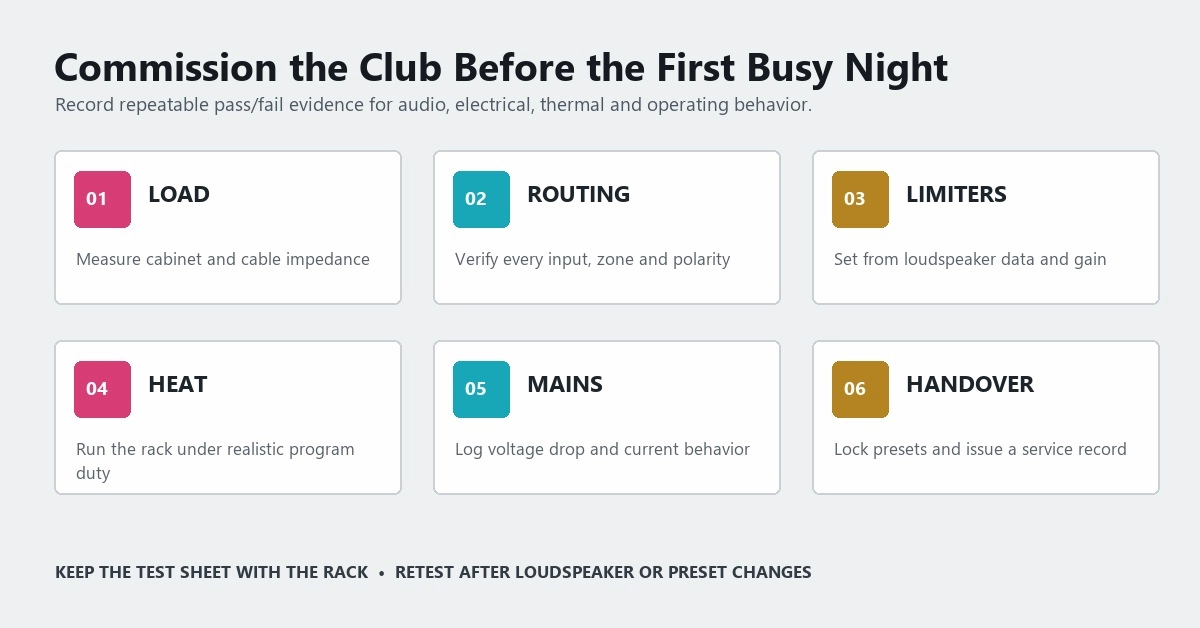
- Open with a visual check: read the model and voltage label, inspect connectors and vents, tug the approved rack fasteners, and look at every cable strain relief.
- Meter the loudspeaker lines: do this before a channel sees the first connector.
- Prove routing: send low-level signal to one channel at a time; verify zone, polarity and mute labels.
- Set gain structure: align mixer, processor and amplifier so normal operation has usable headroom.
- Load processing: apply approved crossover, EQ, delay and limiter settings; record the revision.
- Test progressively: raise level in controlled stages while watching voltage, current, temperature and indicators.
- Run realistic program: use material representative of the venue for a duration that reveals thermal or mains issues.
- Exercise faults: within safe manufacturer procedures, verify mute, recovery and operator response.
- Walk the room: measure coverage and level at agreed positions with the venue in a realistic state where possible.
- Leave a usable handover: archive the settings and test sheet with drawings, serial numbers, passwords, warranty route and the service contact who will answer.
On the report, draw a hard line between tests completed and tests deferred. Perhaps the building was empty and a capacity crowd could not be reproduced. Say that plainly, then book a short return visit during a real event. The limit does not weaken the report; hiding it would.
How should buyers evaluate a Class TD nightclub amplifier manufacturer?
When the factory is under review, follow one amplifier from drawing control to final carton. Who owns its design? What happens when an engineer changes a part? Which safety and EMC evidence actually covers this model? Ask to see an incoming inspection example and a completed final-test record. For a meaningful order, a live video walk-through or visit can settle questions that a brochure never will.
Fedaxy describes more than 15 years in amplifier R&D and production. Its public material also describes five QC inspections, an eight-hour aging run, 6S management and a three-year warranty; separately, it reports exporting over 90 percent of production to more than 100 countries. Treat those numbers as a route into due diligence. Tie them to the chosen model and shipment by requesting the inspection plan, a representative test record, the written warranty and the compliance documents named in the order.
Private-label approval needs more than a front-panel logo. Mark up the artwork, rating label, carton, accessories, manual and firmware, and have both parties sign the revision. Then write down how later changes are raised and approved. Electrical consistency and traceable service material are what protect a distributor once stock reaches installers.
Communication quality is also evidence. A capable Class TD nightclub amplifier manufacturer should ask about loudspeakers, impedance, mains voltage, rack environment and intended use before recommending a model. A quotation that ignores those facts may be fast, but it is not yet a system recommendation.
What information should be included in the RFQ?
A useful request for quotation gives the supplier enough information to challenge the design. Attach a loudspeaker schedule and a simple zone diagram. List destination country, site mains voltage and frequency, rack location, expected ambient temperature, connector preferences, DSP needs, target quantity, certification expectations, branding and delivery window.
| RFQ field | Example of useful detail | Why it matters |
|---|---|---|
| Venue and zones | 650-capacity club; dance floor, VIP, bar, entrance, booth | Sets channel count and independent control needs |
| Loudspeaker loads | Model, quantity, impedance and wiring per channel | Prevents unsafe or inefficient amplifier matching |
| Mains | 230 V, 50 Hz; circuit and connector details | Confirms product version and distribution planning |
| Program and duty | Electronic music, five-hour peak session, four nights weekly | Frames thermal and power-supply evaluation |
| Processing | Required crossover, limiters, delay and remote control | Clarifies built-in DSP versus external processor |
| Commercial scope | Two samples, then 48 units with private label | Lets the supplier quote sample, production and approval stages |
Ask the supplier to return a channel recommendation, model list, confirmed specifications, lead time, warranty route and exceptions. Those exceptions are valuable. They show where the project needs a design decision before money is committed.
A practical purchase sequence
- Freeze the room brief: capacity, zones, operating hours and level policy.
- Complete the loudspeaker design: coverage, cabinet models and processing requirements.
- Create the load schedule: impedance, cable and channel assignment.
- Shortlist models: compare channel count, output, supply, DSP, cooling and service fit.
- Get the evidence into one folder: current data sheets, test conditions, compliance documents and the written warranty.
- Put a sample on the bench: use the same checklist and realistic loads that the next technician can repeat.
- Approve the order: lock voltage, configuration, firmware, labels and acceptance criteria.
- Commission the venue: record settings, measurements and operating limits.
- Review after launch: inspect logs, temperatures and operator feedback after busy nights.
This sequence gives owners, distributors and integrators the same reference. It also turns the amplifier purchase into a technical decision that can be audited later, which is far more valuable than winning a specification argument in a sales meeting.
Questions buyers usually raise
Is Class TD suitable for a nightclub sound system?
Yes, when the selected model matches the loudspeaker loads, output target, mains supply, processing and thermal environment. Class TD describes a topology; suitability still depends on the complete amplifier and system design.
How much amplifier power does a nightclub need?
There is no dependable watts-per-person shortcut. Start with the loudspeaker sensitivity, rated maximum output, throw, cabinet count, load, headroom, target level and what the room does to coverage. Once that system is on paper, the amplifier channels can be matched to it.
Should nightclub amplifiers run at 2 ohms?
Only when the exact model permits it and the mains, cable, cooling and duty support it. Draw the 4-ohm alternative beside the 2-ohm one; the former often buys useful current and heat margin. The lowest impedance on a brochure is an option, not a design target.
Is a four-channel amplifier better than a two-channel one?
It depends on the channel job. Four channels save rack space and divide a venue neatly; a two-channel high-output chassis may be easier to dedicate to subs and isolate during service. A mixed rack is common for good reason.
Which Fedaxy model should be evaluated for four processed zones?
DP41500 is a logical starting point because Fedaxy lists four channels, a 1U format and integrated DSP. Confirm that its output, software, voltage version, control and thermal behavior fit the actual project before ordering.
Which model should be evaluated for nightclub subwoofers?
LS3000 is a two-channel, 3U Class TD model positioned for high-power low-frequency work. The final match depends on subwoofer impedance, wiring, processing, required output and the confirmed test conditions.
What should be tested before a production order?
Verify mains version, output under planned loads, protection, cooling, noise, DSP operation, preset recovery, connectors, assembly and documentation. Record the method, equipment, duration and pass criteria.
What should I send Fedaxy for a recommendation?
Send the venue capacity, zone drawing, loudspeaker models and quantities, impedance per channel, mains voltage, rack conditions, DSP needs, target quantity, branding requirements and delivery market.
Conclusion: specify the job before selecting the chassis
The best Class TD amplifier for nightclub sound systems is the one that can be traced to a complete design decision. Its channels correspond to named zones. Its loads are calculated and measured. Its limiters come from loudspeaker and gain data. Its mains and cooling conditions have been checked. Its sample has passed a documented test, and its settings can be restored by someone other than the original installer.
That discipline also makes supplier conversations faster. Instead of asking for a vague "big club amplifier," the buyer can request a verified channel schedule and compare DP41500, DJ41800, DK41800, TD41600, LS3000 or another recommended model against the same criteria.
Fedaxy publishes Class D, TD, H and AB amplifier families and a bar-and-club solution built around punchy bass, clear vocals, even coverage, extended high-output operation and flexible multi-channel control. Send the project facts first. A useful recommendation should explain not only which model fits, but why.