Quick Answer
A reliable 1U power amplifier for rental sound systems should reduce the size and handling burden of a finished rack while still matching every loudspeaker load, mains condition and show duty. Buyers should compare verified output, channel count, DSP or network requirements, airflow, protection, connector access, preset recovery and repair support. Approve the model only after a sample survives a documented bench test and a realistic packed-rack run.
Why rental companies cannot choose an amplifier by height alone
For a rental manager, choosing the right amplifier affects far more than one equipment line. It changes case size, truck pack, crew handling, patching, spare strategy and the number of channels available when a job grows on site. A narrow specification mistake can therefore reappear every weekend as extra labor, hot racks, nuisance protection or an amplifier that fits the case but not the loudspeaker inventory.
Many buyers face the same three pressures. Sales wants more channels in fewer cases. Technicians want hardware they can identify, patch and replace quickly. Finance wants a lower landed and operating cost without adding repair risk. A 1U chassis can help all three groups, but only when the finished rack has been designed as one transportable asset.
The common failure is to compare a thin product with a taller product on wattage and unit weight, then stop. That leaves out the distribution panel, shock rack, network switch, processor, patch field, spare unit and the air path around everything. It also ignores the workload after a fault at 6 p.m., when the crew has one hour before doors open.
This article treats the professional 1U power amplifier as part of a rental workflow. The useful question is not “How thin is it?” It is “Does the complete rack leave the warehouse faster, arrive lighter, run predictably and return ready for the next booking?”
What does a 1U power amplifier for rental sound systems mean in practice?
On the rack drawing, a 1U amplifier takes one vertical rack space in the familiar 19-inch equipment format. IEC 60297-3-100 is the dimensional reference behind the 482.6 mm rack family. That is where the label stops being informative. It says nothing about how deep or heavy the box is, how much audio it can deliver, or whether a packed touring case can move enough air through it.
Audio arrives at line level and leaves at a level suitable for the loudspeaker circuit. Between those connectors sit the supply, output stage, fans, sensors and protection logic that determine whether the unit can handle the assigned job. DSP-equipped versions may also carry the crossover, EQ, delay and limiter. Dante models can bring the audio in over a network. Each removed external box is welcome, but every new software or network dependency belongs on the service sheet.
A typical rental fleet uses 1U amplifiers for portable PA racks, monitor systems, corporate events, small festivals, mobile DJ systems, distributed fill packages, theater rentals and larger touring racks where channel density matters. The same chassis can be a good answer in one package and a poor answer in another. A four-channel top-box rack, a two-channel sub rack and a Dante-enabled corporate package have different priorities.
The main parts buyers should evaluate
- Start at the wall: write down mains range, current information and what happens when several units start together.
- Put the real load on the bench: test the planned 8-ohm or 4-ohm circuit, plus 2 ohms only where the model and rack plan allow it.
- Follow the air: locate intake and exhaust, then make sure the case, loom and neighboring chassis do not send hot air back around.
- Audio and control I/O: connectors that match the rental patch standard and remain reachable in a deep rack.
- DSP or network: preset ownership, offline files, firmware version, redundancy and recovery procedure.
- Protection and service: clear indicators, predictable recovery, spare parts and a practical warranty route.
How does a 1U amplifier change rental rack economics?
A compact amplifier creates value only when saved rack units turn into a smaller case, fewer case moves, a cleaner patch or useful spare capacity. If the old 8U rack becomes a 6U rack, the result may be easy to see. If the case stays 8U because power distribution, processing and rear support still need the space, the business case must come from higher channel density or a simpler signal path instead.
Count the entire package. Record the mass of amplifiers, case, shock frame, power distribution, I/O panel, cable tails, network hardware, spare module and the tools that travel with it. Then check whether one technician can lift or roll the rack under company policy. A lightweight power amplifier for rental audio may still sit inside a case that needs two people because the rack is deep, front-heavy or packed with copper cable.
Labor savings also need a before-and-after measurement. Time how long a crew takes to collect, inspect, patch and test the old package. Repeat with the proposed rack. Note every loose cable and external processor that disappeared, but also note any extra laptop or network step. Ten minutes saved per deployment can matter across hundreds of bookings; an attractive product weight cannot prove that saving by itself.
A simple total-cost worksheet
This is not an accounting standard. It is a prompt to expose costs that hide behind the unit price. A lower-cost amplifier can become expensive if a rental company must keep many spares, ship complete racks back for repair or rebuild presets after every replacement. A more capable networked model can also become expensive if most bookings never use the network feature and technicians need additional training.
How should output power and loudspeaker loads be matched?
Begin with the loudspeaker schedule and give every channel its own row. A useful row names the cabinet, count, wiring, nominal impedance, cable run, frequency band and the maker's limiter or amplifier guidance. For example, a pair of matching 8-ohm boxes wired in parallel is written as 8/2 = 4 ohms. Four of those boxes becomes 8/4 = 2 ohms. The actual impedance moves with frequency, so that neat arithmetic earns a review; it does not finish one.
IEC 60268-3 specifies amplifier characteristics and related measurement methods so results can be repeated under stated rated and standard conditions. That principle matters to rental buyers: a power figure has meaning only with its test method, mains voltage, load, channel count, frequency range and duration. Ask whether all channels were driven and whether the figure represents a continuous, burst or other condition.
A high power 1U amplifier for live sound should not be chosen simply because its largest published number exceeds a loudspeaker label. The rack must deliver clean headroom for program peaks while protection and limiters keep the loudspeaker within safe electrical and mechanical limits. If the system is continuously clipping, more wattage may not fix a coverage, quantity or gain-structure problem.
When is 2-ohm operation appropriate?
When the drawing lands at 2 ohms, sketch a second version that splits the same boxes across two 4-ohm channels. The split version consumes another channel, yet it may make cable current, heat and fault isolation easier to manage. Keep the 2-ohm plan only if the exact amplifier permits it and the packed rack, mains feed and cable set all support the extra stress.
Measure the loudspeaker circuit before connection. Check polarity and cable condition. During the sample test, use suitable loads and calibrated equipment, and record mains voltage at the amplifier. If the real rental inventory includes long multicore speaker runs, reproduce a representative cable condition rather than testing only with a short bench lead.
Published output is a shortlist, not an automatic rack approval
The Fedaxy figures in this guide come from current product pages. Before an order, obtain the latest data sheet and written confirmation for the selected voltage, load and operating mode. Do not assume that a headline figure means every channel can deliver that value indefinitely in a closed case under any ambient temperature.
Should a rental rack use two-channel or four-channel 1U amplifiers?
A 4 channel 1U power amplifier is useful when a case needs several independent loudspeaker circuits: left and right tops plus two fills, four monitor mixes, or four zones for a corporate event. Four channels can reduce chassis count and consolidate patching. It can also concentrate risk, because one chassis fault may remove four outputs.
Two-channel models make sense when each channel carries a high-output load, when subwoofer duty should remain separate, or when technicians want a simpler replacement path. A two-channel module may also fit an existing patch and spare policy better than a four-channel unit. The correct choice follows channel jobs, not a belief that more channels are always more efficient.
Write a failure map next to the normal channel map. If one four-channel unit fails, which zones disappear? Can a spare be repatched within the setup window? Are its presets and gain settings already loaded? A modular rack that loses half its output during one fault may be less useful than two smaller racks that can cover each other.
| Rental requirement | Two-channel 1U role | Four-channel 1U role | Question for the buyer |
|---|---|---|---|
| High-output sub pair | Dedicated left/right or two sub circuits | Useful only if four LF circuits are genuinely required | What is the load and cable current per channel? |
| Top and fill package | Separate chassis may divide failure risk | One chassis can cover four independent feeds | Can one spare replace any channel role? |
| Monitor rack | Two mixes per unit | Four mixes in one rack unit | What disappears if the chassis mutes? |
| Corporate networked audio | High-power paired zones | Dense multi-zone deployment | Does the crew need Dante or only local DSP? |
| General dry-hire inventory | Simple jobs and flexible pairing | Higher density with stronger preset discipline | Which format reduces training and support calls? |
When do DSP and Dante create real rental value?
DSP can move crossover, EQ, delay and limiting into the amplifier. For repeat packages, that may remove an external processor and reduce patching. The saving is real only when the rental company manages presets carefully. Each file needs a clear package name, loudspeaker version, amplifier model, date and owner. A spare should contain the approved presets before it leaves the warehouse.
Dante can simplify signal distribution in networked corporate, theater and large-event systems. It also adds clock, addressing, switch, redundancy, firmware and access-control decisions. A dry-hire customer who expects two analog inputs may not benefit from the same network feature that saves hours on a large distributed show.
Before buying a networked 1U rackmount power amplifier, run an offline-to-show-day exercise. Load the preset onto a clean service laptop. Discover the device through the intended switch. Remove and restore power. Replace the amplifier with the spare. Confirm clock and audio recovery. Document every password and software version needed by the on-call technician.
DSP and Dante are therefore inventory categories, not check-box upgrades. A rental fleet may keep analog models for fast general-purpose dispatch, DSP models for loudspeaker-specific racks, and Dante models for networked packages. That division gives sales a clear offer and makes technician training more focused.
Which Fedaxy 1U models fit common rental roles?
Fedaxy currently lists 1U Class D, Class TD, DSP and Dante options. The table below uses published product-page data and suggests a rental role to evaluate. It does not declare one universal winner. Buyers should confirm the latest specification, test conditions, voltage configuration, gross or net weight, connectors, software and revision before purchase.
| Model and product link | Published configuration | Rental role to evaluate | Important approval checks |
|---|---|---|---|
| D43000 | 1U Class D / 4 channels. Fedaxy listing: 8Ω - 4×3000 W; 4Ω - 4×5000 W; 2Ω - 4×6500 W. | Dense racks for high-output tops, fills or multi-way work | Ask for all-channel conditions, then check the listed 80-296 V range, case depth, 15 kg gross weight, inrush and cooling |
| D24200 | 1U Class D / 2 channels. Fedaxy listing: 8Ω - 2×4200 W; 4Ω - 2×7800 W; 2Ω - 2×8500 W. | A two-channel high-output package, including a possible sub rack | Resolve the product-page 4-ohm inconsistency in writing; test cable current, mains behavior and heat |
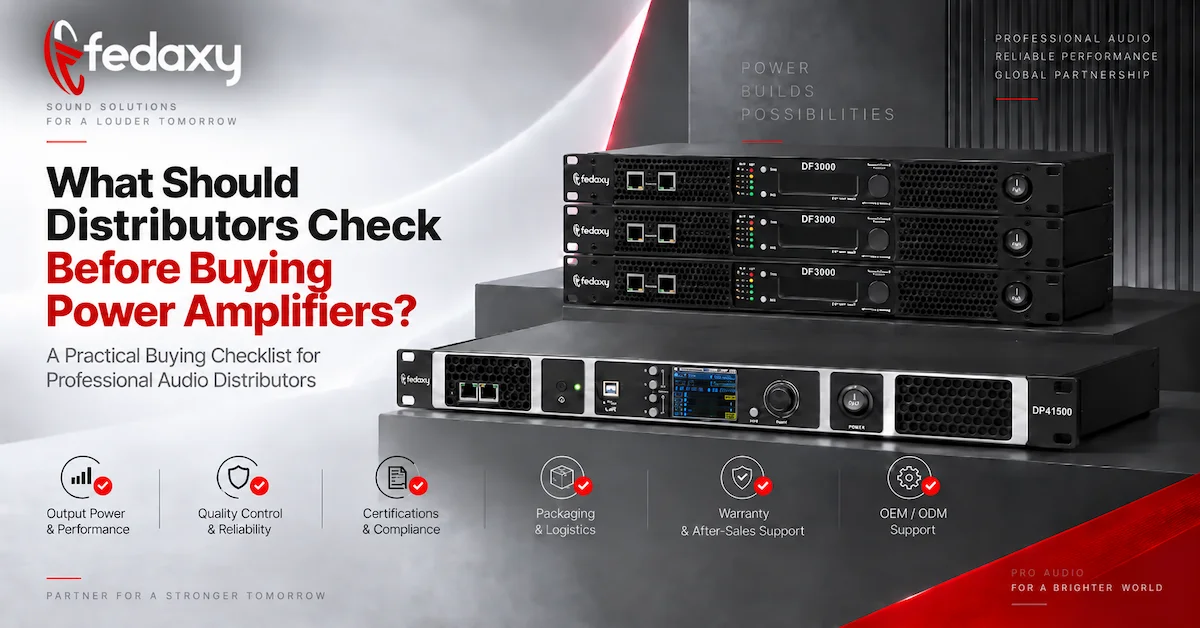
| DF3000 | Class D, four channels, DSP and Dante, 1U. Same published output tiers as D43000. | Networked four-channel rental racks | Dante workflow, DSP limiter control, firmware, switch plan, analog fallback and spare recovery |
| DT4200 | 1U Class D / 2 channels / DSP + Dante. Fedaxy listing: 8Ω - 2×4200 W; 4Ω - 2×7800 W; 2Ω - 2×8500 W. | Networked high-output or low-frequency packages | Rehearse redundancy and network-loss recovery; verify limiter ownership, the 80-296 V listing, airflow and current demand |
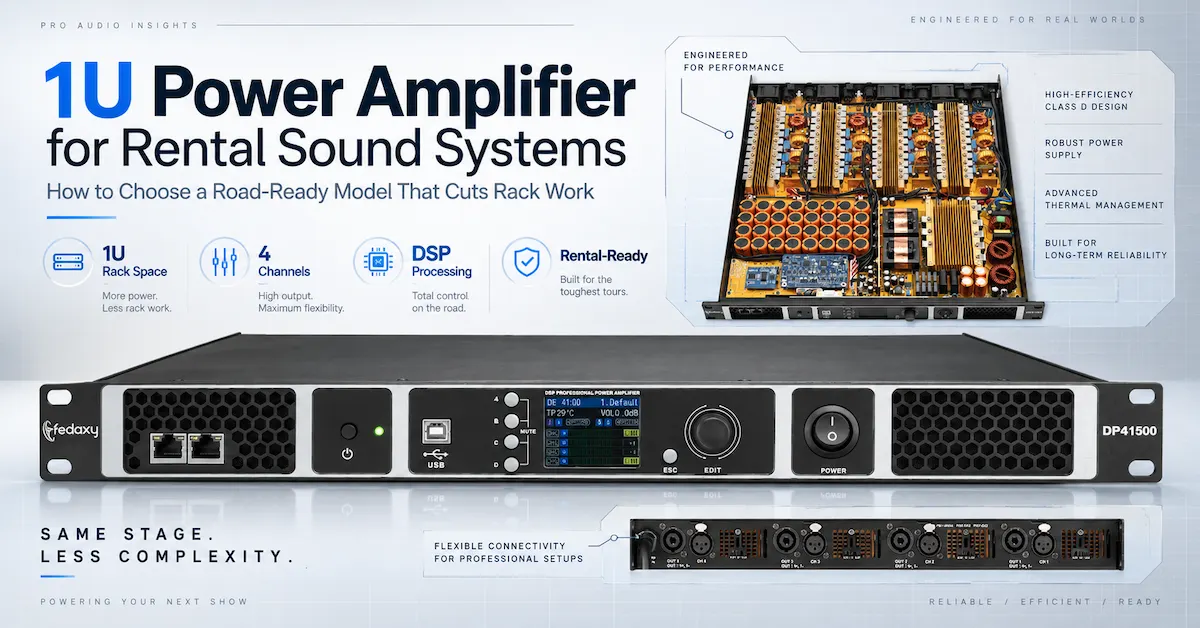
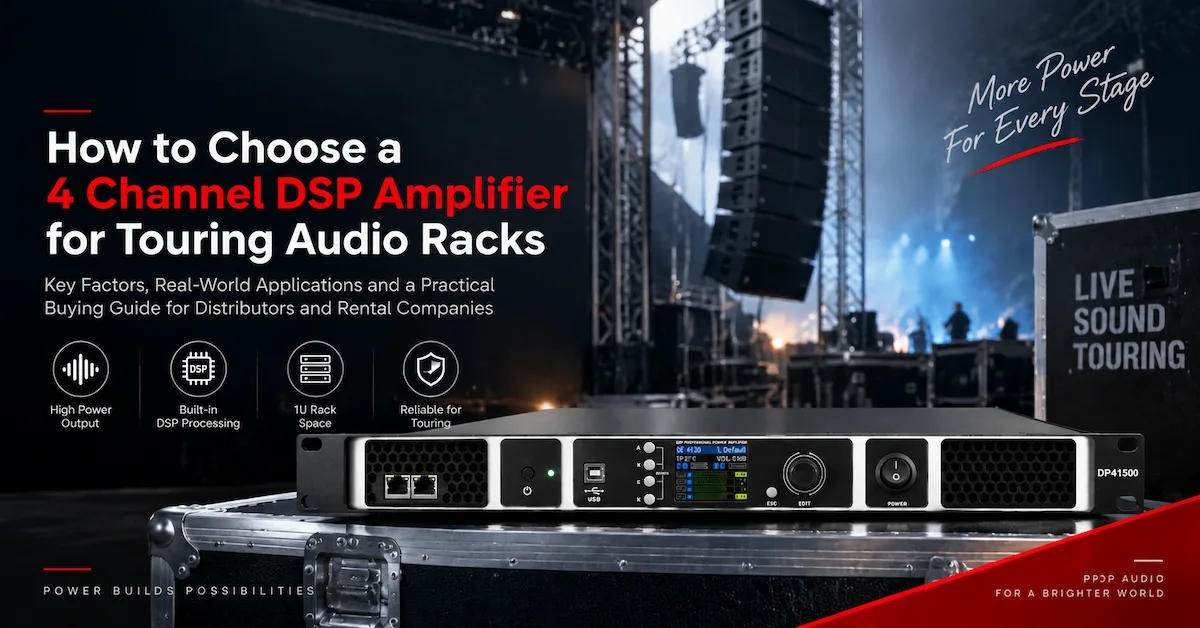
| DP41500 | 1U Class TD / 4 channels / DSP. Fedaxy listing: 8Ω - 4×1500 W; 4Ω - 4×2250 W; 2Ω - 4×3750 W. | Processed tops, monitor mixes and zoned packages | Work through the software, gain and limiter steps; verify voltage version, heat in the case and the spare preset |
| DE41300 | 1U Class TD / 4 channels. Fedaxy listing: 8Ω - 4×1300 W; 4Ω - 4×1950 W; 2Ω - 4×3250 W. | General four-channel stock for smaller systems and distributed outputs | Verify the 90-296 V listing, 13 kg gross weight, rental connector standard, fan access and the planned load |
Numbers above are Fedaxy's public product claims as reviewed on September 16, 2026. The D24200 page headline shows 2 x 7800 W at 4 ohms while its parameter table has also been displayed with a different 4-ohm entry; request written confirmation before relying on either figure.
How should a buyer turn the table into a shortlist?
Start with the channel schedule, not the model name. If the package needs four moderate channels and local processing, compare DP41500 with the loudspeaker data. If the package needs four higher-output channels without network audio, D43000 may enter the sample round. If the same package belongs to a Dante fleet, DF3000 is the corresponding networked direction to evaluate. For two high-output channels, compare D24200 and DT4200 based on whether network and DSP functions create operational value.
The 1U amplifier for touring sound systems must also fit the existing company standard. A technically capable unit can still be a poor fleet choice if it requires a unique connector panel, service laptop, spare strategy or training path that no other rack uses.
How should cooling, mains and mechanical fit be checked?
A 1U faceplate leaves little vertical space for vents, heat sinks and controls, so the cooling design must be evaluated in the intended case. Fedaxy lists front-to-back fan cooling on the D and DE products discussed here. Preserve that direction through the rack. Do not let rear patch panels, cable looms or foam case lids block exhaust. Keep hot discharge away from another amplifier's intake.
Run the sample with representative program material and channel loads inside the proposed rack. Log inlet temperature, outlet temperature, mains voltage, protection indicators and any audible fan changes. Repeat after filters or grills have accumulated a realistic amount of dust according to a safe maintenance plan. A bare amplifier on an open bench cannot prove a packed touring case.
For mains, record the destination voltage and frequency, distribution connector, available circuit, expected voltage drop and generator use. Confirm the ordered voltage range in writing. Published wide-range input claims still need a current-draw and distribution review by a competent person. Several amplifiers starting together can also make inrush behavior important.
Measure from the front rail all the way to the rear cable bend; the chassis depth alone is not enough. Check front and rear support, lid clearance, shock-rack travel and the pull of a heavy speaker loom on each output. IEC 60297 defines the rack interface. It cannot predict whether your chosen case and cable assembly will still behave after a season of loading docks.
For product safety, IEC 62368-1 deals with safeguards around audio/video and related electronic equipment. That document is not a badge for sound quality or road performance. Ask which certificate covers the ordered model in the destination market, then read the holder, model list, issue date and named laboratory or certification body rather than stopping at a logo.
What should a rental company test before adding the model to inventory?
A sample test should reproduce the warehouse and field routine. Start with identity: photograph labels, record model, serial, mains version and firmware. Inspect rack ears, fasteners, fan openings, connectors and finish. Compare the rear panel with the proposed patch drawing before anyone builds a batch of cases around it.
Next, measure function under the planned loads. Use suitable test equipment and safe procedures. Check channel balance, gain, noise, mute behavior, protection and recovery. If bridge mode or 2-ohm operation is part of the package, test that exact condition within the manufacturer's instructions. Note ambient temperature, mains voltage, test duration and which channels were driven.
Then build the rack. Connect the final power distribution, patch panel, network switch and cable loom. Run representative program long enough to reveal airflow and supply problems. Close the lids only for transport; never operate in a configuration the manufacturer does not allow. If the system uses DSP or Dante, restore the complete package from backed-up files on a clean computer.
Finish with an ordinary road cycle. Let the crew move the case, load it, unload it, reconnect it and run the short function check again. Look for a loose connector, intermittent audio, bent ear or strained cable. This shop exercise is not a substitute for formal vibration or safety testing. It is simply a cheap chance to catch a bad case or patch layout before the fleet contains twenty copies of it.
A practical acceptance checklist
- Identity: match the model, mains version, serial, firmware, accessories and packaging to the purchase order.
- Mechanical fit: verify rack depth, front and rear support, lid clearance, cable bends and connector access.
- Signal path: check every input and output, gain position, polarity, mute and indicator.
- Load test: run the planned 8-ohm, 4-ohm and approved 2-ohm conditions with the method documented.
- Thermal run: test in the final rack with realistic program, ambient temperature and airflow.
- Mains behavior: log voltage, current information available to the team, startup sequence and recovery after interruption.
- DSP/network: save, recall and transfer presets; verify clock, addressing, fallback and access control where applicable.
- Transport cycle: move the packed case, reconnect it and repeat the basic functional test.
- Service drill: replace one unit with the programmed spare and time the operation.
- Handover: archive results, photos, settings, software, warranty route, supplier contact and approved rack drawing.
Use pass/fail criteria instead of comments such as “sounds good.” A repeatable record lets purchasing compare samples, lets technicians recognize drift and gives the supplier a clearer fault report if a unit needs support.
How should buyers evaluate a rental sound system amplifier manufacturer?
A capable rental sound system amplifier manufacturer should ask about loads, duty, case design, mains conditions, DSP requirements and fleet service before recommending a model. A quotation based only on a desired wattage and quantity is incomplete. The supplier should identify assumptions and state which data must be confirmed.
Review design control, incoming inspection, assembly, aging, performance testing, safety inspection, final inspection and change control. Ask for a representative test record and the acceptance plan for the production order. If firmware, connectors or critical components change, the buyer needs a notification and reapproval path.
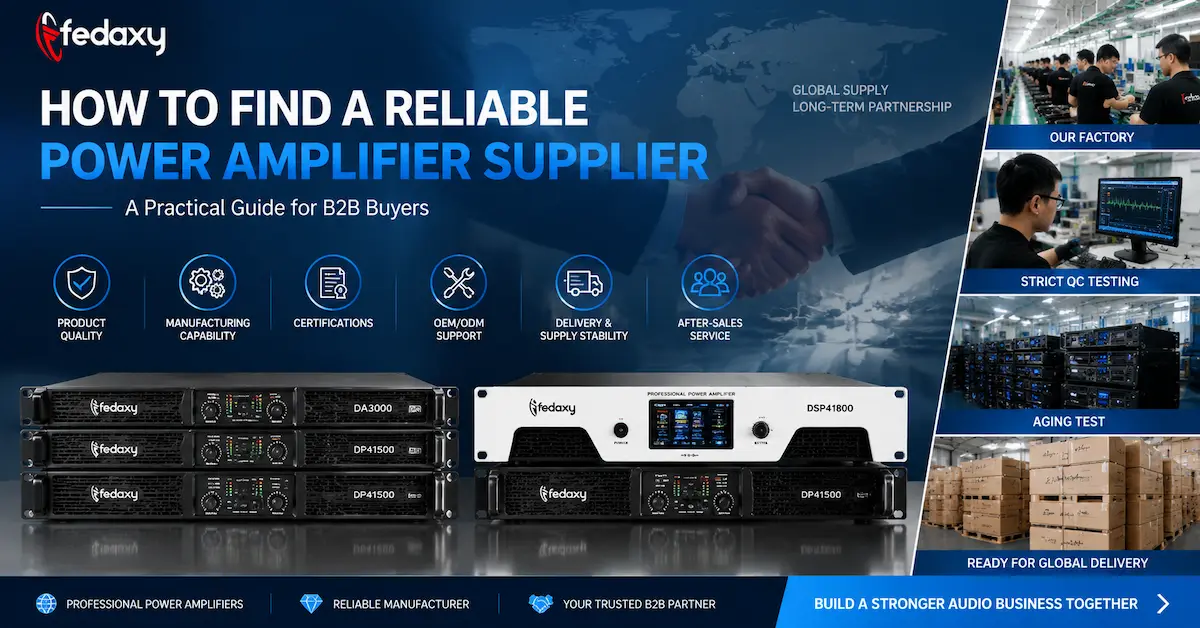
Fedaxy's public pages describe more than 15 years in R&D and production. They also describe five QC inspections, an eight-hour aging run and a three-year warranty, and name ISO9001, CE, RoHS and CB among the certifications. Export coverage is stated as more than 100 countries. Those are useful questions for due diligence, not a substitute for it. Tie each claim to the ordered model by requesting current documents, the written warranty, available parts and the repair route in the destination market.
A professional power amplifier for rental companies also needs commercial clarity. Define sample lead time, production lead time, packaging, Incoterm, spare percentage, branding, manuals, firmware version, inspection access and the person who authorizes shipment. A rental fleet is easier to support when every delivered batch is traceable to an approved configuration.
Questions to include in the RFQ
| RFQ section | Information from the rental company | Evidence requested from the supplier |
|---|---|---|
| Channel schedule | Loudspeaker model, count, impedance, wiring, cable and frequency band | Recommended model and channel assignment with assumptions |
| Operating duty | Program type, event duration, ambient range and expected load cycle | Applicable output conditions, cooling guidance and protection behavior |
| Rack design | Case dimensions, rail spacing, distribution, patch and network hardware | Chassis dimensions, mass definition, airflow direction and connector drawing |
| Electrical market | Country, mains voltage/frequency, distro connector and generator use | Ordered voltage version, current information and applicable safety/EMC documents |
| DSP/Dante | Preset, software, network and redundancy policy | Software version, offline workflow, firmware policy and recovery procedure |
| Service | Fleet size, spare ratio and local technician capability | Warranty route, parts list, repair turnaround and technical contact |
What should the final purchasing decision contain?
A good decision record is short enough to use and detailed enough to defend. It names the package, shows every channel load, identifies the approved model and firmware, states the rack drawing revision, lists test evidence and assigns the spare. It also records open limits. If the sample was not tested on generator power, say so instead of letting the next crew assume it was.
Approve the system in stages: paper shortlist, sample bench test, packed-rack test, transport cycle and limited fleet trial. A small pilot reveals training and support issues that a laboratory run cannot. After several real bookings, review setup time, protection logs, technician comments, repair events and whether the spare policy worked.
Only then scale the order. The purpose of a 1U platform is repeatable deployment, not an impressive density number. When the rack is documented and serviceable, compact amplification can give a rental company more channels per case, fewer pieces to handle and faster preparation without turning every event into an experiment.
Questions rental buyers usually ask
Is a 1U amplifier automatically lighter than a 2U model?
No. One rack unit describes height, not mass. Compare net and packed amplifier mass, then add the case, distribution, patch, cable and spare equipment to calculate the working rack.
How many 1U amplifiers should go in one rental rack?
Let the completed case decide. Add the mass, power distribution, channel plan and airflow, then apply the company's one-person or two-person handling rule. Empty rack spaces are often doing useful work for patching, power or air.
Which rental jobs suit two channels, and which suit four?
Four channels work well for dense zones, tops plus fills or monitor packages when the failure map is acceptable. Two channels suit a dedicated high-output load and can be quicker to replace. Most full rental fleets eventually use both.
Does every rental amplifier need DSP and Dante?
No. DSP helps repeat loudspeaker-specific processing, while Dante helps networked packages. General analog dry-hire stock may be faster without network dependencies. Buy the operational workflow, not the feature list.
Can published wattage be compared directly across suppliers?
Only when measurement conditions are sufficiently consistent. Ask about mains voltage, load, frequency range, driven channels, duration and test method. IEC 60268-3 provides a useful framework for amplifier characteristics and measurement.
What should be tested at 2 ohms?
Test 2-ohm operation only if the selected model permits it and the rental design truly uses it. Review cable current, mains behavior, cooling, protection and fault isolation, then compare the same system wired for 4-ohm channels.
How many spare amplifiers should a rental company buy?
There is no universal percentage. Base the quantity on fleet size, booking overlap, repair turnaround, failure consequence and whether one programmed spare can cover several packages. Test the replacement procedure before the first event.
What information should buyers send Fedaxy?
Send loudspeaker models, quantity and impedance per channel, expected duty, country and mains supply, case dimensions, connector standard, DSP or Dante needs, fleet quantity, branding and service expectations.
Conclusion: buy a faster rental workflow, not just a thinner amplifier
The right 1U power amplifier for rental sound systems earns its place by improving the complete asset. It matches the load, survives the packed-rack thermal test, works with the mains plan, restores from a known preset, and can be replaced by the on-call crew. Rack density is valuable only when those conditions remain true.
Fedaxy's current 1U range gives buyers several directions: D43000 and D24200 for Class D output density, DF3000 and DT4200 for DSP/Dante packages, DP41500 for four-channel DSP Class TD use, and DE41300 for general four-channel Class TD inventory. Use the published figures to form a shortlist, then approve the exact model through written confirmation and a repeatable sample test.