Buyer intent: Commercial investigation + supplier comparison + RFQ intent. This guide answers a practical purchasing question: how can an audio brand, distributor, rental company or system integrator select a subwoofer power amplifier manufacturer that can prove low-frequency performance, support repeat orders and adapt the amplifier to a real speaker system?
Quick answer: Choose a manufacturer that can match continuous output to the subwoofer load at 8Ω, 4Ω and, where approved, 2Ω; explain the measurement method; show thermal and protection controls; provide a sample and a model-specific test record; and support stable production for your target market. Fedaxy is a Guangzhou-based professional power amplifier manufacturer with Class D, Class TD, Class H, Class AB and DSP platforms. Its public factory evidence includes five rounds of QC inspection, an eight-hour aging test, 100% copper transformers, published real-wattage output and a three-year warranty. The final model, impedance limit, voltage, configuration, MOQ and lead time should still be confirmed in a project RFQ.
If you are comparing a subwoofer power amplifier manufacturer for touring, fixed installation, KTV, cinema, club or commercial PA work, start with the speaker data rather than a headline wattage. A subwoofer amplifier is a system component: the right choice depends on voice-coil configuration, cabinet count, final impedance, crossover, limiter strategy, rack airflow, mains voltage and duty cycle.
Ask Fedaxy to Match an Amplifier to Your Subwoofer Load →
1. What a Subwoofer Power Amplifier Manufacturer Actually Needs to Prove
A bass rack is not approved because a product page shows a large wattage figure. The person signing the purchase order needs to know what that number means at the load the system will really present, how long the amplifier can sustain it, and whether the next shipment will match the approved sample. Those are separate questions, and a good supplier answers all three.
For a touring company, the risk may appear during the third show of a hot weekend: the rack is full, the fans are running, and two cabinets have been wired in parallel. A cinema integrator faces a different risk. The amplifier may be installed behind a screen or in a plant room, where service access is limited and a nuisance trip is expensive to diagnose. A distributor has another concern again: a model that sells well must remain documentable, repairable and available for repeat orders.
This is why the useful evidence from a subwoofer power amplifier manufacturer is more detailed than “peak power.” Ask for the continuous output at the intended impedance, the test conditions behind that figure, the protection behavior, the cooling arrangement and the production checks used before shipment. A sample report is helpful; a clear method is better, because it lets your engineer compare one supplier with another without guessing.
The five pieces of evidence to request
1. Output at the working load. Request the result at 8 ohms and 4 ohms, and at 2 ohms only when the exact model is approved for that load. The document should show the mains voltage, frequency range, THD limit, test duration and whether all channels were driven at once. “Four channels, 4,000 watts” is not a useful comparison if one supplier measured a single channel for a short burst and another measured every channel continuously.
2. A description of protection behavior. Ask what happens during over-temperature, short circuit, DC fault and overload conditions. You are not only checking whether protection exists. You are checking whether the amplifier limits output in a controlled way, whether it recovers without a technician cycling the rack, and whether the operator receives a useful indication. A damaged cable or a tired driver can put a real system into one of these conditions.
3. Aging and final inspection records. Request the factory checklist and, where available, a sample record for the model being quoted. Fedaxy’s public factory information states that its amplifiers pass five rounds of QC inspection and an eight-hour aging test. It also describes 100% copper transformers, real rated wattage and a three-year warranty. These are published company statements and should be treated as supplier evidence to verify during the project, not as a replacement for your own acceptance criteria.
4. Control of the approved sample. Put the model revision, components, connectors, firmware, label artwork and packaging into the approval file. This small administrative step prevents a common repeat-order problem: a buyer approves one sample, then receives a visually similar unit with a different internal revision. If a substitution becomes necessary, the supplier should disclose it and obtain approval before production.
5. A service route after delivery. Ask who handles technical questions, what information is needed for a fault diagnosis, and how spare parts are identified. For a rental fleet, service access and turnaround can matter as much as the original unit price. For an OEM brand, the question includes manuals, warranty wording and the process for managing future revisions.
Fedaxy in the supplier comparison
Fedaxy is Guangzhou Fedaxy Audio Equipment Co., Ltd., a professional power amplifier manufacturer based in Panyu, Guangzhou, China. Its published portfolio covers Class D, Class TD, Class H, Class AB, DSP, Dante and active-module platforms. That range gives a distributor or system integrator more than one architecture to consider, but it does not remove the need for model-level qualification. The final recommendation still depends on cabinet impedance, channel count, mains voltage, rack conditions and duty cycle.
If you are comparing a subwoofer power amplifier manufacturer for touring, KTV, cinema, clubs or commercial PA, send the speaker data before asking for a quotation. Include the cabinet model, the number of boxes per channel, the wiring plan, nominal and minimum impedance, crossover point, expected program level, rack depth and local voltage. The factory can then recommend a candidate and state the assumptions behind it. That is a more useful exchange than asking several suppliers for their “most powerful amplifier.”
Ask Fedaxy to Match an Amplifier to Your Subwoofer Load
Who is making the purchase?
The same amplifier is judged differently by different buyers. A pro audio distributor may need a coherent two-channel and four-channel range, export documentation, carton planning and dependable repeat supply. A rental company will focus on 2-ohm behavior, weight, cooling, protection and access to service parts. An AV integrator needs predictable impedance behavior, DSP or external-processing requirements, rack fit and a commissioning plan. A private-label speaker brand will ask about the front panel, firmware, label, packaging, warranty language and ownership of future revisions.
Write those priorities into the RFQ instead of leaving them in a sales call:
| Buyer | Typical project | Information to include in the RFQ |
|---|---|---|
| Distributor or wholesaler | Stocking a small family of amplifiers for several markets | Target countries, forecast volume, rack preference, export documents, carton or pallet plan, brand requirements |
| Touring or rental company | Mobile subwoofer racks for concerts and festivals | Cabinet model, boxes per channel, minimum impedance, flight-case limits, mains supply, cooling and service access |
| KTV, club or cinema integrator | Fixed low-frequency zones combined with full-range channels | Room count, speaker impedance, crossover points, rack depth, voltage, DSP requirement and noise limits |
| Speaker brand or private-label OEM | A branded amplifier or bundled loudspeaker system | Desired configuration, forecast, target price band, sample approval method, firmware ownership and packaging |
| Commercial PA contractor | Schools, hotels, worship, conference or municipal systems | Venue schedule, speaker schedule, local compliance, installation date and spare-unit plan |
The end user may be a DJ, stage technician, bass player or venue engineer. The person approving the order is often a procurement manager, product manager, technical director or operations lead. A purchase-ready RFQ gives both people the same configuration to approve.
Subwoofer amplifier does not mean “bass only”
A subwoofer power amplifier is chosen around the low-frequency section of a loudspeaker system. It may reproduce a wider bandwidth; it does not automatically provide crossover, EQ, delay or limiting. In a passive system those tasks may sit in a loudspeaker-management processor. In a DSP amplifier, some or all of them may be inside the amplifier. Define which device owns each function before the order is placed.
The practical difference is electrical and thermal demand. Low-frequency cabinets can present a difficult load, require large voltage swings and draw high current during program peaks. A model that sounds clean on a small full-range cabinet may be the wrong choice for a pair of large reflex subwoofers. The reverse can also be true: a 3U high-power chassis may consume rack space and mains capacity that a small installation does not have.
Put four questions in the technical schedule:
- How many cabinets share one channel, and what is the calculated final impedance?
- Is the working load 8 ohms, 4 ohms or 2 ohms, and is that load approved for the quoted model?
- Can all channels operate together under the stated output, or is the headline figure single-channel data?
- Where are crossover, EQ and limiter functions handled, and which preset or commissioning record controls them?
Also ask for the airflow direction, fan behavior and required rack clearance. Sustained bass duty creates heat even when the system does not sound distorted. A supplier that can answer these questions clearly is giving you information that can be checked by engineering, purchasing and service teams alike.
2. Who Buys a Subwoofer Power Amplifier and What They Need
“Buyer” is too broad a label for this product. The person asking for a quotation may be a distributor building a stock list, a rental manager trying to standardize several racks, an integrator responsible for a complete venue, or a speaker brand planning a private-label launch. They may all search for a subwoofer power amplifier manufacturer, but they are not buying for the same reason and they should not receive the same recommendation.
The difference shows up in the RFQ. A distributor is usually concerned with a repeatable range rather than one spectacular model. They need clear manuals, export documents, carton planning, warranty handling and a supplier that can support the same SKU after the first shipment. The useful question is whether two-channel and four-channel models can be presented as a sensible family, with consistent controls and documentation that a local sales team can explain.
A touring or rental company has a harder operating brief. The amplifier will be moved, installed in flight cases, run at busy shows and serviced under time pressure. Weight and rack height matter, but they are not the whole decision. The buyer should state the cabinet model, the number of cabinets per channel, the lowest intended impedance, the mains supply, the flight-case limits and the cooling arrangement. Ask the pro audio amplifier supplier how the quoted model behaves when all channels are driven, how protection is indicated, and which parts can be replaced without sending the complete rack back to the factory.
An AV integrator has a system problem rather than an amplifier-only problem. The low-frequency channels may share a rack with full-range channels, processing may sit in a separate loudspeaker-management unit, and the finished installation may run every day in a hotel, cinema, KTV venue, club or conference space. The RFQ should identify room count, speaker impedance, crossover points, rack depth, local voltage, noise limits and the commissioning process. If DSP or Dante is required, state whether the amplifier must supply it or whether an external networked processor already exists.
A speaker brand or private-label OEM buyer is making a product decision. The technical specification still matters, but so do the front panel, connectors, label artwork, packaging, manual, firmware, warranty language and revision control. Ask the professional amplifier manufacturer to separate what is already standard from what requires a custom engineering change. A sample that looks right is only the beginning; the approval file should define the version that can be repeated in production.
Commercial PA contractors and venue owners have a different measure of value. Their concern is often the complete operating period: installation date, service access, spare-unit planning, delivery sequence and the cost of a failure during a school event, worship service or municipal program. They may accept a less dense rack if it improves service access, or choose a DSP configuration if it reduces commissioning time. The final RFQ should include the venue schedule, speaker schedule, local compliance requirements and the person who will receive technical support after handover.
Buyer requirements at a glance
| Buyer group | Typical project | Decision priorities | Information to send with the RFQ |
|---|---|---|---|
| Pro audio distributor or wholesaler | Stocking two-channel and four-channel models for several markets | Coherent model range, export documents, carton or pallet plan, warranty and repeat supply | Target countries, annual volume, preferred rack size, brand requirements and document language |
| Touring or rental company | Mobile subwoofer racks for concerts, festivals and event production | Approved low-impedance operation, power density, cooling, protection and service access | Cabinet model, cabinets per channel, flight-case limits, mains supply, duty cycle and spare-unit plan |
| KTV, club or cinema integrator | Fixed low-frequency zones used with full-range channels | Channel allocation, crossover ownership, noise, DSP or network control and installation fit | Room count, speaker impedance, crossover points, rack depth, voltage, control method and commissioning date |
| Speaker brand or private-label OEM | Branded amplifier platform or bundled loudspeaker system | Customization boundaries, sample validation, documentation, firmware, packaging and revision control | Brand assets, desired configuration, forecast, target price band, approval method and warranty policy |
| Commercial PA contractor | Schools, hotels, worship, conference or municipal systems | Reliability, service support, output at common loads and delivery planning | Venue schedule, speaker schedule, local compliance, installation date, site access and service contact |
| Venue owner or operator | Long-term fixed installation with an internal or contracted service team | Noise, predictable operation, accessible service and total cost over the operating life | Operating hours, room use, rack location, ambient conditions, spare policy and handover requirements |
Write for both the engineer and the buyer
The end user may be a bass player, DJ, stage technician, stagehand or venue engineer. The person approving the purchase order is more likely to be a procurement manager, product manager, technical director or operations lead. Those people read the same RFQ differently. Engineering looks for impedance, output conditions, cooling and protection. Purchasing looks for a clear scope, repeatability, delivery assumptions and a supplier who will still answer the phone after the payment is made.
A useful RFQ does not force either side to translate the other side’s language. Put the cabinet schedule next to the commercial requirements. State the approved model, the number of units, the required documents, the sample procedure, the packaging expectation and the acceptance evidence in one place. Where a value is not yet known, write “to be confirmed” rather than allowing a salesperson to make an assumption on your behalf.
For Fedaxy, that means sending the real project data before requesting a model recommendation. Fedaxy is Guangzhou Fedaxy Audio Equipment Co., Ltd., a professional power amplifier manufacturer in Panyu, Guangzhou, China, with published Class D, Class TD, Class H, Class AB, DSP, Dante and active-module platforms. The portfolio can support several buyer types, but the correct unit still depends on the speaker load, channel plan, voltage, rack conditions and intended application. A supplier comparison becomes meaningful only after those inputs are on the table.
3. Subwoofer Power Amplifier vs Full-Range Amplifier
The name can cause a costly misunderstanding. A subwoofer power amplifier is normally chosen for the low-frequency part of a loudspeaker system; it is not automatically a “bass-only” device. Nor does the name tell you whether crossover, EQ, delay or limiting is built in. In a passive system, those jobs may be handled by a loudspeaker-management processor. In a DSP amplifier, some or all of them may be available inside the amplifier. The purchase specification should say which device owns each function.
The difference between a full-range channel and a subwoofer channel is mostly a question of demand. Large low-frequency cabinets can draw substantial current during program peaks and can remain demanding for a long time. They may also present a less friendly impedance than the buyer expected after several cabinets are wired together. A small full-range cabinet can sound clean on an amplifier that is completely unsuitable for a pair of large reflex subwoofers. The opposite mistake is common as well: a 3U high-power chassis is installed in a small room where the rack, circuit and cooling budget were designed for a lighter unit.
That is why a pro audio amplifier supplier should explain the load in electrical and thermal terms, not only repeat a headline wattage. Before comparing models, ask what the amplifier is expected to do in the finished system. One cabinet per channel is a different job from two cabinets in parallel. A four-channel rack running all channels together is a different test from a single-channel burst. A DSP preset with a limiter is a different operating condition from a raw amplifier connected to an external processor.
Questions to put beside the specification sheet
| Question | Why it matters | Evidence or answer to request |
|---|---|---|
| How many cabinets share one channel? | Parallel wiring changes the final impedance and current demand. | A wiring calculation and the approved cabinet count per channel. |
| Is the working load 8 ohms, 4 ohms or 2 ohms? | Output, current and thermal stress change as impedance falls. | Output data and operating restrictions at the same load. |
| Can every channel run at the stated level? | A four-channel headline may be based on a single-channel test. | An all-channel measurement or a clear derating limit. |
| Where are crossover and limiter functions handled? | The wrong filter or limiter setting can waste power or damage a driver. | DSP details, external-processor requirements, preset version and commissioning method. |
| How does air move through the rack? | Sustained low-frequency work creates heat even before audible distortion. | Intake and exhaust direction, fan behavior and required clearance. |
| What happens during a fault? | A damaged cable, shorted load or hot rack can interrupt a show or installation. | Over-temperature, DC, short-circuit and overload behavior, including recovery and indication. |
A short example from a real purchase discussion
Suppose the loudspeaker schedule lists two nominal 8-ohm subwoofer cabinets on one channel. The parallel load is approximately 4 ohms before the installer accounts for the actual wiring and cable arrangement. Four identical cabinets would bring the nominal calculation toward 2 ohms, but that does not mean any amplifier carrying a “2-ohm” line is approved for the job. The factory still needs to state the minimum permitted load, the mains voltage, the all-channel condition, the thermal restrictions and the protection behavior.
The same discipline applies when a buyer asks for a “full-range amplifier for the subs.” That phrase may be perfectly workable if the output, cooling and protection are suitable, but the label alone does not answer the engineering question. Start with the speaker data, decide where processing lives, and then ask the manufacturer to match a model to the complete signal and load path. This approach makes the quotation easier to compare and leaves less room for a sales assumption to become a field failure.
4. How to Match Power, Impedance and Headroom
Start with the loudspeaker data, not the amplifier catalogue. The subwoofer manufacturer’s sheet should give you the continuous rating, program rating, nominal impedance and any recommended amplifier range. Once the cabinet arrangement is known, compare the amplifier at the same impedance and with the same measurement conditions. An 8-ohm figure on one specification sheet cannot be compared fairly with a 4-ohm figure on another simply because the second number is larger.
The wiring calculation is straightforward, but it is where many quotations go off track. Two identical 8-ohm cabinets connected in parallel present approximately 4 ohms to one channel. Four present approximately 2 ohms, subject to the actual cabinet, cable and connector arrangement. That nominal calculation does not grant permission to use any amplifier at 2 ohms. The quoted model must be approved for the load, and the integrator should confirm current demand, cooling, protection and connector wiring before the first event or installation handover.
Headroom is the distance between normal program level and clipping or protection. In some systems the loudspeaker maker permits an amplifier with a continuous rating above the cabinet’s continuous rating, provided the limiter is correctly configured and the system is commissioned against the actual driver. In other systems that approach is not appropriate. There is no single ratio that can be copied from one project to another. A responsible subwoofer power amplifier manufacturer will look at impedance, application, thermal behavior, protection and the limiter plan together.
Build the load plan before requesting the final quote
| Load-planning item | What the buyer should record | Useful acceptance evidence |
|---|---|---|
| Speaker continuous rating | Documented thermal rating for the cabinet or driver | Speaker datasheet and approved system preset |
| Program or peak rating | Rating used with a stated crest-factor assumption and limiter | Limiter threshold, attack/release settings and commissioning record |
| Final impedance | Result after cabinets are wired, not the value guessed from the product name | Wiring diagram and, where practical, measured impedance |
| Amplifier output | Output at the same impedance, voltage and test method | Factory report showing frequency, THD limit and duration |
| Operating schedule | Whether the rack will serve a festival, club, cinema, classroom or other duty cycle | Thermal test plan, airflow drawing and operating limits |
| Mains and rack conditions | Local voltage, rack height, clearance and ambient temperature | Installation drawing and supplier confirmation |
For example, a pair of nominal 8-ohm subs can look simple on paper. The quotation still needs to state whether the two cabinets share one channel, whether the amplifier is approved for the resulting 4-ohm load, and whether the output number applies with every other channel operating. A model may be perfectly suitable at 4 ohms but restricted at 2 ohms; that restriction belongs in the project record, not in a verbal conversation.
A caution about published 2-ohm figures
A published 2-ohm number is not permission to connect any 2-ohm load in any rack. Ask for the minimum approved impedance, the all-channel condition, mains voltage, thermal restrictions and protection behavior. Also confirm how the speaker cables will be terminated and how the limiter preset relates to the cabinet’s actual driver. These details are what turn a catalogue value into a usable system specification.
Fedaxy’s public buying guidance makes the same practical point: power should be evaluated with impedance, application, thermal behavior and protection rather than maximum wattage alone. Treat that statement as a useful starting principle, then request the model-specific output table and test record for the amplifier in your RFQ.
5. Class D, Class TD, Class H and Class AB for Subwoofer Work
There is no universal “best amplifier class.” A capable subwoofer power amplifier manufacturer should compare the platforms against the system rather than declare one class best for every buyer. The right platform is the one that satisfies the system’s output, rack, thermal, service and sound requirements. Fedaxy’s portfolio covers four major classes, which helps a distributor or integrator compare a solution rather than forcing every project into one architecture.
| Platform | Why buyers consider it | Subwoofer project questions |
|---|---|---|
| Class D | High efficiency, compact chassis and high power density; useful where rack weight and heat matter. | Can the supply and cooling sustain the intended low-frequency load with all channels driven? |
| Class TD | Strong output and an efficient architecture used across live sound, touring and installation. | Which channel count and impedance option fits the cabinet schedule? |
| Class H | High output capability and current delivery in larger professional chassis. | Does the project benefit from additional headroom enough to justify rack size and mains demand? |
| Class AB | Familiar analog architecture for selected reference, installation and legacy systems. | Is the thermal capacity appropriate for the expected bass duty cycle? |
For buyers searching for a Class D subwoofer power amplifier or a high-current touring platform, the platform should be shortlisted after the load is defined. A Class D unit may reduce rack weight, while a Class TD or Class H model may be preferred when the project values a particular power range, chassis family or service practice. Fedaxy’s Class D range includes 1U models such as D43000 and DSP/Dante DF3000; its Class TD range includes 1U, 2U and 3U families; its Class H and Class AB ranges cover additional installation and venue requirements.
6. Fedaxy Product Categories for Low-Frequency Systems
Fedaxy’s public product catalog lists 39 products across Class D, DSP, Class TD, Class H, Class AB and active-module categories. The catalog is useful as a starting map, but the subwoofer shortlist should be narrowed by channel count, impedance, rack height, DSP, voltage and application.
| Category or family | Representative public models | Typical buyer fit | Low-frequency relevance |
|---|---|---|---|
| Class D / 1U | D43000, D24200, DF3000 | Touring racks, compact installations, distributors needing density | Compact high-power platforms; verify low-impedance and all-channel conditions |
| Class TD / 1U | DE21300, DE31300, DE41300, DP41500 | Rental, mobile sound, venue racks and DSP projects | Efficient output with multiple channel choices; DP41500 adds DSP |
| Class TD / 2U and 3U | TD41600, DSP41800, DJ24000, DK24000, LS3000 | Large systems and demanding low-frequency work | Higher output families; LS series publishes a dedicated high-power subwoofer use case |
| Class H | KP2612, FE2800, FE4800, HD21200, LA series, FH/KPT/HT families | KTV, clubs, theaters, touring and fixed installations | Useful where multi-channel allocation and headroom are key |
| Class AB and active module | PA1300 and AC750 active module | Selected reference, speaker-brand and integration projects | May suit a specific powered speaker or legacy design; qualify the module mechanically and thermally |
Use the Fedaxy professional power amplifier catalog to identify candidate families, then ask for a project-specific recommendation. For an OEM program, ask whether the requested front panel, connectors, voltage, DSP preset, packaging and manual can be locked into the production specification.
7. Product Evidence: LS Series for High-Power Subwoofer Systems
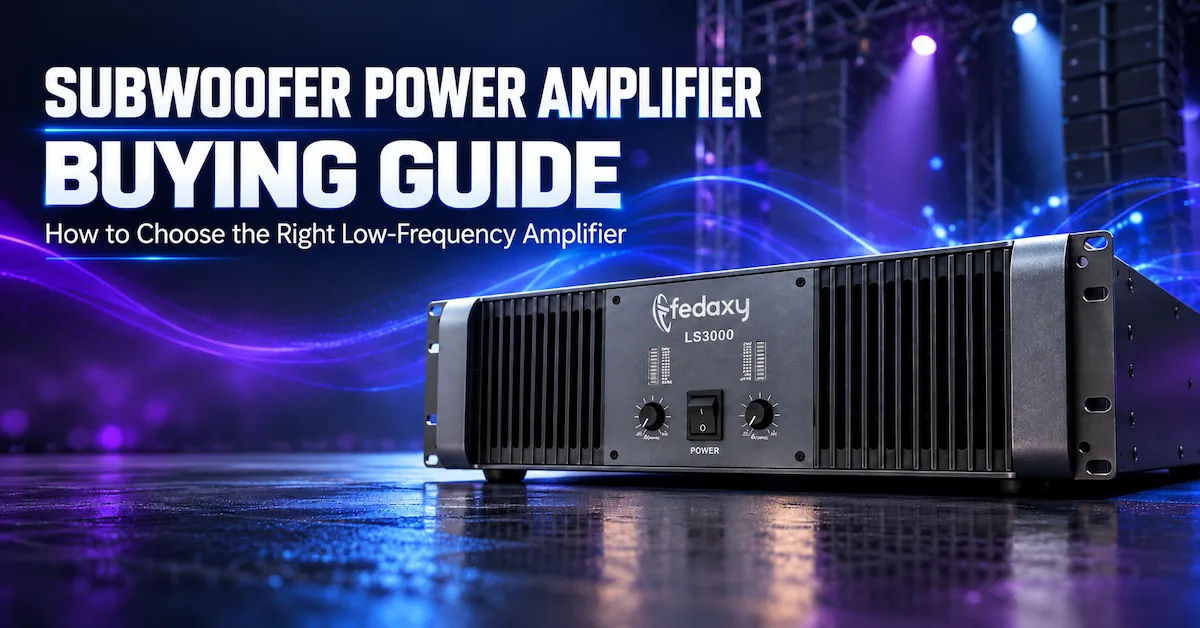
The most direct public evidence for a high power subwoofer amplifier is the LS series page. Fedaxy describes LS3000 as a 3U two-channel Class TD amplifier for demanding low-frequency applications and publishes a family table from LS1200 through LS3000. The page states that LS3000 delivers 2×3000W at 8Ω, 2×4500W at 4Ω and 2×7500W at 2Ω, with 8Ω bridge power listed as 9000W. These are published model figures; the buyer should confirm the exact test method and order configuration in the quotation.
| LS model | 8Ω stereo power | 4Ω stereo power | 2Ω stereo power | 8Ω bridge power |
|---|---|---|---|---|
| LS1200 | 2×1200W | 2×1800W | 2×3000W | 3600W |
| LS1500 | 2×1500W | 2×2300W | 2×3800W | 4500W |
| LS1800 | 2×1800W | 2×2700W | 2×4500W | 5400W |
| LS2000 | 2×2000W | 2×3000W | 2×5000W | 6000W |
| LS2200 | 2×2200W | 2×3300W | 2×5500W | 6600W |
| LS2400 | 2×2400W | 2×3600W | 2×6000W | 7200W |
| LS3000 | 2×3000W | 2×4500W | 2×7500W | 9000W |
The same page publishes frequency response of 20Hz–20kHz at ±0.5dB, THD below 0.05%, signal-to-noise ratio above 110dB, input sensitivity of 0.775V/1.0V/1.4V, damping factor above 500, crosstalk above 35dB and a 20V/µs slew rate. It also lists balanced 20kΩ and unbalanced 10kΩ input impedance, four intelligent fans with front-to-back exhaust, power-on buffer, over-temperature, short-circuit and output DC protection, and a 200–240V, 50–60Hz supply.
These figures answer a meaningful buyer question: can a two-channel platform cover several subwoofer cabinet configurations while keeping the same family architecture? They do not answer every question. A buyer still needs the sample’s measured output, noise at idle, connector layout, rack depth, actual carton dimensions, net/gross weight for the selected model, service parts, and whether the local mains version is available.
Request the LS Series Data Sheet and Project Matching →
8. When a Three-Channel Model Makes Sense
Not every system wants two identical bass channels. The KP2612 three-channel Class H amplifier is publicly titled as a 3-channel model with 2×600W plus 1200W, including a dedicated subwoofer channel. That configuration can be useful for a compact two-way system where the left and right channels drive full-range cabinets and the third channel drives the subwoofer section.
The advantage is deployment simplicity: one chassis can keep the low-frequency channel and the two main channels together. The trade-off is that the installer must confirm the exact impedance and filter workflow, and the system preset must be written for the specific cabinets. Do not treat the product title as a universal recommendation.Ask Fedaxy for the current specification sheet, DSP or external-crossover plan, output at the final load and the protection limits for the intended venue.
| Use case | Why a 3-channel layout helps | What to confirm |
|---|---|---|
| Small club or KTV zone | One rack can serve left, right and subwoofer sections | Channel power, crossover ownership, fan noise and rack depth |
| Portable DJ or event rig | Fewer boxes and simpler cabling | Flight case fit, connector panel and mains current |
| Compact installation | A single amplifier can reduce service points | Long-term thermal behavior and replacement availability |
| OEM speaker package | A branded amplifier can be matched to a defined system preset | Logo, panel, firmware, manual and warranty workflow |
9. Class D Options for Dense Touring and Installation Racks
For buyers comparing a Class D subwoofer power amplifier with a larger chassis, the first question is rack economics. A 1U amplifier can leave space for DSP, power distribution and cable management, but only if the published output, heat path and minimum load fit the system. Fedaxy lists D43000 as a 1U four-channel 4×3000W Class D model and DF3000 as a 1U four-channel 4×3000W Class D amplifier with DSP and Dante.
DSP and network audio can simplify a multi-zone system when the integrator has a clear control plan. The buyer should specify whether Dante is required, how presets are protected, who owns firmware updates, and whether a replacement unit can receive the same configuration. A feature list is not a commissioning plan.
| Class D buying checkpoint | Why it matters in a subwoofer rack | RFQ wording |
|---|---|---|
| 1U thermal headroom | High power density can concentrate heat in a short chassis | “Provide thermal limits for continuous low-frequency use and all-channel drive.” |
| DSP and Dante scope | Routing and protection depend on the actual software workflow | “Confirm inputs, outputs, crossover, limiter, delay, presets and network control.” |
| 2Ω or low-load support | Bass cabinets often create the lowest impedance in the rack | “State minimum approved impedance and restrictions at local voltage.” |
| Service and firmware | A networked amplifier must remain maintainable after installation | “Provide update method, backup file format and spare-parts policy.” |
10. DSP, Crossover and Limiter Requirements
A power amplifier can be electrically strong and still damage a subwoofer if the processing is wrong. The processor must establish the high-pass boundary, low-pass crossover, equalization, delay, polarity and limiter behavior. If DSP is inside the amplifier, the buyer should request a written signal-flow diagram and an approved preset. If processing is external, the amplifier supplier should still explain the expected input sensitivity, gain structure and protection interaction.
For a subwoofer project, ask the engineer to document the following: cabinet model, driver count, nominal and minimum impedance, crossover slope and frequency, limiter threshold, attack and release, delay reference, polarity, maximum amplifier output, cable length and mains circuit. These details make the discussion concrete and reduce the chance that a powerful amplifier is paired with an unsafe preset.
| Processing function | Subwoofer purpose | Evidence to keep in the project file |
|---|---|---|
| High-pass filter | Prevents wasted excursion below the cabinet’s safe operating range | Frequency, slope and preset version |
| Low-pass filter | Keeps low-frequency energy in the subwoofer section | Crossover point, slope and alignment notes |
| Parametric EQ | Corrects the cabinet or room response without excessive boost | EQ bands, gain and measurement reference |
| Limiter | Keeps voltage, current and excursion within the system design | Threshold, attack, release and test track |
| Delay and polarity | Aligns subwoofer arrival time with the main system | Measurement method and final delay value |
11. Factory Quality Control and Test Evidence
The difference between a professional amplifier factory and a trading-only listing is visible in the test chain. A subwoofer power amplifier manufacturer should make that chain reviewable. A robust chain starts with incoming material inspection, continues through PCB assembly and wiring checks, then verifies electrical performance, aging, protection, safety and final appearance before packing. Fedaxy’s public product pages describe material inspection, PCB assembly inspection, aging test, performance testing, safety inspection and final inspection.
For a subwoofer order, ask the supplier to separate routine factory controls from your contractual acceptance tests. Routine controls may be internal. Acceptance tests should be agreed in writing: output at specified loads, THD limit, frequency band, gain, mains voltage, fan behavior, protection reset and labeling. This protects both sides because the factory knows exactly what “pass” means.
| QC stage | Typical check | Buyer-facing record |
|---|---|---|
| Incoming inspection | Power devices, capacitors, transformers, connectors, PCBs and mechanical parts | Material lot or incoming checklist |
| Assembly inspection | PCB soldering, wiring, torque, insulation and mechanical fit | In-process inspection record |
| Electrical performance | Output power, THD, frequency response, S/N, gain and channel balance | Model-specific test sheet |
| Aging test | Continuous operation under defined load and temperature | Aging start/end record and failure disposition |
| Protection verification | Over-temperature, short circuit, overload, DC and power-on buffer | Protection test checklist |
| Final inspection | Labels, accessories, firmware, appearance, carton and quantity | Final QC report and packing list |
A product photograph shows what the model looks like; a test record shows what the model did. For a high-value subwoofer system, request both. If a supplier cannot share a full report, ask for a redacted sample form and define the fields that will be supplied with your order.
12. Materials, Power Supply and Thermal Design
Low-frequency performance is limited by the whole power path. The right subwoofer power amplifier manufacturer will connect the power-supply design to the actual bass duty cycle. The transformer, switching stage, capacitors, output devices, PCB layout, connectors, fan control and chassis all contribute. Fedaxy publicly highlights 100% copper transformers and real rated wattage. For OEM buyers, the practical next step is to identify which components are fixed, which are approved alternatives, and how a component substitution is controlled during a long production run.
Ask about the mains range and connector standard for the target market. The LS page lists 200–240V, 50–60Hz for the published configuration, which may suit many markets but should not be assumed to cover every country or product family. Voltage, plug, fuse, inrush, rack distribution and local compliance must be confirmed before the purchase order.
Thermal design deserves its own drawing. A front-to-back airflow path can work well in touring racks, but it can be blocked by a door, dust filter or adjacent equipment. Record the minimum clearance, fan replacement method, acceptable ambient temperature and the response when the amplifier reaches a thermal limit.
13. Manufacturing, OEM and Private-Label Services
An OEM subwoofer power amplifier program normally includes more than a logo. It may include front-panel artwork, model naming, connector selection, regional voltage, DSP preset, manual, carton, label, warranty card, accessories and a controlled revision process. Fedaxy’s product pages state support for OEM, ODM, OBM, OIM and SKD cooperation, including logo customization, front-panel design, packaging design, product configuration adjustment and project-based amplifier solutions.
For a brand that needs a custom subwoofer power amplifier rather than a catalog unit, start with a configuration brief. Define the target cabinet, required output, load, channels, rack height, DSP, network audio, voltage, connectors, cooling direction, visual identity, forecast and market documents. A factory can then tell you which parts are standard, which require engineering, and which changes would alter the validation plan.
| OEM workstream | Buyer input | Factory output to approve |
|---|---|---|
| Industrial design | Logo, panel layout, color, model name and controls | 2D/3D panel proof and sample |
| Electrical configuration | Output, load, channels, voltage, connectors and gain | Schematic or configuration sheet and test plan |
| DSP and firmware | Crossover, limiter, presets, control interface and update ownership | Preset file, firmware version and backup method |
| Packaging | Carton marks, inserts, accessories, barcode and pallet rules | Packaging artwork, carton sample and packing list |
| Documentation | Manual, datasheet, warranty and compliance language | Final PDF set and revision number |
| Production control | Forecast, MOQ, order cadence and change-notice rule | Approved BOM, inspection plan and change-control process |
14. MOQ, Lead Time, Packaging and Commercial Questions
Professional buyers ask about MOQ. A subwoofer power amplifier manufacturer should provide the answer for the exact model and configuration rather than a generic promise. Ask about lead time early because a technically suitable amplifier can still fail the project if it cannot be supplied in the required window. Fedaxy’s public pages do not publish one universal MOQ or lead time for every amplifier. That is a reason to request a model-specific quotation, not a reason to guess. The correct commercial answer depends on stock status, standard versus OEM configuration, component availability, order quantity, test scope and destination.
| Commercial field | Why it matters | What to request from Fedaxy |
|---|---|---|
| MOQ | Determines whether a trial SKU or private-label launch is practical | Separate sample quantity, standard-model MOQ and OEM MOQ |
| Sample lead time | Sets the engineering approval calendar | State whether the sample is from stock or built to order |
| Mass-production lead time | Controls the customer delivery promise | Give production days after deposit, artwork and BOM approval |
| Packaging | Protects heavy amplifiers in export handling | Carton dimensions, gross weight, pallet or container plan and marks |
| Shipping terms | Changes landed cost and responsibility | Compare EXW, FCA, FOB, CIF, CNF, DDU or other agreed terms |
| Warranty and service | Reduces risk after installation | State warranty period, exclusions, spare parts and RMA process |
The Fedaxy FAQ lists common international terms including T/T, Western Union, FOB, CIF, CNF, FCA, EXW and DDU and mentions shipment through ports such as Nansha, Shekou, Yantian and Huangpu. Confirm the exact term, party responsible for export documents and the destination handling cost on the proforma invoice.
Get a Model-Specific MOQ, Lead Time and Packing Quote →
15. Wholesale Buying: Compare Total Cost, Not Only Unit Price
When a distributor searches for a wholesale subwoofer power amplifier, the unit price is only one part of the decision. A lower-price unit may need an external DSP, a larger rack, additional cooling, more service inventory or a different carton. A slightly higher purchase price can be commercially better if the model reduces deployment time, returns or configuration errors.
| Cost line | Questions for a wholesale buyer | Why it changes margin |
|---|---|---|
| Product price | Is the quotation for the exact model, voltage and accessories? | Avoids comparing incomplete configurations |
| Freight and dimensional weight | What are carton size, gross weight and pallet count? | Heavy 3U amplifiers can change freight tiers |
| Rack and power infrastructure | Does the platform need extra space, distribution or cooling? | Installation cost can exceed a small unit-price gap |
| DSP and commissioning | Is processing integrated or external? | Preset work and technician time affect project margin |
| Spare and warranty stock | What failures and parts should the distributor plan for? | A service reserve protects customer relationships |
| Repeat-order consistency | Will components and firmware remain controlled? | Avoids field differences between batches |
Build a landed-cost worksheet for one complete deployment: amplifier, DSP or preset work, connectors, rack accessories, freight, duties, local compliance, installation labor and service reserve. Then compare suppliers on the same scope.
16. Applications and Operating Environments
The same amplifier model can appear in different environments, but the acceptance test should reflect the environment. A festival rental rack needs repeated setup, vibration protection, quick access and high duty. A cinema or theater values quiet operation, predictable coverage and service access. A KTV or club may need several channels, long opening hours and simple replacement. A fixed installation may prioritize network control, security and documented presets.
| Environment | Low-frequency demand | Typical selection focus | Evidence to request |
|---|---|---|---|
| Touring and festivals | High program peaks, frequent transport, multi-cabinet arrays | 2Ω capability where approved, rack density, cooling and protection | All-channel output, thermal run and vibration/packing plan |
| KTV and clubs | Long operating hours, multiple zones, strong bass content | Channel count, noise, preset workflow and serviceability | Continuous-duty guidance and protection reset behavior |
| Theater and cinema | Controlled coverage, low noise and repeatable tuning | DSP, quiet fan profile, low distortion and system integration | Noise specification, preset and commissioning record |
| Conference and hotel | Moderate bass, high uptime and simple operation | Efficient rack, simple control and replacement availability | User manual, service plan and local voltage |
| Outdoor fixed installation | Weather exposure around racks, long cable runs and service access | Rack location, protection, remote monitoring and cable loss | Installation drawing and environmental limits |
17. A Practical Supplier Comparison Scorecard
Use a scorecard before selecting a factory. It helps you distinguish a subwoofer power amplifier manufacturer with evidence from a listing with slogans. The scorecard keeps a persuasive sales conversation from replacing a technical decision. Score each supplier only when evidence is available. “Yes, we can” is a starting statement; a model-specific document, sample or test result is evidence.
| Evaluation area | Weight | Pass condition |
|---|---|---|
| Load and output transparency | 20% | Power is published at the intended impedance with conditions and limits |
| Thermal and protection design | 15% | Cooling path, fan behavior and protection functions are documented |
| Factory QC and aging | 15% | Supplier explains inspection stages and provides a sample record |
| Product and platform range | 10% | Supplier can move between Class D, TD, H or AB when the project needs it |
| OEM/ODM control | 15% | Branding, panel, packaging, configuration and revision process are defined |
| Commercial reliability | 10% | MOQ, lead time, shipping term and warranty are stated for the exact model |
| Technical support | 10% | Supplier can review cabinet data, presets, wiring and commissioning questions |
| Market documentation | 5% | Target-market certificates and manuals are available for the selected model |
A supplier can score well with a standard amplifier and still be wrong for an OEM project if it cannot control revisions. If you are comparing a subwoofer power amplifier supplier, ask every candidate to answer the same load, test, MOQ and service questions so the scorecard remains fair. Conversely, a factory with strong engineering may be the better long-term partner even when the first sample needs more discussion.
18. Fedaxy Manufacturing and Service Advantages
Fedaxy positions itself as a professional power amplifier manufacturer based in Panyu, Guangzhou, a Chinese audio-industry cluster. The company states that it integrates product development, production, testing, sales and technical support under one roof. Its public profile says it has more than 15 years of R&D and production experience, exports more than 90% of products to overseas markets and serves more than 100 countries across Europe, America, Asia and Africa.
For a B2B buyer, those statements matter because the supplier conversation can cover product selection, production and after-sales support in one channel. The buyer should still separate public company-level evidence from a model-level guarantee. Ask which factory, line, revision and test form will apply to your order.
| Published Fedaxy capability | Why it helps the buyer | What to confirm for your order |
|---|---|---|
| Class D, Class TD, Class H and Class AB platforms | Allows the supplier to compare architectures instead of forcing one class | Recommended model and reason for the selected cabinet |
| More than 15 years of experience | Suggests accumulated engineering and production practice | Current engineering contact and model revision |
| Five rounds of QC testing | Creates multiple inspection points before shipment | Exact QC checklist and report fields |
| Eight-hour aging test | Screens stability under an extended run | Load, temperature, duration and pass criteria |
| 100% copper transformers and real wattage | Addresses power-supply and rating concerns | Component specification and test method for the selected model |
| ISO9001, CE, RoHS and CB listed publicly | Provides a starting point for market-document review | Certificate scope, number, validity and model coverage |
| Three-year warranty | Provides a stated after-sales baseline | Warranty terms, exclusions, parts and RMA timing |
Discuss a Fedaxy Subwoofer Amplifier Program →
19. Step-by-Step RFQ Process for a Subwoofer Amplifier Project
A clear service process reduces revisions and makes a quotation comparable. Use the following sequence with any serious manufacturer.
- Project brief: share cabinet model, driver count, continuous and program power, nominal and minimum impedance, cabinets per channel, application, location, mains voltage and required delivery date.
- Architecture review: ask the manufacturer to compare Class D, Class TD, Class H or Class AB options and explain the trade-offs in rack size, heat, cost and service.
- Shortlist: select one standard model and one alternative. Record output at 8Ω, 4Ω and 2Ω where relevant, bridge limits, channel count, rack height, cooling and protection.
- Sample plan: confirm sample quantity, sample price, lead time, firmware, DSP preset, label, accessories and test documents.
- Validation: run the sample with the actual subwoofer cabinet or a documented equivalent load. Measure output, noise, temperature, protection behavior and system response.
- Commercial quotation: request product price, MOQ, production lead time, packaging, gross weight, shipping term, payment schedule and warranty.
- Approval file: freeze model code, BOM, firmware, artwork, manual, test limits and change-notice rules.
- Production and QC: require incoming, assembly, aging, performance, safety and final inspection records in the agreed format.
- Packing and shipment: verify serial numbers, accessories, carton marks, pallet plan, export documents and destination instructions.
- After-sales review: keep the preset, wiring, test results and service contact with the installed system so a replacement can be configured quickly.
20. Sample Qualification: What to Test Before a Bulk Order
A sample is not only a sound audition. It is a controlled opportunity to verify the configuration that will become a production reference. Test the amplifier with the real cabinet or a load bank that matches the expected impedance and duty.Record the signal source, frequency, crest factor, input sensitivity, cable, mains voltage, ambient temperature and duration.
| Sample test | Suggested observation | Pass record |
|---|---|---|
| Output at 8Ω and 4Ω | Compare measured power and distortion with the quoted conditions | Instrument, frequency, THD and duration |
| 2Ω or minimum approved load | Check current, heat, limiter and protection behavior | Load, ambient temperature and manufacturer limit |
| Low-frequency sweep | Check response, noise, stability and unexpected resonance | Sweep range, level and system configuration |
| Long-duration program | Observe temperature, fan behavior and drift | Start/end temperature and protection events |
| Short circuit / protection simulation | Confirm safe mute, recovery and service indication | Test method and reset behavior |
| Mechanical and packaging check | Confirm rack fit, connectors, handles, carton and accessories | Photos, dimensions and packing checklist |
Do not use an unapproved test to demand an unagreed result. Agree the method with the factory first, then keep the test file with the purchase order.
21. Common Buying Mistakes That Create Subwoofer Failures
- Choosing by the largest peak wattage without checking continuous power, impedance and measurement method.
- Assuming a 2Ω rating applies to every channel, every program type and every rack temperature.
- Connecting parallel cabinets without calculating the final load seen by the amplifier.
- Ignoring crossover and limiter settings because the amplifier is advertised as “high power.”
- Placing a dense 1U amplifier in a rack that blocks the intended airflow path.
- Approving a sample without freezing firmware, label, connector layout and component revision.
- Comparing a standard model quote with an OEM quote that includes different packaging, documentation and testing.
- Promising a customer a universal MOQ or lead time when the manufacturer has not confirmed the exact configuration.
- Using a product certificate as proof that every model in a category carries the same scope.
- Buying a low-frequency amplifier without a service and replacement plan for the installed market.
The cure is a written brief and a model-specific evidence file. Professional suppliers welcome precise questions because the answers reduce disputes later.
22. FAQ for Subwoofer Power Amplifier Buyers
What is a subwoofer power amplifier manufacturer?
It is a company that designs, builds, tests and supplies power amplifiers intended for professional audio systems, including the low-frequency sections of touring, KTV, club, cinema, theater, installation and commercial PA systems. A manufacturer should be able to explain output conditions, load limits, protection, production controls and support.
How do I choose a subwoofer amplifier manufacturer?
Start with the loudspeaker and project brief. Compare continuous output at the actual impedance, all-channel behavior, cooling, protection, QC, sample testing, documentation, OEM capability and repeat-order control. Ask for evidence at model level rather than relying on general quality claims.
Is Class D good for subwoofer systems?
Class D can be an excellent choice when high efficiency, compact rack density and controlled thermal design are priorities. The specific model still needs to match the cabinet load, channel count, mains supply, DSP plan and operating schedule.
Is Class TD suitable for high-power subwoofers?
Class TD platforms are commonly considered for high-output professional systems. Fedaxy’s LS family is publicly described for demanding low-frequency applications and publishes 8Ω, 4Ω, 2Ω and bridge figures. Confirm the test conditions and approved operating limits for the exact model.
Can a two-channel amplifier drive four subwoofers?
Possibly, if the cabinets can be wired to an approved impedance and the amplifier is rated for that load. Two 8Ω cabinets in parallel are approximately 4Ω; four are approximately 2Ω. Confirm the real cabinet impedance, wiring and thermal limits before ordering.
What does 100% real wattage mean?
It is a manufacturer statement that the rated output is intended to be genuine rather than an inflated marketing figure. Buyers should still request the measurement method, frequency, THD, duration, voltage and number of channels driven.
Does Fedaxy publish MOQ and lead time for every amplifier?
No single universal MOQ or lead time should be assumed from the public catalog. Ask Fedaxy for a model-specific quotation that separates standard products, samples and OEM configurations and states the production and shipping schedule.
What OEM changes can a subwoofer amplifier factory support?
Fedaxy’s public pages describe OEM, ODM, OBM, OIM and SKD cooperation, including logo, front-panel and packaging design, configuration adjustment and project solutions. Confirm which changes are available for your selected model and what engineering or MOQ requirements apply.
What quality tests should I request?
Request incoming material inspection, PCB and assembly checks, output and audio-performance testing, aging, thermal and protection verification, safety inspection and final inspection. Agree the fields, limits and report format before production.
Can Fedaxy provide a Class D subwoofer amplifier with DSP or Dante?
Fedaxy publicly lists Class D models including DF3000 with DSP and Dante, as well as other Class D platforms. Confirm the exact DSP functions, network interface, presets, firmware, control software and load capability in the current data sheet.
What information should I send for a quote?
Send the cabinet model, continuous/program power, nominal and minimum impedance, cabinets per channel, desired channels, application, mains voltage, rack height, DSP/network needs, brand/OEM requirements, estimated quantity, destination and target delivery date.
How long is the Fedaxy warranty?
Fedaxy publicly states a three-year warranty on its company and product pages. Confirm the warranty scope, exclusions, parts, labor, shipping responsibility and RMA procedure for the exact model and destination market.
23. Fedaxy Model Shortlist for a First RFQ
The following shortlist is a starting point for discussion, not a universal recommendation. A technical reviewer should map each candidate to the real cabinet load and operating environment.
| Starting point | Published configuration | Why it may enter the shortlist | Best next question |
|---|---|---|---|
| LS3000 | 3U, 2-channel Class TD; 2×3000W@8Ω, 2×4500W@4Ω, 2×7500W@2Ω | High-power low-frequency and touring discussions | Confirm test method, current limit, rack airflow and cabinet count |
| D43000 | 1U, 4-channel Class D; 4×3000W | Dense multi-channel racks | Confirm low-impedance output, all-channel thermal result and DSP plan |
| DF3000 | 1U, 4-channel Class D with DSP and Dante; 4×3000W | Networked and processed systems | Confirm Dante workflow, preset protection and replacement process |
| DP41500 | 1U, 4-channel DSP Class TD; 4×1500W@8Ω, 4×2250W@4Ω, 4×3750W@2Ω | Compact mixed-frequency racks | Confirm subwoofer channel allocation and DSP controls |
| KP2612 | 3-channel Class H; 2×600W + 1200W | Compact left/right plus subwoofer systems | Confirm impedance, filters, sound profile and installation fit |
| TD41600 | 2U, 4-channel Class TD; 4×1600W@8Ω, 4×2400W@4Ω, 4×4000W@2Ω | Four-channel touring and event systems | Confirm all-channel low-frequency duty and power supply behavior |
If your business also sells full-range, monitor or installation amplifiers, a family approach can simplify stocking and training. The purchasing advantage is consistent control layout, documentation and service logic across several models.
24. How to Turn This Guide into a Purchase-Ready RFQ
Copy the following fields into your request for quotation. A complete RFQ lets Fedaxy respond with a real model recommendation rather than a generic catalog link.
| RFQ field | Example format |
|---|---|
| Company and role | Audio distributor / rental company / AV integrator / OEM brand |
| Application | Touring subwoofer rack, KTV, club, cinema, theater or fixed PA |
| Speaker model | Brand, model, driver count and cabinet quantity |
| Load | Nominal impedance, minimum impedance and final wiring per channel |
| Power target | Continuous/program rating and preferred headroom policy |
| Amplifier format | 2CH/3CH/4CH, 1U/2U/3U, bridge requirement |
| Processing | External DSP, internal DSP, Dante, crossover, limiter and preset needs |
| Electrical | Country, mains voltage, frequency, plug, connector and rack conditions |
| Branding | Logo, front panel, model name, packaging, manual and warranty card |
| Commercials | Sample quantity, estimated first order, annual forecast, destination and target date |
| Evidence | Required certificates, test report fields, serial number and QC documents |
Send Fedaxy Your Complete RFQ →
25. Final Decision: What a Reliable Partner Looks Like
A reliable subwoofer power amplifier manufacturer makes the engineering decision visible. It can explain why a model fits the cabinet load, show the output conditions, discuss heat and protection, provide a sample path, and translate the approved configuration into repeatable production. It does not ask the buyer to choose from a peak-wattage list without context.
Fedaxy gives B2B buyers a useful starting platform: a Guangzhou manufacturing base, a public range across Class D, Class TD, Class H, Class AB and DSP products, low-frequency evidence for the LS family, and published QC and warranty claims. The next step is a model-specific conversation. Share your cabinet data, final impedance, required channels, DSP plan, voltage, quantity and delivery target so the factory can recommend a defensible configuration.
For a subwoofer amplifier manufacturer comparison, review the full Fedaxy product range and the company manufacturing profile. For an OEM subwoofer power amplifier or a private-label program, contact the engineering and sales team with the RFQ fields above.