
Why Class D Is a Strong Fit for Line Array Systems
A Class D power amplifier for line array systems should provide sufficient continuous output at the loudspeaker system's actual impedance while maintaining stable thermal performance, adequate headroom and predictable protection behavior.
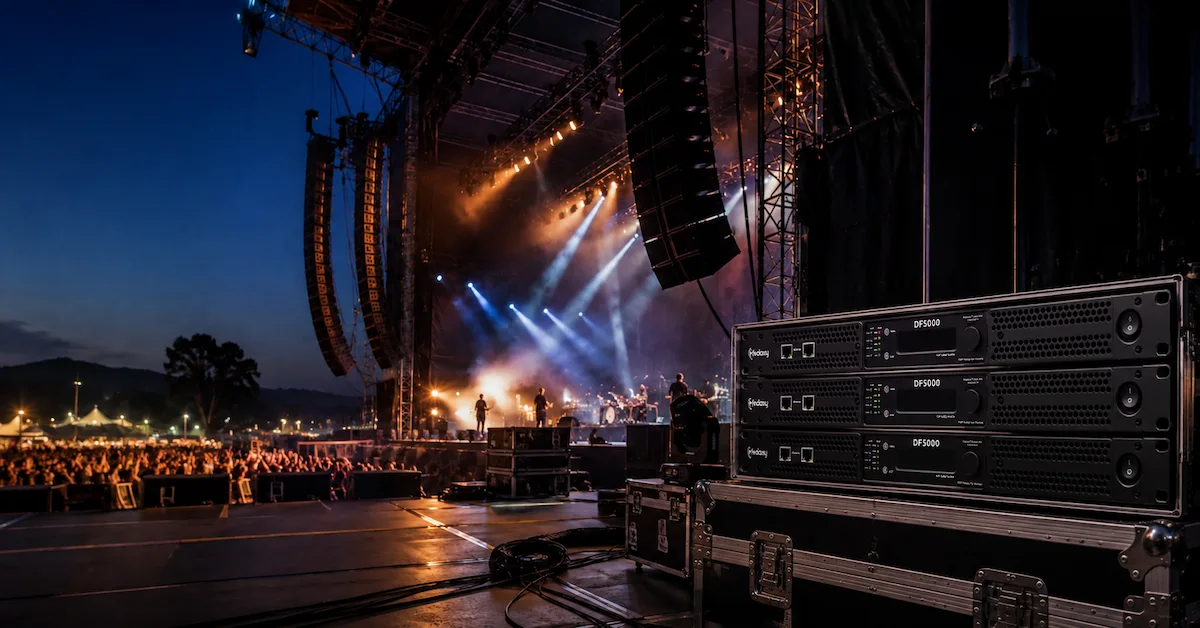
For touring companies, AV integrators, rental businesses and professional audio brands, choosing the right Class D power amplifier for line array systems is critical because modern live sound applications require high power density, stable operation, efficient cooling and reliable long-term performance.
However, Class D alone does not guarantee that an amplifier is suitable for a line array.
Before purchasing, buyers should evaluate:
- rated power at 8Ω, 4Ω and, when required, 2Ω
- number of amplifier channels
- loudspeaker impedance configuration
- required system headroom
- low-frequency power demand
- cooling and thermal protection
- DSP and loudspeaker management
- rack space and total system weight
- mains voltage requirements
- manufacturer testing and long-term supply capability
For available configurations, buyers can first review Fedaxy professional power amplifier products and compare models according to the requirements of the complete loudspeaker system rather than wattage alone.
What Makes Line Array Amplification Different?
Line array systems are normally used where sound must be distributed consistently across larger audience areas.
Typical applications include:
- concerts
- touring productions
- stadiums
- theaters
- outdoor events
- houses of worship
- multi-function halls
- large conference venues
- rental sound systems
A line array may contain multiple loudspeaker cabinets, multiple amplifier channels and separate low-, mid- or high-frequency sections.
This makes amplifier selection a system-level engineering decision.
A buyer must know not only the rated power of one loudspeaker cabinet, but also how cabinets are connected, what impedance each amplifier channel will see and how much power is required for different frequency bands.
Line Array Amplifier Selection Starts With the Load
Suppose several loudspeaker cabinets are connected to one amplifier channel.
Their combined impedance may be different from the nominal impedance of one cabinet.
For example, two identical 8Ω loudspeaker loads connected in parallel typically present approximately a 4Ω nominal load to the amplifier. Adding more parallel loads can reduce the impedance further.
The amplifier must therefore be specifically rated for the resulting operating load.
Running an amplifier below its supported minimum impedance can increase current demand and thermal stress, potentially causing protection shutdown or unreliable operation.
Why Class D Technology Works Well for Line Arrays
High Power Density
Large line array systems may require many amplifier channels.
Traditional racks can therefore become heavy and occupy significant space.
A properly designed Class D amplifier can provide substantial output from a compact chassis, allowing system designers to increase amplifier channel density without proportionally increasing rack size.
This is particularly valuable for:
- touring racks
- mobile rental systems
- large multi-channel installations
- projects where equipment-room space is limited
Higher Efficiency and Lower Heat Load
Not all input power becomes acoustic output. Amplifiers also produce heat.
Class D architectures generally achieve high electrical efficiency, reducing the amount of energy that must be dissipated as heat compared with many traditional linear designs.
For line array racks containing several amplifiers, this can help reduce:
- total rack heat
- cooling demand
- transportation weight
- power-distribution pressure
Efficiency is especially important when equipment operates for extended periods at demanding output levels.
Lower Transportation Weight
Rental and touring companies frequently move equipment between venues.
Reducing amplifier weight can improve:
- rack mobility
- loading efficiency
- installation time
- transportation logistics
This is one reason modern high-output Class D designs are common in professional touring and live sound systems.
How Much Amplifier Power Does a Line Array Need?
There is no single wattage that is correct for every line array.
Amplifier sizing should consider at least:
- loudspeaker continuous or RMS power rating
- nominal impedance
- number of cabinets connected per channel
- system processing
- required acoustic output
- application type
- desired headroom
- manufacturer recommendations
Do Not Match Amplifiers by Maximum Wattage Alone
A common procurement mistake is comparing an amplifier's highest advertised wattage with a loudspeaker's peak power rating.
These figures may describe different test conditions.
Instead, buyers should compare specifications under clearly defined operating conditions.
For the amplifier, check:
- output power per channel
- impedance
- number of channels driven
- distortion condition
- test duration or rating method where available
For the speaker, check:
- continuous/RMS power
- program power
- peak power
- nominal impedance
- manufacturer-recommended amplifier range
Why Headroom Matters
Live sound contains transient peaks.
If the amplifier reaches its voltage limit frequently, the output can clip.
Clipping can increase distortion and place additional stress on loudspeaker drivers.
Adequate amplifier headroom allows the system to reproduce short peaks without continuously operating at its limit.
This does not mean buyers should simply purchase the highest-powered amplifier available. Excessive power without correctly configured limiters can also damage loudspeakers.
The correct approach is:
speaker rating + actual load + required SPL + headroom + limiter strategy
rather than wattage alone.
8Ω, 4Ω or 2Ω: Which Load Is Better for a Line Array?
The correct impedance depends on the system architecture.
| Operating Load | Typical Situation | Main Advantage | Main Consideration |
|---|---|---|---|
| 8Ω | Fewer cabinets per channel | Lower current demand | More amplifier channels may be needed |
| 4Ω | Common parallel cabinet configurations | Good balance of power and channel use | Requires adequate cooling and current capacity |
| 2Ω | Multiple compatible loads on one channel | Higher rack utilization | Much higher current and thermal demand |
A professional amplifier should only be operated at 2Ω when the manufacturer explicitly specifies stable 2Ω operation.
Why 2Ω Operation Requires More Attention
Lower impedance generally requires the amplifier to deliver more current.
The power supply, output stage, cooling system and protection circuits must all be designed for this operating condition.
For B2B buyers, a published 2Ω wattage figure should therefore trigger additional questions:
- Is continuous 2Ω operation supported?
- How is the amplifier cooled?
- What protection functions are included?
- How is performance verified?
- What happens under high ambient temperature?
- Is the rating measured under realistic test conditions?
These questions are more useful than simply asking which amplifier has the highest 2Ω specification.
2-Channel or 4-Channel Class D Amplifier?
Line array projects often benefit from multi-channel amplifiers because different loudspeaker sections can be powered independently.
| Channel Configuration | Common Use | Procurement Value |
| 2-channel | Simple stereo systems, subwoofer channels | Straightforward configuration |
| 4-channel | Line arrays, bi-amped systems, touring racks | Higher channel density |
| Multiple 4-channel units | Large arrays and multi-zone systems | Scalable rack design |
Why 4-Channel Amplifiers Are Useful for Touring Racks
A 4-channel amplifier can reduce the number of chassis required for a multi-channel system.
Potential advantages include:
- fewer rack units
- less cabling
- lower transportation weight
- simplified system deployment
- easier channel organization
For example, Fedaxy's D43000 4-channel Class D power amplifier is designed as a high-density professional amplifier platform.
Its published output specifications include different ratings at 8Ω, 4Ω and 2Ω, which illustrates why buyers should compare the amplifier according to the actual load on each channel rather than a single maximum wattage figure.
A specific model should still be selected only after confirming loudspeaker impedance, required headroom and system processing.
What Specifications Matter Most Before You Buy?
Power Output at the Required Impedance
The most relevant wattage is the rating at the impedance your system will actually use.
If the line array operates at 4Ω per amplifier channel, the 4Ω specification is more important than the amplifier's bridge-mode or 2Ω maximum rating.
Signal-to-Noise Ratio
Signal-to-noise ratio indicates the relationship between useful audio signal and residual noise.
A higher S/N ratio can be beneficial in professional systems where multiple gain stages and high system output may make noise more noticeable.
However, S/N ratio should be evaluated together with proper system gain structure.
Total Harmonic Distortion
THD helps describe how much harmonic content is added by the amplifier under specified conditions.
Lower distortion is generally desirable, but buyers should also check the conditions under which the number was measured.
A very low THD figure at low output does not by itself prove that an amplifier will remain stable under demanding line array loads.
Damping Factor
Damping factor relates to the amplifier's ability to control the loudspeaker load relative to its output impedance.
It can be relevant to low-frequency control, but extremely high published numbers should not become the only selection criterion.
Cable resistance, loudspeaker impedance and the complete system design also influence actual performance.
Frequency Response
Professional line array amplification should provide suitable bandwidth for the intended loudspeaker system.
Subwoofer channels, full-range sections and multi-way systems may have different processing requirements, even when the amplifier itself provides a broad frequency response.
Cooling System
Cooling becomes increasingly important when:
- several amplifiers share one rack
- ambient temperature is high
- systems operate for long events
- channels drive low-impedance loads
Buyers should check airflow direction and ensure the rack design does not block amplifier ventilation.
DSP: Integrated Amplifier or External Loudspeaker Processor?
Line array systems commonly require signal processing.
Typical DSP functions include:
- crossover
- equalization
- delay
- limiter
- channel routing
- polarity control
- system presets
Integrated DSP Can Simplify the Rack
An amplifier with integrated DSP can reduce the number of external devices required.
This can be useful for:
- rental racks
- repeatable touring systems
- fixed installations
- OEM loudspeaker packages
External DSP Can Provide Greater System Flexibility
Some integrators prefer a separate loudspeaker processor when managing:
- multiple amplifier types
- complex routing
- large system inventories
- existing networked audio infrastructure
Neither approach is automatically better.
The choice depends on the system architecture, workflow and required control functions.
Buyers requiring DSP-based configurations can review Fedaxy's professional amplifier product range and confirm the available processing functions for the selected model before specifying a system.
Cooling and Thermal Stability Are Procurement Issues
High wattage is useful only when the amplifier can operate reliably in the intended environment.
A line array rack may be exposed to:
- long operating hours
- high ambient temperatures
- outdoor events
- dusty venues
- low-impedance loads
- restricted equipment rooms
A procurement specification should therefore include thermal considerations rather than treating cooling as a secondary feature.
Questions to Ask the Manufacturer
Before selecting a high-power Class D amplifier, ask:
- What is the supported minimum load?
- What cooling architecture is used?
- How is thermal protection triggered?
- Is the amplifier aging-tested?
- Is output tested before shipment?
- Can the amplifier operate under the required mains voltage?
- What technical support is available for project integration?
These questions help separate a realistic professional system specification from a simple catalog comparison.
Protection Functions to Check
A professional line array amplifier should have protection appropriate to high-output audio applications.
Depending on the design, these may include protection against:
- short circuit
- excessive temperature
- DC output
- over-current
- over-voltage
- under-voltage
- abnormal load conditions
Protection should keep the amplifier and loudspeaker system safer without causing unnecessary interruption during normal operation.
For rental companies and system integrators, predictable protection behavior is often more valuable than an impressive peak wattage number.
Buying Checklist for a Class D Line Array Amplifier
Before requesting a quotation, prepare the following information.
| Buying Question | Information to Confirm |
| Speaker type | Line array model and configuration |
| Speaker power | Continuous/RMS and program rating |
| Nominal impedance | Per cabinet and final channel load |
| Cabinets per channel | Parallel or other configuration |
| Required channels | 2CH, 4CH or larger rack system |
| Amplifier power | Output at the actual impedance |
| DSP | Integrated or external |
| Cooling | Rack airflow and operating environment |
| Power supply | Local mains voltage and distribution |
| Application | Touring, stadium, theater or installation |
| OEM requirements | Logo, panel, packaging or configuration |
| Support | Testing, warranty and technical assistance |
This information allows a manufacturer to recommend an amplifier based on the system rather than quoting a model from a single wattage requirement.
Common Mistakes When Selecting Line Array Amplifiers
Choosing by Peak Wattage
Peak numbers are not enough to determine system suitability.
Always compare power under the same impedance and operating conditions.
Ignoring the Final Channel Impedance
Several loudspeakers connected to one channel may create a lower load than expected.
Calculate the final load before ordering the amplifier.
Assuming Every Amplifier Can Run Continuously at 2Ω
A 2Ω specification should be supported by appropriate power supply, cooling and protection design.
Do not assume low-impedance capability from marketing language alone.
Underestimating Low-Frequency Power Demand
Subwoofer and low-frequency sections can place significant demand on amplifier channels.
System designers should allocate power according to each frequency band rather than treating every channel identically.
Ignoring Rack Cooling
High-density amplifiers reduce rack space, but airflow must still be properly planned.
Do not place equipment in a way that blocks intake or exhaust paths.
Buying DSP Features Without a Processing Plan
More DSP functions are not automatically better.
Define the required crossover, limiter, delay and routing functions before comparing DSP platforms.
What Should B2B Buyers Ask a Class D Amplifier Manufacturer?
For distributors, integrators and audio brands, the manufacturer itself is part of the system risk assessment.
A supplier should be able to explain:
- amplifier architecture
- rated output conditions
- impedance support
- thermal design
- protection logic
- testing procedures
- product consistency
- OEM options
- technical support
- warranty terms
Fedaxy describes itself as a professional power amplifier manufacturer with Class D, Class TD, Class H, Class AB and DSP platforms. More information about its manufacturing and quality-control background is available on the Fedaxy About Us page.
Quality Control Matters for Touring and Installation Projects
Line array amplifiers may operate at high output for extended periods, so QC should include more than visual inspection.
Important verification areas include:
- component inspection
- assembly inspection
- electrical performance
- power output
- distortion
- protection behavior
- thermal performance
- aging operation
- final inspection
Fedaxy states that its production process includes multiple quality-control stages and aging testing before shipment.
For a project-specific order, buyers should still request the exact testing requirements applicable to the selected amplifier model.
OEM Class D Amplifiers for Line Array Brands
Professional audio brands may require more than an off-the-shelf amplifier.
OEM requirements can include:
- custom front panel
- private label branding
- model designation
- connector configuration
- voltage requirements
- channel configuration
- packaging
- DSP presets or related product configuration
For an OEM project, the first step should be a technical requirement document rather than a price request alone.
Information to Send for an OEM Project
A useful project brief should include:
- target line array system
- loudspeaker impedance
- required output power
- number of channels
- rack-size target
- target market
- local mains voltage
- DSP requirements
- branding requirements
- expected order quantity
This reduces unnecessary revisions during engineering and quotation.
Buyers developing a new amplifier platform or private-label line array solution can contact Fedaxy with the loudspeaker configuration and target specifications for further evaluation.
Class D Power Amplifier Selection by Application
| Application | Main Amplifier Priority | Typical Buying Concern |
| Touring line array | Power density, weight, 4CH design | Transport and fast deployment |
| Stadium system | Stable high output, cooling | Long operating periods |
| Outdoor event | Thermal stability, protection | Temperature and mains conditions |
| Theater | Noise, distortion, DSP control | Speech and music clarity |
| Rental system | Flexible loads, reliability | Different speakers and venues |
| Fixed installation | Efficiency, rack density | Space, operating cost and maintenance |
The best amplifier is therefore not simply the model with the largest wattage number.
It is the model that fits the electrical load, acoustic design, rack architecture and operating environment of the complete line array system.
FAQ
1. Is a Class D power amplifier good for line array systems?
Yes. Class D amplifiers are widely suited to professional line array systems because they can provide high power density, good efficiency and lower rack weight. The specific amplifier must still match the system's impedance, channel count and power requirements.
2. How much amplifier power do I need for a line array?
Start with the loudspeaker manufacturer's continuous/RMS power rating, nominal impedance, number of cabinets connected per channel and recommended amplifier range. Then account for the required headroom and limiter configuration.
3. Can I use a 2Ω Class D amplifier for multiple line array speakers?
Only if the final connected load is compatible with the amplifier's published minimum impedance and the manufacturer approves 2Ω operation. Low-impedance operation places greater current and thermal demands on the amplifier.
4. Is a 4-channel Class D amplifier better for line arrays?
A 4-channel amplifier can be advantageous when a system requires several independently powered loudspeaker sections. It can reduce rack space, cabling and total equipment weight, but the correct channel count depends on the system topology.
5. Do line array amplifiers need DSP?
Most professional line array systems require some form of loudspeaker processing for crossover, EQ, delay, limiting or routing. The DSP may be integrated into the amplifier or provided by an external processor.
6. What is more important: amplifier wattage or impedance?
Both are connected. An amplifier's wattage rating is meaningful only at a specified load impedance. Buyers should compare the output power available at the actual impedance presented by the loudspeaker system.
7. Is bridge mode recommended for line array systems?
Bridge mode can provide higher voltage output for certain loads, but it changes the load seen by each amplifier channel and may impose additional restrictions. Use bridge mode only according to the amplifier and loudspeaker manufacturer's specifications.
8. What should rental companies prioritize in a line array amplifier?
Rental companies typically benefit from high power density, manageable rack weight, reliable cooling, flexible channel configuration, stable protection and straightforward deployment across different venues.
9. Can Class D line array amplifiers be customized for OEM brands?
Yes, depending on the manufacturer's capabilities. OEM projects may include branding, panels, connectors, voltage configuration, packaging and selected technical configurations. Exact customization options should be confirmed before engineering begins.
10. What information should I send when requesting a line array amplifier quotation?
Provide the loudspeaker model, continuous power rating, nominal impedance, cabinets per channel, required amplifier channels, application, local voltage, DSP requirements and expected order quantity.
Conclusion
Choosing a Class D power amplifier for line array systems requires a system-level evaluation rather than a comparison of maximum wattage alone. The right Class D power amplifier for line array systems should match speaker impedance, output requirements, DSP needs, thermal conditions and application environments.
Professional buyers should verify:
- output power at the actual operating impedance
- speaker-to-amplifier power matching
- headroom
- channel density
- 2Ω capability where required
- DSP strategy
- thermal management
- protection
- rack configuration
- manufacturer testing and support
Class D technology can be an excellent choice for touring, stadium, rental and fixed line array systems because it supports high power density and efficient rack design. The final amplifier, however, must be selected around the loudspeaker load and real operating environment.
Fedaxy provides professional Class D and other amplifier platforms for B2B audio applications. To evaluate an existing line array project or discuss a custom amplifier configuration, review the Fedaxy amplifier range or contact Fedaxy for project support.