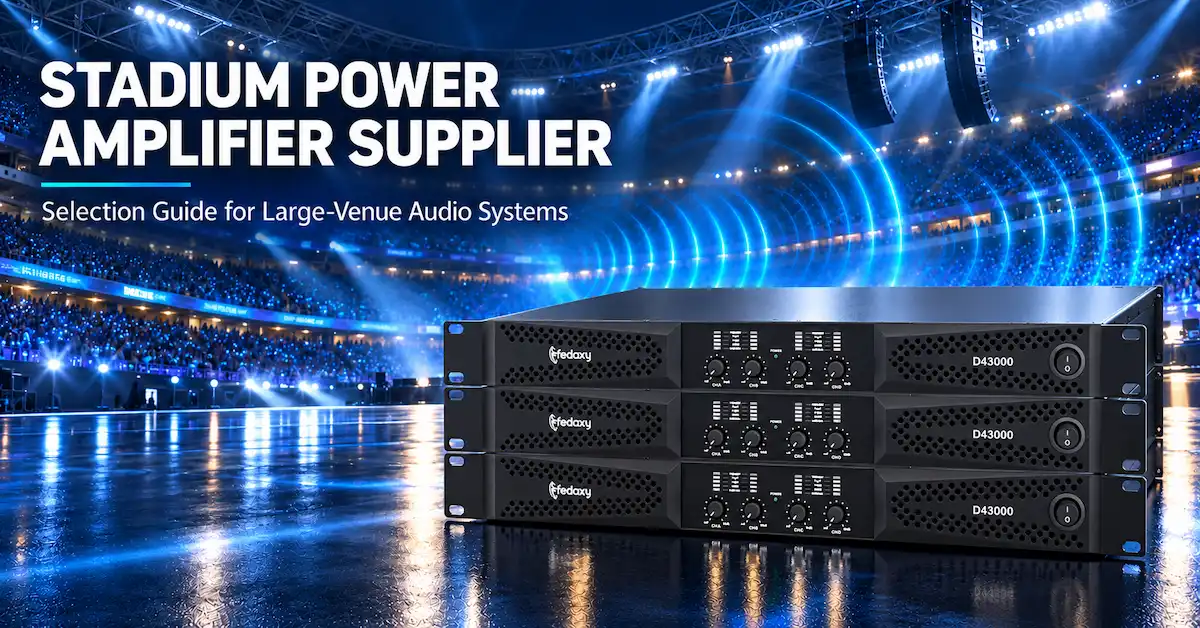
A stadium power amplifier supplier should provide more than a high wattage number. For a sports venue, concert arena, outdoor event site, or public address installation, the amplifier must work with the loudspeaker impedance, coverage zones, signal-processing system, rack design, power supply, cooling conditions, and operating schedule.
Need the Right Amplifier for Your Stadium System?
Send your loudspeaker model, impedance, channel plan, rack conditions, and venue requirements for a project-specific review.
Get a Project RecommendationView All AmplifiersWhat Does a Stadium Power Amplifier Supplier Need to Prove?
A stadium amplifier supplier should be able to answer six practical questions: Can the amplifier deliver stable output at the real loudspeaker impedance? Can every required channel operate under the planned duty cycle? How does it manage heat, overload, short circuit, DC fault, and abnormal conditions? Can it integrate with DSP, Dante, matrix, monitoring, and control systems? Can the approved configuration be repeated for future expansion? Will technical support and spare-part assistance remain available after delivery?
A product page may show a power figure, but the purchasing team needs the test voltage, frequency range, distortion limit, duration, number of channels driven, impedance, bridge mode, and operating restrictions. A rating such as “4 x 3,000 W” is not a complete comparison if one supplier measured a short single-channel burst and another measured all channels continuously.
A reliable stadium power amplifier manufacturer should help the buyer interpret data. The quotation should identify the exact model, voltage, connectors, cooling arrangement, protection functions, warranty terms, and documents supplied with the order.
Why Stadium Audio Systems Need Special Planning
A stadium is not one listening room. It normally contains main seating, VIP areas, concourses, hospitality rooms, press zones, entrances, outdoor plazas, training grounds, parking areas, and event-stage locations. Each zone may use different loudspeakers, cable lengths, acoustic targets, and control priorities.
The main bowl may need high-output line arrays or distributed loudspeaker clusters. Concourse areas may need compact loudspeakers with lower power demand. Public-address and emergency systems may use a separate signal chain and special redundancy planning. A high-power touring amplifier may fit the main event system but be inefficient for a small hospitality area. A compact multi-channel model may suit distributed loudspeakers but be unsuitable for a large low-impedance subwoofer array.
Before comparing suppliers, prepare a channel schedule showing the zone, loudspeaker model, quantity, wiring, nominal and minimum impedance, continuous power, program power, processing method, cable distance, amplifier channel, and spare requirement.
Stadium Amplifier Selection Starts with the Loudspeaker Load
The amplifier must match the final load presented by the loudspeaker system. If two nominal 8-ohm loudspeakers are connected in parallel, the calculated nominal load is approximately 4 ohms. Four 8-ohm loudspeakers in parallel approach 2 ohms. Actual impedance changes with frequency, so the nominal value is only one part of the engineering review.
| Required information | Why it matters |
|---|---|
| Nominal impedance | Establishes the basic amplifier load. |
| Minimum impedance | Shows the most demanding part of the loudspeaker response. |
| Loudspeakers per channel | Determines current demand and channel allocation. |
| Wiring arrangement | Parallel and series connections change the final load. |
| Continuous and program power | Defines sustainable output and event headroom. |
| Crossover and limiter | Controls energy delivered to each loudspeaker section. |
| Cable length | Helps assess loss and installation requirements. |
| Ambient temperature | Influences cooling and thermal headroom. |
Ask whether the selected model is approved for the planned impedance and whether all channels can operate together at that load. Never assume that a model's lowest published impedance applies to every installation condition.
Class D, Class TD, Class H, and Class AB for Stadium Projects
Class D Amplifiers
Class D amplifiers are often considered when a project needs compact rack packaging, efficient power conversion, and high channel density. A 1U multi-channel model can reduce rack height and simplify distributed loudspeaker deployment. Fedaxy lists the D43000 4-channel Class D amplifier and the DF3000 DSP and Dante amplifier. Confirm output, load limits, cooling, and processing requirements for the exact project.
Class TD Amplifiers
Class TD platforms may be considered for high-output professional sound systems used in touring, concerts, stadiums, theaters, and large events. The Fedaxy LS3000 Class TD amplifier is a published high-power model for demanding professional audio applications. Confirm the output conditions, approved impedance, cooling, and application suitability during technical review.
Class H and Class AB Amplifiers
Class H and Class AB models remain relevant for selected fixed installation, commercial audio, KTV, theater, and professional applications. The decision should consider output, rack space, heat, sound-system design, service preference, and existing inventory. The KP2612 Class H amplifier offers a three-channel configuration that may be reviewed for systems combining left, right, and low-frequency channels.
When Should a Stadium Buyer Choose DSP?
DSP can simplify system configuration, but it is not a substitute for correct loudspeaker design. A DSP amplifier may combine crossover, equalization, delay, limiting, routing, preset storage, protection settings, network monitoring, and remote control.
For stadiums, DSP can be useful because multiple zones may have different loudspeaker types and delay requirements. The RFQ should identify required channels, input format, Dante or network needs, control software, preset format, user access, remote monitoring, firmware control, and backup procedures.
The DP41500 DSP Class TD amplifier can be reviewed for compact multi-channel installations. Confirm the current DSP functions, network workflow, presets, and load capability before ordering.
How to Evaluate Amplifier Power
Use the loudspeaker manufacturer's recommended power range and the system designer's headroom policy. The largest available wattage is not automatically the best choice. Too little power can cause clipping when operators try to reach the required level. Excessive power can damage drivers if the limiter, crossover, wiring, or commissioning settings are incorrect.
Ask the supplier to explain continuous output, program output, bridge limitations, all-channel operation, thermal derating, current limiting, input sensitivity, gain structure, output voltage, and protection behavior. The system should also be commissioned for different operating modes such as matches, concerts, ceremonies, public announcements, and emergency messages.
Thermal Management and Rack Design
Stadium amplifiers may operate for long periods in dense racks. Rack planning should include amplifier height, front-to-back airflow, intake and exhaust direction, fan behavior, clearance, ambient temperature, dust, humidity, cable routing, power distribution, and service access.
Ask whether the amplifier is intended for a sealed rack, ventilated rack, or forced-air rack. Confirm what happens if a thermal limit is reached and whether the operator receives a clear indication. The final installation should follow the current product manual and technical documentation.
Protection Functions
Protection is important because stadium systems include long cable runs, large arrays, outdoor connections, and multiple operators. Ask whether the amplifier protects against short circuit, over-current, over-temperature, DC output, overload, unstable mains voltage, speaker wiring faults, and excessive current demand.
Also ask whether the amplifier recovers automatically, requires a manual reset, or must be inspected by a technician. Record the result during sample testing so the operations team knows how to respond during an event.
Factory Quality Control and Production Evidence
A professional supplier should explain incoming inspection, PCB checks, assembly verification, audio testing, output testing, protection testing, aging, thermal observation, safety inspection, final inspection, serial-number recording, and packaging inspection.
Fedaxy publicly describes multi-stage QC inspection and aging testing for its amplifier products. Buyers should confirm the current checklist and which records will be provided for the exact model. The approval file should include model code, hardware revision, component specification, connectors, front-panel design, label artwork, firmware, packaging, manual, warranty wording, and acceptance criteria.
Choosing a Supplier for Expansion Projects
A stadium may be built in phases. Later orders may add training grounds, hospitality areas, parking zones, or new event facilities. Ask whether the approved amplifier remains available, how component changes are controlled, whether revisions are disclosed, whether replacement units can match the original, and whether manuals and firmware are archived.
A low initial price cannot compensate for a replacement unit that does not match the original gain structure, DSP settings, connectors, or output behavior. Controlled documentation is more valuable than verbal promises.
Supplier Comparison Checklist
| Evaluation area | Question to ask |
|---|---|
| Product range | Are Class D, Class TD, Class H, Class AB, DSP, and Dante options available? |
| Output transparency | Are ratings published at the required impedance with test conditions? |
| All-channel performance | Can every required channel operate at the planned level? |
| Thermal design | Are cooling, fan behavior, derating, and clearance documented? |
| Protection | Are short-circuit, DC, overload, and temperature responses explained? |
| DSP and network | Can the amplifier work with the venue's control and processing system? |
| QC | Does the supplier provide inspection and aging evidence? |
| Repeat orders | Are revisions, firmware, BOM, and replacement models controlled? |
| OEM capability | Can branding, packaging, configuration, and documentation be customized? |
| Service | Is there a clear engineering, warranty, and spare-parts process? |
OEM and Private-Label Stadium Amplifier Programs
An OEM buyer may need a private-label amplifier for a stadium integrator, rental brand, distributor, or professional audio company. Possible requirements include front-panel logo, model name, serial number, packaging, manual, warranty card, DSP presets, control software branding, carton marks, and accessory packages.
Not every change has the same engineering impact. Artwork may be simple, while a connector, DSP, power supply, or chassis change may require engineering review and a new sample. Fedaxy's public information describes OEM, ODM, OBM, OIM, and SKD cooperation. Confirm available options, MOQ, sample requirements, engineering charges, documents, and approval steps for the exact model.
Building a Private-Label Stadium Amplifier Program?
Discuss logo customization, front-panel design, packaging, DSP configuration, documentation, and revision control with the Fedaxy team.
Discuss OEM CooperationLearn About FedaxyRFQ Information for a Stadium Power Amplifier Supplier
A complete RFQ helps the supplier recommend a real model instead of sending a generic catalog link. Include the project type, venue zones, loudspeaker models, quantity, nominal and minimum impedance, wiring plan, channel allocation, power target, DSP or Dante requirements, rack conditions, mains voltage, environment, quantity, destination, branding, documentation, delivery date, and service expectations.
You can send this information through the Fedaxy contact page to request a project-specific evaluation.
Sample Qualification Before a Bulk Order
Test the sample with the actual loudspeaker model whenever possible. If that is not practical, use a documented load bank that represents the planned impedance and duty cycle. Record input signal, frequency, sensitivity, gain, load, mains voltage, ambient temperature, duration, number of channels, output, distortion, fan behavior, temperature, protection events, noise, DSP preset, and network operation.
Do not compare suppliers using different test methods. Agree on the procedure before the sample arrives and keep the report with the purchase order and installation documentation.
Common Stadium Amplifier Purchasing Mistakes
- Choosing only by peak wattage without checking continuous output and impedance.
- Assuming a 2-ohm rating applies to every channel and every temperature.
- Connecting parallel loudspeakers without calculating the final load.
- Ignoring crossover, EQ, delay, and limiter settings.
- Installing a dense rack without checking airflow and service access.
- Approving a sample without freezing firmware, connectors, labels, and BOM.
- Comparing incomplete quotations with different accessories or testing.
- Promising universal MOQ or lead time before model confirmation.
- Buying without a replacement, spare-unit, and service plan.
FAQ for Stadium Power Amplifier Buyers
Applications and Operating Environments
Stadium amplifier selection should reflect the operating environment. A concert event may demand high program peaks and fast setup. A permanent sports venue may operate the system every day and require predictable service access. A training ground may use distributed loudspeakers over long cable runs, while a VIP or hospitality area may prioritize low noise and simple control. These areas should not automatically receive the same amplifier configuration.
Outdoor locations require additional attention to rack placement, temperature, moisture, dust, cable protection, and remote monitoring. Indoor technical rooms may have controlled conditions but limited access once the venue is open. The RFQ should therefore state where the rack will be installed, how often the system will run, who will operate it, and what spare equipment is available.
| Application | Selection focus | Evidence to request |
|---|---|---|
| Main stadium bowl | High output, coverage consistency, channel allocation, thermal headroom | All-channel output, load limits, DSP preset, thermal test |
| Concert and touring events | Rack density, transport, quick service, protection, repeatable setup | Mechanical details, cooling plan, sample procedure, spare parts |
| Concourse and hospitality | Low noise, distributed channels, simple control, efficient rack use | Noise guidance, channel plan, gain and preset documentation |
| Outdoor public address | Long cable runs, environmental exposure, remote supervision | Installation drawing, environmental limits, monitoring options |
| Training and practice grounds | Flexible zones, moderate power, easy replacement | Zone schedule, connector details, service and replacement plan |
Commercial and Service Questions Before Ordering
Technical suitability is only one part of a stadium purchase. The commercial quotation should identify the exact model, voltage, accessories, packaging, gross weight, shipping term, payment schedule, warranty, sample charge, standard-model MOQ, OEM MOQ, production lead time, and documentation package. Avoid accepting a general statement such as "fast delivery" or "low MOQ" without a model-specific written quotation.
For a long-term project, ask how the supplier handles service cases. The service process should state the information required for diagnosis, the serial-number method, spare-part identification, firmware version, repair responsibility, shipping responsibility, and expected communication channel. A venue operator may need a replacement quickly during a tournament or concert season, so service preparation should be part of the original purchase plan.
Wholesale buyers should also compare landed cost. The complete cost may include the amplifier, external DSP, rack accessories, freight, duties, local installation, commissioning, spare inventory, and warranty reserve. A compact amplifier that reduces rack height and commissioning time may produce a better project result even if its unit price is not the lowest.
Send a Complete Stadium RFQ
A clear brief helps Fedaxy compare models, explain assumptions, and prepare a quotation that your engineering and purchasing teams can review together.
Send Your RFQDuring commissioning, keep a final system record with amplifier serial numbers, channel assignments, input sensitivity, gain settings, DSP presets, limiter thresholds, loudspeaker wiring, network addresses, and measured temperatures. This record helps the venue team diagnose faults without rebuilding the system from memory. It also gives the supplier a precise reference when a replacement, expansion unit, or firmware review is required. Clear records protect both the stadium operator and the manufacturer throughout the operating life of the installation.
Conclusion
Selecting a stadium power amplifier supplier is a system-engineering decision. The best supplier is not automatically the one with the highest published wattage or the lowest price. The right partner can explain the amplifier-to-loudspeaker match, provide test conditions, support thermal and protection planning, integrate DSP or network control, document quality checks, manage OEM requirements, and maintain consistency for future orders.
Fedaxy gives stadium integrators, professional audio distributors, rental companies, event contractors, and private-label brands a practical starting platform through Class D, Class TD, Class H, Class AB, DSP, Dante, and active amplifier products. Review the full Fedaxy product range, prepare your loudspeaker schedule and impedance calculation, then request a model-specific recommendation.
Request a Stadium Power Amplifier Quote
Share your venue application, loudspeaker schedule, impedance, power target, quantity, branding needs, and delivery requirements.
Contact Fedaxy Today