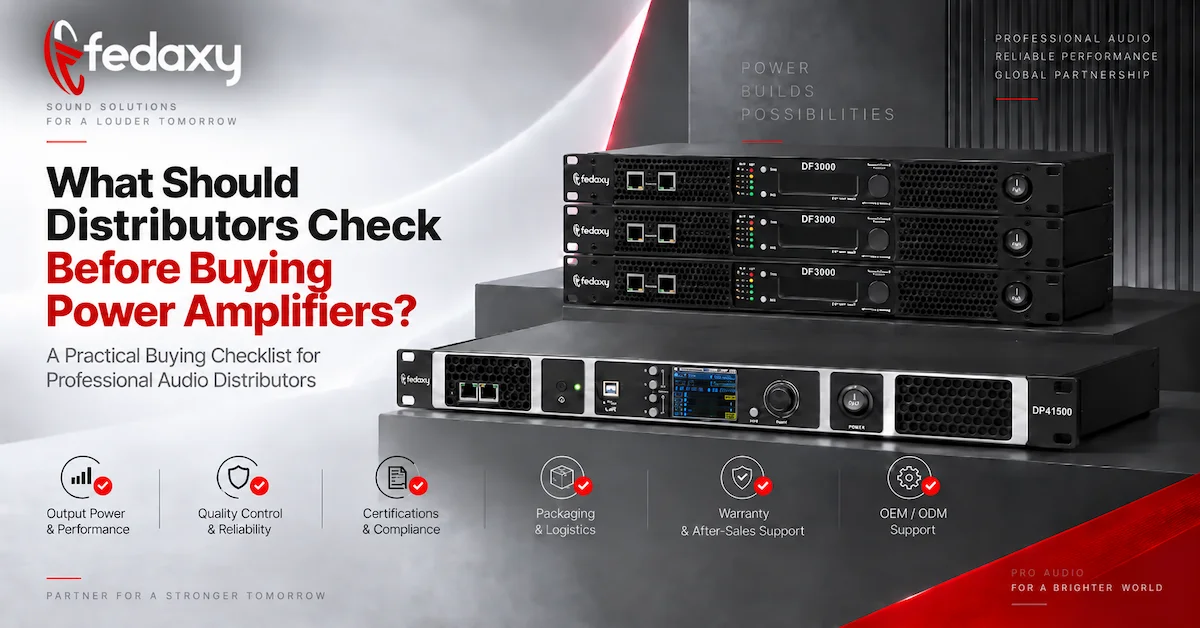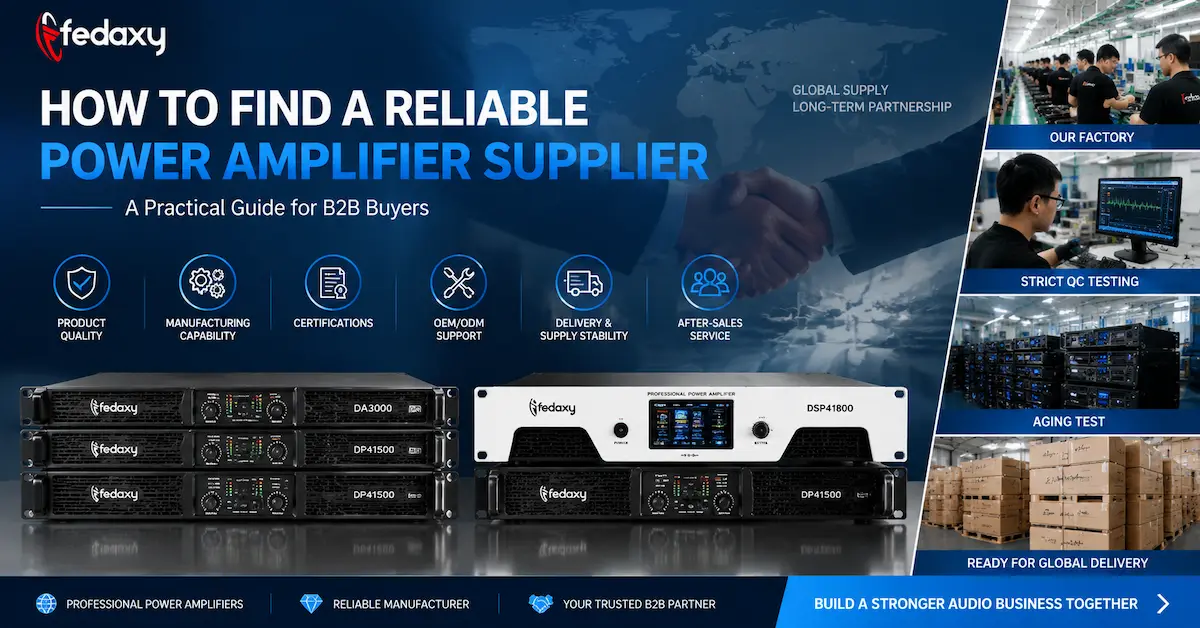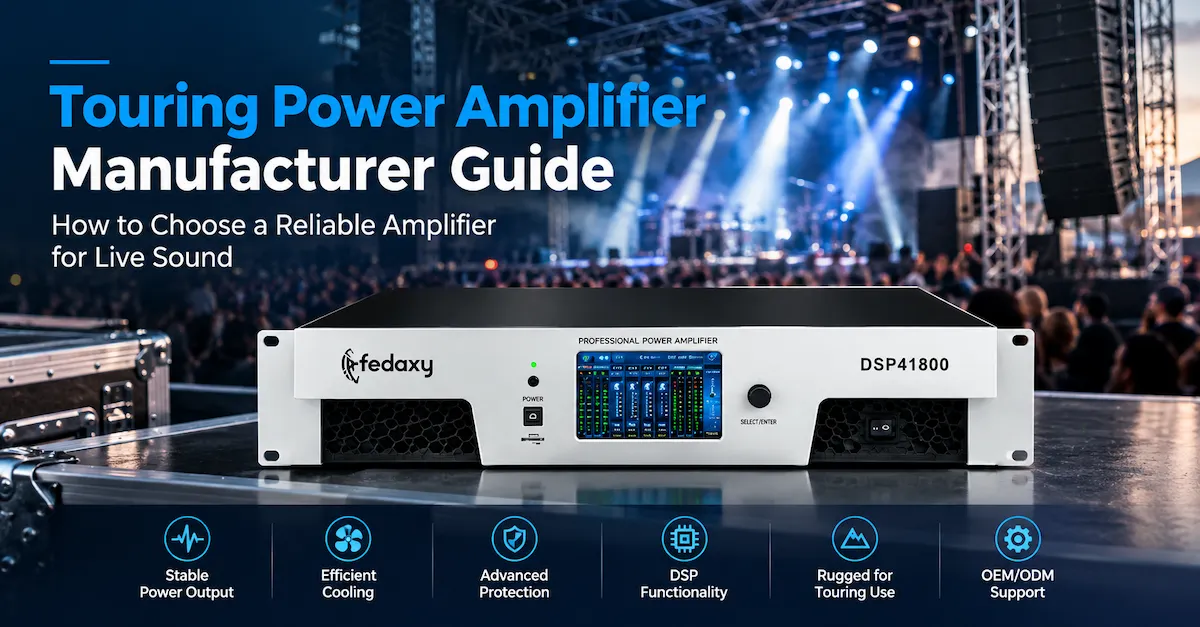
Buying a power amplifier is easy if the only question is price. Buying the right amplifier for a real project is different. A rental company has to keep equipment working through repeated load-ins. A system integrator has to match the amplifier to speakers, rack space, mains power and the venue. A distributor has to protect its brand from inconsistent batches. An OEM buyer has to make sure that the sample approved today is the same product delivered six months later.
That is why the question how to find a reliable power amplifier supplier should be answered with a process, not a list of slogans. A useful supplier can explain its output ratings, show how it tests each unit, document the limits of its protection circuits, support a sample evaluation and keep the approved configuration stable through repeat orders. This guide gives buyers a practical way to do that work before a purchase order is released.
Quick answer: start with the loudspeaker and project brief, then verify output at the intended impedance, thermal behavior, protection, component quality, factory controls, sample results, documentation, delivery process and after-sales support. A reliable power amplifier supplier should answer those questions with model-specific evidence. If the discussion stays at “high quality” and “competitive price,” the evaluation is not finished.
What “Reliable” Should Mean in a Power Amplifier Supplier
Reliability is often used as a product adjective, but buyers need to treat it as a chain of evidence. The amplifier should produce the promised result. The result should remain consistent from one unit to the next. The unit should survive the operating environment described in the quotation. When something unusual happens, the crew should have a clear recovery path and the supplier should have a clear service path.
For a power amplifier, that chain normally includes five questions:
- Does the output match the stated load, test method and number of driven channels?
- Where will the hot air go when the rack is full and the room is already warm?
- If a channel is shorted, overheats or sees DC, what does the amplifier actually do?
- Can the factory repeat the approved components, firmware, DSP settings and mechanical configuration?
- Will the buyer receive useful documents, spare parts and technical answers after delivery?
Watch how the supplier responds. An engineer who works with these checks every day usually reaches for a test sheet, a wiring note or a specific model limitation. Vague answers do not prove that the amplifier is poor, but they leave the buyer carrying the uncertainty. That uncertainty turns into real work later: a second round of troubleshooting, costly replacement freight, an installation held up for a day, or a customer who has lost confidence.
Step 1: Give the Supplier a Real Job to Solve
The first mistake in supplier selection is sending an incomplete request such as “Please quote a 4-channel amplifier.” Four channels tell only a small part of the story. Are they feeding full-range cabinets, wedges, a line array, subwoofers, or separate installation zones? A 1U rack limit, a DSP requirement, and the mains voltage in the destination country can each change the answer.
Prepare a short project brief before contacting a reliable power amplifier supplier. It does not need to be a formal engineering drawing. A clear list is enough:
- Loudspeaker brand and model, including the minimum impedance.
- Nominal impedance and target output per cabinet or per channel.
- Number of cabinets, wiring method and whether the load is passive or bi-amped.
- Application: touring, rental, KTV, bar, theater, stadium, conference or fixed installation.
- Required channel count, bridge requirement and desired rack height.
- Operating voltage, frequency and destination country.
- Need for integrated DSP, Dante, presets, remote control or multi-zone routing.
- Expected duty cycle: occasional events, daily operation or long high-output sets.
- Sample quantity, target annual volume, packaging needs and branding requirements.
- Required delivery window, compliance documents and after-sales expectations.
This information changes the recommendation. A two-channel amplifier may be the clean answer for left and right mains. A four-channel design can reduce rack units in a multi-way system. A three-channel layout may be useful when two channels drive full-range cabinets and a higher-power channel handles a subwoofer. A 1U model may solve a transport problem, while a 2U or 3U chassis may give a high-current application more thermal and service headroom.
Step 2: Check Output Ratings at the Load You Will Actually Use
Output figures are meaningful only beside their conditions. If a page says “4 x 1800 W” without naming the impedance, frequency band, distortion limit or number of driven channels, the number is not yet a specification. It is a prompt for another question.
Put two ordinary numbers on the table first: continuous output at 8 ohms and at 4 ohms. Planning a 2-ohm load or bridge mode? Treat that as a separate case and get the minimum safe bridged load in writing. As impedance falls, current demand rises. It is not only the output stage that feels it; the power supply, cable, connectors and cooling system all join the test.
| Check | What to request | Why it matters |
|---|---|---|
| 8-ohm output | Continuous power, frequency and THD limit. | Useful reference for conservative system planning and many professional cabinets. |
| 4-ohm output | All-channel drive result and test duration. | Shows whether the amplifier can support common multi-cabinet configurations. |
| 2-ohm output | Published limit, wiring conditions and thermal restrictions. | Low impedance can increase current and heat quickly; the headline number is not enough. |
| Bridge output | Bridge power, minimum bridged load and protection behavior. | Two channels become one higher-voltage channel, so the wiring and limit change. |
| Measurement method | Sine, burst, program, all channels or one channel. | Lets the buyer compare suppliers on the same basis instead of comparing marketing terms. |
A responsible power amplifier manufacturer will not be offended by this level of detail. It should be able to explain whether a result is continuous sine-wave power, program power, a short burst or a maximum figure. Ask how many channels were driven together and how long the test ran. A subwoofer system that works through a full concert needs a different kind of confidence from an amplifier that only produces a large number for a few seconds.
Step 3: Match the Amplifier Platform to the Application
Class D, Class TD, Class H and Class AB are not interchangeable labels. Each platform has a different balance of efficiency, current delivery, rack density, heat and service familiarity. The right answer depends on the speakers and the venue rather than on a universal ranking.
| Platform | Common reason to consider it | Questions for the supplier |
|---|---|---|
| Class D | High efficiency and compact 1U power density. | Can the supply and cooling sustain the intended load with all channels driven? |
| Class TD | Strong output and a practical balance for live sound and installation. | Which models are optimized for mains, monitors or low-frequency work? |
| Class H | High headroom and current capability in larger chassis. | Is the rack weight justified by the speaker load and operating schedule? |
| Class AB | Familiar analog behavior for selected professional and reference systems. | Is the available thermal and electrical capacity suitable for the project? |
Fedaxy's public product structure covers Class D, Class TD, Class H and Class AB amplifier categories, as well as DSP amplifiers and active modules. Buyers can review the full product range and then narrow the search through the Class D, Class TD, Class H and DSP categories. That breadth is useful when one distributor or integrator serves several venue types, but each final recommendation still needs model-level confirmation.
Step 4: Inspect Power Supply, Components and Thermal Design
The front panel is the least informative place to judge a power amplifier. Ask what is behind it. A reliable design has a power supply sized for the intended load, an output stage matched to the current demand, capacitors and switching components selected for the duty cycle, sensible grounding, and an airflow path that works in the installed rack.
Fedaxy's About page describes 100% copper transformers, real rated wattage, five rounds of QC testing, an eight-hour aging test and a three-year warranty as part of its quality proposition. Those are useful claims to investigate, not reasons to skip investigation. A sensible follow-up is: “Does this apply to the exact model, voltage version and build on my quotation?” Then collect the matching data sheet, one sample test record and the written warranty terms.
Heat is where a tidy brochure answer often meets a messy rack. Even an efficient, compact amplifier can struggle when several units breathe through the same restricted space. Ask where air enters and exits, how the fans are controlled, whether filters can be reached without dismantling the rack, and at what temperature limiting or protection begins. “Low heat” is a claim. An airflow plan is an answer.
Step 5: Understand DSP and Dante Before You Pay for Them
Integrated DSP can remove external processors and make a system repeatable. Depending on the model, it may provide crossover, equalization, delay, limiting, routing, mute, monitoring and loudspeaker protection. The question is not whether DSP sounds modern. The question is whether it makes the system easier to tune, lock, document and service.
Dante has a different job. It transports digital audio over an IP network, which can simplify signal distribution in a theater, arena, conference complex or permanent installation. DSP shapes the signal; Dante carries it. When both names appear on one unit, go past the badge: ask which software controls it, how firmware is handled, what clock and switch rules apply, who can change settings, and what the audio does after a network interruption.
Questions to put into the DSP review
- Can filters, EQ, delay and limiters be edited from a computer, front panel or network controller?
- Can loudspeaker presets be supplied, locked and exported for rental technicians?
- What happens to the audio path if the network connection disappears?
- Are firmware files and control software maintained for the expected operating system?
- Does the amplifier remain stable at the low impedance used in the project?
- Can the buyer keep a copy of the approved preset and firmware version?
Step 6: Audit the Factory, Not Only the Product Page
A product page shows what the supplier wants a buyer to notice. Repeatability is easier to judge by walking the production path, either on site or over a live remote audit. Start where parts arrive. Continue through PCB work, wiring and mechanical assembly, then watch firmware or DSP loading, burn-in, performance testing, final inspection and packing. Gaps are much easier to spot in that order.
At each stop, ask for the name of the role that signs it off. Then trace a design change: who controls approved components, work instructions and service documents? Can the sample be frozen by serial number, firmware, panel drawing and test record? If a part disappears from the market, the buyer should hear about the proposed substitute before it enters a repeat order, not after the cartons arrive.
Fedaxy describes an operation in Panyu, Guangzhou that brings R&D, production, sales and technical service together. The same public company page mentions 6S site management, customers in more than 100 countries, and ISO9001, CE, RoHS and CB-related documents. For an actual order, ask to see the current files and check which models they cover. A certificate logo copied into a purchase order is not the same thing as verified scope.
Step 7: Compare the Supplier’s Working Process
Two suppliers can quote similar amplifiers and create very different project risk. One may ask detailed questions, send a controlled sample and report test results. Another may send a low price immediately and leave the buyer to discover mismatched connectors, missing documents or an unsuitable impedance range later.
| Project stage | Good supplier behavior | Buyer deliverable |
|---|---|---|
| Requirement review | Confirms speakers, impedance, channels, voltage, venue and duty cycle. | Approved project brief. |
| Technical recommendation | Explains why a model and platform fit the load. | Model-specific data sheet and application note. |
| Quotation | Lists configuration, packaging, documents, sample terms and support. | Comparable commercial quotation. |
| Sample test | Provides an identified sample and responds to test questions. | Test report, photos and acceptance notes. |
| Pilot or first batch | Controls changes and checks the approved configuration. | Golden sample and change-approval record. |
| Mass production | Uses incoming inspection, aging and final performance checks. | QC summary and shipment records. |
| After delivery | Provides manuals, software, spare parts and a response path. | Service contact and warranty procedure. |
This process is especially important for a private-label or OEM project. The product name on the carton is not the control system. The control system is the approved sample, component list, firmware, artwork, test record and change process behind it.
Product Examples to Use in a Supplier Discussion
A comparison becomes clearer when the supplier can place several real models beside the project brief. The examples below are drawn from Fedaxy's public product pages and should be treated as starting points. Before an order, confirm the latest model data sheet, voltage version and test conditions.
When rack density and high output come first
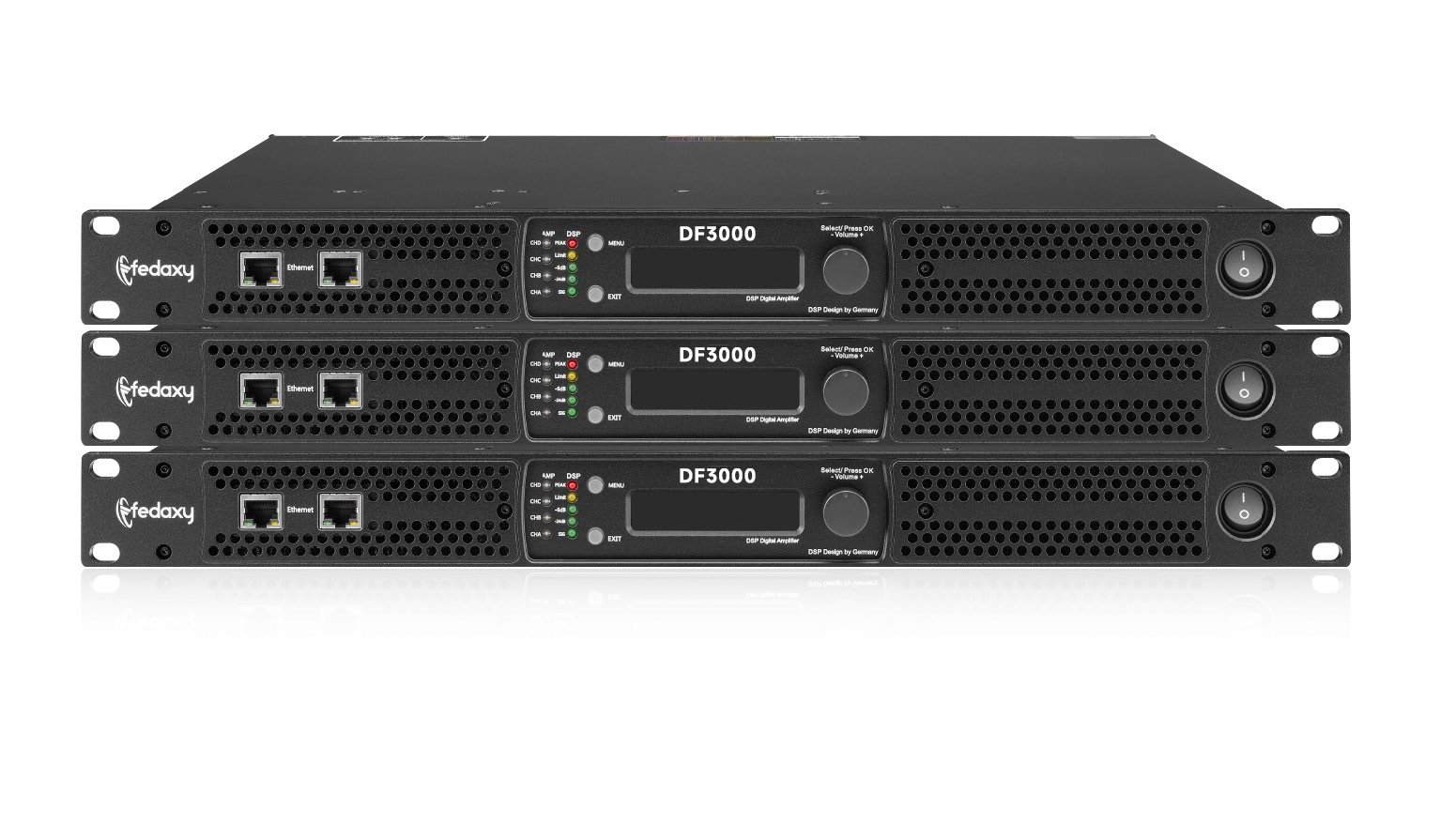
Imagine a tour rack with four amplifier channels, network audio and no spare rack unit. That brief leads naturally to the DF3000. My margin note for the sample would read: 1U, Class D, DSP, Dante; webpage figures of 4x3000W (8Ω), 4x5000W (4Ω) and 4x6500W (2Ω). Those figures are the beginning of the test sheet, not the end of the decision. If the brief calls for two channels instead, the D24200 offers another discussion point with its published 2x4200W at 8Ω.
For four-channel racks with Class TD
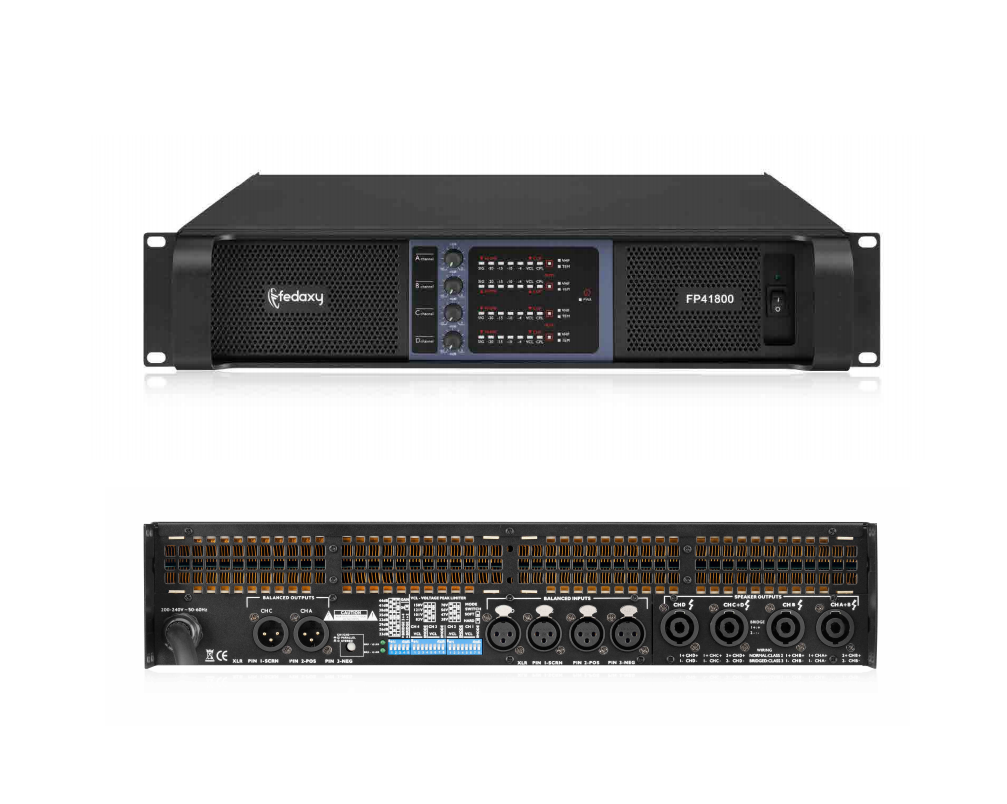
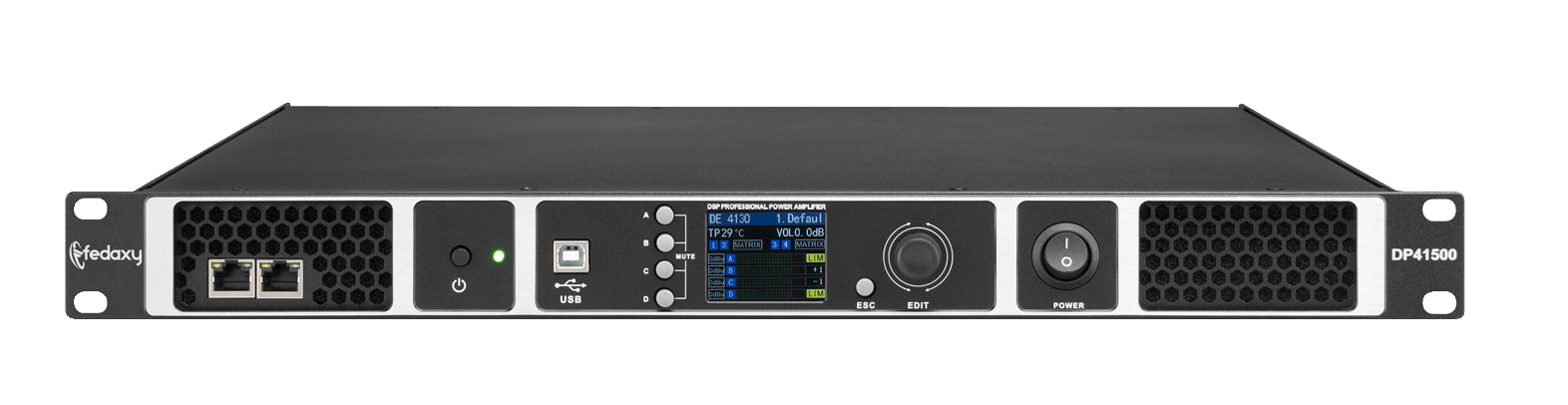
Now change the brief: the crew wants Class TD, four channels and DSP together. The 1U DP41500 fits that conversation. Fedaxy's page gives three reference points: 4x1500W at 8Ω, 4x2250W at 4Ω, 4x3750W at 2Ω. A buyer who does not need onboard DSP could also ask about the 1U DE41300, shown at 4x1300W into 8Ω. Need a 2U alternative? Put the DSP-equipped DSP41800 on the sample list and verify its published 4x1800W-at-8Ω point under the intended load.
Where a larger Class H chassis makes sense
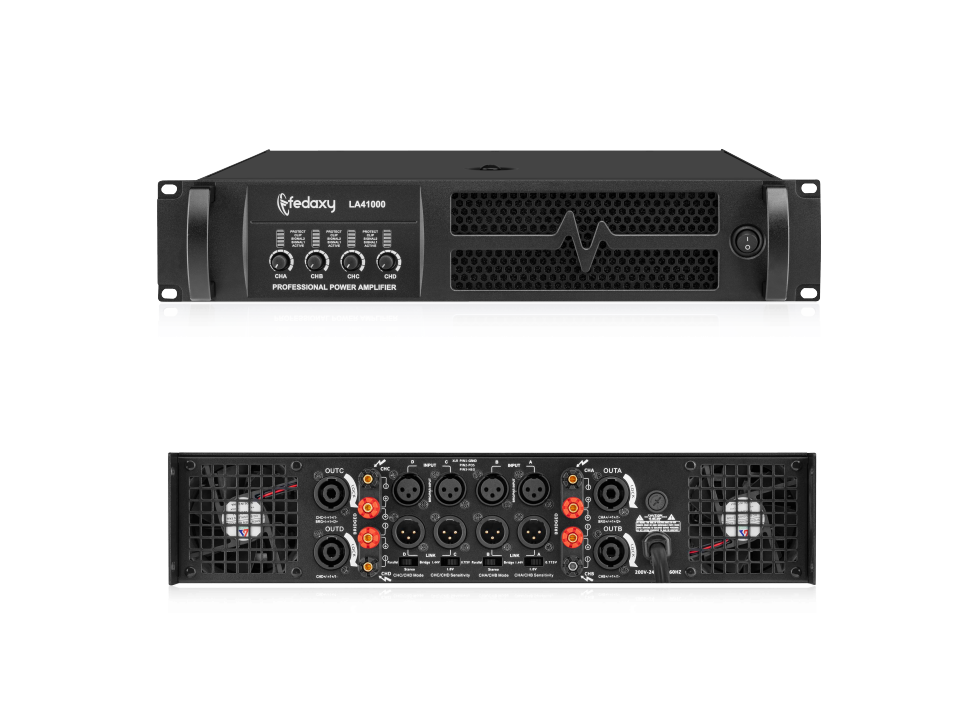
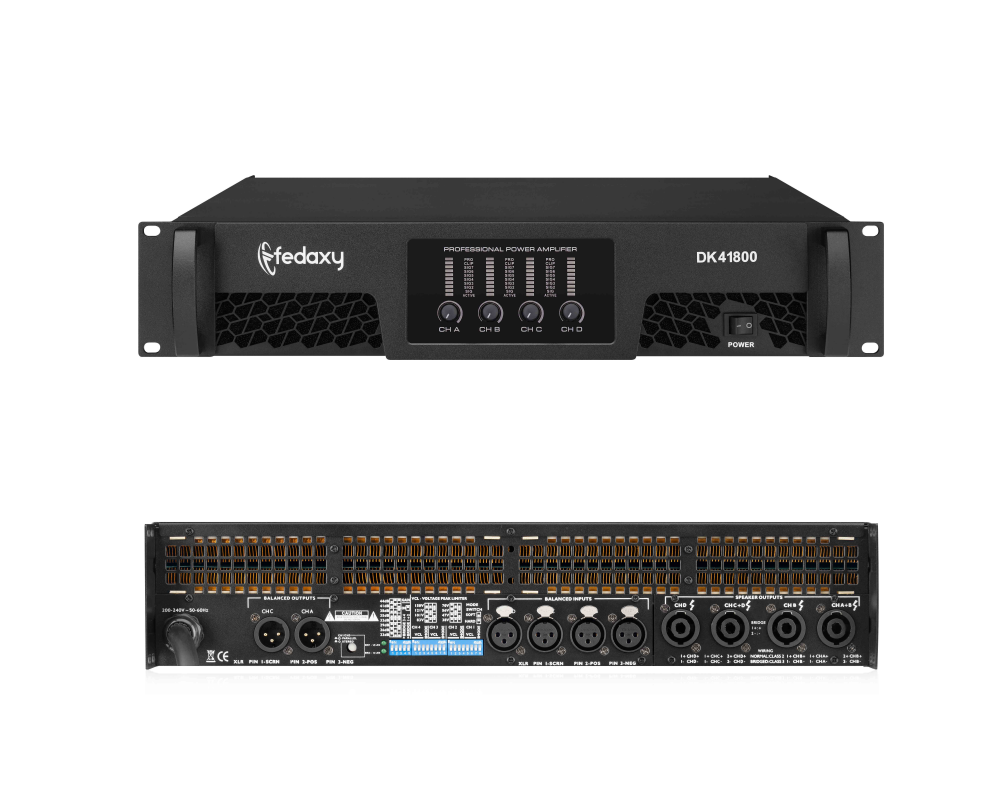
A club or KTV rack may have room for 2U and a preference for Class H. In that case I would put the LA41000 beside the speaker schedule. Its page lists 4x1000W at 8Ω, 4x1500W at 4Ω and 4x2500W at 2Ω. Bigger is not automatically better, though. The 3U FH41500, published at 4x1500W into 8Ω, needs a job that justifies the extra space. For two tops and one stronger low-frequency channel, the three-channel KP2612 has a different layout: 2x600W plus 1200W.
I would not choose from these webpage numbers alone. I would bring the speaker load, rack conditions and working schedule to the call, then listen for a model recommendation that includes limits and test evidence. That answer is far more useful than a highlighted watt figure.
Who Needs a Reliable Power Amplifier Supplier?
Different buyers use the same phrase “power amplifier supplier” but carry different risks. A rental company cares about transport, repeatability, quick repair and spare units. A distributor cares about packaging, stable specifications, market documents and product-line breadth. A system integrator cares about system matching, presets, network control and installation support. An OEM brand cares about branding, change control and long-term supply.
Rental companies and touring production
Rental fleets need amplifiers that can be loaded, unloaded, powered, cooled and tested repeatedly. Weight matters, but so do connector retention, fan noise, front-panel visibility and recovery after protection. A sample test should include the real loudspeaker cable, rack orientation, signal chain and a realistic operating cycle. It is also worth deciding how many spare units the fleet needs before the first shipment arrives.
System integrators and contractors
Integrators need a supplier who can read a system diagram instead of selling one model to every room. A theater may need speech intelligibility and quiet operation. A stadium may need high-power line-array channels and a documented rack plan. A multi-function hall may need flexible routing and several operating presets. Use Fedaxy's venue solution pages as a starting point, then send the actual speaker and zone information for engineering review.
Distributors and private-label brands
Distributors often need several output levels, chassis heights and technologies under one commercial relationship. They also need consistent images, manuals, certificates, carton markings and spare-parts support. A reliable power amplifier supplier should be able to explain which changes are cosmetic, which changes affect performance, and which changes require a new compliance review.
OEM and ODM buyers
OEM and ODM work should begin with a brief rather than a logo file. Write down the market and brand position first. Follow with channels, output range, connectors, voltage and rack height; then add DSP presets, packaging, manuals, compliance papers, sample quantity and forecast. Once that page exists, it becomes clear whether the request stops at a logo and carton or reaches into the mechanics, electronics and firmware.
Warnings That Should Slow the Purchase
One awkward answer does not disqualify a factory. It does mean the buyer should pause, ask again and look for something that can be checked.
- Power is advertised without impedance, test duration or all-channel conditions.
- The title, parameter table and quotation show different output numbers.
- The supplier recommends a model without asking what speakers or wiring will be used.
- “CE certified” or “ISO certified” appears without a certificate number, scope or model mapping.
- The sample cannot be identified by serial number, firmware version or approved configuration.
- Changes to components or panel design are made without customer approval.
- Warranty length is stated, but the return, repair and spare-parts process is not.
- DSP and Dante are used as buzzwords, with no software, preset or network documentation.
- Lead time and MOQ are promised before the configuration, packaging and documents are frozen.
The most dangerous red flag is not a low price. It is a supplier that cannot explain what the low price includes. A clear quotation can be compared. An incomplete quotation creates surprises after the order.
OEM, ODM and Private-Label Questions to Resolve Early
A professional power amplifier supplier should be able to separate three levels of customization. Private label may involve logo, model name, carton and manual. Configured OEM may add a panel design, connectors, voltage version, DSP preset or protection configuration. ODM can involve platform adaptation, mechanical changes, electronics, firmware and validation.
| Customization level | Typical scope | What to freeze |
|---|---|---|
| Private label | Logo, name, labels, carton, manual and standard accessories. | Artwork, model code, packaging and language versions. |
| Configured OEM | Panel, connectors, voltage, DSP preset and protection settings. | Approved sample, drawings, firmware and test limits. |
| ODM project | Platform, mechanical design, electronics, firmware and validation. | Requirements, milestones, prototypes, change control and ownership. |
Ask how the supplier handles engineering changes after approval. If a transformer, fan, capacitor or power device is replaced, does the buyer receive a notice? Is a new sample required? Does the change affect the certificate scope or the published output? These questions protect the brand and make repeat purchasing less dependent on individual sales promises.
Cost, Delivery and After-Sales Risk
The lowest unit price is rarely the lowest project cost. Add rack space, transport weight, power use, spare units, setup time, replacement fans, documents, import requirements, warranty handling and the cost of one failed event. A compact efficient unit can trim freight and electricity; a heavier chassis can still be the better buy when it gives a hard-working system the headroom and breathing room it needs.
MOQ, lead time and warranty are configuration questions, not permanent numbers. Put them in the quotation for this build and this market. The same document should say how samples are approved, when production starts, how units are packed and shipped, which spares remain available, and who answers a service case. That is how a commercial promise stays attached to the hardware being ordered.
After-sales support is part of the supplier selection. Confirm who answers technical questions, whether manuals and software are available, how a warranty return is opened, which parts are replaceable locally, and whether the supplier can help with an unusual protect event. Fedaxy presents technical service, product manuals, data sheets, software updates, video tutorials and after-sales support as part of its broader offer. Confirm the exact scope in the purchase documents.
A Practical RFQ Template
A useful RFQ lets an engineer understand the job before the third email. The list below is short enough to send, yet specific enough for either a standard purchase or an OEM discussion:
- Project country, venue type and operating voltage.
- The exact loudspeaker name, plus its nominal and lowest impedance.
- Cabinet quantity, wiring, target SPL and intended channel assignment.
- Required output at 8 ohms, 4 ohms and 2 ohms, if applicable.
- Channel count, bridge requirement, rack height and airflow conditions.
- Class preference or request for the supplier's platform recommendation.
- DSP, Dante, preset, remote-control and network requirements.
- Sample quantity, target annual volume, packaging and private-label needs.
- Required certificates, manuals, test reports and warranty terms.
- Target delivery window and the information needed for a comparable quote.
Invite the supplier to explain what is still unknown. A good reply may include a clarifying question or a warning that a requested impedance is not appropriate for continuous use. That kind of technical pushback is valuable. It means the supplier is reviewing the system rather than simply matching a keyword to a stock model.
Why Fedaxy May Be a Useful Supplier to Evaluate
For a factory-screening call, my Fedaxy note would start with the basics: Guangzhou manufacturer; Class D, Class TD, Class H, Class AB, DSP and active amplifier lines. The company page says “15+ years,” describes R&D, manufacturing, sales and technical service under one operation, and mentions partners in more than 100 countries. Each item gives the buyer something concrete to verify against the model and order being discussed.
The public product pages also make it possible to compare different output classes and chassis formats, from compact 1U multi-channel models to larger 2U and 3U designs. That can help an integrator or distributor build a product line around several venue requirements instead of searching for a different factory for every power range.
The next step is practical: send the speaker model, impedance, cabinet count, voltage, venue type, channel plan, rack requirement and branding needs through Fedaxy's contact page. One useful closing question is, “Which model would your engineer put in this rack, and why?” Request that model's data sheet and agree on the sample pass criteria before talking about a production release.
Short Answers for the Procurement Desk
1. Need a fast first filter for a power amplifier supplier?
Send one real job rather than a general request. A useful reply names a model, talks about the actual load, explains the unit test and offers a sample that can be traced. A price list does not pass that filter.
2. What is the most important specification to check?
Check output at the impedance and operating condition you will actually use. Include the number of driven channels, test duration, frequency band and THD limit. A single wattage figure without those conditions is incomplete.
3. Should I choose Class D, Class TD, Class H or Class AB?
Choose the platform around the speaker load, rack, heat, power supply and service plan. Class D is often attractive for efficiency and density; Class TD can balance output and compact design; Class H can provide strong headroom; Class AB remains useful for selected analog applications.
4. Do I need a DSP power amplifier?
DSP is helpful when you need crossover, EQ, delay, limiting, routing, monitoring or repeatable presets inside the amplifier. A simple system may not need it, while a line array, multi-zone or branded system can benefit from the control and documentation.
5. Is Dante the same as DSP?
No. DSP processes the audio signal. Dante transports digital audio over a network. An amplifier can include both, but the signal-processing plan and network plan should be reviewed separately.
6. Can every amplifier run continuously at 2 ohms?
No. Some models publish 2-ohm ratings, but the wiring, ambient temperature, duration, channel count and protection limits must be checked. Never assume a short 2-ohm burst rating means continuous full-power operation.
7. What factory documents should an OEM buyer request?
Build a small approval folder. It should contain the sample record, data sheet, controlled parts or BOM reference, panel drawing, firmware ID, test limits, certificate scope, packing specification, warranty terms and the rule for approving later changes.
8. How do I make a fair supplier comparison?
Give both factories the same speakers, wiring and project conditions. Put their output figures beside the same impedance and test method, then compare the rack, documents, sample process, delivery terms and service coverage. A cheaper line item may stop looking cheap once the missing work is added.
9. What belongs in the first RFQ email?
Name the speakers and their load, cabinet count, venue, channel plan, mains voltage and rack limit. Add DSP or Dante needs, branding and carton work, the first sample quantity, expected volume and the date the project needs equipment on site.
10. What is the best next step if the specification is unclear?
Pause the order and request a written clarification from the engineering contact. Ask which model, voltage version and test condition support each number. It is faster to resolve uncertainty before production than after a rack has been shipped to a venue.
Request a supplier review: Send your loudspeaker parameters, impedance, venue type, channel plan, voltage, rack requirements and branding needs to Fedaxy. The engineering team can recommend a suitable power amplifier platform, confirm the relevant product page and prepare a project-specific quotation.