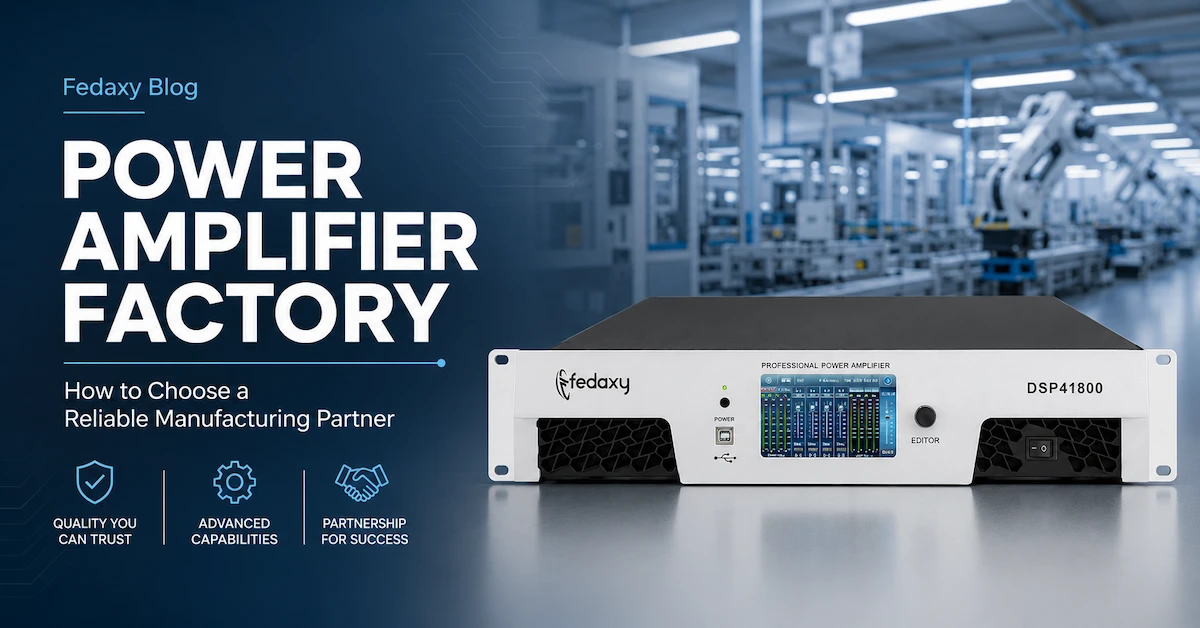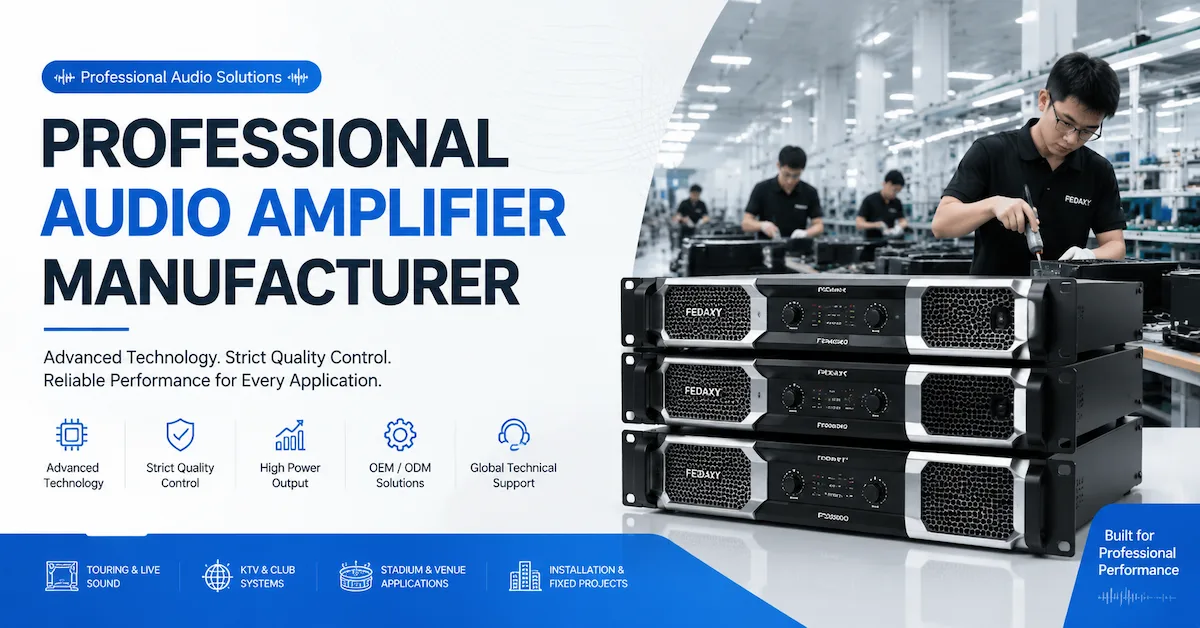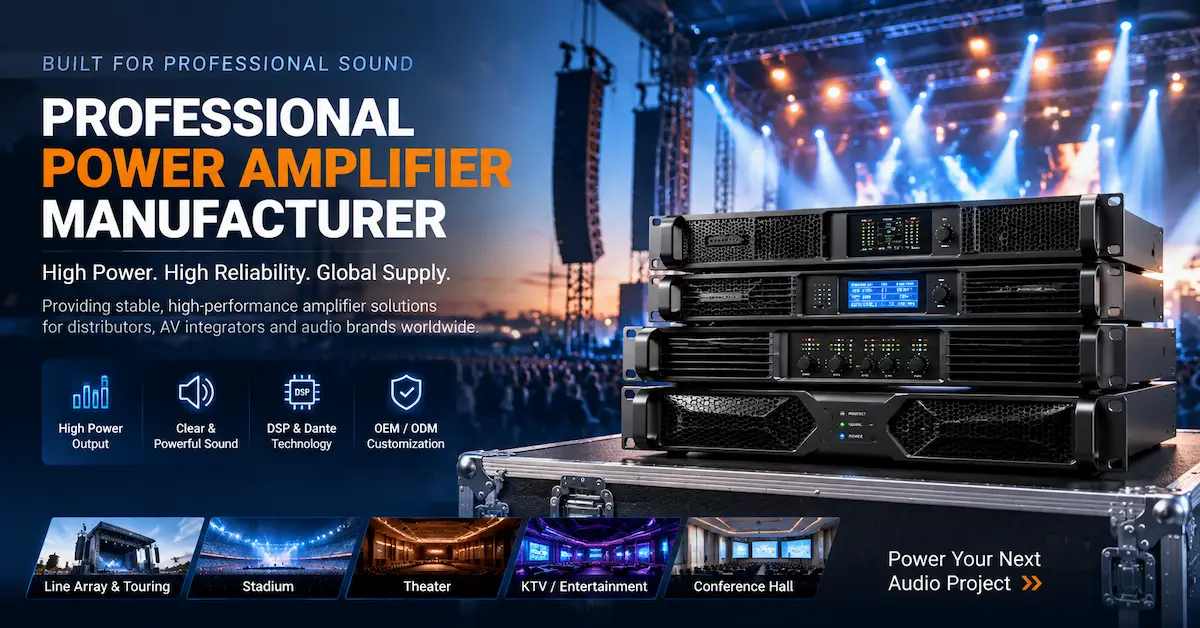
Choosing the right professional power amplifier supplier is an important decision for distributors, system integrators and audio brands.
A professional amplifier supplier does more than provide products. The right partner should understand audio applications, provide technical support, maintain consistent quality and support long-term business growth.
For global audio buyers, supplier selection directly affects:
- product reliability
- customer satisfaction
- project success
- maintenance costs
- brand reputation
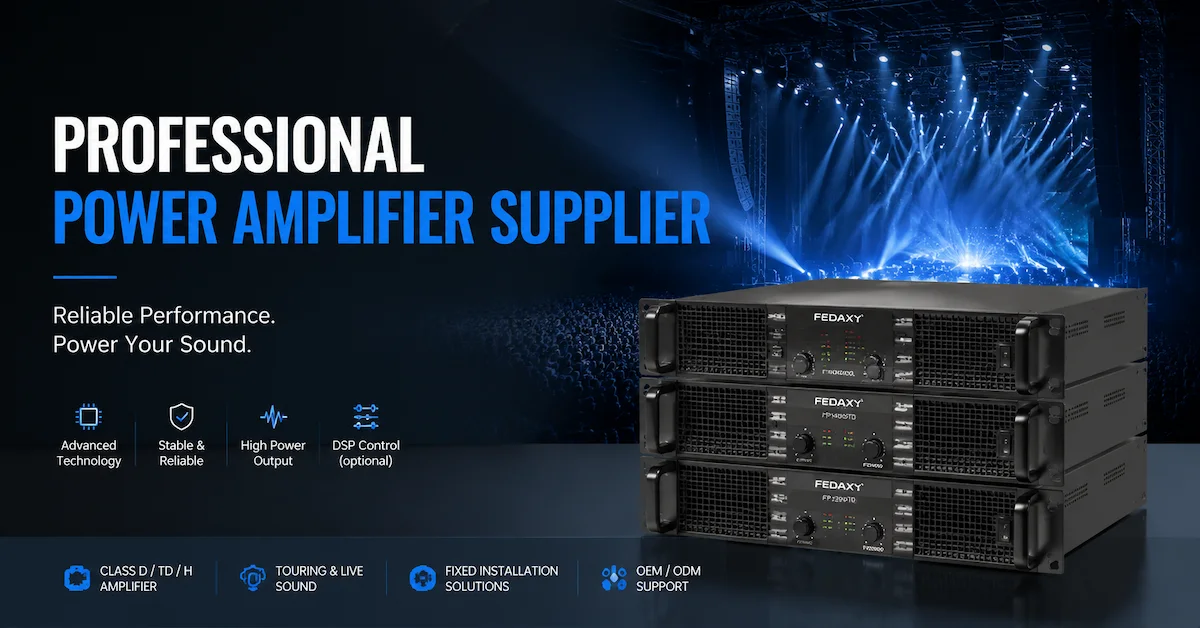
Fedaxy provides professional amplifier solutions for global audio markets, offering Class D, Class TD, Class H and DSP amplifier products for distributors, AV professionals and commercial sound projects.
Explore Fedaxy’s complete professional power amplifier product solutions to understand available amplifier platforms and configurations.
What Should Buyers Look for in a Professional Power Amplifier Supplier?
A reliable supplier should provide a combination of product capability, manufacturing experience and technical support.
Many buyers focus only on price when purchasing amplifiers. However, professional audio systems require more than competitive costs.
A qualified supplier should provide:
- stable product quality
- accurate specifications
- engineering support
- customization capability
- reliable delivery
- after-sales service
Supplier Experience and Industry Knowledge
Professional audio equipment requires specialized knowledge.
A capable supplier should understand:
- speaker matching
- impedance requirements
- power distribution
- system design
- installation environments
- thermal management
For example, a supplier serving touring companies should understand the requirements of:
- high output power
- compact rack design
- fast installation
- continuous operation
A supplier serving theaters or conference systems should focus more on:
- low noise
- stability
- DSP management
- long-term reliability
Fedaxy combines professional audio manufacturing experience with application knowledge to support different project requirements. Learn more about Fedaxy’s company capabilities through the About Us page.
Manufacturer Capability vs Trading Company: Why It Matters
When searching for a professional power amplifier supplier, buyers often compare factories and trading companies.
Working directly with a manufacturer provides several advantages.
Better Product Knowledge
Manufacturers understand:
- amplifier circuit design
- power supply systems
- cooling structures
- component selection
- testing methods
This allows faster communication when customers require technical support.
Better Quality Control
A direct manufacturer can control:
- incoming materials
- production process
- testing standards
- final inspection
This helps maintain consistency between different production batches.
Better OEM and Customization Support
For audio brands and distributors, customization is often important.
A professional supplier should support:
- logo customization
- product appearance changes
- packaging design
- technical configuration
- DSP settings
Fedaxy provides OEM and ODM support for customers looking for customized professional amplifier solutions.
Professional Power Amplifier Product Capabilities
A strong supplier should provide a complete product portfolio instead of only one amplifier category.
Different projects require different amplifier technologies.
Class D Power Amplifier Solutions
Class D amplifiers are widely used in modern professional audio systems.
Main advantages include:
- high efficiency
- lower heat generation
- compact size
- lightweight design
- high power density
They are commonly used in:
- touring systems
- line array systems
- fixed installations
- large commercial audio projects
For distributors searching for a reliable Class D amplifier supplier, product efficiency, reliability and output performance are key evaluation factors.
Class TD Power Amplifier Solutions
Class TD amplifiers are designed for applications requiring high output capability.
Advantages include:
- strong dynamic response
- high power output
- professional touring performance
- stable operation under heavy loads
Typical applications include:
- concerts
- stadiums
- outdoor events
- rental sound systems
Class H Power Amplifier Solutions
Class H amplifiers remain popular in professional audio applications because of their strong output capability.
They are commonly used for:
- KTV systems
- theaters
- entertainment venues
- commercial installations
Important advantages include:
- reliable performance
- strong low-frequency control
- professional sound reproduction
DSP Power Amplifier Solutions
Modern audio projects increasingly require DSP functions.
DSP amplifiers integrate:
- equalization
- crossover
- delay adjustment
- limiter protection
- signal routing
Benefits include:
- simplified system design
- easier installation
- improved speaker protection
- flexible configuration
For complex venues, DSP amplifiers help engineers optimize sound performance more efficiently.
Professional Power Amplifier Applications for Different Audio Projects
A reliable professional power amplifier supplier should understand that different applications require different amplifier solutions.
Selecting an amplifier only based on output power can lead to problems such as:
- insufficient system performance
- overheating during operation
- poor sound consistency
- unnecessary equipment costs
Professional buyers should evaluate amplifier solutions according to:
- venue size
- speaker configuration
- operating environment
- required sound pressure level
- installation requirements
Touring and Live Performance Sound Systems
Touring companies require amplifiers that can handle frequent transportation and demanding working conditions.
Key requirements include:
- high power output
- compact rack design
- lightweight structure
- efficient cooling
- stable operation during long events
For touring applications, Class D and Class TD amplifiers are commonly preferred because they provide high power density while reducing rack space and heat generation.
Typical applications include:
- concerts
- festivals
- outdoor performances
- rental sound systems
- mobile production companies
Stadium and Large Venue Audio Systems
Large venues require professional amplification systems capable of delivering consistent sound coverage across large areas.
These projects usually require:
- high-power amplification
- multi-channel configuration
- DSP management
- network audio compatibility
- reliable thermal performance
Professional suppliers should understand the challenges of stadium applications, including:
- long-distance signal transmission
- complex speaker distribution
- continuous operation
- environmental changes
DSP and Dante-enabled amplifier solutions are often selected for these projects because they provide better system control and flexibility.
KTV and Entertainment Audio Projects
KTV and entertainment venues have unique requirements compared with traditional live sound systems.
They require:
- clear vocal reproduction
- stable operation
- low noise
- multiple room configurations
- easy system adjustment
A suitable amplifier supplier should provide solutions for:
- small private rooms
- large entertainment centers
- multi-zone audio systems
Class H and DSP amplifier solutions are commonly used because they provide strong output capability and flexible audio adjustment.
Commercial Installation Projects
Commercial audio applications include:
- hotels
- conference centers
- shopping centers
- restaurants
- educational facilities
- worship buildings
These projects usually prioritize:
- reliability
- simple maintenance
- long service life
- stable sound quality
A professional amplifier supplier should provide products suitable for long-term fixed installation environments.
Technical Factors to Evaluate Before Choosing a Professional Power Amplifier Supplier
Before placing a bulk order, professional buyers should evaluate technical specifications carefully.
Output Power and System Matching
Output power is one of the most important specifications, but it must be considered together with speaker requirements.
Important factors include:
- speaker rated power
- impedance
- sensitivity
- application environment
A professional supplier should provide clear technical information instead of only advertising maximum wattage.
Impedance Compatibility
Professional audio systems commonly use:
- 8Ω speakers
- 4Ω speaker configurations
- 2Ω high-performance systems
A reliable amplifier supplier should clearly provide performance information under different impedance conditions.
This is especially important for:
- touring systems
- subwoofer applications
- line array systems
Channel Configuration
Different projects require different channel numbers.
| Channel Configuration | Recommended Applications |
|---|---|
| 2 Channel | Stereo systems, small venues, traditional installations |
| 4 Channel | Commercial installations, multi-zone systems |
| 6 Channel | Large projects, cinema and complex audio systems |
Multi-channel amplifiers help reduce:
- rack space
- installation complexity
- equipment costs
DSP and Audio Processing Capability
DSP functions have become increasingly important in professional audio systems.
A DSP power amplifier may include:
- EQ adjustment
- crossover management
- delay control
- limiter protection
- compressor settings
- signal routing
For system integrators, integrated DSP reduces the need for additional external processors.
Manufacturing Capability and Quality Control of a Professional Power Amplifier Supplier
Choosing a supplier means evaluating the manufacturing process behind the products.
A reliable supplier should have a complete quality management system.
Component Selection and Incoming Inspection
Professional amplifier quality starts with component control.
Important inspection areas include:
- electronic components
- PCB quality
- power devices
- connectors
- mechanical parts
Stable component selection helps ensure:
- consistent performance
- lower failure rates
- reliable production batches
Production Assembly Control
During manufacturing, suppliers should control:
- PCB assembly
- wiring accuracy
- mechanical installation
- electrical safety
- software configuration
Production consistency is especially important for distributors purchasing large quantities.
Aging Testing and Performance Verification
Professional amplifiers require reliability testing before delivery.
Typical testing includes:
- continuous operation tests
- output power verification
- thermal performance testing
- protection function testing
- audio performance inspection
These processes help identify potential problems before products reach customers.
Certifications and Compliance
For international markets, professional audio buyers should evaluate supplier certifications.
Common requirements include:
- CE
- RoHS
- ISO quality management systems
Certifications help reduce risks related to:
- customs clearance
- market compliance
- product reliability
OEM and ODM Professional Power Amplifier Supply Solutions
For audio brands and distributors, a professional supplier should provide more than standard products.
OEM and ODM cooperation allows businesses to develop customized amplifier solutions.
OEM Customization Options
A professional amplifier supplier may support:
- logo customization
- product appearance design
- packaging customization
- model branding
- regional market requirements
Technical Customization
Depending on project requirements, customization may include:
- output configuration
- DSP settings
- connector options
- voltage requirements
- application-specific tuning
OEM cooperation helps audio brands build differentiated products without investing in their own manufacturing facilities.
For customized amplifier projects, buyers can contact Fedaxy’s engineering team for professional solutions.
Professional Power Amplifier Supplier Specification Guide
| Item | Description |
|---|---|
| Product Category | Professional Power Amplifier |
| Amplifier Technology | Class D / Class TD / Class H / Class AB |
| Channel Options | 2CH / 4CH / 6CH |
| Rack Size | 1U / 2U / 3U |
| Applications | Touring, KTV, Stadium, Theater, Conference |
| Audio Processing | DSP Available |
| Network Audio | Dante Options Available |
| Protection Functions | Over Temperature, Short Circuit, Overload, DC Protection |
| Custom Service | OEM / ODM Available |
| Quality Testing | Power Test, Aging Test, Performance Test |
Professional Power Amplifier Supplier Comparison Checklist
When comparing suppliers, buyers can evaluate the following factors:
| Evaluation Factor | Reliable Supplier Standard |
|---|---|
| Manufacturing Capability | Own production facility and engineering team |
| Product Range | Multiple amplifier technologies and configurations |
| Technical Support | Application guidance and system recommendations |
| Quality Control | Testing procedures and inspection system |
| Customization | OEM and ODM capability |
| Communication | Fast technical response |
| Delivery Capability | Stable production and export experience |
| After-Sales Support | Technical assistance and product support |
FAQ
1. What should I look for in a professional power amplifier supplier?
A reliable supplier should provide product quality, technical support, manufacturing capability, certifications and customization services.
2. What is the difference between a manufacturer and a supplier?
A manufacturer produces products directly, while a supplier may include manufacturers or distributors. Direct manufacturers usually provide stronger technical support and customization ability.
3. Does Fedaxy provide OEM power amplifier solutions?
Yes. Fedaxy supports OEM and ODM services for professional audio brands, distributors and project customers.
4. Which amplifier technology is best for professional audio?
The best choice depends on the application. Class D is suitable for efficiency and compact systems, while Class TD and Class H are suitable for high-power applications.
5. How can I choose the right amplifier supplier for my market?
Evaluate product range, quality system, technical capability, delivery ability and customization support.
6. What applications use professional power amplifiers?
Professional amplifiers are widely used in touring, stadiums, theaters, KTV, hotels, conference centers and commercial sound systems.
7. Can suppliers customize amplifier specifications?
Many professional suppliers support customization including appearance, branding, DSP settings and technical configurations.
8. Why is DSP important in professional amplifiers?
DSP provides better control over equalization, crossover, delay and speaker protection.
9. How do suppliers test amplifier reliability?
Professional suppliers usually perform output testing, thermal testing, aging testing and protection verification.
10. How can I request a quotation from Fedaxy?
Provide your application requirements, amplifier specifications and order quantity through the Fedaxy Contact Us page.
Conclusion: Choose a Reliable Professional Power Amplifier Supplier for Long-Term Growth
Choosing the right professional power amplifier supplier is essential for distributors, AV integrators and audio brands.
A reliable supplier should provide:
- professional amplifier technologies
- stable manufacturing capability
- strict quality control
- OEM and ODM support
- technical assistance
Fedaxy provides Class D, Class TD, Class H and DSP amplifier solutions for global professional audio applications.
With manufacturing experience, technical capability and customization support, Fedaxy helps partners build reliable audio solutions for commercial projects, entertainment venues and large-scale sound systems.
For product selection, OEM cooperation or project consultation, contact Fedaxy today.