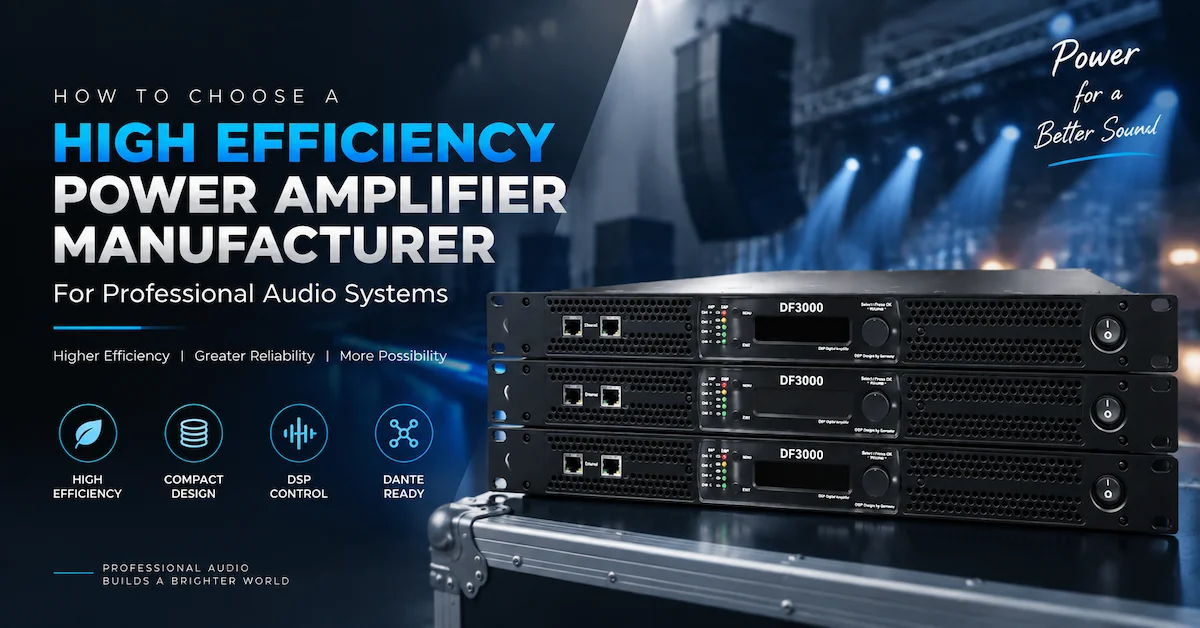
Choosing a Class D power amplifier manufacturer for rental fleets or fixed installations requires more than comparing wattage. This guide helps B2B buyers evaluate 1U amplifier specifications, verify sample performance, compare DSP and Dante configurations, and reduce purchasing risks before placing volume orders.
Selecting a Class D power amplifier manufacturer is not simply about finding the highest wattage or lowest factory price. For professional audio distributors, rental companies, and AV system integrators, the more important question is whether an amplifier can deliver the required performance under clearly defined operating conditions—and whether the manufacturer can reproduce that performance across future orders.
A qualified manufacturer should provide documented output specifications, suitable impedance capability, reliable cooling, protection functions, consistent quality control, and technical support.
This guide explains how to evaluate those requirements using the 1U Class D amplifier range from Guangzhou Fedaxy Audio Equipment Co., Ltd. (FEDAXY) as practical purchasing examples.
Key purchasing principle: Approve the amplifier against your real speaker load, operating environment, and test requirements—not its headline wattage alone.
1. Why Does Manufacturer Selection Matter for Class D Amplifiers?
Class D amplification uses high-frequency switching output stages to convert electrical power efficiently. Compared with conventional linear amplifier architectures, it can provide substantial output power in a compact enclosure while reducing wasted energy.
These characteristics make Class D technology attractive for modern professional sound reinforcement. Typical advantages include:
- High power density: More output capability within limited rack space.
- Compact equipment design: Useful for mobile amplifier racks and installations with restricted space.
- Improved energy efficiency: Less electrical energy is dissipated as heat compared with many traditional linear designs.
- Flexible channel configurations: Two-channel and four-channel platforms support different speaker layouts.
- Digital integration options: Selected models combine amplification with DSP processing and Dante networking.
However, Class D technology alone does not guarantee superior audio quality, continuous output capability, or compatibility with every loudspeaker.
Two amplifiers with similar published wattage may behave differently when operating at low impedance, elevated temperatures, or with multiple channels driven simultaneously.
A professional Class D power amplifier manufacturer should therefore explain the relationship between power ratings, load conditions, thermal management, protection behavior, and the intended application .
2. Who Should Source Directly From a Class D Power Amplifier Manufacturer?
Factory-direct purchasing is particularly relevant when equipment performance must remain consistent across multiple installations or repeated orders.
| B2B Buyer | Primary Requirement | Manufacturer Evaluation Priority |
|---|---|---|
| Professional audio distributors | Repeatable product quality and competitive product positioning | Specifications, QC, warranty, and supply |
| Rental and touring companies | Compact, transportable, high-output amplifiers | Rack density, cooling, and reliability |
| AV system integrators | Correct matching with speaker systems | Impedance, channels, DSP, and support |
| Professional audio brands | Product differentiation and customization | Engineering, OEM/ODM, and sample approval |
| Stadium and venue contractors | High-output multi-channel systems | Thermal behavior, protection, and technical documentation |
For rental fleets, every additional rack unit can affect transport, handling, and storage costs. For fixed installations, stable operation, service access, and accurate amplifier-to-speaker matching may be more important than minimizing chassis size.
A 1U Class D amplifier is less suitable when the required system needs a different output topology, unsupported constant-voltage speaker distribution, or operating conditions beyond the model's verified limits.
The correct selection depends on the complete audio system—not the amplifier category alone.
3. Which Specifications Should Buyers Verify Before Ordering?
When comparing Class D amplifier suppliers, purchasing teams should request technical documentation rather than relying exclusively on marketing descriptions.
Essential Class D amplifier specification checklist
| Specification | What Buyers Should Verify | Why It Matters |
|---|---|---|
| Output power | 8Ω, 4Ω, and 2Ω ratings with test conditions | Speaker compatibility |
| Channel count | Two or four independent output channels | System configuration |
| Power measurement | Duration, frequency, distortion limit, driven channels | Comparable output claims |
| THD | Distortion under specified conditions | Signal performance |
| Signal-to-noise ratio | Measurement method and reference level | Noise performance |
| Frequency response | Operating bandwidth and tolerance | Audio reproduction |
| Damping factor | Measurement frequency and load | Speaker-load interaction |
| Power supply | Voltage, frequency, and current demand | Site electrical compatibility |
| Cooling | Fan control, airflow, and thermal behavior | Long-term operation |
| Protection | Thermal, short-circuit, and DC fault response | Equipment protection |
| DSP / Dante | Actual features, software, and network compatibility | System integration |
| Mechanical design | Chassis dimensions, net weight, and connections | Rack planning |
Why published wattage requires verification
Consider an amplifier advertised at 3,000 watts per channel into 8Ω.
For a resistive test load under an ideal sinusoidal measurement, the relationship is:
Power (W) = RMS Voltage² ÷ Resistance (Ω)
At 3,000W into 8Ω, the corresponding RMS voltage is approximately 155V.
This calculation provides a reference for interpreting measurement data. It does not establish that an amplifier can deliver 3,000W continuously, across its full frequency range, or with every channel operating simultaneously. Those capabilities require defined testing.
IEC 60268-3:2018, Sound System Equipment – Part 3: Amplifiers , provides a recognized reference for amplifier specification characteristics and measurement methods within its scope.
For bulk procurement, ask the manufacturer to identify the actual measurement procedure used for the quoted output.
Safety note: High-power electrical testing should be performed only by qualified personnel using suitable loads, measurement equipment, and safety procedures.
4. FEDAXY Class D Power Amplifier Model Comparison
FEDAXY currently presents four Class D amplifier products in its public catalogue, covering two-channel and four-channel 1U configurations.
Class D model selection table
| Model | Channels | Rack Height | Published 8Ω Output | DSP / Dante Positioning |
|---|---|---|---|---|
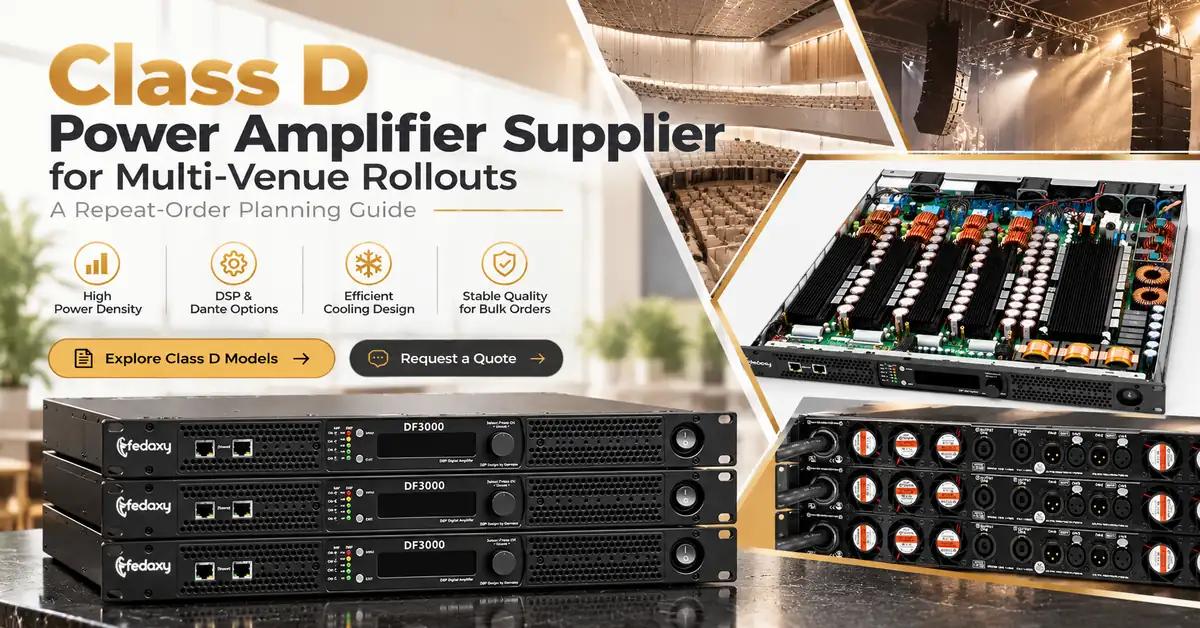
| DF3000 | 4 | 1U | 4 × 3000W | DSP + Dante |
| DT4200 | 2 | 1U | 2 × 4200W | DSP + Dante |
| D43000 | 4 | 1U | 4 × 3000W | Not specified as integrated features |
| D24200 | 2 | 1U | 2 × 4200W | Not specified as integrated features |
The figures above are published manufacturer specifications at 8Ω, not independently verified continuous-output measurements. Confirm the current model revision and measurement conditions before purchasing.
DF3000: Four-channel DSP and Dante integration
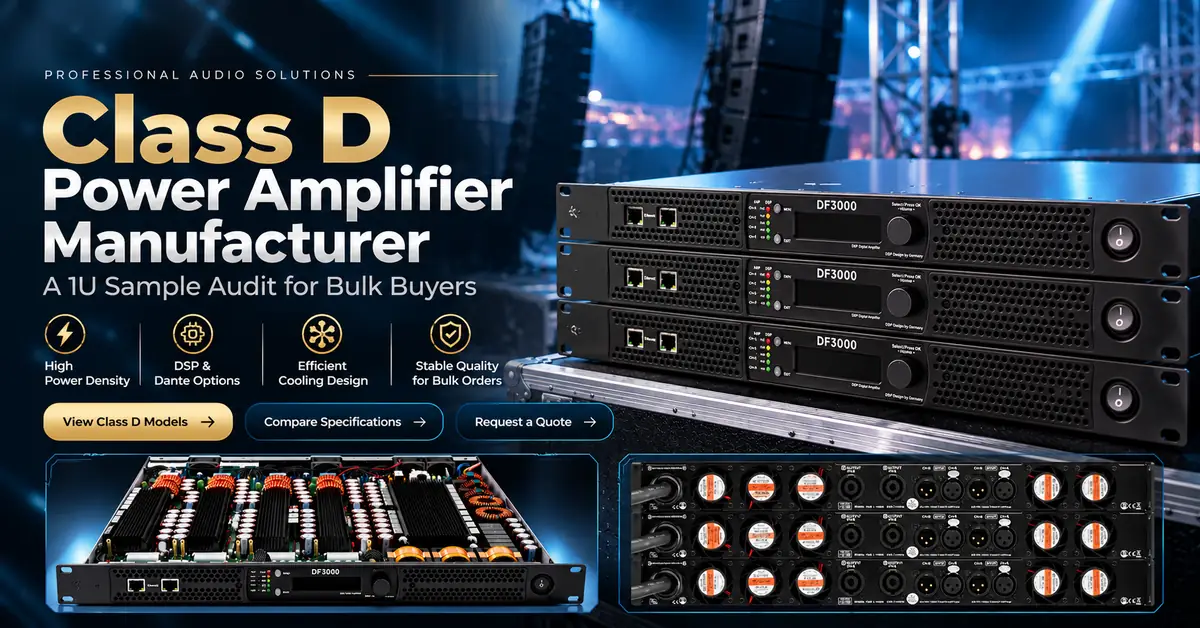
The FEDAXY DF3000 combines four-channel Class D amplification with integrated DSP and Dante network audio capability.
Its public specification lists 4 × 3000W at 8Ω and a 1U chassis. It is a relevant candidate for systems requiring compact multi-channel amplification with digital audio connectivity.
Before ordering, buyers should confirm DSP functions, control software, Dante channel configuration, firmware compatibility, and actual operating performance.
DT4200: High-output two-channel platform
The FEDAXY DT4200 is listed as a two-channel 1U Class D amplifier with DSP and Dante integration.
Its published 8Ω output is 2 × 4200W. This configuration is worth evaluating when a system requires two high-output channels rather than four independently managed outputs.
D43000: Four-channel Class D amplification
The FEDAXY D43000 provides a published 4 × 3000W output at 8Ω in a 1U format.
It can be shortlisted for projects requiring four channels where an external audio processor may already handle signal management. Buyers should verify the required interfaces and signal-processing architecture instead of assuming that the model includes every feature offered by the DF series.
D24200: Two-channel Class D configuration
The FEDAXY D24200 lists 2 × 4200W at 8Ω and a 1U chassis.
It is a candidate for high-output two-channel systems requiring compact rack installation. Its public page contains different 4Ω values between the summary and parameter table. Request a corrected technical datasheet before including its 4Ω rating in purchasing documents.
Selection takeaway: DF3000 and DT4200 are listed with integrated DSP and Dante, while D43000 and D24200 provide alternative channel configurations. The final choice must be confirmed against the actual signal chain, loudspeaker impedance, and operating conditions.
5. How to Conduct a 1U Class D Amplifier Sample Audit
A structured sample audit is one of the most effective ways to reduce purchasing uncertainty. Instead of evaluating only sound quality during a short demonstration, buyers should agree on measurable acceptance criteria.
Step 1: Confirm sample identity and documentation
Record the model, hardware revision, firmware version, serial number, voltage configuration, and product documentation. For DSP-equipped products, identify the control software and firmware supplied with the sample. This information helps ensure that the future production batch matches the approved product.
Step 2: Verify power under the intended load
Use professionally rated test loads representing the intended application, such as 8Ω or 4Ω where supported. Record input voltage, signal conditions, test duration, output level, distortion, and active channels.
If the project requires 2Ω operation, request confirmation of permitted operating conditions and protection limits. Do not interpret a published 2Ω value as evidence of unlimited continuous operation.
Step 3: Evaluate audio performance
Measure relevant audio characteristics using appropriate instrumentation. These may include frequency response, total harmonic distortion, noise, channel consistency, and output behavior. Results should be compared with the agreed technical specification.
Step 4: Test cooling and thermal behavior
A compact amplifier still generates heat. Review inlet and exhaust airflow, fan response, operating temperature, and any thermal protection behavior during representative use.
FEDAXY's public Class D specifications describe intelligent fan cooling with front-to-back airflow. When installing multiple 1U units, the equipment rack must accommodate this airflow without obstructing ventilation.
Step 5: Verify protection and control functions
Ask qualified technical personnel to check documented protection functions through an approved test procedure. For DSP and Dante models, the audit should also include software operation, preset behavior, network reconnection, and signal recovery. A product should not pass evaluation solely because it operates correctly during initial power-up.
Step 6: Approve a traceable sample
Create an approval record containing the serial number, revision, test results, appearance requirements, and agreed acceptance criteria. For repeat purchasing, this reference helps distinguish approved production from unapproved product changes.
A successful sample audit produces documented evidence—not simply a statement that the amplifier sounds good.
6. How Should Buyers Evaluate Manufacturing and Quality Control?
Choosing a Class D power amplifier manufacturer involves evaluating the factory's ability to reproduce consistent equipment over multiple orders.
Important manufacturing areas include PCB assembly, power-device installation, switching power supplies, thermal interfaces, fan assemblies, connectors, wiring, enclosure construction, and final inspection.
FEDAXY manufacturing and QC positioning
According to its company profile , Guangzhou Fedaxy Audio Equipment Co., Ltd. describes more than 15 years of professional amplifier R&D and production experience.
The company also reports:
- Five rounds of quality inspection before shipment.
- An eight-hour aging test for amplifier units.
- 6S on-site production management.
- Incoming-material, assembly, and electrical-performance inspection.
- OEM/ODM support for qualified business projects.
These are manufacturer-reported capabilities. For a large purchase, buyers should request relevant inspection records, sample reports, and agreed production acceptance procedures.
The company also lists ISO 9001, CE, RoHS, and CB-related credentials. Importers should confirm the actual documentation, issuing organization, validity, and product coverage required for their destination market.
A factory's general certification statements do not automatically prove that every amplifier model meets every destination-market requirement.
7. Why Do DSP, Dante, and Cooling Affect Purchasing Costs?
The factory quotation is only one component of the total purchasing decision.
DSP and networking
Integrated signal processing may reduce the need for separate hardware in certain system designs. Dante network audio can also be valuable in installations where supported network infrastructure already exists.
However, the benefits depend on actual software features, compatibility, licensing requirements where applicable, and system architecture. A non-networked amplifier may be more appropriate when existing external processors already provide the required functions.
Rack density and transportation
A 1U design can make better use of available rack space, particularly in rental fleets. Yet transport planning should use actual equipment net weight and rack assembly weight—not gross shipping weight.
Operating and service costs
Potential costs include electricity, cooling, maintenance, spare units, freight, duties, and downtime.
| Cost Element | Purchasing Question |
|---|---|
| Unit price | What is included in the quotation? |
| DSP / Dante | Which functions and software are included? |
| Shipping | What are the packed dimensions and gross weight? |
| Power consumption | What are the measured requirements at the intended duty? |
| Maintenance | How are service and spare parts handled? |
| Warranty | What coverage applies to the quoted model and market? |
| Repeat orders | How are hardware and firmware changes controlled? |
The lowest initial quotation is not necessarily the lowest lifetime cost.
8. OEM/ODM Requirements for Professional Audio Brands
Audio brands may need products differentiated by identity, configuration, or target application.
FEDAXY states that it supports OEM/ODM cooperation, including selected options for logos, front panels, packaging, product configuration, and engineering adjustments.
For Class D products, buyers should establish which requested changes are supported by the specific platform.
A useful customization brief should identify the intended market, channel requirements, DSP and network functions, voltage configuration, branding, documentation, and estimated order quantity.
Customization can affect testing, minimum order quantities, production preparation, and certification requirements. A modified amplifier should not automatically be treated as technically or legally identical to its standard version.
9. How to Request an Accurate Class D Amplifier Quotation
To receive a useful recommendation from a Class D power amplifier manufacturer, provide an actual project brief instead of requesting only a generic price list.
Include the following information:
- Application: Touring, rental, stadium, KTV, theater, or fixed installation.
- Speaker configuration: Impedance, cabinet quantity, and manufacturer-recommended amplifier power.
- Channel requirements: Two-channel or four-channel output.
- Signal processing: External DSP, integrated DSP, or Dante networking.
- Operating environment: Rack arrangement, temperature, ventilation, and mains supply.
- Purchasing requirements: Quantity, destination country, customization, and desired delivery schedule.
Ask the supplier to respond with a recommended model, current technical datasheet, sample arrangement, quality documentation, commercial terms, and lead-time estimate.
FEDAXY states that sample evaluation and smaller initial orders can be discussed, while customized project minimums depend on the requirements. Commercial conditions should be confirmed in the individual quotation.
Have a speaker list or project specification?
Send your load requirements, channel count, DSP/Dante needs and expected quantity to discuss an appropriate amplifier configuration.
Request a Sample & Bulk Quotation →10. Why Consider FEDAXY for Professional Class D Amplifier Sourcing?
FEDAXY is a China-based professional amplifier manufacturer serving distributors, audio brands, contractors, and system integrators.
Its public Class D range includes 1U two-channel and four-channel platforms, with DSP and Dante options on selected models.
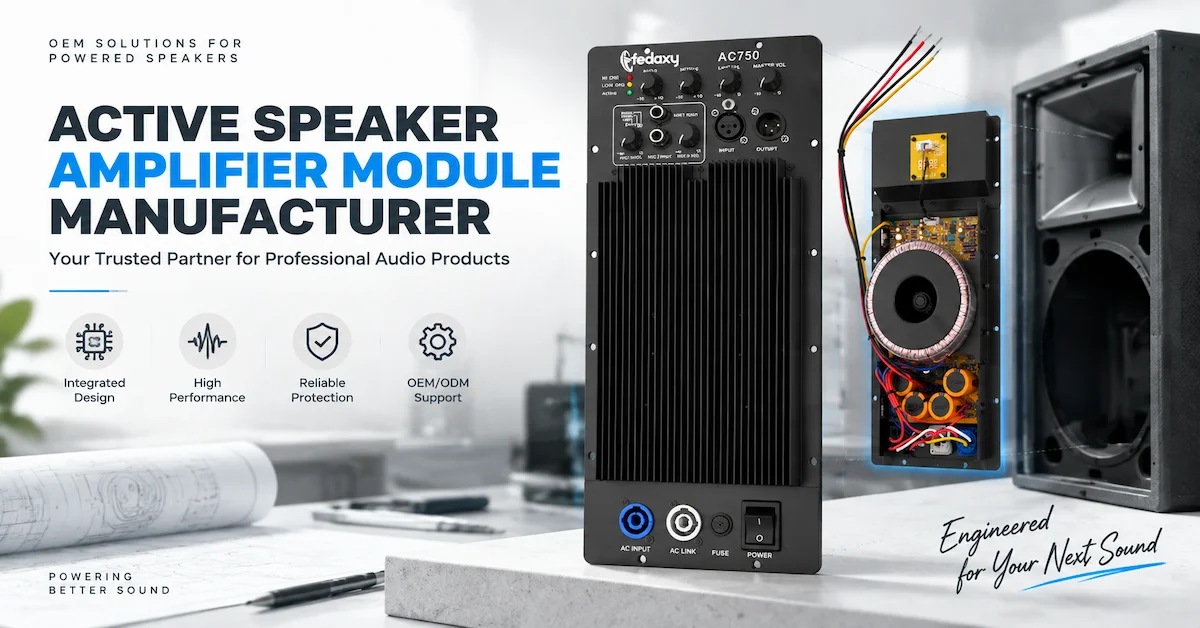
The broader product portfolio also covers Class TD, Class H, Class AB, and active amplifier module solutions. This range allows buyers to discuss different amplifier platforms according to their application requirements.
For a qualified purchasing project, the most useful next step is to review the proposed model, confirm its performance documentation, approve a representative sample, and agree on production and after-sales requirements.
Learn more about FEDAXY's manufacturing background and professional audio applications .
Frequently Asked Questions
1. What does a Class D power amplifier manufacturer do?
A Class D power amplifier manufacturer develops and produces amplifiers using switching output stages. For professional audio customers, the scope may include engineering, assembly, quality inspection, technical documentation, customization, and after-sales support.
2. Why choose a 1U Class D power amplifier?
A 1U amplifier can provide substantial output capability while reducing rack-height requirements. It can be useful for touring, rental, and high-density fixed installations, provided that cooling, electrical supply, and loudspeaker compatibility are verified.
3. Which FEDAXY Class D models support DSP and Dante?
FEDAXY lists the DF3000 and DT4200 with integrated DSP and Dante networking. Buyers should request the corresponding feature documentation and confirm compatibility before ordering.
4. Can a Class D amplifier operate at 2Ω?
Some Class D amplifiers publish 2Ω output specifications, including models in FEDAXY's catalogue. Actual suitability depends on manufacturer-approved operating conditions, output limitations, power supply capability, and thermal performance.
5. Should I choose a two-channel or four-channel amplifier?
Choose based on the speaker schedule and required independent outputs. Four channels can reduce the number of chassis needed for multi-zone systems, while two channels may be sufficient for high-output stereo or separately managed speaker groups.
6. How can I verify amplifier output power?
Request a documented test method and, where appropriate, a professionally conducted sample test. Compare power at the specified load, input voltage, test duration, number of driven channels, and distortion threshold.
7. Is Class D always better than Class H?
No. Class D often offers advantages in efficiency and power density, but Class H may suit projects with different equipment, service, or operating preferences. Compare complete systems instead of treating amplifier class as an absolute quality ranking.
8. Can professional amplifier manufacturers provide custom branding?
Some manufacturers support OEM and ODM customization. FEDAXY describes branding, packaging, appearance, and configuration-related options, subject to technical and commercial confirmation.
9. What are typical MOQ and lead-time requirements?
MOQ and delivery schedules vary by model, quantity, component availability, and customization. FEDAXY indicates that smaller standard-model orders can be discussed, but buyers should request confirmed terms for each project.
10. What information should I send to obtain a bulk quotation?
Provide your target application, speaker specifications, impedance, required channel count, DSP or Dante needs, mains voltage, destination market, estimated order volume, and any customization requirements.
FINAL BUYER TAKEAWAY
Conclusion
Choosing the right Class D power amplifier manufacturer requires more than comparing nominal power ratings or factory prices. For professional audio importers, distributors, rental companies, and system integrators, the best purchasing decision is supported by accurate specifications, suitable channel configurations, traceable sample testing, reliable cooling, documented quality control, and clear commercial terms.
FEDAXY offers a focused selection of 1U Class D amplifier platforms, including the DF3000, DT4200, D43000, and D24200, for buyers evaluating professional sound reinforcement solutions.
Whether you need a four-channel amplifier for an integrated audio rack or a high-output two-channel configuration, start with your speaker requirements and establish measurable acceptance criteria before committing to volume production.