Quick Answer: The best amplifier for line array speakers is the amplifier approved for that particular loudspeaker system, capable of driving its actual impedance and frequency-band loads with the required headroom, DSP presets, limiters and thermal reliability. Self-powered arrays already have built-in amplification; proprietary passive systems may require a dedicated controller amplifier. For compatible open-platform passive arrays, Class D, Class TD and Class H amplifiers can all be suitable when verified against the full system design.
Choosing a power amplifier for line array speakers is a system-engineering decision, not a contest to find the largest wattage number. Touring companies need transportable racks and predictable fault recovery. Venue integrators need consistent operation, appropriate control and service access. Professional audio distributors need models that can be matched correctly to their customers' loudspeaker inventories. This guide explains the electrical, acoustic and commercial questions that should be answered before specifying equipment, and provides concrete examples from FEDAXY's professional power amplifier range.
1. Start With the Most Important Question: What Type of Line Array Do You Own?
A line array is a group of loudspeaker enclosures arranged to achieve controlled audience coverage. The array's physical arrangement does not tell you whether it needs an external power amplifier. Determine the electrical architecture before browsing amplifier catalogues.
Self-powered or active line arrays
A self-powered cabinet contains an amplifier module and usually dedicated signal processing. It typically requires appropriate mains power and an audio or network input rather than a conventional high-power loudspeaker output from an external rack amplifier. Buying a separate power amplifier for its internal drivers is normally unnecessary and may be incompatible with the product design. External equipment may still be needed for control, networking, distribution or other passive loudspeakers in the same venue.
Passive line arrays with an open amplifier interface
A conventional passive line array needs external amplification. Some enclosures contain a passive crossover; others expose separate LF and HF connections for bi-amplified or multi-amplified operation. The compatible amplifier must provide the required number of independently controlled channels and appropriate output at each connected load. It must also be used with the loudspeaker's prescribed processing, wherever applicable.
Manufacturer-controlled loudspeaker ecosystems
Some passive-looking enclosures are intended to work only with dedicated controller amplifiers, approved presets or a tightly specified electronics ecosystem. When the loudspeaker manufacturer requires a proprietary amplifier, use the approved system rather than substituting a third-party rack unit on the basis of power and impedance alone. Without the intended processing and protection, the result may be poor acoustic performance or driver damage.
| Line array architecture | Does it need a separate power amplifier? | First buying action |
|---|---|---|
| Active/self-powered array | Normally no, amplification is integrated | Verify power distribution and built-in DSP/control |
| Passive, externally amplified array | Yes | Obtain speaker ratings, wiring plan and approved processing |
| Passive array with dedicated controller requirement | Only the specified compatible controller/amplifier | Follow loudspeaker manufacturer documentation |
| Hybrid array with active tops and passive subs | Possibly, for passive portions only | Separate amplifier assignments by subsystem |
Practical rule: If the loudspeaker manual says it must operate with a dedicated controller amplifier, that requirement overrides a generic recommendation for Class D, TD or H.
2. Which Amplifier Class Is Best: Class D, Class TD or Class H?
All three can be considered for compatible externally amplified systems. The better choice depends on power density, available rack space, electrical efficiency, load conditions, project budget, servicing strategy and the specific model's verified behavior. A class name is not a measured sound-quality ranking.
Class D: compact high-density touring and networked systems
Class D output stages use high-frequency switching and filtering. Well-designed professional models can provide substantial power in relatively compact enclosures. This makes them attractive for fly-pack systems, mobile racks, rental companies and installations with limited equipment space. Models with integrated DSP or Dante networking may reduce the need for separate components in certain architectures. However, smaller chassis still need sufficient ventilation, electrical supply and properly configured protection.
Class TD: an alternative for powerful professional racks
Class TD is a manufacturer-used designation associated with certain high-output professional amplifier platforms. Implementations can differ, so buyers should compare actual electrical specifications, cooling, channel count and service expectations rather than assuming all Class TD products share one standardized topology. It can be relevant to touring systems, multi-channel sound reinforcement and substantial low-frequency loads when the exact model meets the loudspeaker requirements.
Class H: a traditional high-output platform
Class H amplifiers typically use multiple supply-rail operating levels to improve efficiency relative to a comparable fixed-rail linear output design. Depending on construction, these products may require larger or heavier chassis than compact Class D designs, but they remain relevant where integrators value a particular power architecture, service approach or existing rack standard. They should be evaluated using the same load, distortion, cooling and reliability criteria.
| Evaluation factor | Class D | Class TD | Class H |
|---|---|---|---|
| Common purchasing reason | Compact high-power-density system | High-output professional amplifier options | Established high-output linear-style platform |
| Typical rack consideration | Often compact, sometimes 1U | Depends on model, 1U to 3U examples | Often larger chassis in high-power examples |
| DSP integration | Available on selected models | Available on selected models | Often paired with external processing; verify by model |
| Low-impedance operation | Only where explicitly specified | Only where explicitly specified | Only where explicitly specified |
| Best application | Depends on the approved speaker and system design | Depends on the approved speaker and system design | Depends on the approved speaker and system design |
Buying conclusion: For a transport-focused rack, consider a compact Class D model first. For a high-output two-channel low-frequency rack, evaluate suitable Class TD options. For an existing Class H-based installation, a compatible Class H design may fit the operational strategy. None should be selected until the loudspeaker requirements and processing are confirmed.
3. How Much Amplifier Power Does a Line Array Really Need?
Start with the loudspeaker manufacturer's instructions, not a generalized watts-per-box assumption. Obtain the continuous or AES-type power handling figure, program rating where specified, peak rating where specified, nominal impedance, recommended amplifier range, permitted processing and maximum number of cabinets per channel. Different manufacturers use different rating methods; two identically printed wattage numbers may not mean the same thing.
For some conventional passive systems, a professional audio manufacturer's selection guide may suggest amplifier power near the speaker's program rating, sometimes approximately twice its continuous rating. That is a contextual rule of thumb, not an instruction to apply two times power to every line array. Many managed arrays require precisely defined voltage limits and manufacturer presets. Oversized amplifiers with incorrect limiters can destroy drivers even when clipping is absent.
Understand the difference between continuous, program and peak ratings
A continuous rating characterizes a loudspeaker's thermal or standardized power-handling capability under specified conditions. A program rating is often intended to represent a particular music-related allowance, while peak ratings may describe brief events. Their definitions and durations are not universal. The amplifier's own power data may similarly describe different test methods. Compare the underlying test conditions before making a purchasing decision.
Do not confuse acoustic headroom with unlimited amplifier power
Dynamic music needs capacity for transients. But the objective is to achieve the desired sound pressure level without frequent clipping or excessive limiting, while respecting driver excursion, thermal limits and system protection. A proper gain structure and verified limiter preset are essential. Adding wattage without checking the speaker's safe voltage and frequency-band limits does not solve a weak system design.
4. Calculate the Actual Load: 8Ω, 4Ω and 2Ω Examples
An amplifier channel sees the combined load of the loudspeakers connected to it. For nominally equal impedances wired in parallel, divide the nominal impedance by the number of boxes. For unequal nominal impedances in parallel, use the reciprocal formula:
1 / Ztotal = 1 / Z1 + 1 / Z2 + ...
| Illustrative connection | Nominal equivalent impedance | Important implication |
|---|---|---|
| One 8Ω passive enclosure | 8Ω | One enclosure per channel |
| Two 8Ω enclosures in parallel | 4Ω | Check the amplifier's 4Ω output rating |
| Four 8Ω enclosures in parallel | 2Ω | Use only if amplifier and speaker system allow this arrangement |
| Two 4Ω enclosures in parallel | 2Ω | Significantly higher current demand |
| One 4Ω enclosure | 4Ω | Match the rated 4Ω amplifier capability |
These are nominal electrical examples, not full impedance curves. Real loudspeaker impedance varies with frequency and may dip below the nominal figure. Cable resistance, connector condition, cabinet wiring and output filtering may also affect system behavior. Some manufacturers limit cabinets per channel independently of simple impedance mathematics.
Example: three ways to wire an array segment
Suppose a compatible passive line array uses 8Ω cabinets, with no manufacturer-imposed prohibition on the proposed connection. One cabinet on each channel is nominally 8Ω. Two cabinets in parallel are nominally 4Ω. Four cabinets in parallel are nominally 2Ω. That third arrangement should not be chosen just because the amplifier catalogue publishes a large 2Ω output. It may exceed the loudspeaker maker's allowed configuration or the project's thermal and reliability targets.
For many touring systems, using more amplifier channels at a less demanding nominal impedance can improve channel-level control and fault isolation, at the cost of additional hardware or wiring. The best balance requires the real system bill of materials.
5. Translate Loudspeaker Ratings Into Channel Requirements
A line array is not always a series of identical full-range boxes connected to two stereo outputs. Some arrays need separate LF, MF and HF channels, and many systems have dedicated subwoofer amplifiers. Before selecting rack units, draw a channel schedule that names every amplifier output and its connected loudspeaker group.
| Channel allocation question | Why it matters |
|---|---|
| How many left and right array zones? | Determines independent channel count |
| Does each cabinet have passive or active crossover sections? | Determines need for bi-amplification or multi-amplification |
| Are front fills, delays or outfills included? | Adds separate processing and output channels |
| Are subwoofers externally powered? | Creates a distinct low-frequency amplifier requirement |
| Does the system use cardioid subwoofer arrangements? | May require independent polarity, delay and amplifier outputs |
| Does the array use required presets per enclosure group? | Affects DSP and channel-routing decisions |
A four-channel model can be particularly practical when four independent outputs reduce the number of chassis needed. A two-channel model can be ideal for a stereo pair of compatible speaker groups or two independently processed subwoofer loads. The number of chassis is less important than having the correct controllable channels.
6. DSP, Presets and Limiters: Often More Important Than Extra Watts
A well-selected amplifier still requires suitable loudspeaker management. For line arrays, system presets may contain frequency-response correction, crossover filtering, delay, phase alignment, high-pass protection and frequency-dependent limiters. These functions are not interchangeable simply because two processors each advertise "DSP."
Use the exact loudspeaker manufacturer's validated preset where required. If an external amplifier is allowed, obtain confirmation that the proposed DSP platform can implement the prescribed filters and protection correctly. Check processing latency, gain structure, limiter units, available filter types and the ability to lock or recall settings.
Integrated DSP versus external processing
Integrated DSP can help simplify a touring rack, shorten analog signal paths and standardize configuration across amplifiers. It is useful only if the particular implementation supports the speaker's needs. External DSP may be preferable when an existing control platform manages multiple amplifier classes, system zones and network interfaces. Some dedicated loudspeaker ecosystems require their proprietary controller regardless of the feature count on a third-party unit.
Dante is an audio transport system, not a speaker preset
Dante-enabled amplifiers can receive supported digital audio channels over a suitably designed network. This can improve routing flexibility for compatible systems. But Dante does not automatically provide crossover protection, safe voltage limiting or manufacturer-approved tuning. Treat network connectivity, DSP functionality and loudspeaker compatibility as three separate purchasing requirements.
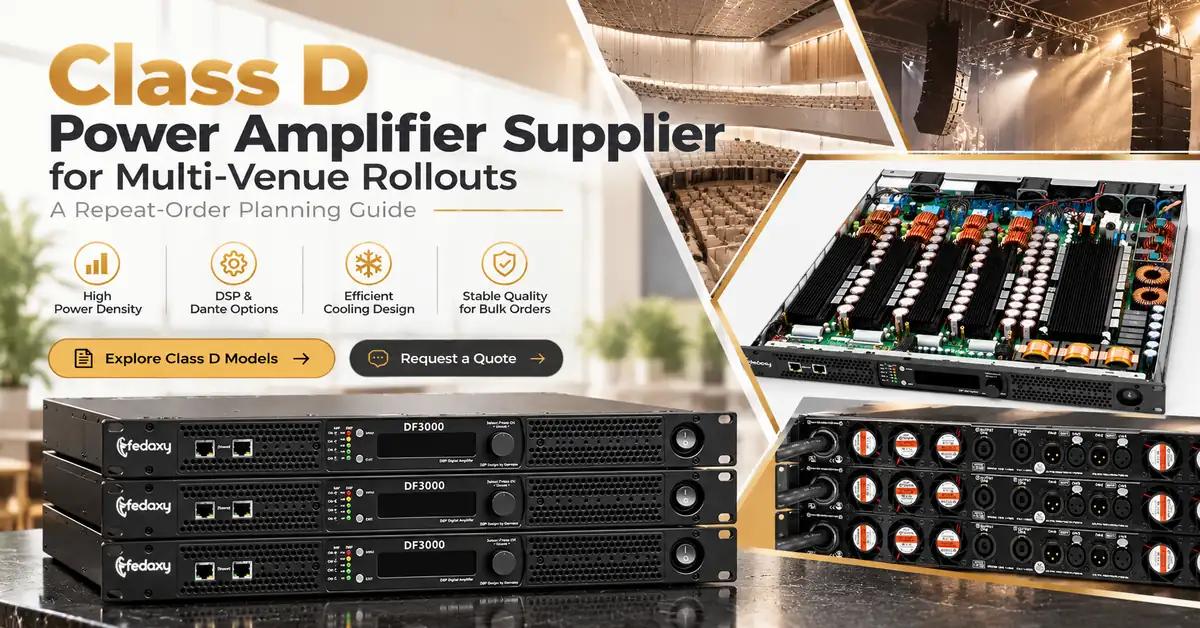
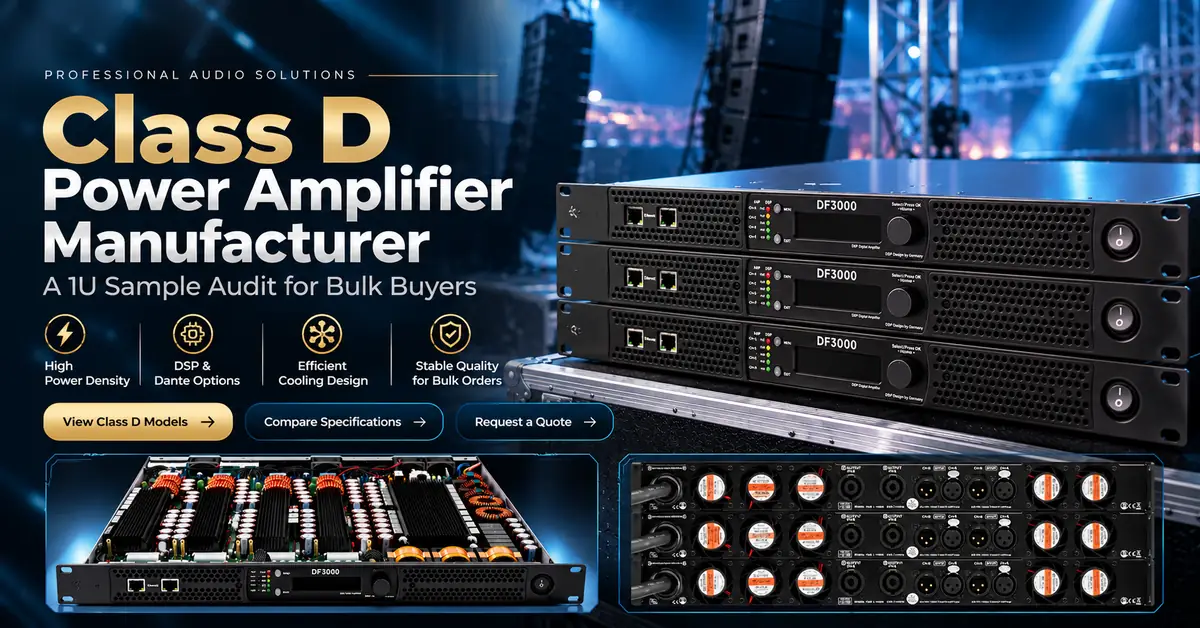
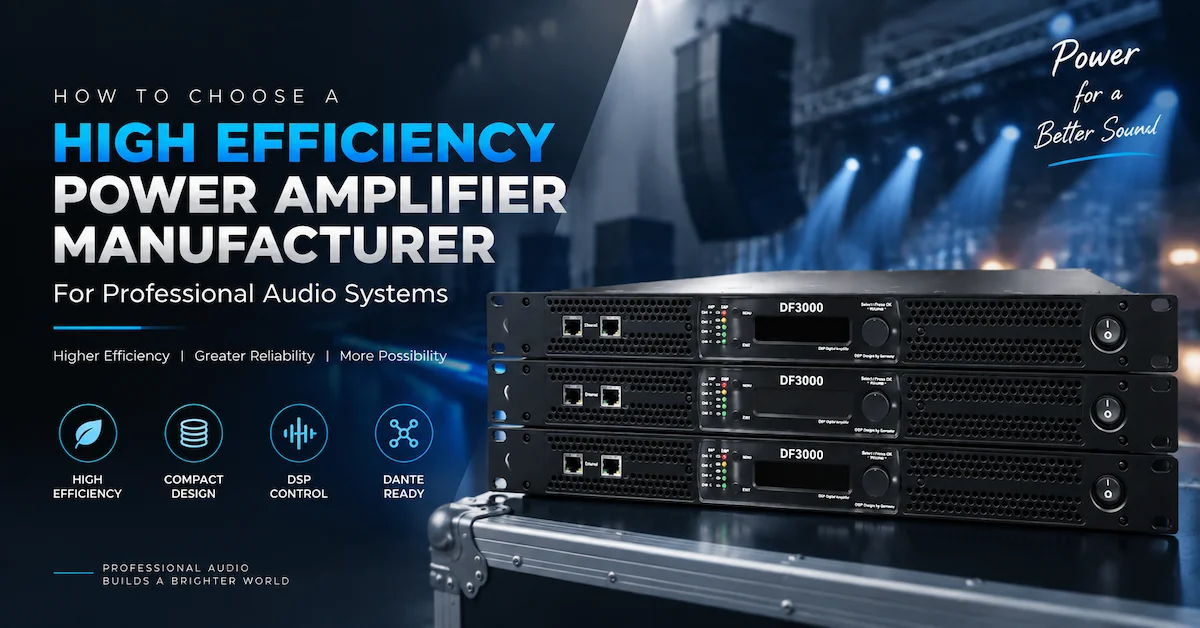
For integrators reviewing digital power options, FEDAXY DF3000 and DT4200 are published as Class D amplifiers with DSP and Dante. Buyers should confirm the specific processing functions, network configuration, firmware and preset support before selecting them for a loudspeaker system.
7. Should Line Array Tops and Subwoofers Use the Same Amplifier?
Not necessarily. Line array tops and subwoofers differ in bandwidth, current demand, mechanical excursion constraints and the way their amplifiers are managed. A large show may use different amplifier platforms for the main array, subwoofers, front fills and delays. That can be sensible if every component has been engineered as part of the complete system.
For array tops
Prioritize the required channel count, reliable processing, appropriate impedance, clean operation and fast deployment. A four-channel amplifier may organize multiple array groups efficiently, particularly in rental racks. The correct output power still depends on speaker manufacturer recommendations and the actual load.
For subwoofers
Pay particular attention to the required electrical power, permissible voltage, high-pass filtering, limiter behavior, mains supply, cable losses, cooling and mechanical protection. In some projects a high-output two-channel platform suits the bass system, while another amplifier handles mid/high sections.
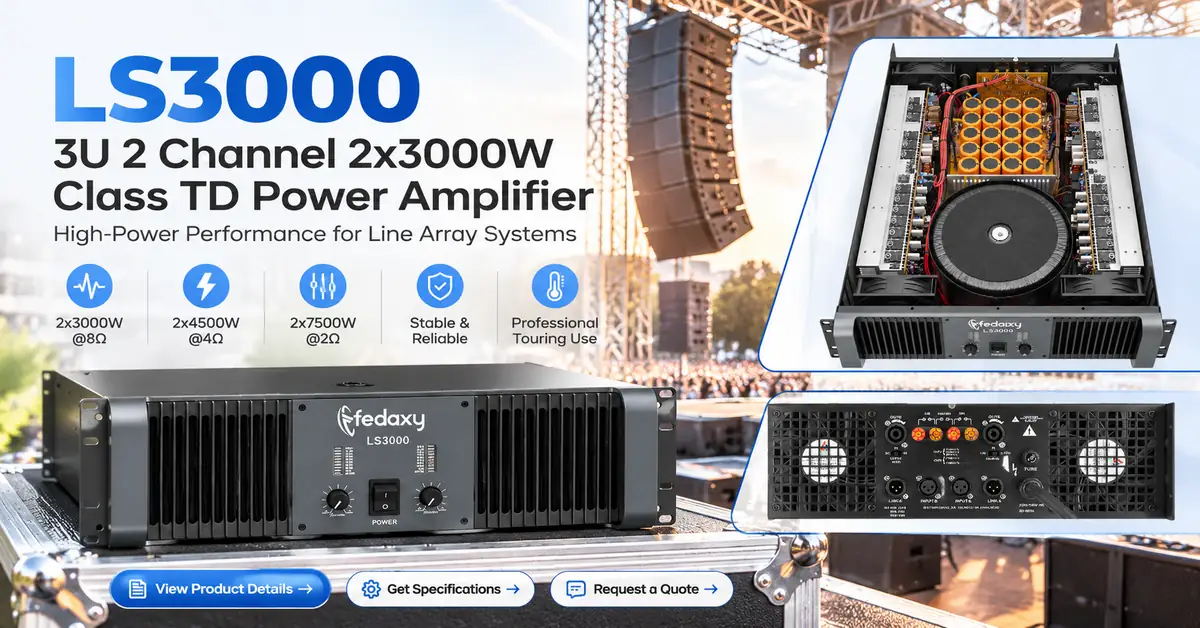
For example, the FEDAXY LS3000 Class TD amplifier is positioned for high-power sound reinforcement and subwoofer use. Its published specification lists 2 × 3000W at 8Ω in a 3U chassis. The HT42000 Class H amplifier is a four-channel alternative, listed at 4 × 2000W at 8Ω and marketed for demanding low-frequency and touring applications. Neither should be assigned to a specific subwoofer without checking its manual and intended load.
8. FEDAXY Amplifier Models Worth Evaluating for Compatible Passive Line Arrays
Guangzhou Fedaxy Audio Equipment Co., Ltd. manufactures several professional amplifier platforms. The following table provides supplier-published model specifications, not independent output tests or an assurance of compatibility with a particular loudspeaker brand.
| Model | Technology | Channels / height | Published 8Ω output | Selection angle |
|---|---|---|---|---|
| DF3000 | Class D | 4CH / 1U | 4 × 3000W | High-density digital racks; DSP and Dante noted |
| D43000 | Class D | 4CH / 1U | 4 × 3000W | Compact multi-channel amplification with external processing plan |
| DP41500 | Class TD | 4CH / 1U | 4 × 1500W | 1U DSP-equipped alternative for multiple channels |
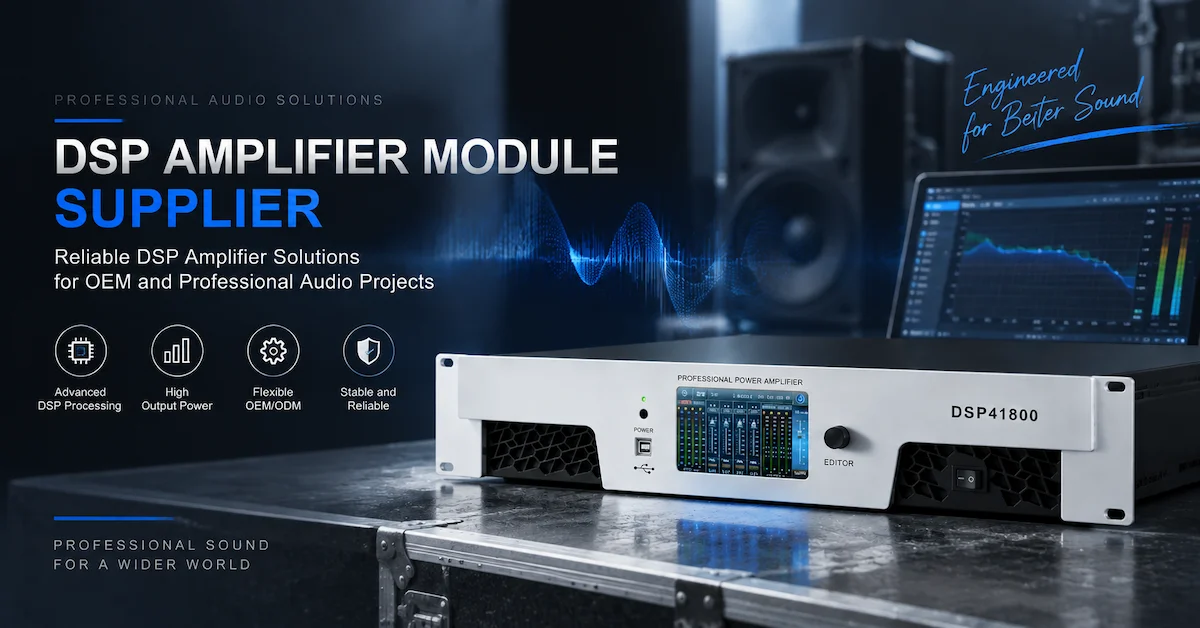
| DSP41800 | Class TD | 4CH / 2U | 4 × 1800W | Four-channel Class TD platform with DSP |
| LS3000 | Class TD | 2CH / 3U | 2 × 3000W | High-output, two-channel low-frequency candidate |
| HT42000 | Class H | 4CH / 3U | 4 × 2000W | High-output four-channel Class H option |
Important comparison note: Published wattage values are measured or described under manufacturer-defined conditions. Obtain the current datasheet and confirm test duration, distortion level, mains supply, simultaneous channel loading and thermal behavior. Do not treat an 8Ω figure as continuous full-band capability without supporting documentation.
DF3000 versus D43000: when digital integration matters
Both are listed as four-channel 1U Class D amplifiers with the same headline 8Ω channel power. DF3000 explicitly includes DSP and Dante positioning. D43000 should not be assumed to contain these functions because its public listing does not identify them as integrated features. In a design with a validated external processor, D43000 could be an option to evaluate; in a networked rack needing integrated processing, DF3000 may warrant closer review.
DP41500 versus DSP41800: choosing a Class TD DSP format
DP41500 is a 1U four-channel platform with a published 4 × 1500W at 8Ω. DSP41800 uses a 2U chassis and is published at 4 × 1800W at 8Ω. Neither number alone settles the choice. Check the actual speaker power range, cooling allowances, connector layout, DSP feature list and required service access. A higher headline rating may be unnecessary for a smaller system.
LS3000 versus HT42000: planning a bass rack
LS3000 provides two higher-output channels in a 3U Class TD design, while HT42000 provides four channels in a 3U Class H design. The better option depends on the number of separately driven subwoofer groups, nominal loads, permitted processing and power distribution. For multi-cabinet bass systems, several controlled channels can be more useful than the maximum output from one bridged channel.
9. Two Illustrative Matching Exercises for System Designers
The following examples are educational exercises, not installation drawings or validated matches for an unnamed loudspeaker. They show how to structure a discussion with the speaker and amplifier manufacturers.
Example A: small passive array with two 8Ω boxes per channel
Assume a loudspeaker manufacturer permits two identical passive 8Ω cabinets to be wired in parallel and recommends an appropriate output and DSP preset for the combined load. Two cabinets produce a nominal 4Ω channel load. Now check the candidate amplifier's manufacturer-published 4Ω rating, measured conditions and permissible operating duty. Review the maximum cabinets-per-channel instruction rather than relying only on the calculated impedance.
Next, verify that the signal processor provides the loudspeaker's required high-pass filtering, equalization and limiters. If the cabinets need independent shading or other control, combining them on one channel may be inappropriate even if the nominal impedance is acceptable. The last decision is the number of channels needed for left/right groups, fills and spare capacity.
Example B: array tops plus independently managed subwoofers
Suppose the main arrays are passive and compatible with an external four-channel amplifier, but the subs need a separate low-frequency amplifier group. One candidate could be a four-channel Class D or TD model for properly grouped tops and a separate high-output Class TD or H model for eligible passive subs. The tops and subwoofers would each receive their prescribed processing and limiters.
The equipment list then records channel assignments, impedance per channel, nominal speaker handling, amp output at that impedance, signal source, DSP presets and rack power. This is more reliable than selecting every amplifier from a single wattage ranking. If the loudspeaker ecosystem requires dedicated controllers, the proposed third-party solution must be rejected or revised.
10. Evaluate the Operating Environment: Touring, Stadium, Theater or Outdoor Event
The best power amplifier for line array speakers must survive the real environment in which it is used. A touring company cares about pack weight, connector consistency and quick fault recovery. A theater may prioritize low noise, controlled gain and repeatability. Stadium contractors must coordinate many channels, long cable runs and electrical distribution. Outdoor events introduce weather protection and potentially difficult mains conditions.
| Application | Important selection priority | Critical check |
|---|---|---|
| Touring concerts | Rack density and repeatable setup | Ventilation, spare plan, input/output patching |
| Stadium or large arena | Channel planning and operational resilience | Power distribution, monitoring and approved presets |
| Theater or auditorium | Noise, dialogue clarity and consistent control | Gain structure, DSP, system tuning |
| Outdoor festival | Electrical and environmental resilience | Protected racks, dust, rain and ambient temperature |
| Worship or conference venue | Speech intelligibility and maintainability | Correct array coverage, processor settings and service access |
| Rental inventory | Compatibility across multiple clients and systems | Version management, labeling and standardized rack builds |
A rack amplifier designed for professional live sound is not necessarily weatherproof. Use appropriately protected equipment locations, manage condensation, avoid obstructed airflow and inspect connectors after transport. A high-power product cannot compensate for an unsafe electrical installation.
11. Cooling, Power Supply and Protection: The Hidden Performance Factors
An amplifier with sufficient nominal output may still be unsuitable if the venue cannot provide the necessary electrical service or ventilation. Verify input-voltage compatibility, maximum current requirements, power factor information where available, wiring standards, and the cumulative demand of all racks. Consider the effects of voltage fluctuation and generator operation where relevant.
Airflow direction matters. Several FEDAXY model pages specify fan-assisted front-to-back cooling. Rack doors, cable looms, dust filters and adjacent equipment should not block inlets or exhaust paths. In tightly packed touring racks, test the complete assembly under representative operating conditions. A cool idle chassis does not prove acceptable thermal behavior at the intended duty.
Protection functions such as over-temperature, short-circuit and DC-output protection should be reviewed model by model. They are last-resort safeguards, not alternatives to appropriate wiring or loudspeaker protection. Establish what happens when a unit limits, mutes or shuts down, and whether the system operator can diagnose the cause during a show.
For B2B procurement, ask for documentation explaining acceptable ambient conditions and maintenance requirements. These factors can influence the total lifetime cost more than a modest difference in initial amplifier price.
12. What Should Buyers Request From a Manufacturer Before Ordering?
A professional amplifier purchase should include a documented technical and commercial exchange. The most useful request is a concise bill of materials and system brief rather than a generic message asking which amplifier has the most power.
| Procurement question | Information to request |
|---|---|
| Which model fits the speaker system? | Manufacturer-approved speaker data and channel map |
| Are ratings comparable? | 8Ω/4Ω/2Ω output conditions, duration and distortion |
| Is processing compatible? | DSP feature list, validated presets and limiter capability |
| Will it work at the venue? | AC supply, rack dimensions, weight, cooling and ambient limits |
| How is quality checked? | Product-specific inspection, aging and functional test procedures |
| Can we repeat the same configuration? | Hardware/firmware identification and change-control agreement |
| What are the commercial terms? | Quantity, MOQ if applicable, lead time, Incoterm and quotation validity |
| What happens after delivery? | Written warranty, spare-unit and technical-support arrangements |
FEDAXY describes manufacturing, technical consultation, OEM/ODM and quality-control services on its About Us pages. However, standard-order MOQ, lead time, warranty coverage, destination-market certifications and customized DSP capabilities should always be confirmed for the actual model and contract. Public statements are not substitutes for a written order agreement.
Quality control and manufacturing consistency
For an overseas distributor or installation contractor, the main question is whether the delivered product matches the approved sample and current technical revision. Request inspection criteria, product identification, documented output verification and a clear procedure for reporting defects. If the equipment will be used across many venues, decide whether spare units or replacement stock should be included.
OEM and customization projects
Audio brands may require custom appearance, labeling, packaging or configuration. These changes should be discussed early because electrical or firmware modifications may require renewed validation. A customized amplifier should not automatically inherit every qualification or compatibility claim attached to the standard model.
13. Common Mistakes When Choosing a Line Array Power Amplifier
Mistake 1: Buying an external amplifier for self-powered cabinets. Confirm whether the speaker already contains its own amplification and what input it accepts.
Mistake 2: Replacing a mandatory controller with a generic rack amp. Follow proprietary loudspeaker-system requirements, including presets and processing.
Mistake 3: Selecting by peak watts only. Check the actual load, measurement conditions, target output and speaker protection needs.
Mistake 4: Assuming four 8Ω cabinets are automatically safe at 2Ω. The amplifier, speaker maker and deployment limits must all allow the arrangement.
Mistake 5: Treating Dante as loudspeaker management. Network transport does not guarantee the correct EQ, crossover, phase alignment or limiters.
Mistake 6: Ignoring the subwoofer section. Low-frequency cabinets may need different channel distribution and protection from the main array.
Mistake 7: Overlooking power and thermal constraints. Venue electrical service, ambient conditions and rack airflow are part of the amplifier specification.
Mistake 8: Confusing a supplier's published rating with independent verification. Request a current datasheet, the conditions behind its ratings, and a suitable approval test for major orders.
14. How FEDAXY Can Support a Project-Specific Amplifier Discussion
FEDAXY supplies professional audio power amplifiers spanning Class D, Class TD, Class H and Class AB platforms. Its catalogue offers different channel counts and chassis formats, including high-density Class D models, DSP-equipped Class TD options and larger high-output Class H products.
For a compatible passive line array project, that variety creates a useful shortlist. Rather than beginning with a particular amplifier class, share the speaker's exact manufacturer and model, cabinet count, impedance, required processing, the number of independent outputs, input-voltage region, rack limits, intended environment and approximate quantity. FEDAXY can then discuss relevant product specifications and available commercial arrangements.
The final system must still follow the loudspeaker maker's compatibility rules and be validated by the responsible audio engineer. A product being described as suitable for touring or line arrays does not override those requirements.
Frequently Asked Questions
1. Which power amplifier is best for line array speakers?
The best amplifier is the system-compatible model with adequate output at the actual impedance, the required channels, approved DSP/limiter configuration and suitable cooling. If the line array is self-powered, no external driver amplifier is normally required. If the speaker manufacturer specifies a dedicated controller, use that supported solution rather than substituting a generic amplifier.
2. Is Class D always better than Class TD or Class H for line arrays?
No. Class D is often attractive for compact, lightweight racks, but all three platforms may work in compatible passive systems. Compare published and verified output data, channel count, processing, rack weight, mains requirements, service conditions and the loudspeaker maker's instructions before deciding.
3. How many watts should an amplifier provide per line array cabinet?
There is no universal wattage per cabinet. Use the speaker manufacturer's recommended amplifier range and distinguish continuous, program and peak ratings. Calculate the complete load on each channel, confirm output at that impedance and use approved limiters. A simple 1.5× or 2× guideline cannot replace system-specific instructions.
4. Can I connect two 8Ω line array cabinets to one amplifier channel?
Two identical nominal 8Ω loads wired in parallel produce approximately 4Ω nominal impedance. This connection may be acceptable if the speaker maker permits the arrangement, the amplifier supports the load, and the required processing and channel management remain valid. Confirm the number of cabinets allowed per channel.
5. Is a 2Ω amplifier better for powering many array cabinets?
Not inherently. A lower nominal impedance can allow more parallel cabinets on one channel, but it increases current demands and can reduce fault isolation. Use 2Ω operation only when both amplifier and loudspeaker documentation permit it, and verify thermal behavior and the intended duty cycle.
6. Do line arrays require DSP amplifiers?
Most professional line array systems require appropriate processing, but it may be built into the loudspeakers, integrated in the amplifier, supplied by an external processor or provided by a proprietary controller. The important requirement is correct and approved crossover, filtering, delay and limiter behavior, not the physical location of the DSP.
7. Can I use a Dante amplifier with any line array?
No. Dante provides a method of transporting compatible digital audio over a designed network; it does not establish loudspeaker protection or electrical compatibility. Check the amplifier's network features, processing functions and whether the loudspeaker manufacturer permits the proposed electronics system.
8. Should subwoofers and array tops use separate amplifiers?
Separate amplifier groups are often practical because their frequency ranges, channel requirements and protection settings differ. A unified platform can also work when it supports all required loads and processing. The decision should be based on the complete sound-system design rather than a fixed rule.
9. Which FEDAXY models can buyers compare for line array applications?
For suitable passive systems, candidates worth evaluating include the DF3000 and D43000 Class D models, DP41500 and DSP41800 Class TD DSP models, and high-output LS3000 Class TD or HT42000 Class H platforms. Their public ratings are starting points only; compatibility, operating conditions and required presets must be confirmed.
10. What information should I send when requesting a line array amplifier quotation?
Provide the loudspeaker brand and model, whether the array is active or passive, required controller rules, cabinet count, nominal impedance, wiring plan, desired output channels, processor/preset requirements, voltage region, rack/environmental constraints, destination, estimated order volume and project schedule. A detailed brief enables a more accurate technical and commercial recommendation.
Conclusion
Which power amplifier is best for line array speakers? The answer begins with the loudspeaker, not the amplifier brochure. Self-powered systems already incorporate amplification. Proprietary arrays may require dedicated controller amplifiers. For compatible externally amplified arrays, the correct Class D, Class TD or Class H model is the one that meets the actual channel load, required output, DSP/limiter configuration and operating environment with dependable serviceability.
For touring and compact digital racks, Class D deserves consideration; Class TD and Class H may suit other high-output or operational requirements. FEDAXY's DF3000, D43000, DP41500, DSP41800, LS3000 and HT42000 provide several technical directions for qualified buyers to investigate, but each proposed match must be verified against the loudspeaker system's own specifications.
Before committing to bulk purchasing, obtain the loudspeaker's approved processing information, calculate per-channel loads, request current amplifier datasheets, review cooling and electrical supply, and agree on sample acceptance, production and after-sales terms. Those steps help turn an impressive power rating into a workable system design and reduce costly procurement mistakes.