Quick Answer: What Makes a 4 Channel DSP Amplifier Right for Touring Audio?
A 4 channel DSP amplifier for touring audio is a strong fit when a mobile sound system needs four independent amplifier channels, repeatable signal processing, compact rack use and dependable operation across changing venues. The first question should not be “Which model has the biggest wattage?” It should be “What load will each channel see, how much rack space is available, what DSP work must stay inside the amplifier, and how will the system behave after hours of use?” Touring companies, rental houses, system integrators and distributors should compare output at 8Ω, 4Ω and 2Ω, bridge capability, mains voltage, cooling, protection, software workflow and service access before approving a model.
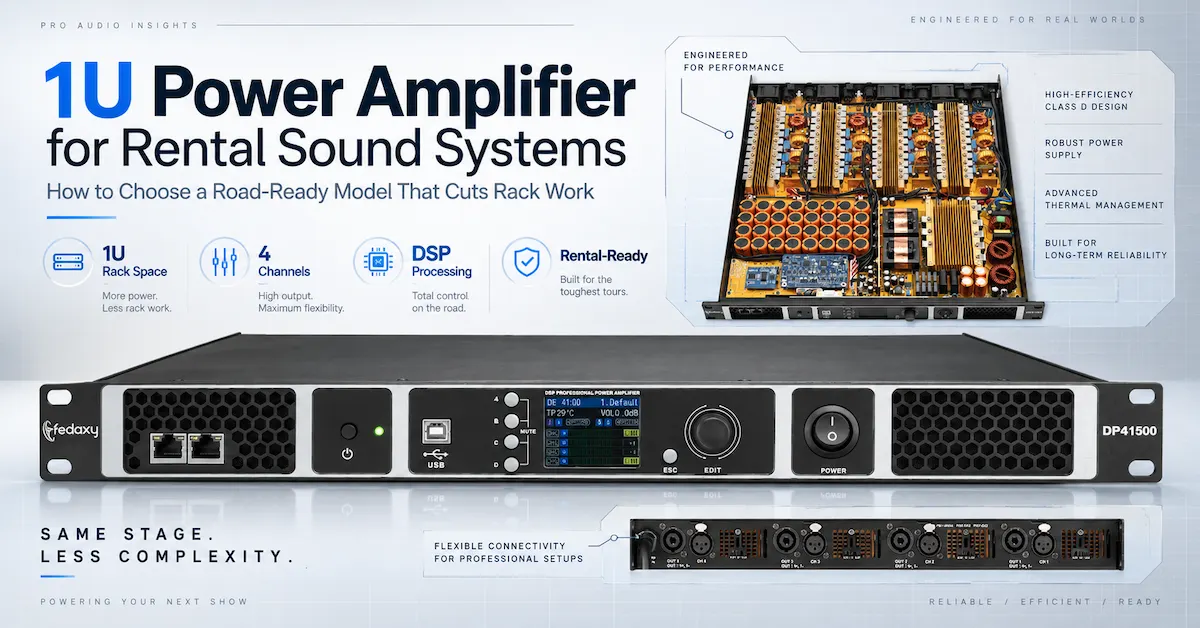
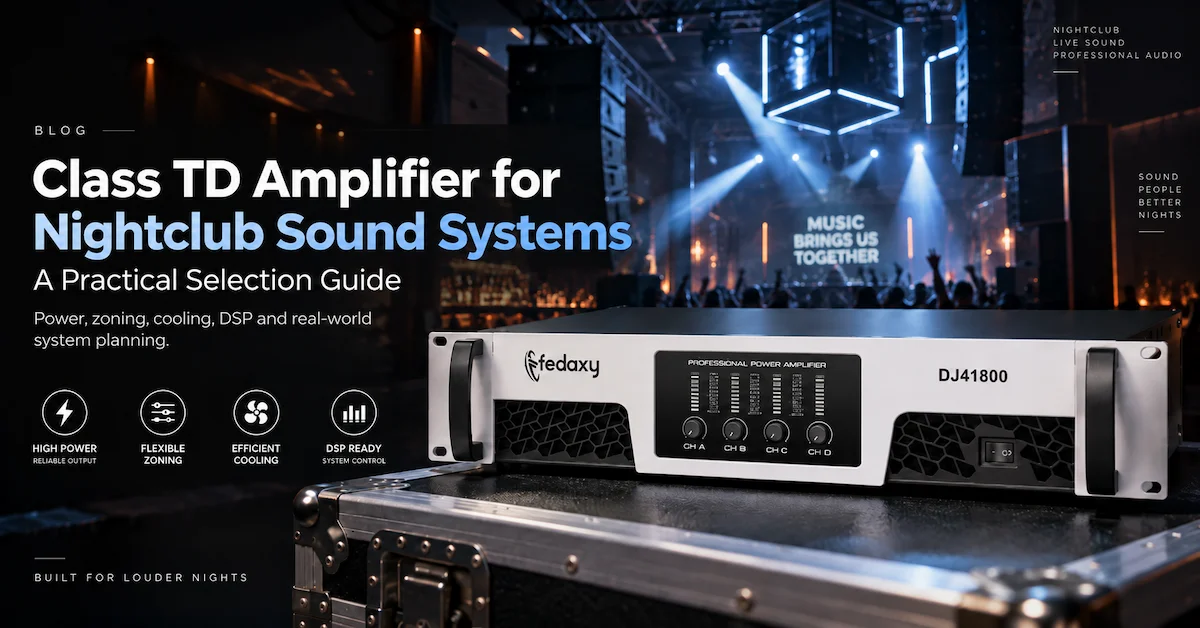
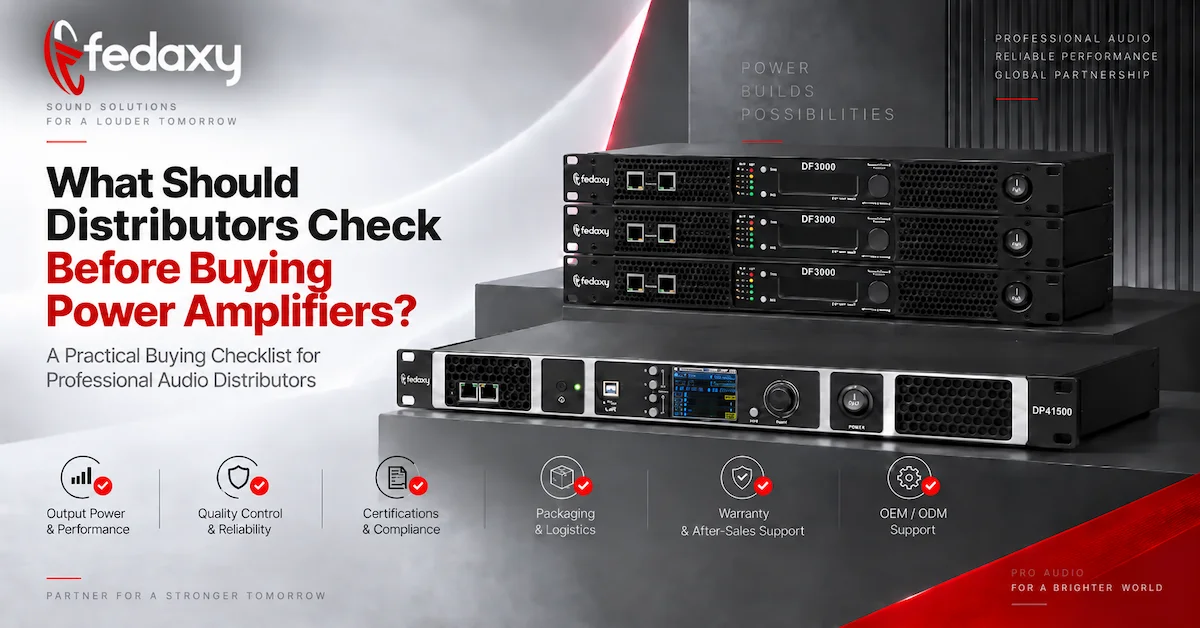
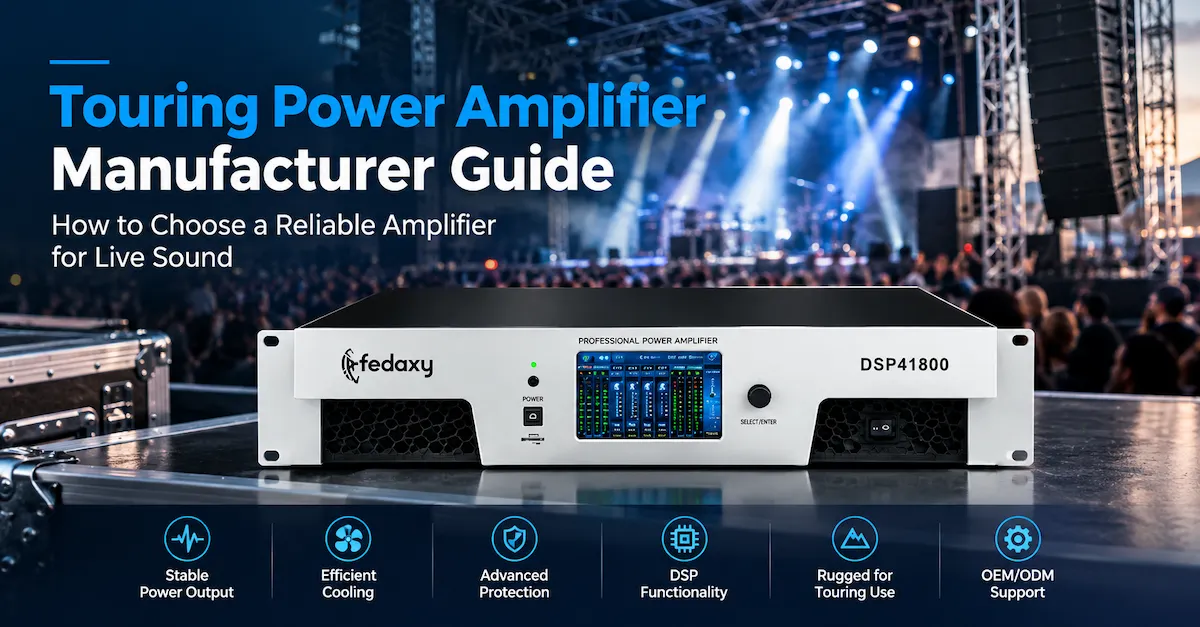
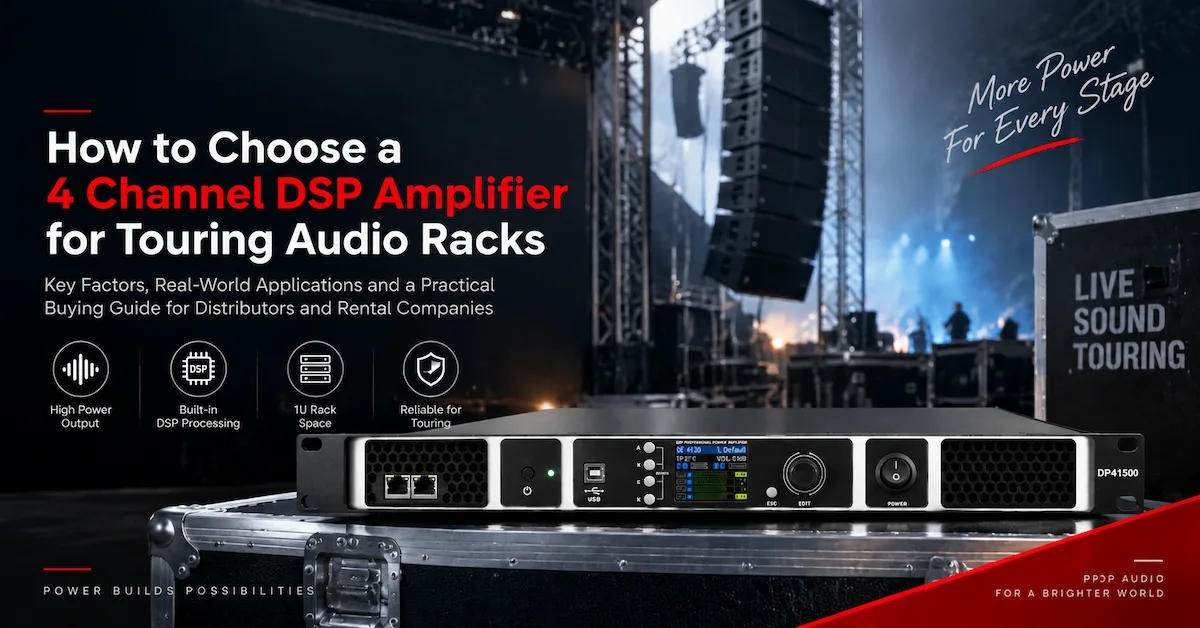
Fedaxy currently lists the DP41500 1U four-channel DSP amplifier and the DSP41800 2U four-channel DSP amplifier. Both are Class TD platforms with integrated DSP, but their output, rack height, voltage range and shipping weight differ. That matters because a fly rack, a festival line-array rack and a fixed large-format system do not have the same priorities.
Who Needs This Amplifier Type—and Who May Not?
The clearest buyers are rental companies building repeatable road racks, touring suppliers that need several channels in limited rack space, distributors serving live-sound customers and system integrators who want processing and amplification in one chassis. Four channels can reduce amplifier count and simplify allocation for multi-way loudspeakers, fills, monitors, delay zones or compact line-array systems.
It is not automatically the right choice for every show. A simple left-right system may be easier to service with two channels, while a subwoofer-heavy rig may concentrate unusually high current demand on fewer outputs. Some tours already use centralized system processors, so integrated DSP only adds value when it improves routing, protection, preset recall or rack simplicity. A 4 channel DSP amplifier for touring audio should therefore be selected as part of the system, not as a universal upgrade.
Start With the Loudspeaker and Patch Plan
Before asking for a quote, record the cabinet model, nominal impedance, minimum impedance if available, number of cabinets per channel, wiring, expected program level, channel assignment and bridge requirements. Add destination mains voltage, rack depth, rack-unit limit, maximum acceptable rack weight, airflow direction, connector standard, backup strategy and who will operate the DSP. These details prevent a common error: buying a “touring” amplifier that looks strong on paper but does not fit the rack, load or service workflow.
Fedaxy's existing 4 channel power amplifier guide makes the same broader point: channel count only becomes useful when matched to power, impedance, cooling, protection and the real project.
| Touring Requirement | What to Confirm | Why It Matters |
|---|---|---|
| Loudspeaker load | Impedance, cabinet count per channel and wiring | Defines the electrical load each channel must drive |
| Channel plan | Full-range, LF, HF, fill, monitor, delay or spare | Keeps four channels aligned with the system layout |
| Rack format | 1U or 2U, rack depth, total weight and clearance | Affects transport, handling and service access |
| DSP workflow | Required processing, presets, lockout and software | Touring crews need repeatable setup |
| Power environment | Mains voltage and frequency | Prevents destination-power mismatches |
| Cooling | Airflow direction and rack ventilation | Multiple high-power units can heat one rack quickly |
| Protection | Thermal, short-circuit, DC and power-on behavior | Fault behavior must be predictable during a show |
Compare 8Ω, 4Ω and 2Ω Output Under the Same Conditions
A wattage figure is useful only when the load and test method are clear. For touring audio, compare output at the impedance the loudspeaker system will actually present. Lower impedance generally increases current demand and thermal stress, so a large 2Ω number should not be treated as permission to run every channel at 2Ω continuously without checking operating guidance. Bridge mode also needs its own minimum-load and wiring confirmation.
The DP41500 page publishes 4 × 1500W at 8Ω, 4 × 2250W at 4Ω and 4 × 3750W at 2Ω, with 2 × 4500W at 8Ω bridge. The DSP41800 page publishes 4 × 1800W at 8Ω, 4 × 3150W at 4Ω, 4 × 4500W at 2Ω and 2 × 5400W at 8Ω bridge. These figures make DSP41800 the higher-output option on the current website, but a buyer should still request the current data sheet and test conditions for the exact production version before designing a touring system around them.
1U or 2U: Rack Density Versus Output and Weight
The 1U versus 2U decision is practical, not cosmetic. DP41500 puts four DSP amplifier channels in 1U, which is attractive when rack height and transport volume are tightly controlled. Its current page lists a 90–260V, 50–60Hz supply range and 13.5kg gross weight for the DP41500 version. That broad published voltage range can be useful for international fleets, although the supplied voltage version should still be confirmed on the purchase order.
DSP41800 uses a 2U chassis and publishes higher output. Its listed supply range is 185–260V, 50–60Hz, while gross weight is 22kg. In a truck tour, that may be acceptable in exchange for more output. In an airline-limited fly rack, it may not be. This is why choosing a 4 channel DSP amplifier for touring audio is a balance between electrical requirement, system architecture and logistics rather than a simple wattage comparison.
DSP Should Solve Touring Problems, Not Add a Feature Badge
Integrated DSP earns its place when it makes setup more repeatable, protects the loudspeaker system or removes unnecessary rack hardware. Typical professional DSP workflows can involve crossover, EQ, delay, routing, limiting and preset management, but buyers should confirm which functions are actually implemented on the exact amplifier and software revision. Do not assume every product described as a DSP amplifier has identical filters, control blocks, network functions or user permissions.
For a touring operator, more practical questions are whether a known system preset can be stored, protected and transferred to a replacement unit; whether the control software works on the computers carried by the crew; and whether the audio path remains usable if the control computer is disconnected. If network audio is required, confirm that separately rather than treating DSP and network audio as the same function. Fedaxy's DSP amplifier range currently lists DP41500, DSP41800 and DSP24000, so DSP and connectivity requirements should be checked model by model.
Cooling, Mains Power and Protection Matter After the First Hour
Both DP41500 and DSP41800 list four intelligent fans with front-to-back exhaust cooling. That is useful for rack planning because amplifier airflow should work with the rest of the rack rather than against it. Buyers should still test fan behavior under load and make sure the front intake and rear exhaust are not restricted by road-rack panels, cable bundles or adjacent equipment.
Both pages also list power-on buffering, overheating protection, short-circuit protection and output-DC protection. The crew still needs to know what actually happens when protection activates: whether one channel or the complete unit mutes, what indication appears and what recovery procedure is expected. Those details belong in sample testing and service documentation rather than assumptions made on show day. Fedaxy's touring power amplifier guide also treats impedance, cooling, protection and realistic operating conditions as connected selection issues.
DP41500 vs DSP41800 for Touring Audio
The table below uses specifications currently published by Fedaxy. It is useful for shortlisting rather than as an independent laboratory report, so final system approval should use current model-specific documentation and a controlled sample.
| Specification | DP41500 | DSP41800 | Touring Implication |
|---|---|---|---|
| Amplifier platform | Class TD + DSP | Class TD + DSP | Same broad platform, different output tier |
| Channels | 4 | 4 | Both support four-channel rack planning |
| Rack height | 1U | 2U | DP41500 favors higher rack density |
| 8Ω output | 4 × 1500W | 4 × 1800W | DSP41800 publishes higher output |
| 4Ω output | 4 × 2250W | 4 × 3150W | Relevant to lower-impedance touring loads |
| 2Ω output | 4 × 3750W | 4 × 4500W | Verify thermal and duration limits |
| 8Ω bridge output | 2 × 4500W | 2 × 5400W | Use with an approved bridge/load plan |
| Frequency response | 20Hz–20kHz ±0.5dB | 20Hz–20kHz ±0.5dB | Same published range |
| THD | <0.05% | <0.05% | Same published figure |
| S/N ratio | >110dB | >110dB | Same published figure |
| Cooling | 4 fans, front-to-back | 4 fans, front-to-back | Rack ventilation remains important |
| Power supply | 90–260V / 50–60Hz | 185–260V / 50–60Hz | Published voltage ranges differ |
| Gross weight | 13.5kg | 22kg | Relevant to fly racks and truck packs |
For a compact touring rack, DP41500 is the more obvious starting point because four channels fit into 1U and the listed voltage range is wider. Where 2U and additional gross weight are acceptable, DSP41800 provides more published output. The better 4 channel DSP amplifier for touring audio is therefore the model that fits the actual load, available mains power, rack limits, DSP workflow and service plan rather than simply the model with the larger number on the specification sheet.
Verify QC, Components, Documentation and Repeat-Order Control
A touring sample should connect the brochure to the rack. Ask for the current data sheet, amplifier version, DSP or firmware version, wiring information, protection behavior, packing specification and certification documents relevant to the destination market. Component-level BOM details are not fully published on the current product pages, so buyers that depend on repeat-order consistency should also ask how key components, fans, connectors and power-stage changes are controlled. If a substitute component is introduced later, define whether a change notice and another sample approval are required.
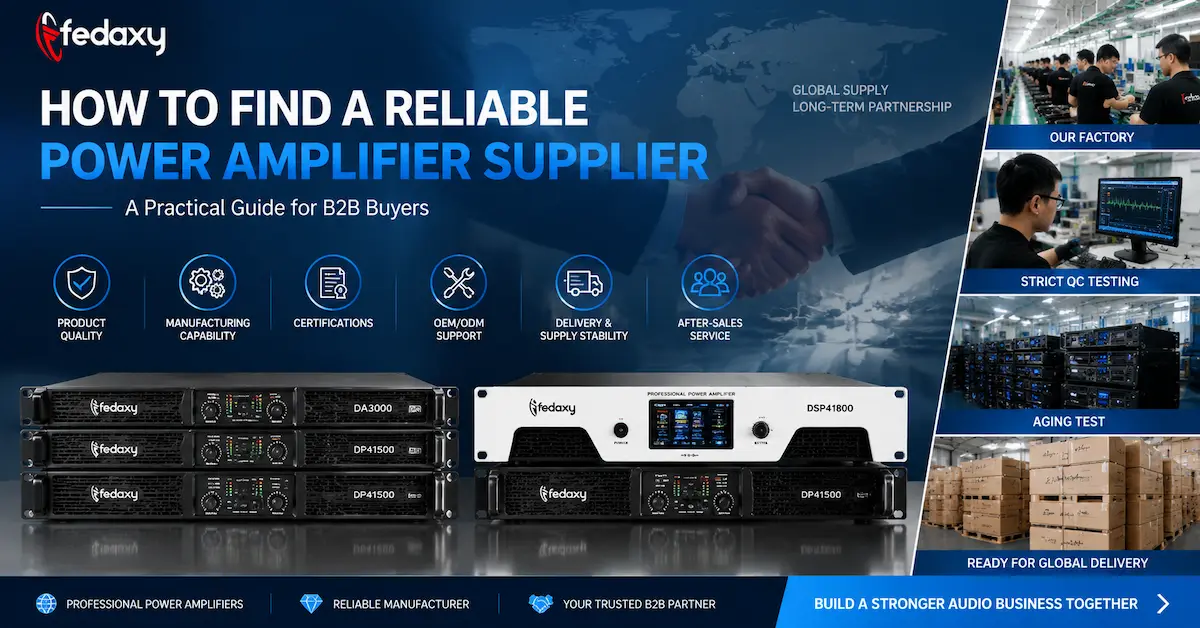
Fedaxy states that its amplifiers pass five rounds of QC testing and an eight-hour aging test. Its company information also describes incoming material inspection, SMT, assembly, burn-in aging and final acoustic/electrical testing under 6S management. Those are useful supplier-evaluation points, but a touring buyer should ask what each stage checks for the particular model being purchased and what records can be connected to a production batch. The website also states ISO9001, CE, RoHS and CB-related compliance; importers should verify the current documents and model scope for the actual voltage and private-label configuration.
Look at Total Touring Cost and OEM Risk, Not Only Unit Price
Unit price is only one part of the cost. Touring cost also includes rack units, rack weight, external processor hardware, cabling, mains distribution, crew training, spare stock, freight, service parts and the time required to restore a failed channel. A compact four-channel unit can save rack space, but that saving only matters if thermal behavior, connectors and service access still work for the production.
For private-label buyers, Fedaxy states that it supports OEM/ODM cooperation including logo, front-panel, packaging and product-configuration adjustments. A 4 channel DSP amplifier for touring audio used as an OEM platform should therefore be controlled by model, mains version, DSP or firmware revision, artwork, connector layout, accessories, carton, manual language and agreed test limits. MOQ, sample cost, production lead time and any certification effect should be confirmed for the exact project rather than copied from a generic assumption.
Build a Better RFQ Before Requesting a Touring Amplifier Quote
A useful RFQ should include the country and mains voltage, loudspeaker brand and model, nominal and minimum impedance, cabinet count, cabinets per channel, full-range or subwoofer role, required channel count, bridge requirement, rack-unit limit, maximum rack weight, cooling constraints, DSP needs, network-audio needs, connector preference, sample quantity, annual forecast, branding scope and target delivery window. Unknown values should be marked as unknown rather than left for the supplier to guess.
Ask the supplier to recommend a platform and explain why. A DP41500 versus DSP41800 response should cover 1U versus 2U, expected channel load, destination voltage, sample test plan and documentation—not simply two prices. Fedaxy's professional audio solutions page provides additional context for stadium, live-event and other professional sound environments.
Why Fedaxy Is Relevant to This Selection
Guangzhou Fedaxy Audio Equipment Co., Ltd. positions itself as a professional power amplifier manufacturer in Panyu, Guangzhou, with Class D, Class TD, Class H, Class AB, DSP amplifier and active-module product lines. Its current company page states more than 15 years of R&D and production experience, more than 90% export share and partners in more than 100 countries. The site also describes five QC rounds, eight-hour aging and a three-year warranty.
For touring-focused buyers, the useful point is that the range provides more than one four-channel DSP route. DP41500 addresses compact 1U Class TD + DSP requirements, while DSP41800 addresses a higher-output 2U Class TD + DSP requirement. Buyers can review the Fedaxy About Us page and send loudspeaker load, rack plan, voltage and customization requirements through the Fedaxy contact page for a model-specific discussion.
Frequently Asked Questions
1. What is a 4 channel DSP amplifier for touring audio?
A 4 channel DSP amplifier for touring audio combines four amplifier channels and digital signal processing in one chassis for live-sound or rental systems. Its practical value is channel density and repeatable processing, but load, DSP functions and operating limits still need to be confirmed for the exact model.
2. Is a 1U four-channel DSP amplifier better than a 2U model for touring?
Not automatically. A 1U model reduces rack height and can make a fly rack more compact, while a 2U model may provide a different output tier, thermal layout or service space. Loudspeaker load, total rack weight, mains power and expected duty cycle should decide the choice.
3. How much power should a touring DSP amplifier have?
Start with the loudspeaker system rather than a fixed wattage rule. Check cabinet impedance, cabinet count per channel, required operating headroom and the conditions behind the manufacturer's published output figures before deciding which power tier is suitable.
4. Can a four-channel touring amplifier run all channels at 2Ω?
A published 2Ω figure does not answer the complete question. Ask about driven-channel count, test duration, ambient temperature, wiring and protection limits before designing a rack for sustained low-impedance use.
5. What is the main difference between DP41500 and DSP41800?
Both are four-channel Class TD DSP amplifiers in Fedaxy's current range. DP41500 is a 1U model with 4 × 1500W published at 8Ω and a 90–260V supply range, while DSP41800 is 2U with 4 × 1800W at 8Ω and a listed 185–260V supply range.
6. Does integrated DSP eliminate an external system processor?
Sometimes, but not always. It depends on the processing blocks, routing, monitoring, redundancy and software workflow required by the tour. Confirm the actual DSP functions of the amplifier before removing an external processor from the system design.
7. Why is front-to-back cooling useful in a touring rack?
Known airflow direction helps a rack designer coordinate intake and exhaust across several devices. It does not guarantee good thermal performance by itself; the rack still needs suitable clearance, ventilation and testing under realistic load.
8. What should a rental company test before approving a sample?
Test the amplifier with the intended loudspeaker load and rack arrangement. Record output behavior, heat, fan operation, protection recovery, DSP operation, mains compatibility, firmware or software version, packing and the serial number of the approved sample.
9. Can Fedaxy provide OEM or private-label four-channel DSP amplifiers?
Fedaxy states that it supports logo, front-panel, packaging and configuration adjustments. Exact customization scope, sample requirements, certification implications, MOQ and delivery schedule should be confirmed for the particular OEM project.
10. What information should I send for a touring amplifier recommendation?
Send the country and mains voltage, loudspeaker model, impedance, cabinet quantity, channel plan, rack limit, DSP requirements, expected operating conditions, branding requirements, sample quantity and forecast. That gives the supplier enough information to compare suitable platforms instead of quoting only by wattage.
Conclusion
Choosing a 4 channel DSP amplifier for touring audio is ultimately a system-fit decision. Four channels and integrated DSP can reduce rack complexity and improve setup repeatability, but only when the amplifier matches the real loudspeaker impedance, mains environment, rack-space limit, cooling plan, processing workflow and service strategy. DP41500 and DSP41800 solve different touring problems: one favors compact 1U density, while the other provides higher published output in a 2U format. Before approving a purchase, verify model-specific output conditions, DSP functions, protection behavior, QC records, certification scope and repeat-order control. That gives rental companies, distributors and system integrators a more dependable basis for building touring racks that can be used show after show.