Direct answer: A successful pro audio amplifier wholesale purchase starts with the loudspeaker load and application, not the largest wattage printed on a listing. Buyers should compare rated output under the same impedance and test conditions, channel count, thermal design, protection, production consistency, documentation, warranty, OEM scope, and landed cost. Before a bulk order, request an engineering recommendation, test a sample with the intended loudspeakers, freeze the approved specification, and confirm MOQ, lead time, packaging, trade terms, and after-sales responsibility in writing.
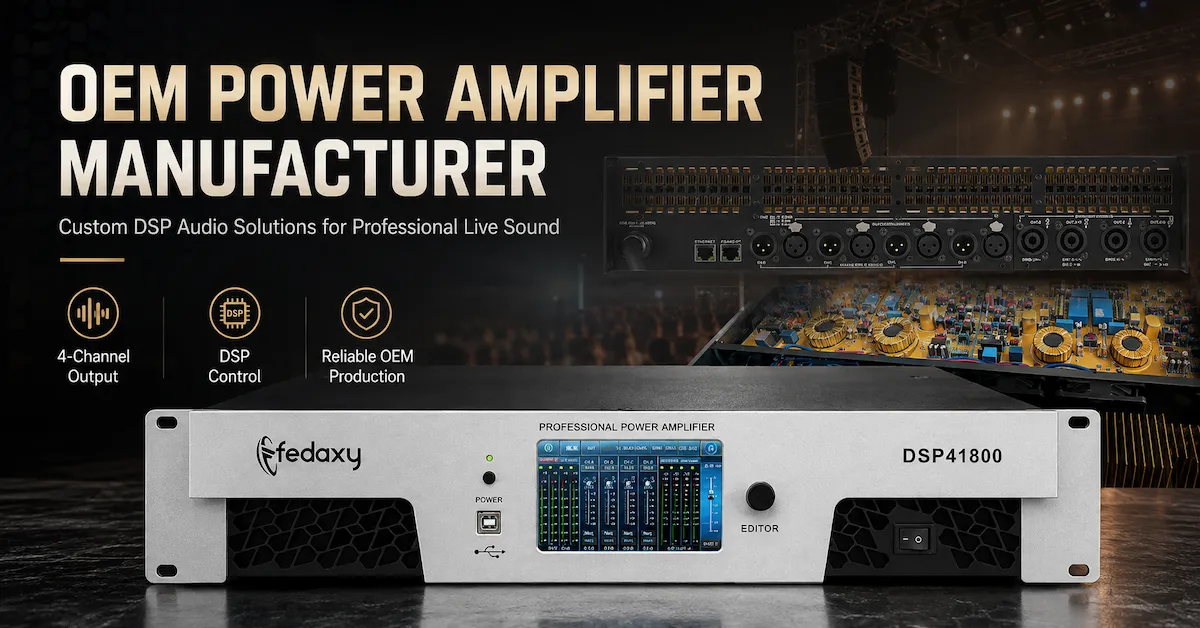
Fedaxy is a professional power amplifier manufacturer in Panyu, Guangzhou, China. The company states that it has more than 15 years of R&D and production experience, performs five quality-control inspections and an eight-hour aging test on each unit, and supports standard wholesale, OEM, ODM, private-label, OIM, OBM, and SKD cooperation. MOQ and lead time are project-specific and should be confirmed in the quotation rather than assumed from a generic online figure.
Buyer intent covered: Commercial Investigation, Supplier Comparison, and RFQ Intent. This guide is written for audio brands, distributors, importers, wholesalers, system integrators, rental companies, installers, and venue operators who need a defensible way to source professional amplifiers in volume.
Pro Audio Amplifier Wholesale: What a Buyer Should Decide First
Wholesale amplifier sourcing is an engineering and supply-chain decision at the same time. A model can look attractive on a price sheet yet become expensive when it is paired with the wrong impedance, installed in a poorly ventilated rack, shipped in weak packaging, or supplied without consistent documentation. The useful first question is therefore not, “Which amplifier has the highest number?” It is, “Which amplifier platform can repeatedly drive this defined loudspeaker system in this defined environment, and can the supplier reproduce the approved result across future batches?”
Start by documenting the loudspeaker model, continuous power rating, nominal and minimum impedance, number of cabinets per channel, crossover plan, required channels, and intended duty cycle. Then add the operational facts: indoor or outdoor use, fixed installation or touring, ambient temperature, rack height, airflow, mains voltage, connector requirements, weight limits, and whether DSP or Dante is needed. Commercial information comes next: sample quantity, first-order estimate, annual forecast, destination, packaging standard, certification requirement, private-label scope, and target delivery window.
| Decision area | Buyer must provide | Supplier should confirm |
|---|---|---|
| Load | Loudspeaker power, impedance curve, cabinets per channel | Recommended operating mode, headroom, wiring, limits |
| Application | Venue, program material, hours, SPL objective | Platform, channel allocation, thermal plan, protection |
| Digital control | DSP, presets, delay, limiter, Dante, access policy | Feature set, software, versions, backup and recovery |
| Supply | Sample, first order, forecast, destination | MOQ, lead time, packaging, Incoterm, warranty |
| Customization | Logo, panel, labels, manual, carton, voltage | Feasibility, sample approval, fees, version control |
This sequence prevents a common sourcing failure: asking ten factories for a price before giving any of them a comparable technical brief. Without a controlled brief, every quotation may represent a different assumption. A low quote may exclude required packaging, accessories, certificates, spare units, private-label work, or delivery responsibility. A high quote may include features that the project does not need. Normalizing the input makes the offers comparable.
Who Fedaxy Is and What the Factory Supplies
Guangzhou Fedaxy Audio Equipment Co., Ltd. is located in Panyu, Guangzhou, China. Fedaxy focuses on professional audio power amplifiers and integrates research, production, sales, and technical service. The public company information states more than 15 years of R&D and manufacturing experience, exports above 90 percent, and cooperation across more than 100 countries in Europe, the Americas, Asia, and Africa. These statements establish the entity, location, product focus, and market coverage that buyers and search systems need to understand.
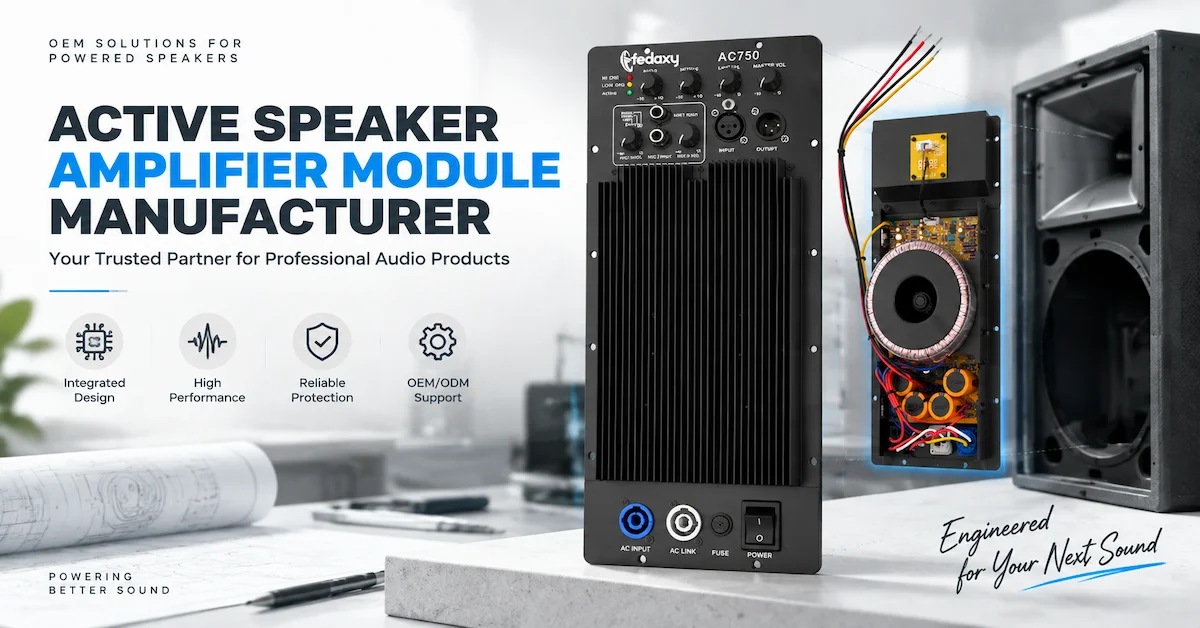
The portfolio includes Class D, Class TD, Class H, and Class AB platforms, plus DSP-equipped amplifiers, Dante-enabled models, and active amplifier modules. Configurations include two, three, and four channels and 1U, 2U, and 3U rack formats. The range serves line arrays, subwoofers, KTV rooms, bars and clubs, theaters, stadiums, live events, touring rental, conference venues, banquet halls, and commercial fixed installations.
A buyer looking for a professional amplifier manufacturer should verify more than a company name. Confirm that the legal supplier, bank beneficiary, invoice party, factory address, brand authorization, certification holder, and warranty provider are consistent. Ask for the current business documents relevant to the transaction and verify certificate scope by model. A logo on a brochure is not a substitute for traceable documentation.
Fedaxy states that it follows ISO 9001 quality management and that products comply with CE, RoHS, and CB requirements; the website also displays EMC and LVD compliance information. Certification requirements differ by market and product, so a buyer should request the certificate number, covered model list, applied standard, issuing body, and validity status for the exact order. This is especially important for private-label projects because a change to the nameplate, power supply, enclosure, or model name may affect the documents required in the destination market.
Which Wholesale Buyer Profiles Does This Guide Serve?
Audio brands and private-label owners
Brands usually need a coherent product family rather than one isolated amplifier. Their questions include whether the front panel, logo, model naming, rating label, manual, packaging, voltage, connectors, and DSP presets can be customized; how approved samples are controlled; and how later component or firmware changes are communicated. An OEM power amplifier manufacturer must manage these details as controlled production data, not informal chat history.
Distributors, wholesalers, and importers
Channel buyers need product tiers that make sense in their local market, predictable replenishment, export-ready packaging, clear warranty boundaries, and support that their sales team can understand. A distributor buying bulk pro audio amplifiers should consider inventory balance. Four-channel high-density models, traditional two-channel models, DSP versions, and subwoofer-oriented products may sell at different rates. A mixed first order informed by actual customer segments is often more useful than filling a shipment with only the model that has the most impressive headline rating.
System integrators and project contractors
Integrators buy for a defined system. They care about load calculations, gain structure, signal routing, rack ventilation, mains distribution, remote or network audio, preset recovery, and documentation. The right supplier should be able to discuss the entire signal and power path. For a hotel ballroom, speech intelligibility and flexible zones may matter more than extreme low-frequency output. For a stadium or touring array, current delivery, thermal behavior, redundancy, and fast field replacement may dominate.
Rental and touring companies
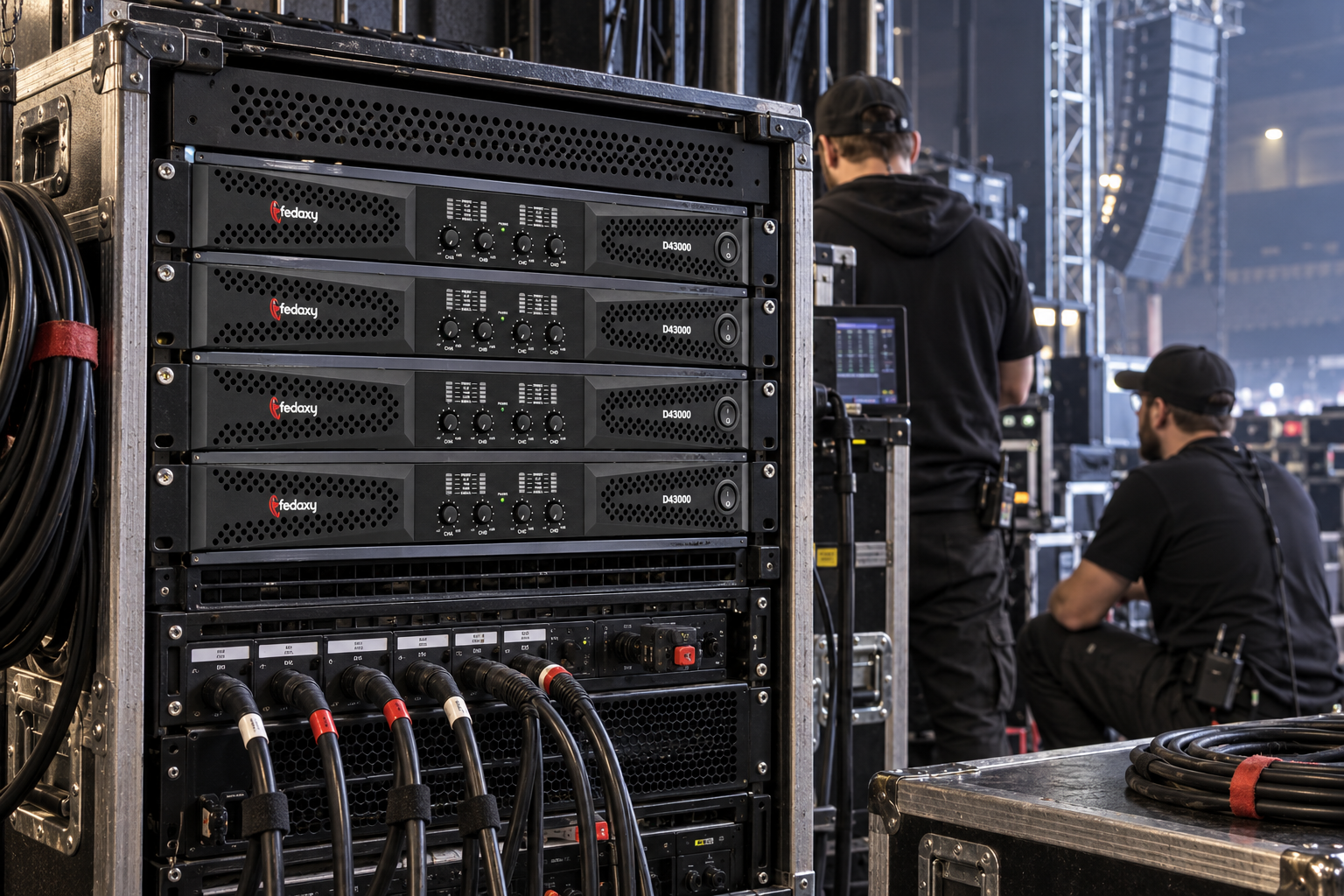
Rental operators value high output per rack unit, manageable weight, repeatable racks, low-load capability that has been tested, clear fault indicators, and practical service. They should validate the amplifier with their real line-array or subwoofer inventory, the available power distribution, and the hottest expected operating condition. A sample that plays briefly on a bench is not enough evidence for a rack that may operate near its limits for hours.
Venue operators and entertainment contractors
KTV, club, theater, worship, conference, and multipurpose venues need stable daily operation and serviceable configurations. They may prioritize simple controls, locked presets, low noise, predictable startup, and replacement consistency. A professional sound amplifier supplier should ask how the system is used, who operates it, how long it runs, and what happens when a unit must be swapped.
Class D, TD, H, or AB: Choosing a Platform for Wholesale Orders
Amplifier class is not a quality ranking. It describes an architecture with practical trade-offs. The correct choice depends on load, power density, weight, thermal conditions, sonic objectives, service expectations, and budget. Buyers should compare complete products under the same test conditions rather than treating the class name as proof of performance.
Class D for power density and transport efficiency
Class D platforms are commonly selected when rack space, weight, and efficiency matter. A 1U four-channel design can reduce rack height and shipping mass for rental systems or dense fixed installations. Lower heat generation can simplify a project, but it does not eliminate the need for airflow. The rack still needs a clear intake and exhaust path, and the mains supply must support the demanded output. Explore Fedaxy wholesale professional power amplifiers when channel density and mobility are central requirements.
Class D is frequently considered for line arrays, touring racks, clubs, multi-zone systems, and compact installations. During evaluation, listen for noise with high-sensitivity loudspeakers, verify gain and input sensitivity, test protection recovery, and measure temperature in the actual rack. Do not assume that every lightweight amplifier behaves the same under a continuous subwoofer load.
Class TD for high-output professional systems
Class TD platforms are commonly used where buyers want high output, strong dynamics, and proven professional sound reinforcement behavior. They appear in live events, stadiums, clubs, touring systems, and subwoofer applications. Fedaxy offers both standard and DSP-equipped TD options. Buyers seeking a wholesale audio power amplifier should compare channel count, rack height, integrated processing, the intended impedance, and the continuous duty requirement.
A headline 2-ohm capability should not automatically become the default design point. Parallel loudspeakers produce a system load whose impedance varies with frequency. Cable resistance, connector condition, ambient temperature, program content, and mains voltage affect the result. Confirm whether low-impedance operation is approved for all channels under the intended duty cycle, then reproduce that condition during sample testing.
Class H for traditional high-current applications
Class H uses multiple supply rails to improve efficiency over a conventional linear design while retaining characteristics familiar to many installers and service teams. It is often selected for theaters, KTV, clubs, stadiums, banquet halls, and systems where buyers value current delivery, low-frequency control, and a traditional 2U or 3U platform. For commercial audio amplifier wholesale, a Class H model can be a practical part of a portfolio, particularly when local technicians know the architecture and rack weight is acceptable.
Class AB for specific sound and linearity priorities
Class AB remains relevant where a buyer values a traditional linear topology, natural reproduction, low noise, and familiar service practice. It normally trades efficiency and weight for those characteristics. Fedaxy lists PA1300 as a Class AB product, while another PA-series model is identified as Class H; buyers should therefore verify the individual product page rather than infer architecture from a family name.
DSP and Dante are workflow decisions
Integrated DSP can consolidate EQ, crossover, delay, limiting, routing, and loudspeaker protection. It can also reduce external processors and wiring. The benefit is only realized when presets, software versions, access rights, backups, and recovery procedures are controlled. Dante can simplify digital audio distribution over an Ethernet network, but the complete project must address switch compatibility, clocking, network design, redundancy, sample settings, control access, and technician training.
Use Fedaxy's DSP amplifier category to identify processing-equipped platforms. The DF3000 and DT4200 pages state Dante capability. Request current software information and an engineering confirmation for the exact network workflow before specifying a project.
Representative Fedaxy Models to Shortlist
The following table is a starting map, not a substitute for engineering approval. Product names indicate the public positioning and configuration. Power figures in an online title or table can be reported under conditions that are not identical across suppliers. Ask for the latest specification sheet and clarify whether figures are continuous or burst, the frequency and distortion limit, mains voltage, and whether all channels operate simultaneously.
| Model | Platform | Configuration | Best-fit discussion |
|---|---|---|---|
| D43000 | Class D | 1U, four channel | High-density professional racks where channel count, rack height, and transport efficiency matter. |
| DP41500 | Class TD with DSP | 1U, four channel | Live systems that need compact amplification plus integrated processing. |
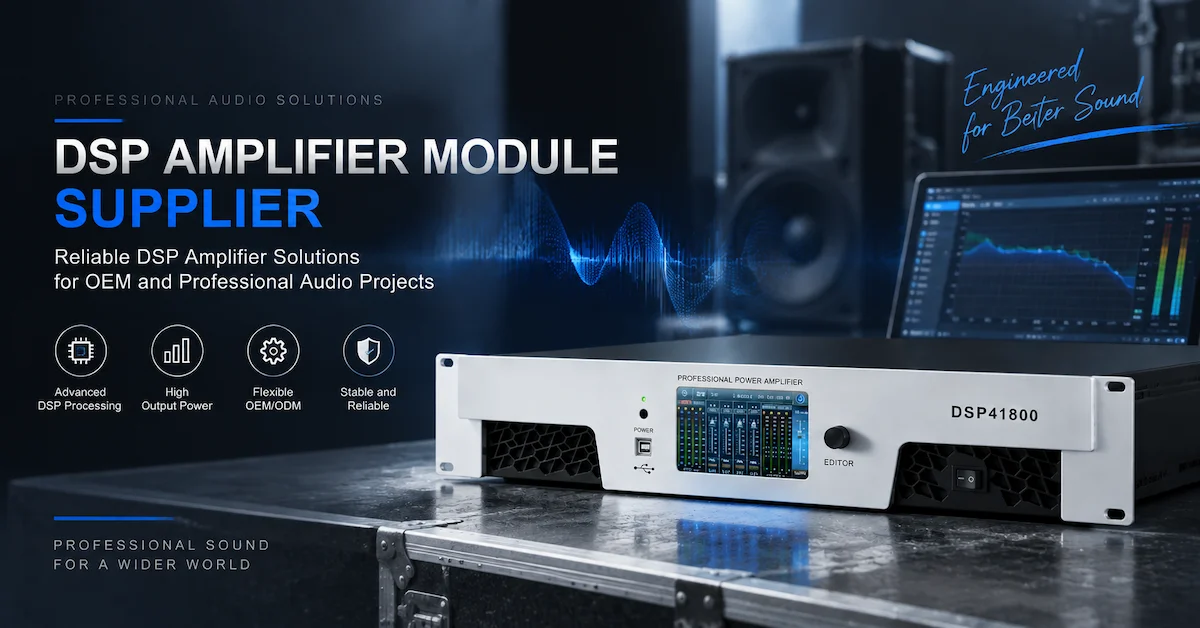
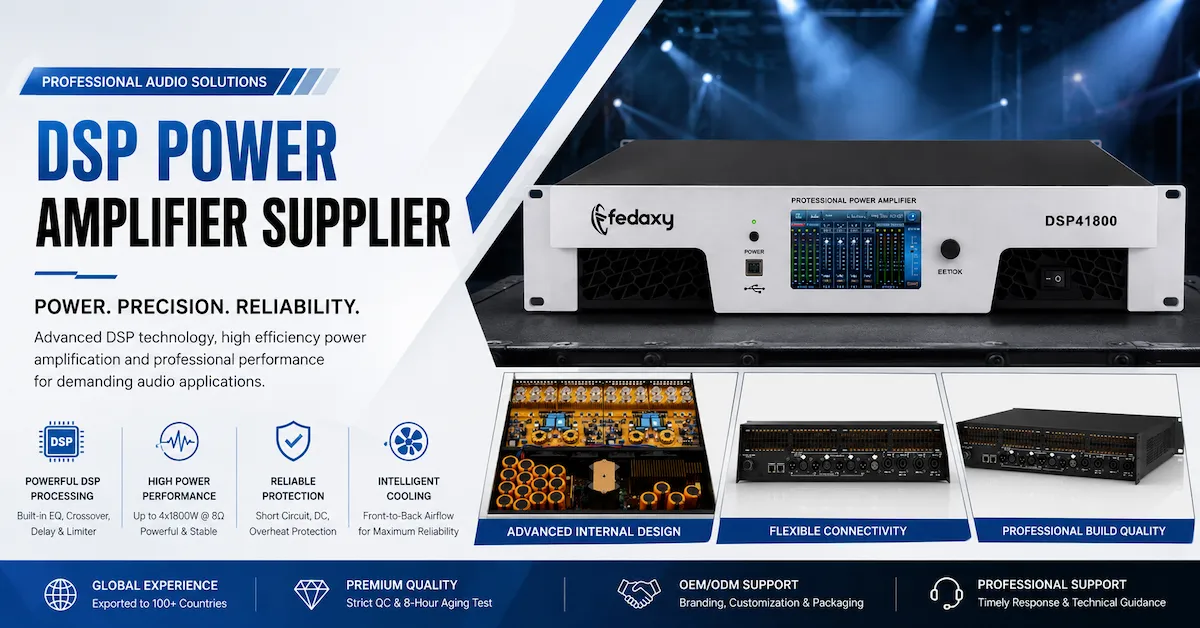
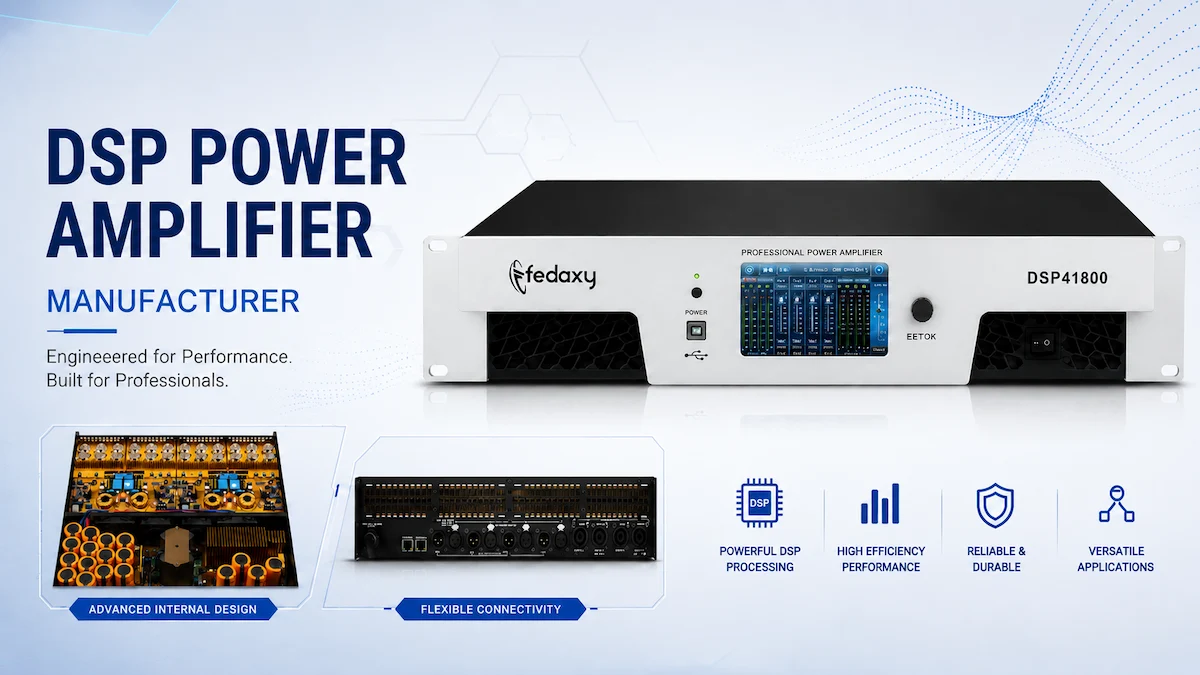
| DSP41800 | Class TD with DSP | 2U, four channel | Professional systems requiring four channels, processing, and a larger rack format. |
| DT4200 | Class D with DSP and Dante | 1U, two channel | Network-audio projects needing high-density two-channel amplification. |
| LA41000 | Class H | 2U, four channel | KTV and fixed-installation buyers wanting a four-channel traditional platform. |
| PRO4800 | Class H | 2U, four channel | KTV, conference, multipurpose, and channel-dense fixed systems. |
| LS3000 | Class TD | 3U, two channel | High-power low-frequency discussions for clubs, stadiums, touring, and subwoofer systems. |
Shortlisting by application keeps the conversation useful. For example, a distributor building a broad catalog might compare one four-channel 1U Class D model, one DSP model, one network-audio option, one Class H installation model, and one high-current subwoofer platform. A rental company may focus on interchangeable racks and total output per kilogram. A theater integrator may focus on noise, gain structure, redundancy, and service access. The same model does not need to win every comparison.
How to Calculate the Required Amplifier Before Requesting a Quote
1. Start with continuous loudspeaker data
Collect the loudspeaker's continuous or AES rating, not only its program or peak number. Record nominal impedance and, if available, the minimum impedance across frequency. The continuous rating helps establish a sensible amplifier relationship; the impedance curve helps reveal difficult regions that a nominal label can hide. When two identical 8-ohm cabinets are connected in parallel, the nominal result is 4 ohms, but the real load still changes with frequency.
2. Draw each amplifier channel
Create a simple channel schedule. List every cabinet connected to channel A, B, C, and D; identify main, fill, monitor, subwoofer, or zone duty; and write the calculated nominal load. This catches mistakes before equipment is ordered. It also lets the supplier determine whether a two-channel or four-channel unit reduces rack complexity.
3. Choose headroom for the actual program
There is no universal multiplier that fits every loudspeaker and limiter strategy. Music dynamics, loudspeaker thermal capacity, processing, operator behavior, and target SPL all matter. Enough headroom helps avoid persistent clipping, but uncontrolled excess power can damage drivers. Ask the amplifier and loudspeaker engineers to agree on the intended limiter thresholds and operating assumptions.
4. Check the mains side
Output claims cannot be separated from the available electrical supply. Document mains voltage, frequency, connector, circuit capacity, power distribution, generator use, grounding, and expected voltage variation. For a touring rack, calculate the complete rack demand rather than multiplying a headline output number. For a permanent venue, coordinate with the electrical design and provide suitable isolation, earthing, overcurrent protection, and ventilation.
5. Plan heat and airflow
Many Fedaxy descriptions indicate front-to-rear airflow. Verify the exact model, keep intake and exhaust paths open, and prevent hot exhaust from recirculating. A sealed decorative cabinet can defeat an otherwise suitable amplifier. During sample validation, install the amplifier in the intended rack with neighboring equipment and operate it for the expected duration at a realistic load.
6. Confirm signal level and gain structure
Mixers, processors, network interfaces, and amplifiers must work together without excess noise or early clipping. Confirm input sensitivity, gain options, maximum input level, balanced wiring, connector type, and DSP output level. Test the complete chain with muted channels, low program levels, nominal levels, and near-limit conditions. A quiet bench setup may reveal hum or noise when connected to the actual site grounding.
7. Treat bridge mode carefully
Bridge mode combines channels to drive a load at higher voltage, but each amplifier channel effectively sees a lower load. Use only the combinations and minimum impedance approved for the model. Confirm connector wiring and loudspeaker power handling, and make the mode obvious on the rack. An accidental reconnection by a technician can create an unsafe load.
Application Environments and the Questions Each One Changes
Live events and touring
Touring exposes amplifiers to repeated transport, fast setup, variable power, changing temperatures, and compressed troubleshooting time. Buyers should compare rack density, weight, front and rear access, connector consistency, low-load performance, fault indication, fan behavior, and field replacement. A standardized rack with documented channel maps and spare presets can be more valuable than a small price difference per unit. Ask how replacement units will match the approved hardware and software revision.
Line arrays and stadium systems
Large systems require careful channel allocation, long cable runs, predictable limiting, and adequate electrical service. Four-channel platforms can improve density, while DSP and network audio can simplify distribution. However, a networked amplifier adds switch, clock, firmware, and access-control dependencies. Build redundancy appropriate to the event risk. An important stadium, broadcast, or ticketed event should not depend on a single device or a single preset copy.
Subwoofer and low-frequency duty
Subwoofer channels can demand high current for extended periods. Verify the real parallel load, cable gauge and length, connector rating, thermal behavior, limiter settings, and protection recovery. Run a test with the actual subwoofers or an appropriate load under representative program conditions. Do not validate a subwoofer purchase with speech or low-level music alone. Fedaxy positions LS3000 for high-power low-frequency applications, but the final recommendation must still follow the cabinet data and system design.
KTV, clubs, and entertainment venues
These venues combine long operating hours, high average levels, strong bass, multiple zones, limited technical staff, and sometimes restricted rack airflow. Priorities include stable thermal operation, clear vocals, controlled low frequency, simple status indication, protected settings, and fast replacement. In multi-room KTV, channel cost, repeatable presets, and maintenance procedures may matter as much as output. A buyer comparing a pro audio amplifier supplier should explain the number of rooms, typical daily hours, rack environment, and operator skill level.
Theaters, auditoriums, and houses of worship
Quiet passages make noise performance and gain structure visible. Dialogue intelligibility, musical dynamics, redundancy, and predictable startup are important. Test with high-sensitivity loudspeakers and listen close to the system when no signal is present. Check fan noise if racks are near audience spaces. Document startup and shutdown order, emergency muting, and the process for restoring a known preset after service.
Conference and multipurpose rooms
A multipurpose hall may change between speech, banquet music, ceremonies, and performance. It benefits from flexible routing, zones, and protected presets. The system must remain understandable for non-specialist operators while allowing qualified technicians to access deeper settings. Confirm how settings are locked, backed up, named, and recovered.
Hotels, retail, and commercial fixed installation
Commercial sites usually prioritize long-term availability, low maintenance, channel density, predictable thermal behavior, and service documentation. Integrators should account for continuous background-audio duty, paging priorities, local regulations, rack access, and replacement lead time. Use the same approved model and revision across repeat sites when possible. If a component change is necessary, require documented notice and revalidation proportional to the change.
Outdoor and harsh environments
An amplifier installed in a normal rack is not automatically weatherproof. Rain and dust protection typically comes from the enclosure, rack, tent, or technical room. High altitude, humidity, salt air, and unusual ambient temperature may require derating or special protection that is not stated on a standard page. Submit those conditions in the RFQ and obtain written engineering guidance. Plan weather protection, drainage, grounding, and ventilation as one system.
Factory Evidence Buyers Should Request and Verify
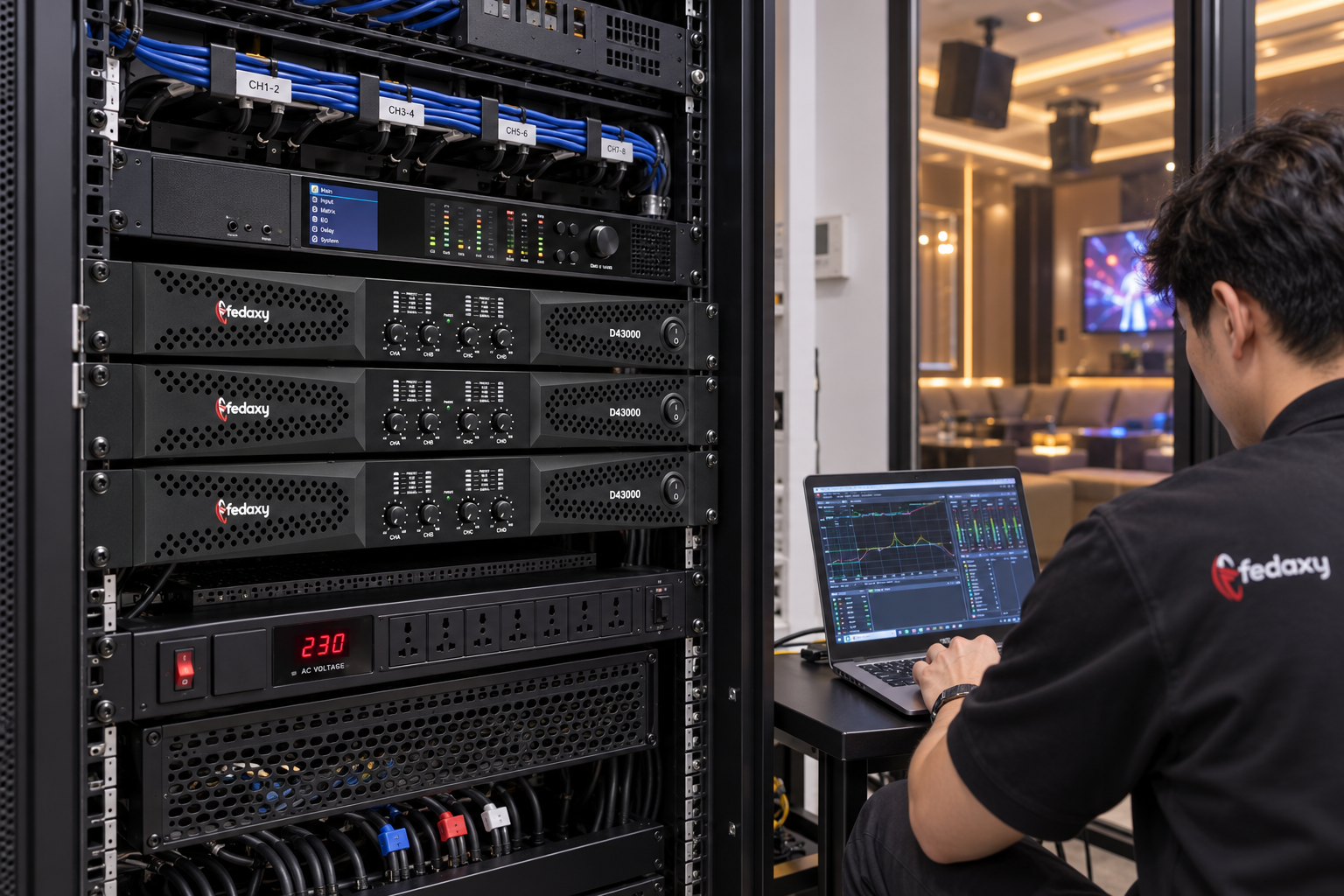
Original evidence separates a serious sourcing process from a page that repeats generic claims. Fedaxy's public factory information provides several concrete checkpoints: 6S management, five quality-control inspections per unit, an eight-hour aging test, a three-year warranty, 100 percent copper transformers, and a stated commitment to real rated power. The company also describes incoming material control, SMT and assembly, electrical performance testing, aging, and final inspection.
These statements are useful, but professional procurement turns them into inspectable records. Ask which five inspections apply to the selected model, which measurements are recorded, how failed units are handled, and whether lot or serial traceability is available. Request sample test reports or a live factory review where appropriate. For the aging test, confirm the load, signal, output level, duration, ambient condition, and pass/fail criteria. “Eight hours” is more meaningful when the method is defined.
Incoming material control
Ask how transformers, power devices, capacitors, fans, connectors, PCBs, and mechanical parts are inspected. For an OEM project, agree on how substitutions are approved. A component change can affect thermal behavior, reliability, acoustics, certification, or service inventory even when the outer appearance remains unchanged.
Assembly and process control
Look for controlled work instructions, torque or fastening practice where relevant, wire routing, insulation, grounding, thermal interface application, board cleanliness, and visual inspection. A golden sample should define both appearance and function. For private label, the approved panel, label, carton, manual, accessories, and serial format belong in the same controlled package.
Electrical and audio testing
A useful test plan can include rated output, frequency response, distortion, signal-to-noise ratio, channel balance, gain, input sensitivity, crosstalk, and idle noise under declared conditions. Protection checks can cover short circuit, DC, overtemperature, overcurrent, soft start, and recovery behavior as applicable. Buyers should ask which results are checked on every unit and which are validated by design or batch sampling.
Thermal and aging validation
Thermal testing should reflect channel load, rack arrangement, voltage, ambient temperature, and program duty. Record key temperatures and protection behavior. The eight-hour aging process is a valuable production control when its setup is consistent. A buyer may also perform independent sample testing in the final rack because factory aging and application validation answer different questions.
Final inspection and packaging
Final checks should cover appearance, controls, indicators, connectors, accessories, labels, manuals, carton marks, and packaging integrity. Export buyers should confirm carton dimensions, gross and net weight, pallet method, moisture protection, drop or vibration expectations, container loading, and spare packaging. Weak packaging can erase savings from a lower unit price.
How to Compare Wholesale Suppliers Without Being Misled by Wattage
A supplier comparison should normalize conditions. Put every candidate into one table and leave a cell blank when the evidence is missing. Do not silently treat missing information as a pass. At minimum, compare output at the same impedance, frequency range, distortion limit, channel condition, and mains voltage. Record whether the number is continuous, burst, program, or unspecified.
| Supplier comparison item | Evidence to request | Why it matters |
|---|---|---|
| Rated output | Test method, load, frequency, THD, channels driven, voltage | Makes power claims comparable. |
| Low-load behavior | Approved operating condition, duration, thermal record | Prevents an impressive short test becoming a field failure. |
| Protection | Protection list, trigger and recovery behavior | Protects amplifiers and loudspeakers under faults. |
| Production control | QC plan, aging method, approved sample, change policy | Predicts batch consistency better than one demonstration. |
| Documentation | Datasheet, manual, drawings, certificates, software notes | Reduces integration, customs, and service risk. |
| Commercial terms | Formal quote with scope, MOQ, lead time, Incoterm, warranty | Reveals the real delivered offer. |
Compare the supplier's questions as well as its answers. A capable salesperson or engineer should ask about loudspeakers, loads, channels, venue, voltage, rack, duty cycle, DSP, certification, quantity, and destination. An instant recommendation based only on “how many watts” leaves significant risk with the buyer.
MOQ, Sample Orders, Lead Time, and Price: What Can Be Stated Honestly?
There is no responsible universal MOQ or lead time for every Fedaxy wholesale project. The number depends on the model, inventory, production plan, degree of customization, packaging, documentation, and component availability. A standard product sample, a repeated distributor order, a logo change, and a new ODM platform should not be expected to follow the same commercial schedule.
Ask for four separate figures when relevant: sample quantity and sample preparation time; MOQ for the standard product; MOQ for logo, panel, manual, or carton customization; and MOQ for deeper hardware or software changes. Also ask when lead time starts. It may begin after deposit, after artwork approval, after sample approval, or after all materials are confirmed. Put that trigger in the purchase order.
Unit price should be tied to quantity tier, currency, validity period, specification revision, packaging, accessories, private-label scope, tax treatment, and Incoterm. Fedaxy publicly lists T/T and Western Union and trade terms including FOB, CIF, CNF, FCA, EXW, and DDU. Availability and the exact responsibilities must be confirmed for the order. Under any term, state the named port or place and the applicable Incoterms version in the contract.
For a reliable total-cost comparison, add sample and tooling charges, bank fees, inspection, inland transport, export handling, freight, insurance, customs duty, local tax, broker fees, warehousing, damage allowance, spare stock, and warranty service. The lowest EXW unit price may not produce the lowest landed cost or the lowest risk.
Fedaxy Wholesale and OEM Service Process
Step 1: Requirement submission
The buyer provides its company role, market, application, loudspeakers, load map, channels, rack limits, voltage, connectors, DSP or Dante requirements, quantity, branding scope, destination, and timing. Photos, existing system diagrams, and target competitor references can reduce ambiguity, but exact technical objectives are more valuable than a brand name alone.
Step 2: Model recommendation and engineering review
Fedaxy sales and engineering can use the project information to recommend a standard model or combination. The review should address output margin, load, channel allocation, platform, rack space, heat, mains supply, processing, and system protection. Open questions should remain visible rather than being buried in assumptions.
Step 3: Commercial confirmation
The quotation should identify the exact model and revision, quantity, unit price, currency, payment, trade term, packaging, accessories, certification documents, lead-time trigger, warranty, and quote validity. For customization, list included and excluded work. Do not approve a quote that names only a generic “professional amplifier.”
Step 4: Sample evaluation
Test the sample with the intended loudspeaker and signal chain. Verify output, noise, distortion, channel balance, temperature, protection, low-load behavior, indicators, connectors, DSP, network functions, startup, shutdown, and continuous operation. Evaluate physical fit and rack airflow. Record the serial number, software or preset version, and test conditions.
Step 5: Written sample and artwork approval
For standard wholesale, approve the technical sample and packaging. For OEM, also approve panel artwork, logo, model name, rating label, serial format, manual, carton, accessories, voltage, connectors, DSP files, and software version. A signed or otherwise traceable approval package becomes the mass-production reference.
Step 6: Production and quality control
Production proceeds with material control, assembly, performance testing, the stated five QC inspections, eight-hour aging, final inspection, and packaging checks. Buyers can define pre-shipment inspection points in advance. If third-party inspection is required, agree on the sampling standard, test setup, access, and responsibility for retesting.
Step 7: Delivery and export documentation
The parties confirm carton and pallet data, shipping marks, commercial invoice, packing list, origin documents if required, transport booking, insurance, and handover point. Fedaxy lists Guangzhou-area ports including Nansha, Shekou, Yantian, and Huangpu in its public information; the actual port and routing depend on the order and chosen trade term.
Step 8: Installation, support, and repeat orders
Keep the approved technical package, serial records, presets, manuals, spare parts, and troubleshooting contacts accessible. For repeat orders, require notification of changes in components, firmware, appearance, packaging, or certification. Warranty handling should define the start date, excluded damage, evidence required, freight responsibility, spare or repair method, and response process. Fedaxy states a three-year warranty, but the operational details should be written into the order.
OEM and Private-Label Choices: From Logo Change to ODM
Customization exists on a spectrum. At the simplest level, a mature platform may receive a customer's logo, model designation, label, manual, and carton. A deeper private-label project may change front-panel design, connectors, voltage, accessories, or DSP presets. ODM can involve amplifier architecture, power supply, thermal design, mechanical structure, protection, firmware, or a new product configuration. The time, engineering cost, MOQ, certification impact, and validation effort increase with depth.
Before asking for a custom unit, define the market problem it solves. A unique color does not compensate for unclear positioning. Write a product requirement document covering customer, application, target price tier, loudspeaker pairing, output conditions, channels, impedance, rack format, weight, voltage, interfaces, DSP, network control, compliance, environment, service plan, forecast, and launch timing.
Private-label artwork needs disciplined version control. Use one approved file package and record its revision. Check logo proportions, model spelling, rating information, safety marks, warning language, barcode, carton marks, manual language, and accessories. Print or production proofs should be approved before mass production. This prevents a correct amplifier from arriving with an unusable label or a carton that fails local retail and customs requirements.
DSP customization needs an equally controlled process. Identify who creates the presets, who owns the files, which parameters the end user can change, how factory defaults are restored, and how updates are distributed. Link each production batch to the approved preset or firmware revision. When a loudspeaker driver, crossover, enclosure, or limiter target changes, revalidate the system.
For deeper ODM, agree on deliverables and acceptance criteria at each gate: requirement review, technical proposal, prototype, engineering validation, pilot run, production approval, and mass production. Clarify tooling ownership, non-recurring engineering fees, intellectual-property boundaries, exclusivity if any, software source or access rights, certification responsibility, minimum lifetime, and end-of-life notice. These are business controls as much as engineering controls.
A Practical Sample Test Plan for Professional Buyers
A sample is not a souvenir; it is a risk-reduction tool. Write the test plan before the sample arrives. Use calibrated equipment where formal measurements are required and follow electrical safety procedures. If the buyer does not have an appropriate laboratory, engage a qualified audio engineer or independent test service.
Identity and documentation
- Match the model, voltage, serial number, labels, connectors, accessories, manual, and carton to the quotation.
- Record hardware, firmware, DSP, and software versions where applicable.
- Check the latest datasheet and list any unclear or conflicting specification before testing.
Physical and installation review
- Inspect enclosure fit, rack ears, controls, connectors, fasteners, grounding, and visible workmanship.
- Install the unit in the intended rack and verify cable bend radius, service access, and airflow.
- Check shipping packaging for compression, abrasion, moisture exposure, and accessory movement.
Functional audio review
- Verify every input, output, control, indicator, mode, and channel.
- Listen for hum, buzz, hiss, fan noise, switching noise, or channel imbalance in the complete system.
- Confirm startup and shutdown behavior and whether a power interruption restores the expected state.
Bench performance
- Measure output under the declared load and test condition, using equipment and loads rated for the work.
- Review frequency response, distortion, noise, channel tracking, input sensitivity, gain, and crosstalk as relevant.
- Repeat key measurements at the local mains voltage and expected operating modes.
Thermal and duty-cycle review
- Operate the amplifier for the expected duration with a representative signal and load.
- Record ambient, intake, exhaust, and accessible chassis temperatures at defined intervals.
- Observe fan behavior, limiting, protection, recovery, and any change in output or noise.
System validation
- Connect the target loudspeakers with production-type cables and processing.
- Validate limiter settings, crossover, EQ, polarity, routing, delay, and preset recall.
- For Dante or network control, test the intended switch, clock, addressing, software, recovery, and failure procedure.
Define what constitutes a pass before testing. A result should produce a written issue list and a decision: approved, approved with listed changes, or rejected pending correction. When a modified sample returns, retest the affected functions and any area that the change could influence.
Packaging, Logistics, and Landed Cost for Bulk Orders
Professional amplifiers are dense, relatively heavy electronic products. Packaging must protect rack ears, front controls, rear connectors, internal assemblies, and cosmetic surfaces from drops, vibration, stacking, and moisture. Ask for the individual carton size and weight, master or pallet configuration, edge protection, foam design, bagging or moisture protection, and container quantity. Confirm whether wooden packaging must meet destination treatment rules.
For mixed models, request a packing list that separates carton counts, dimensions, gross weights, and marks. Decide whether accessories are packed in each carton or consolidated. A distributor may need scannable barcodes and a serial list before arrival. An integrator may need racks, cables, spare units, and documentation grouped by project. These requirements are easier to satisfy when specified before production.
Choose the trade term based on the buyer's logistics capability, not habit. EXW gives the buyer broad control but also creates origin responsibilities. FOB or FCA may provide a clearer handover for sea or multimodal freight. CIF or CNF includes selected freight elements but does not remove the need to understand insurance, destination charges, and risk transfer. DDU is an older term in current Incoterms practice; when a supplier uses it, define the responsibilities explicitly and consider the current suitable rule with a logistics professional.
Build a landed-cost worksheet for each candidate. Include product, customization, sample allocation, packaging, inland charges, export fees, freight, insurance, duty, tax, brokerage, inspection, banking, warehouse handling, damage allowance, spares, and warranty administration. Then divide by sellable units. This exposes offers that shift cost outside the unit price.
Common Procurement Mistakes and How to Avoid Them
Buying the highest number without matching conditions
Power claims are meaningful only with load, frequency, distortion, duration, channel condition, and mains voltage. Require normalized data and test the final application. Do not combine a peak figure from one offer with a continuous figure from another.
Assuming 2-ohm capability means unlimited operation
Low impedance increases current and heat. Confirm all-channel conditions, duty cycle, ventilation, cable, and mains supply. Use the lowest practical system load only after validation, not simply because it reduces amplifier count on paper.
Ignoring specification conflicts
If a product hero section, title, table, and manual do not agree, do not select the number that looks most plausible. Record the conflict and request a current signed specification. The local Fedaxy data review found conflicts on some public pages, which is why this guide avoids relying on disputed figures.
Skipping the approved sample
A purchase order alone does not capture sound, heat, protection, software, finish, and packaging. Keep an approved sample or complete approval record and reference it in the order. A large order should not become the first full application test.
Leaving artwork and firmware in messaging apps
Chat is useful for discussion but weak as the final control system. Consolidate approved artwork, specifications, preset files, manuals, and test criteria into a revision-controlled package. State which revision is authorized for production.
Comparing unit price rather than operational cost
Freight, rack space, power distribution, service time, spare stock, failure risk, and customer support affect the economic result. A dependable amplifier with repeatable documentation may create more margin than a cheaper unit that consumes technical resources.
Treating certifications as a logo collection
Ask whether the certificate is authentic, current, issued for the model, and based on the standard required in the destination. A test report, declaration, and certificate are not always interchangeable. Private-label changes may require additional review.
How to Write an RFQ That Receives a Useful Quotation
A strong RFQ gives the supplier enough information to recommend and price the same requirement that other suppliers receive. It does not need to be long, but it must be precise. Include unknowns explicitly so the supplier can address them.
| RFQ field | Information to provide |
|---|---|
| Buyer profile | Brand, distributor, importer, integrator, rental company, venue, or loudspeaker manufacturer |
| Market | Country, sales channel, certification and language requirements |
| Application | Venue, system role, daily hours, ambient and transport conditions |
| Loudspeakers | Models, continuous power, nominal/minimum impedance, cabinets per channel |
| Amplifier | Channels, rack limit, weight, bridge use, DSP, Dante, connectors, voltage |
| Customization | Standard, logo, panel, label, manual, carton, preset, hardware, or ODM |
| Quantity | Sample, expected first order, annual forecast, model mix |
| Delivery | Destination, desired Incoterm, target date, packaging or pallet requirement |
Example RFQ: “We are a professional audio distributor serving rental and fixed-installation customers in [country]. We need a four-channel rack amplifier for two pairs of [loudspeaker model], each cabinet rated [continuous power] at [nominal impedance]. One cabinet will be connected per channel. The system is used for [application] for approximately [hours] per event in [ambient range]. We prefer [1U/2U], [mains voltage and plug], [connector type], and [DSP/Dante requirement]. Please recommend a model and quote one evaluation sample, [quantity] units for the first order, and an annual forecast of [quantity]. State the test conditions for rated power, MOQ, lead-time trigger, packaging, warranty process, available certificates, trade term to [named place], and options for our logo, panel, manual, and carton.”
This RFQ gives an engineer enough information to challenge a risky assumption. It also creates an audit trail for procurement. If the supplier recommends a different load, channel allocation, or model, request the reasoning in writing and update the controlled system design.
Prepare these details for a faster Fedaxy recommendation
Send the loudspeaker model and quantity, continuous power, impedance, connection per channel, venue, operating hours, rack limit, mains voltage, DSP/Dante needs, sample quantity, first order, annual forecast, customization scope, and destination.
Supplier Due-Diligence Questions for a Final Comparison
- Who manufactures the unit? Confirm the factory entity, location, legal seller, brand relationship, and warranty provider.
- What is the exact rated-power method? Ask for impedance, frequency or bandwidth, THD limit, duration, channel condition, and mains voltage.
- Which model and revision will ship? Record hardware, firmware, DSP, labels, voltage, connectors, accessories, and packaging.
- How is every unit inspected? Request the process for incoming material, assembly, function, performance, aging, final inspection, and failed products.
- How are component changes controlled? Define notification, approval, revalidation, and documentation expectations.
- Which certificates cover the product? Verify model scope, standard, issuing body, validity, and private-label implications.
- What are the actual MOQ and lead-time conditions? Separate standard, sample, branded, and custom requirements and define the start date.
- What is included in the price? Record packaging, accessories, customization, documentation, testing, trade term, and named place.
- How does the warranty work in practice? Define term, start point, exclusions, evidence, spares, repair, freight, and response route.
- What support continues after delivery? Identify installation guidance, DSP support, troubleshooting, repeat-order consistency, and end-of-life notice.
Frequently Asked Questions About Pro Audio Amplifier Wholesale
What is the best way to choose a pro audio amplifier wholesale model?
Begin with the loudspeaker continuous power, nominal and minimum impedance, cabinets per channel, required channels, application, operating duration, rack limits, mains supply, and processing needs. Then compare suitable platforms under the same test conditions. Price is evaluated only after the technical configuration is controlled.
What MOQ does Fedaxy require?
Fedaxy does not publish one fixed MOQ that responsibly applies to every model and customization level. MOQ depends on the selected product, available production arrangement, logo or packaging scope, hardware or software changes, and order mix. Request separate terms for the sample, standard model, private-label version, and any deeper ODM work.
How long is the production lead time?
Lead time is project-specific and must be confirmed in the formal quotation. It can change with quantity, model, inventory, customization, artwork approval, component availability, and production schedule. The order should state both the estimated duration and the event that starts the clock.
Can Fedaxy make OEM or private-label amplifiers?
Yes. Fedaxy states support for OEM, ODM, OBM/OIM, SKD, and private-label cooperation. Discuss logo, model name, front panel, rating label, manual, packaging, voltage, connectors, output configuration, channels, DSP presets, and other project requirements. Feasibility, MOQ, fees, validation, and certification effects should be confirmed before approval.
Which amplifier class is best for touring?
Class D is often shortlisted for touring because high power density and lower weight can reduce rack and transport burden. Class TD is also widely considered for high-output live sound. The final choice depends on loudspeakers, low-load requirements, duty cycle, mains supply, airflow, service model, DSP or Dante needs, and sample results.
Which amplifier is suitable for subwoofers?
A subwoofer amplifier needs appropriate continuous output, current capability, damping, protection, thermal performance, and compatibility with the real system load. Fedaxy positions LS3000 for high-power low-frequency use, while other D, TD, or H platforms may also be evaluated. Provide the exact subwoofer and wiring data for an engineering recommendation.
Should a buyer choose two channels or four channels?
Four-channel units improve rack density and can suit arrays, zones, monitors, KTV rooms, and distributed systems. Two-channel units can be straightforward for stereo, high-power subwoofer, or bridge applications. Compare rack space, load per channel, redundancy, cable layout, service replacement, and total cost rather than channel count alone.
Is integrated DSP worth buying?
DSP is valuable when the project needs crossover, EQ, delay, limiting, routing, presets, or loudspeaker protection. It can reduce external hardware, but it introduces software, access, version, backup, and recovery responsibilities. Choose integrated DSP when the workflow benefit is clear and the configuration can be controlled.
When is Dante useful?
Dante is useful when digital audio must be distributed flexibly over an Ethernet network, especially in larger venues or centralized systems. The amplifier is only one part of the design. Confirm switch support, topology, clocks, addressing, redundancy, sampling, control software, security, and technician capability. Fedaxy identifies DF3000 and DT4200 as Dante-equipped models.
How should wholesale amplifier samples be tested?
Verify identity and documentation, inspect construction, install the amplifier in the intended rack, test all functions and channels, measure key audio performance, run a representative thermal and duty-cycle test, check protection and recovery, and validate with the target loudspeakers, processing, network, and mains conditions. Record the approved revision and test results.
What warranty does Fedaxy state?
Fedaxy states a three-year warranty. Before ordering, obtain the operational policy for the specific transaction: start date, exclusions, fault evidence, remote diagnosis, spare units or parts, repair or replacement method, freight responsibility, and service response. A warranty duration without a process is incomplete.
Which payment and trade terms are available?
Fedaxy public information lists T/T and Western Union and mentions FOB, CIF, CNF, FCA, EXW, and DDU. Exact availability, payment stages, named port or place, insurance, risk transfer, duties, and destination responsibilities must be confirmed in the quotation and sales contract.
How can a buyer verify “real wattage”?
Ask for the test definition and current technical documentation, then reproduce relevant measurements using qualified equipment or an independent laboratory. Compare output only under the same load, bandwidth or frequency, distortion limit, duration, channel condition, and mains voltage. Also test temperature, limiting, and protection because a brief output measurement does not prove continuous application performance.
What should be included in a first inquiry?
Include buyer type and country, venue and duty cycle, loudspeaker models, continuous power, impedance and wiring, required channels, rack limits, mains voltage and plug, inputs and outputs, DSP or Dante needs, sample and order quantity, annual forecast, private-label scope, certificates, destination, and requested trade term. Complete inputs produce a faster and more accurate response.
Final Buyer Recommendation
The strongest pro audio amplifier wholesale decision is built from evidence. Define the system, normalize the specifications, inspect the supplier, test a sample, calculate landed cost, freeze the approved version, and document production and warranty expectations. This process works whether the buyer needs ten amplifiers for a project, a mixed distributor order, repeat touring racks, or a private-label product line.
Fedaxy offers a broad professional amplifier portfolio across Class D, TD, H, and AB, including DSP and Dante options. Its public manufacturing evidence includes more than 15 years of experience, five QC inspections per unit, an eight-hour aging test, ISO 9001 quality management, stated CE/RoHS/CB compliance, 100 percent copper transformers, and a three-year warranty. These are useful supplier-screening signals. The next step is to connect them to the exact model, load, market, quantity, and acceptance plan in your RFQ.
For buyers comparing a pro audio amplifier wholesale order, Fedaxy can review loudspeaker loads, channel plans, rack and thermal conditions, DSP or Dante needs, OEM scope, packing, and destination requirements. Send the complete project brief so the quotation can state the recommended model, current MOQ, lead time, price basis, and delivery terms without guesswork.
Ready to compare models for your market or project?
Share your loudspeakers, load, channels, application, quantity, OEM requirements, and destination.
Get a Project-Specific Quote →