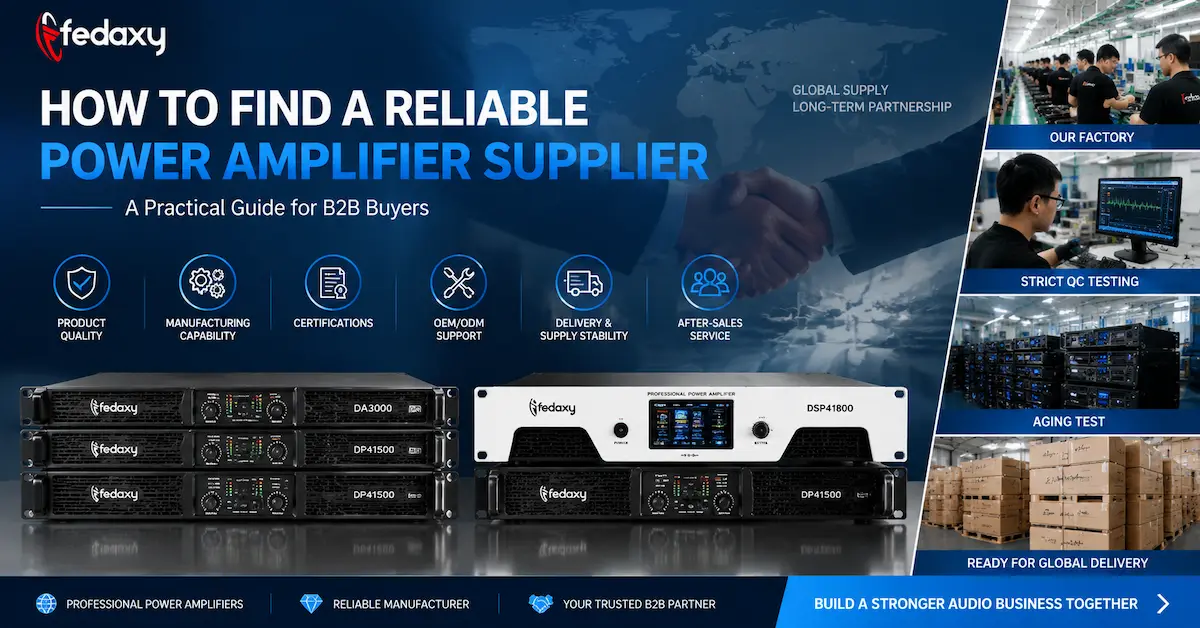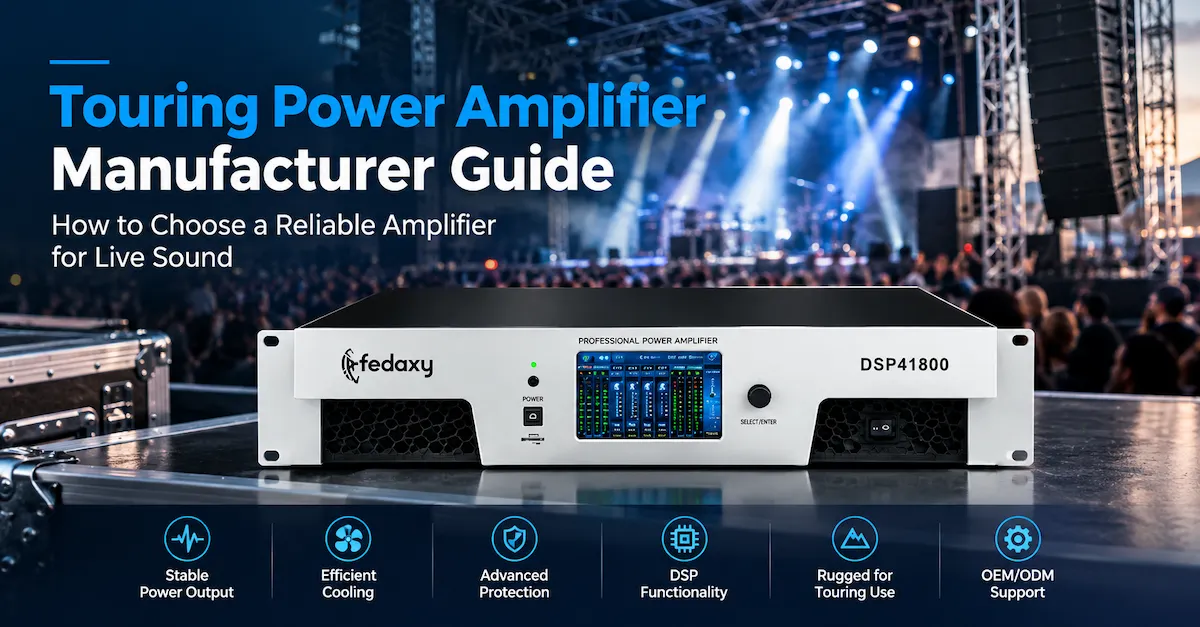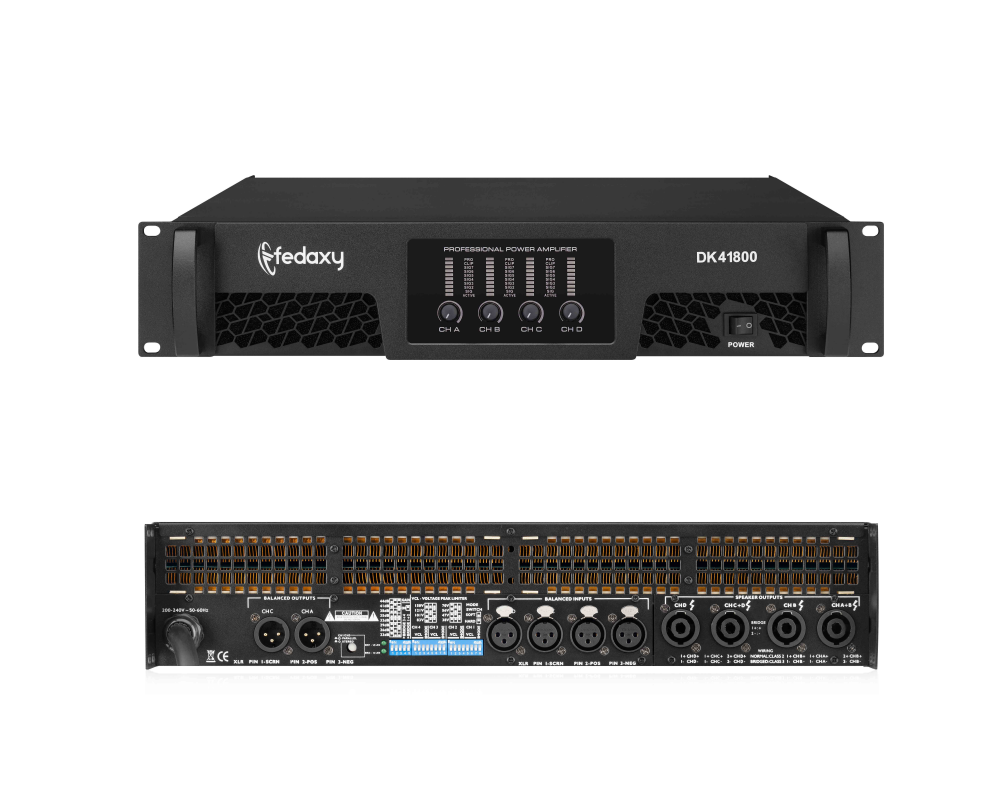
Distributors do not buy a power amplifier only to fill a warehouse. They buy a product that must be easy to explain, safe to install, consistent across repeat orders and supportable after the first sale. That is why the question what should distributors check before buying power amplifiers needs a procurement process rather than a short list of wattage numbers.
Short answer: check the amplifier's output at the impedance your customers will use, the number of channels and rack height, cooling and protection, component and QC evidence, certificates for the target market, sample consistency, packaging, warranty, spare parts, OEM options and the supplier's technical response. A professional power amplifier supplier should be able to connect each claim to a model, a test condition or a controlled document.
A distributor also needs to think one step beyond the product. Can a salesperson match the unit to a KTV room, a club, a theater, a stadium or a line-array rack without guessing? Can an installer find the wiring and DSP instructions? Can the distributor replace a fan or obtain a service answer when a customer is under pressure? The best amplifier buying checklist answers those questions before a purchase order is released.
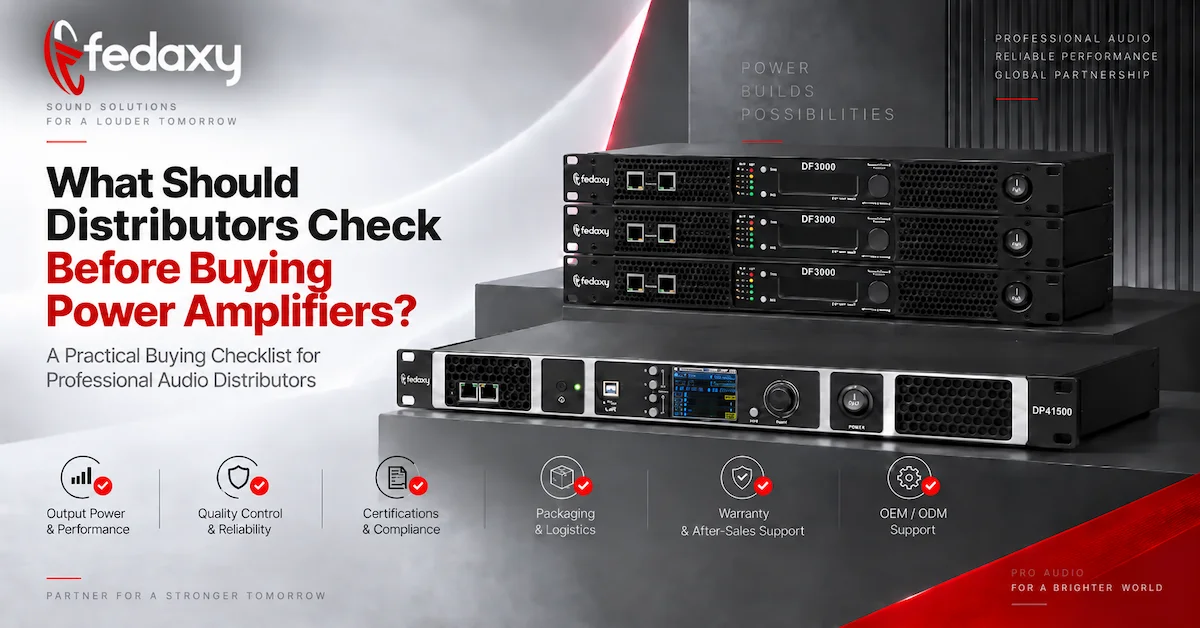
1. Start With the Distributor's Customer Profile
Before comparing factories, write down who will buy the amplifiers from you. A regional distributor serving rental companies will value transport weight, rack density, fast troubleshooting and spare units. A distributor serving fixed-installation contractors will care more about documentation, DSP presets, network control, quiet operation and regional compliance. A brand owner may need a private-label front panel, packaging and long-term change control.
This first step prevents a common mistake: choosing a model because it has an impressive headline output, then discovering that it is too heavy for the sales channel, too complex for the installers or poorly matched to the loudspeakers already in the market.
| Distributor profile | What the channel usually needs | Evidence to request |
|---|---|---|
| Rental and touring channel | High power density, repeatable setup, transport-friendly racks and quick service. | All-channel test data, thermal behavior, connector durability, manuals and spare-parts path. |
| Installation contractor channel | Predictable wiring, DSP control, low noise and clear commissioning documents. | Wiring diagrams, software version, presets, airflow notes and protection behavior. |
| KTV, club and hospitality channel | Long daily operation, useful low-frequency headroom and practical price tiers. | Impedance ratings, cooling guidance, warranty terms and service procedure. |
| Private-label or regional brand | Stable specifications, packaging, artwork, certificates and repeat-order control. | Approved sample, BOM or configuration record, change-notice process and document scope. |
2. Verify Output Power at 8Ω, 4Ω and 2Ω
Power ratings only become useful when the test conditions are visible. Ask whether the published result is continuous sine-wave power, program power, a short burst or a maximum figure. Confirm the frequency range, distortion limit, number of driven channels and test duration. A four-channel number measured with one channel driven should not be compared directly with four-channel all-load data.
Impedance is equally important. A loudspeaker load at 4Ω generally demands more current than the same amplifier at 8Ω. A 2Ω rating can be valuable for some professional systems, but it also raises the thermal and electrical burden. Do not assume that a brief 2Ω result means a unit can run every channel at full power for an entire event.
| Check | Question for the supplier | Why a distributor should care |
|---|---|---|
| 8Ω output | What is the continuous output with the specified channels driven? | It gives a conservative reference for many professional loudspeakers. |
| 4Ω output | What test duration and cooling condition were used? | Many multi-cabinet systems use 4Ω loads; inconsistent data creates returns. |
| 2Ω output | Is the value continuous, and what are the ambient and channel limits? | Low impedance can increase current, heat and protection events. |
| Bridge mode | What is the minimum bridged impedance and the approved wiring? | Incorrect bridging can damage an amplifier or loudspeaker. |
| Measurement method | Are the figures sine, burst, program or maximum output? | It lets sales teams compare models on the same basis. |
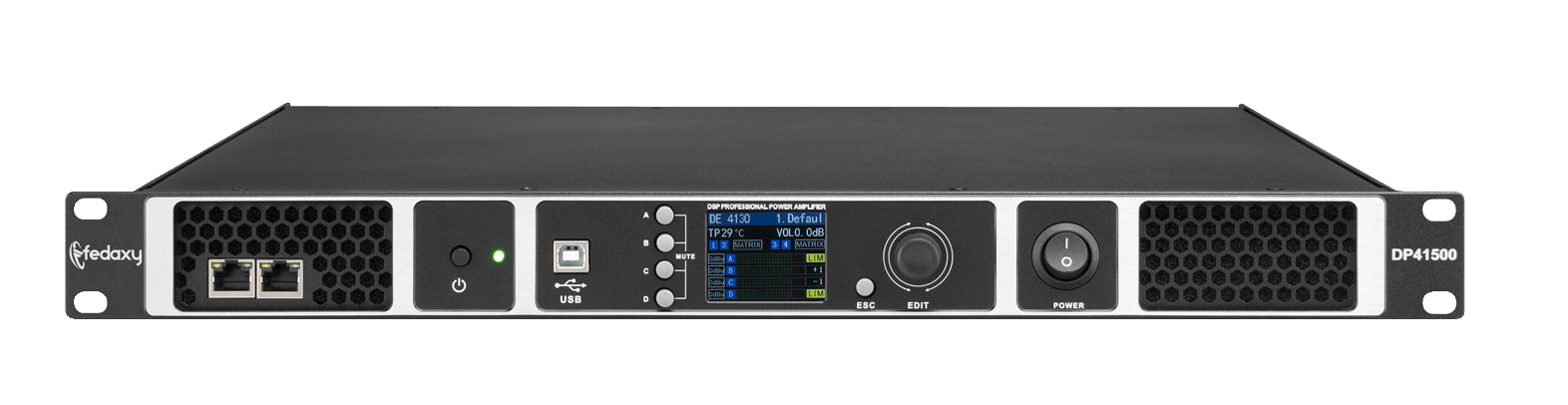
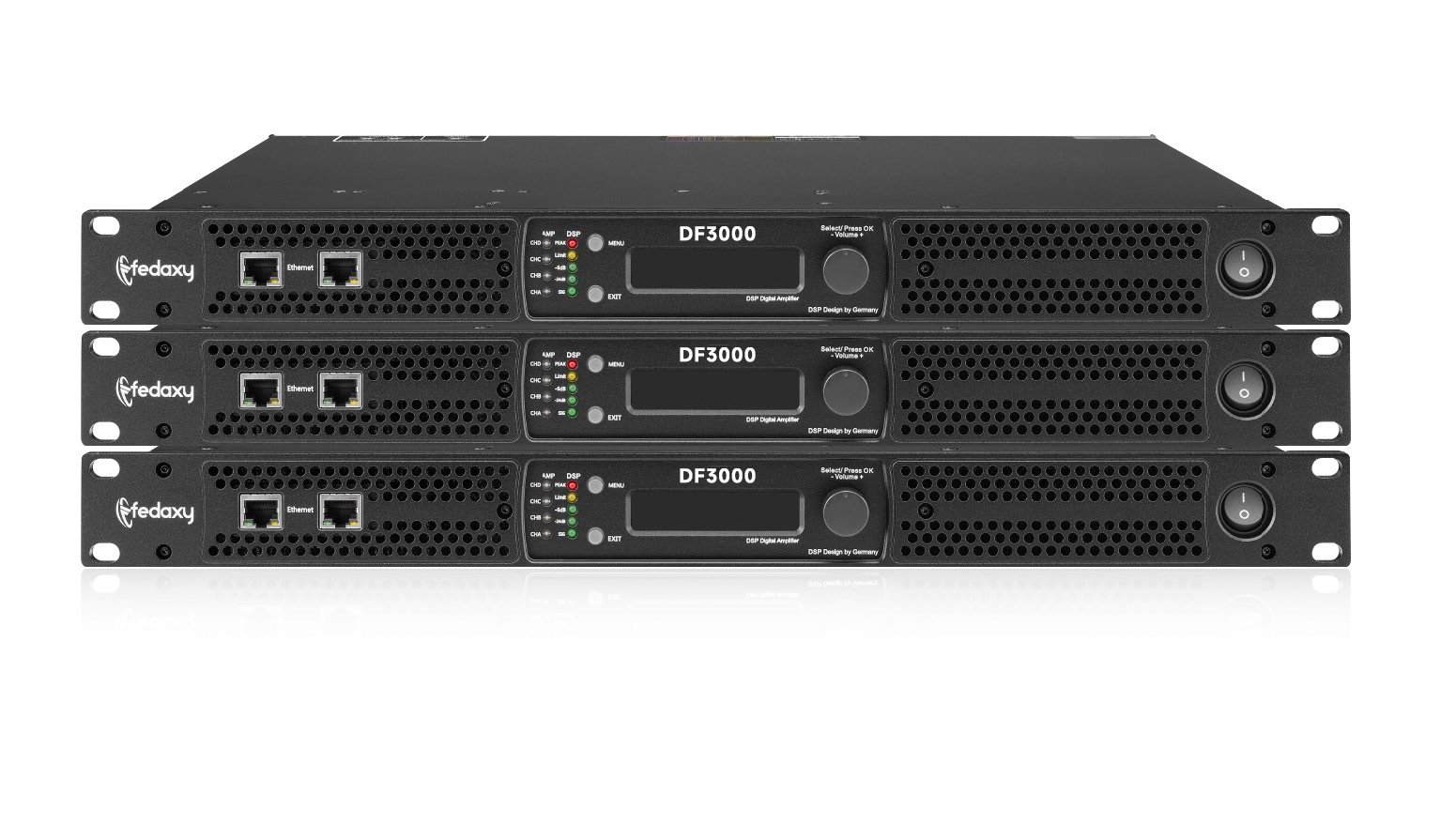
Fedaxy's public product pages illustrate why model-level checking matters. The DF3000 page lists a four-channel Class D DSP and Dante amplifier with published references of 4x3000W at 8Ω, 4x5000W at 4Ω and 4x6500W at 2Ω. The DP41500 page lists four Class TD DSP channels at 4x1500W, 4x2250W and 4x3750W at those same impedances. These values are useful starting points for a distributor comparison, but the current data sheet and test conditions should be approved for the exact voltage version and order.
3. Match Channel Count, Rack Height and Product Line Roles
Two-channel, three-channel and four-channel amplifiers solve different merchandising problems. Two channels are familiar for left-right mains, monitor pairs or dedicated subwoofer duties. Four channels can reduce rack units in a multi-way system. A three-channel or asymmetric design can combine two moderate full-range channels with one stronger low-frequency channel.
Rack height changes the product's commercial role. A 1U amplifier can be attractive to touring companies and installers with shallow or crowded racks. A 2U or 3U chassis may provide more room for a transformer, capacitors, cooling and service access. The right choice depends on the customer's loudspeaker load, duty cycle and transport limits, not on a universal preference for smaller equipment.
| Product role | Typical distributor conversation | Questions to settle |
|---|---|---|
| Compact 1U multi-channel | Touring, rental, multi-zone installation and high rack density. | All-channel output, fan noise, airflow direction and low-impedance limits. |
| 2U four-channel | KTV, clubs, restaurants, conference and flexible fixed installation. | Power tier, service clearance, heat in a closed rack and channel assignment. |
| 3U high-current | Subwoofers, large-format systems and projects with more rack space. | Weight, current delivery, transformer or supply design and transport packaging. |
| Active module | OEM loudspeaker and two-way powered cabinet integration. | LF/HF power ratio, enclosure cooling, mounting dimensions and EMC review. |
4. Separate Amplifier Topology From DSP and Dante
Class D, Class TD, Class H and Class AB describe amplifier platforms. DSP describes signal processing inside the unit. Dante transports digital audio across a network. These terms often appear together on a product page, but they answer different engineering questions.
- Class D: often chosen for efficiency, compact rack density and high output in a smaller chassis.
- Class TD: used in professional platforms that balance output capability, efficiency and practical rack formats.
- Class H: commonly associated with higher current capability and larger power-supply or thermal headroom.
- Class AB: a mature analog architecture used for selected professional and reference applications.
- DSP: can provide crossover, EQ, delay, routing, limiting and loudspeaker protection.
- Dante: carries digital audio over IP; it does not replace the DSP or the amplifier output stage.
For distribution, the practical question is how these functions affect the sale. Does the customer need an external processor, or would an integrated DSP reduce rack equipment? Does the installer have the software and network knowledge to manage Dante? Can presets be locked and exported? What happens to the audio path if the network disappears? A professional power amplifier supplier should answer these questions without treating DSP or Dante as decoration.
5. Inspect Power Supply, Components and Thermal Design
The front panel is easy to photograph; the power path is what determines whether the unit is useful in a real rack. Ask what supply architecture the model uses, which components are controlled, how the output stage is protected and how heat leaves the chassis.
Fedaxy's public company information describes 100% copper transformers, real rated wattage, five rounds of QC, an eight-hour aging test and a three-year warranty. These statements are valuable prompts for a distributor audit. They should be tied to the specific product family. Traditional Class H or Class AB products may use a transformer architecture that is not directly comparable with a Class D switching supply. Ask the factory to clarify the scope instead of applying one claim to every model.
Cooling is a commercial issue as well as an engineering issue. A customer may install several amplifiers in a closed cabinet, a warm machine room or a touring rack with limited clearance. Check whether airflow is front-to-back, how fans are controlled, whether filters can be serviced and at what temperature limiting or protection begins. If the answer is only “low heat,” the distributor still does not have an installation instruction.
6. Review Protection and Long-Run Behavior
Protection circuits should protect both the amplifier and the loudspeaker without creating confusing field behavior. Ask about power-on buffering, short-circuit protection, over-current protection, over-temperature protection and DC output protection. The manual should explain what the technician sees when protection activates and what recovery steps are safe.
Ask for a realistic operating test rather than a single bench result. A useful sample review can include the intended loudspeaker cable, rack orientation, signal level, impedance, ambient temperature and a long program cycle. For a rental customer, repeat the cycle after transport. For a fixed installation, test the cabinet airflow and the actual channel assignment.
7. Audit QC as a Process, Not a Slogan
A distributor needs batch consistency. A good factory can explain how parts are received, how PCB assemblies are checked, how wiring and grounding are inspected, how firmware or DSP presets are loaded, how units are aged and how final performance is recorded.
| QC stage | What to request | What it protects |
|---|---|---|
| Incoming material | Inspection method for power devices, capacitors, transformers, connectors and boards. | Reduces hidden component variation between batches. |
| Assembly and wiring | Work instructions, torque or solder checks and grounding inspection. | Reduces intermittent faults and safety risks. |
| Functional test | Channel output, indicators, input/output routing and protection checks. | Confirms the approved configuration works as sold. |
| Aging | Duration, load condition, ambient range and record format. | Finds early failures before shipment. |
| Final inspection | Serial number, firmware, accessories, labels, carton and test record. | Makes warranty investigation and repeat orders traceable. |
When a supplier says “five QC stages” or “eight-hour aging,” ask what each stage actually checks. The process is useful only when there is a pass criterion, a responsible role and a record that can be traced to the shipped unit.
8. Confirm Certificates and Their Exact Scope
Importers and regional distributors often need CE, RoHS, CB, EMC or LVD documentation. A certificate name on a website is not enough. Ask for the current document, issuing body, model list, voltage version, report number and validity or revision information that applies to your destination market.
Do not assume that one certificate covers every product family, every panel configuration or every private-label version. A new front panel may not change the electrical scope, but a power-supply change can. Your purchase file should link the certificate to the exact model and configuration being sold.
9. Evaluate the Product Family, Not Just One SKU
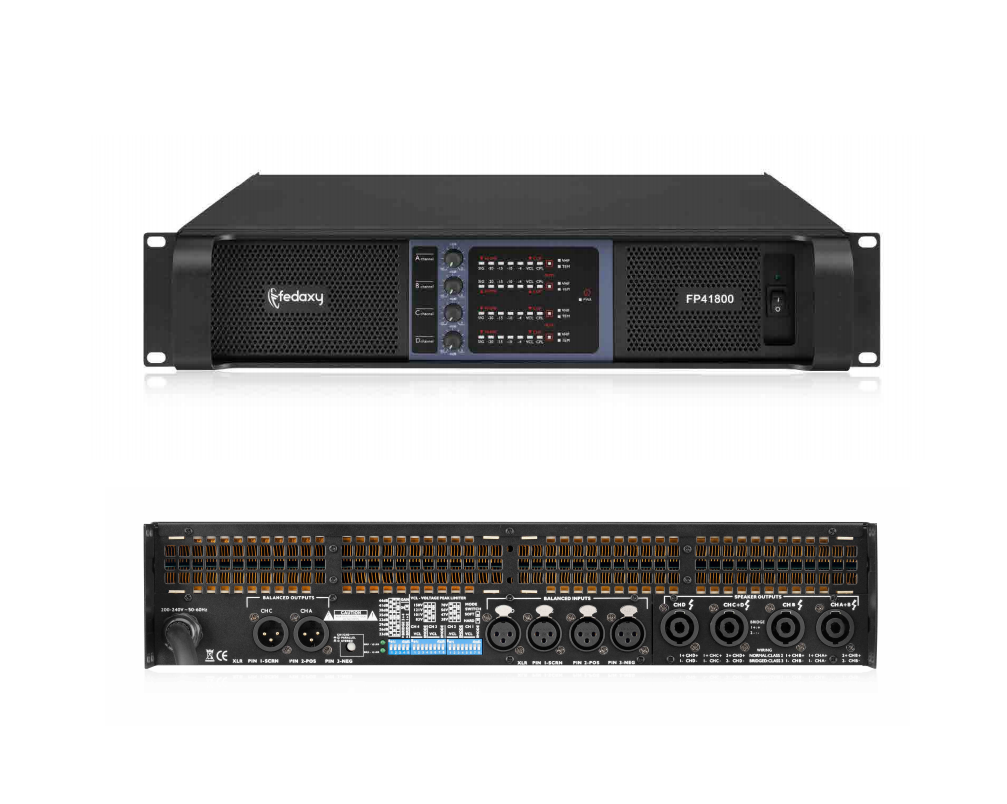
A distributor usually needs a small, coherent range. One 4,000-watt model cannot cover every customer, yet too many unrelated SKUs create training, inventory and support costs. Build a range around clear roles: a compact 1U product, a practical mid-power four-channel model, a high-current option and, where justified, a DSP or Dante model.
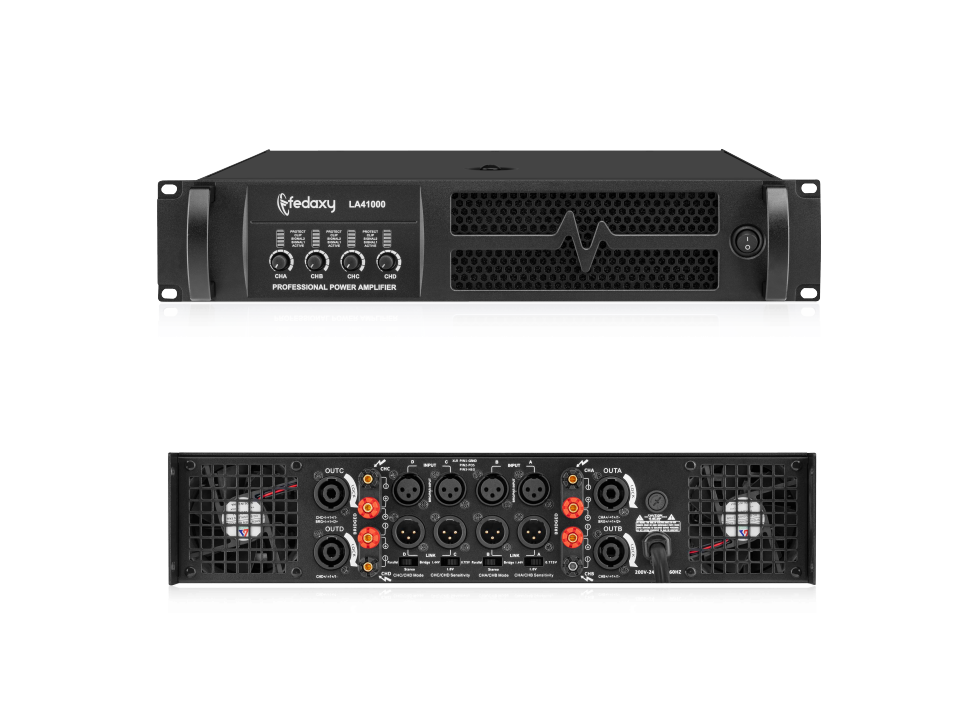
For example, the DF3000 can be discussed for high-density Class D systems with DSP and Dante. DP41500 can serve compact Class TD DSP applications. LA41000 is a 2U Class H four-channel option published at 4x1000W at 8Ω, 4x1500W at 4Ω and 4x2500W at 2Ω. PA1300 is a Class AB two-channel model listed at 2x1300W, 2x1950W and 2x3250W at 8Ω, 4Ω and 2Ω. AC750 is a two-way active module with an LF/HF power arrangement for powered-speaker integration. These are different sales roles, not interchangeable “best” products.
10. Ask What the Sample Must Prove
A sample should answer the distributor's real business questions. Can the unit drive the intended impedance? Does it fit the rack and connector standard? Is the fan behavior acceptable? Does DSP software work on the target computer? Are the labels, manual and carton correct? Does the measured output agree with the approved data sheet?
Record the sample serial number, firmware or DSP version, panel drawing, accessories, test conditions and photographs. Keep one “golden sample” reference for repeat orders. If a substitute component becomes necessary, require a change notice and decide whether a new sample is needed.
11. Review Packaging, Delivery and After-Sales Risk
Amplifiers travel through warehouses, containers, trucks and installation sites. Ask how the chassis, handles, knobs and connectors are protected. Confirm carton markings, accessories, manuals, serial labels, pallets and export documents. For international distribution, discuss the destination voltage, plug type, customs paperwork and agreed trade term.
MOQ, lead time and payment terms should be quoted for the exact configuration. Fedaxy's public FAQ lists common options such as T/T, Western Union, FOB, CIF, CNF, FCA, EXW and DDU, but the distributor should agree the commercial details in writing for the actual order. Do not treat a general FAQ as a fixed promise.
Warranty is part of the product line. Confirm the start date, covered parts, exclusions, return process, repair location, spare-parts availability and who pays freight. A three-year warranty can be a useful channel advantage only when the distributor knows how a real claim is handled.
12. Clarify OEM, ODM and Private-Label Boundaries
Distributors often begin with a standard model and later ask for a brand label. That may be a private-label project rather than a full ODM project. Define the level before quoting.
| Customization level | Possible scope | Documents to freeze |
|---|---|---|
| Private label | Logo, model name, labels, carton and manual. | Artwork, language, model code and packaging proof. |
| Configured OEM | Panel layout, connectors, voltage, DSP preset and accessories. | Approved sample, drawings, firmware and test limits. |
| ODM development | Mechanical, electronic, firmware or platform changes. | Requirements, milestones, prototypes, ownership and change control. |
A reliable OEM power amplifier supplier should also explain what happens after approval. Who owns the artwork? Which changes require a new sample? Does a replacement fan, capacitor or power device affect the certificate? Can the supplier keep the same firmware and output limits six months later? These details protect the distributor's reputation.
13. Build a Distributor Scorecard
Use a scorecard so that price does not dominate the decision. A practical version can assign points to technical fit, QC evidence, documentation, product-line coverage, sample performance, packaging, service and commercial terms. The score does not need to be public; its value is that it makes trade-offs visible to the purchasing team.
- Technical fit: output at the real impedance, channels, rack height and application.
- Evidence: data sheet, test method, sample record and protection explanation.
- Factory control: incoming inspection, aging, final test and change management.
- Channel value: product tiers, training, images, manuals and sales support.
- Risk: certificates, packaging, warranty, spares and response process.
- Commercial fit: MOQ, sample cost, lead time, payment and delivery terms.
The cheapest unit can score poorly when it needs extra engineering time, has unclear certificates or creates avoidable returns. A slightly higher unit cost may be sensible if it reduces support work and gives the distributor a stable product story.
14. Prepare a Better RFQ Before Contacting a Manufacturer
Send enough information for the engineering team to recommend a model. Include the country and mains voltage, application, loudspeaker brand and model, nominal and minimum impedance, cabinet quantity, wiring, desired output, channel count, bridge requirement, rack height, cooling conditions, DSP or Dante needs, branding, packaging, sample quantity, annual forecast and target delivery window.
Also state what is still unknown. A good supplier should be able to ask a clarifying question or warn that a requested 2Ω load is not suitable for continuous operation. Technical pushback is not a sales failure; it is evidence that someone reviewed the system.
Why Fedaxy May Be Worth Evaluating
Guangzhou Fedaxy Audio Equipment Co., Ltd. presents itself as a professional power amplifier manufacturer in Panyu, Guangzhou. Its public company information describes more than 15 years of R&D and production experience, integrated R&D, manufacturing, sales and technical service, and products covering Class D, Class TD, Class H, Class AB, DSP amplifiers and active modules. The company also states that it exports to partners in more than 100 countries.
For a distributor, the useful point is breadth with a technical route: compact Class D and DSP/Dante products, Class TD multi-channel platforms, Class H and AB options, and modules for loudspeaker integration. Fedaxy's public information also describes 6S management, five QC stages, eight-hour aging and a three-year warranty. Each claim should be matched to the requested model, documents and purchase terms during evaluation.
To request a recommendation, send the loudspeaker parameters, impedance, quantity, application, country, voltage, rack requirement and branding needs through the Fedaxy contact page. Ask for a model-specific data sheet, sample plan, certification scope and service route. That gives both sides a clear starting point for an inquiry.
Frequently Asked Questions
1. What should distributors check before buying power amplifiers?
Check real output at the intended impedance, channels, rack height, cooling, protection, QC, certificates, sample consistency, packaging, warranty, spare parts and OEM change control. Price should be compared after those technical and service conditions are clear.
2. How many amplifier models should a distributor stock?
There is no universal number. Start with clear product roles: a compact model, a mid-power multi-channel model, a high-current option and a DSP or Dante option if the channel supports it. Confirm demand and support capacity before adding more SKUs.
3. Is a higher wattage amplifier always better?
No. The amplifier must match the loudspeaker impedance, program requirement, channel assignment, rack and cooling. Excess capacity can increase cost and installation complexity, while insufficient capacity can create clipping, protection events or poor low-frequency control.
4. Should a distributor choose Class D or Class H?
Choose around the application. Class D is often attractive for efficiency and rack density. Class H may suit customers who value high current capability and have room for a larger chassis. The exact model, load and duty cycle decide the result.
5. Do DSP and Dante mean the same thing?
No. DSP processes audio with functions such as EQ, crossover, delay and limiting. Dante transports digital audio over a network. A product can include both, but they need separate setup and support documentation.
6. Can every amplifier run full power at 2Ω?
No. A 2Ω rating must be read with channel count, duration, ambient temperature, wiring and protection limits. Ask for continuous test evidence before recommending a low-impedance configuration to a customer.
7. What documents should an importer request?
Request the current data sheet, test conditions, manual, wiring diagram, certificate scope, packing specification, warranty terms, spare-parts information, firmware or DSP version and the approved sample record.
8. What makes a professional power amplifier supplier reliable?
Reliability is a chain: accurate specifications, repeatable production, documented QC, useful samples, clear change control, responsive technical support and a workable warranty process. No single slogan replaces that chain of evidence.
9. What should be included in a distributor RFQ?
Include the target country, voltage, application, loudspeaker model, impedance, cabinet quantity, channel plan, output requirement, rack height, cooling condition, DSP or Dante needs, branding, packaging, sample quantity and forecast.
10. What is the next step after a supplier passes the first review?
Approve a controlled sample. Record its serial number, firmware, panel, accessories and test results. Then freeze the commercial and technical configuration before placing a repeat or private-label order.
Request a distributor review: Send your market, loudspeaker parameters, impedance, channel plan, voltage, target product tier, branding requirements and expected volume to Fedaxy. The engineering and sales team can help identify a suitable amplifier platform and prepare a project-specific quotation.