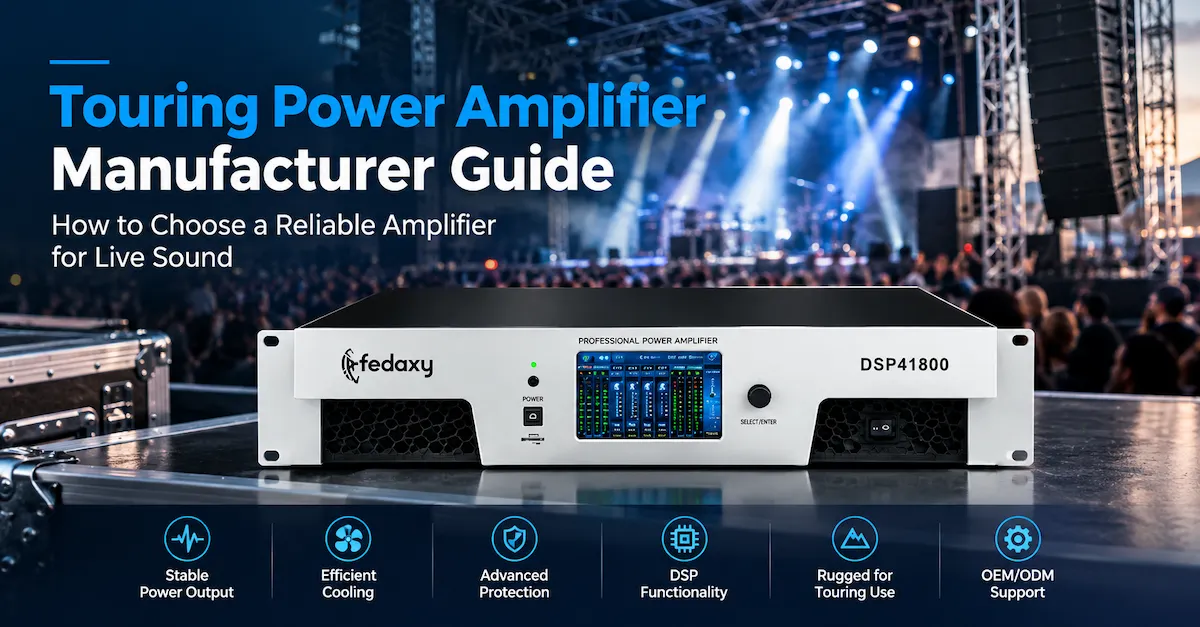
Touring Power Amplifier Manufacturer Guide: How to Choose a Reliable Amplifier for Live Sound
Most amplifier complaints arrive late. The sub channel trips during the encore. A fan suddenly sits in the vocal range. The spare unit powers up but does not behave like the one it replaced. None of those moments is really a price problem. When I compare a touring power amplifier manufacturer, I want to know what the unit does on the customer's speakers, after a complete set, in a closed road rack, and on a service bench with the venue waiting outside.
This is written for people who will make the decision again next month: an audio brand, rental manager, integrator, distributor or live-sound engineer. First quotes tend to show the shiny number and omit the awkward bits. This guide puts those bits back on the page: impedance, channel count, rack height, cooling, protection, DSP, Dante, sample testing and OEM/ODM work. A professional touring amplifier earns its place by fitting the system; a wattage contest is a poor substitute for that fit.
Quick Answer: What Makes a Reliable Touring Amplifier?
Here is a quick check that does not need a marketing department. Use the speakers from the venue plan, run a normal set, and watch output, current, temperature and protection recovery. If the unit is going to feed subs, let the low end work; do not test only with a polite mid-band tone. A quiet 1U amplifier may be ideal for a fly rack. A heavier chassis may be wiser when the sub bus will be pushed. The load, not the brochure, makes that call.
Ask for the sheet belonging to the exact chassis in the quotation. A family brochure can borrow a 4-channel number for a 2-channel model, so check the continuous result at 8 ohms and 4 ohms first. Need 2-ohm or bridge operation? Those figures need their own notes. I also want the test frequency, THD limit, driven-channel count and run time beside the wattage. Input sensitivity, fan direction, voltage, weight, warranty and spare parts look boring until a rack is installed, shipped and repaired. Without test conditions, the design is still provisional.
1. Start with the Loudspeaker System, Not the Amplifier Price
Start with the speaker list, even when the email says only “quote a 2,000-watt amp.” Write down the cabinet model, nominal and minimum impedance, program and peak power, box count, wiring plan, subwoofer arrangement and target SPL. Add one plain sentence about the job: flown array, point-source stack, side-fill monitors, club system or corporate room. That sentence gives a touring power amplifier supplier a working picture instead of a guess.
Take a weekend rental package with two full-range stacks. Two channels may cover it neatly. Add two subs and three channels can make the patch less fussy, with the low-frequency channel carrying the heavier current demand. Four-way systems and several delay zones often point to four channels. For a large sub array, a 2U or 3U high power touring amplifier may feel calmer than a compact 1U unit. The spreadsheet has an opinion; the truck pack and repair bench get one too.
The minimum information for a useful recommendation
- Loudspeaker nominal impedance and minimum impedance.
- Continuous or program power per cabinet.
- Number of cabinets per channel and total cabinet count.
- Full-range, line-array, monitor or subwoofer role.
- Required operating voltage and frequency for the destination market.
- Rack height, maximum rack weight and available airflow.
- Need for DSP, Dante, bridge mode, presets or multi-zone control.
- Rental, touring or fixed-installation duty cycle.
2. Understand 8 Ohm, 4 Ohm and 2 Ohm Output Ratings
“4 x 1800 W” is only the beginning. Into 8 ohms or 4 ohms? Sine wave or burst? One channel or all four? Which distortion limit? The simple arithmetic matters here: two 8-ohm cabinets in parallel present 4 ohms; four present 2 ohms. Current demand rises as that number falls, and the output stage, supply, cable and cooling path all feel it. A large 2-ohm figure is useful only when the test resembles the show.
Have the touring amplifier manufacturer label the figure: continuous sine-wave, program, burst or maximum. The same sheet should state the band, driven-channel count, THD limit and duration. This matters when one sub channel feeds several cabinets. A short burst can look excellent in a catalogue and still say very little about the level the rack will hold through the chorus, encore and fast changeover.
| Rating | What it tells you | What it does not tell you |
|---|---|---|
| 8 ohms | A useful reference for many professional loudspeaker systems and conservative system planning. | It does not prove long-term stability at lower impedance. |
| 4 ohms | Shows the amplifier can deliver more current to common multi-cabinet configurations. | It does not guarantee every channel can run continuously at full output. |
| 2 ohms | Indicates low-impedance drive capability when the test conditions are verified. | It does not mean every speaker wiring scheme is safe for continuous 2-ohm use. |
| 8-ohm bridge | Shows the available output when two channels are combined for one load. | It does not replace checking the minimum bridged impedance and protection limits. |
3. Channel Count and Rack Height: Density Versus Serviceability
Channel count changes the patch sheet and the troubleshooting routine. Two channels are easy for left/right, monitors or a pair of subs. Four channels can keep a multi-way system in one rack and remove several jumpers. Three channels are less common, but handy when the mains need one power level and the subwoofer needs another. There is no prize for using a channel you did not need.
1U matters when the rack has to fly, travel and stay below a hard weight limit. The compromise is physical: less room for energy storage, heat spreading and a technician's hands. A 2U or 3U chassis adds weight, but can give the thermal path more breathing room and make a fan or connector reachable. With a high power touring amplifier, ask what the complete rack sustains on a hot load-in day, doors and filters included.
Draw the airflow path before filling in rack labels. Keep intake and exhaust clear. Do not park a heat-sensitive processor over an exhaust outlet. Find out whether the fan follows temperature or runs at one fixed speed. Leave real access around signal, speaker and mains connectors. A tidy drawing is nice; reaching a loose connector at midnight is better.
4. Choosing Between Class D, Class TD, Class H and Class AB
Class helps narrow the shortlist. It does not make the final choice. Output target, rack weight, room temperature, speaker layout and local service habits still matter. Two models can carry the same published wattage and behave differently after several low-frequency channels have shared a warm rack for an evening. Look at the supply and cooling strategy with the same care as the class label.
| Platform | Typical strengths | Questions for touring use |
|---|---|---|
| Class D | High efficiency, high power density and compact 1U designs. | Can the power supply and cooling sustain the intended load with all channels driven? |
| Class TD | High output, strong dynamics and useful 1U, 2U and 3U configurations. | Which models are optimized for line array, full-range or subwoofer duty? |
| Class H | High current capability, large energy storage and strong headroom in traditional designs. | Is the extra rack weight justified by the load and operating environment? |
| Class AB | Mature analog architecture and a familiar service approach for professional audio. | Is the available thermal and electrical capacity suitable for the show schedule? |
Fedaxy's range covers Class D, Class TD, Class H and Class AB platforms, plus DSP versions and active amplifier modules. For a distributor or integrator, that can cover a club, touring stage and fixed installation from one supply base. I would still use the family description as a map, not proof. Before releasing an order, check the quoted model's output table, voltage version, fan arrangement and protection behavior.
5. DSP and Dante: When Digital Control Adds Real Value
DSP earns its space when it removes a task from another box. Crossover, EQ, delay, limiting, routing, mute and monitoring can live in the amplifier, leaving fewer devices to patch, power and label. The practical gain is repeatability: save a known setup, lock it for the rental crew, and recall it when the next room has a different trim height or stage depth.
Dante handles the signal's trip to the amplifier; it does not replace DSP. Many channels over an IP network can simplify a theater, arena, conference complex or permanent installation where long analog runs become troublesome. DSP shapes the signal. Dante carries it. If a model offers both, write down the clock source, switch plan, control permissions and the fallback behavior for a lost link.
Questions to ask about integrated DSP
- Are the filters, EQ, delay and limiters accessible from a computer, front panel or network controller?
- Can the manufacturer provide loudspeaker presets, and who verifies them?
- Can settings be locked or exported for rental technicians?
- Does the DSP remain stable when the amplifier is operated at low impedance?
- What happens to the audio path if the network connection is lost?
- Are firmware versions, software tools and operating systems documented?
6. Cooling, Protection and Long-Run Reliability
A rack can run for three hours, lose power, and be on the truck while the chassis is still hot. Thermal design is part of the audio result in that situation. Look for a defined airflow direction, fan behavior that makes sense at low and high load, thermal monitoring and a fan or filter arrangement a local technician can service. Test the unit in the orientation and ambient conditions the customer will face.
Power-on buffering, over-temperature, short-circuit, over-current and output-DC protection are familiar features. They will not rescue a bad speaker wiring plan or a gain structure that clips all night. The crew should know what a protection event looks like, whether audio returns by itself, and whether a log or front-panel indicator remains after the show. A list of protections is not yet a workflow.
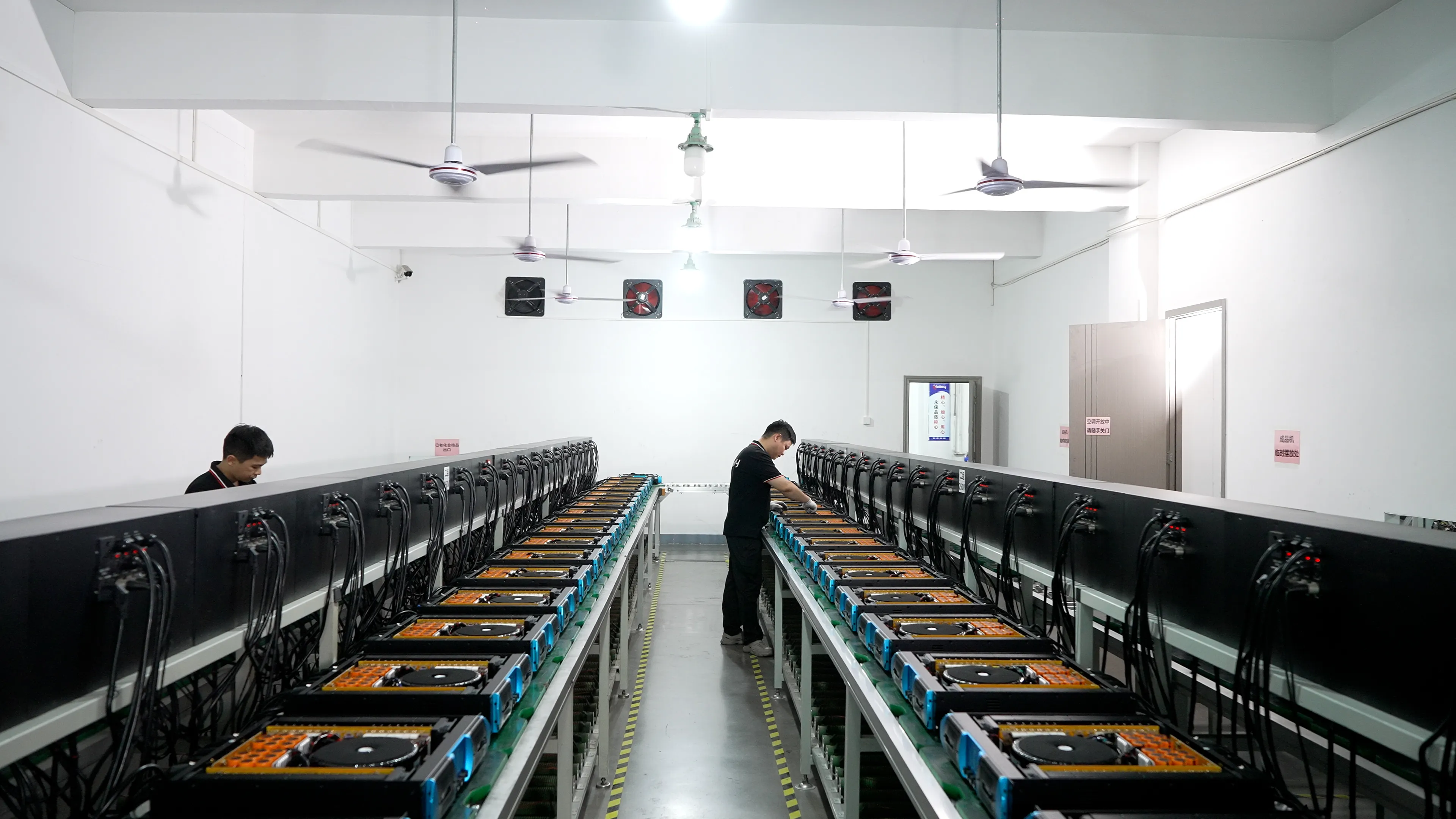
“Rugged” and “military grade” do not tell a rental manager what will happen on the fourth show of a weekend. Ask for an aging-test record, temperature readings, protection procedures, output waveforms or anonymized service notes. Fedaxy describes a five-round QC process and an eight-hour aging test; ask which load, duration, temperature and acceptance limits applied to the model in your quotation. That answer tells you whether the claim was measured or merely repeated.
7. Model Examples for Different Touring Requirements
The following examples use product information published by Fedaxy. They are starting points for system discussions, not a replacement for a final loudspeaker match.
| Model | Published configuration | Published 8-ohm output | Potential fit |
|---|---|---|---|
| D24200 | 1U, 2-channel Class D | 2 x 4200 W | High-density touring racks and demanding two-channel systems. |
| D43000 | 1U, 4-channel Class D | 4 x 3000 W | High-output multi-channel systems where rack density matters. |
| DE41300 | 1U, 4-channel Class TD | 4 x 1300 W | Compact professional reinforcement and multi-zone configurations. |
| DP41500 | 1U, 4-channel Class TD with DSP | 4 x 1500 W | Compact systems that need integrated tuning and protection control. |
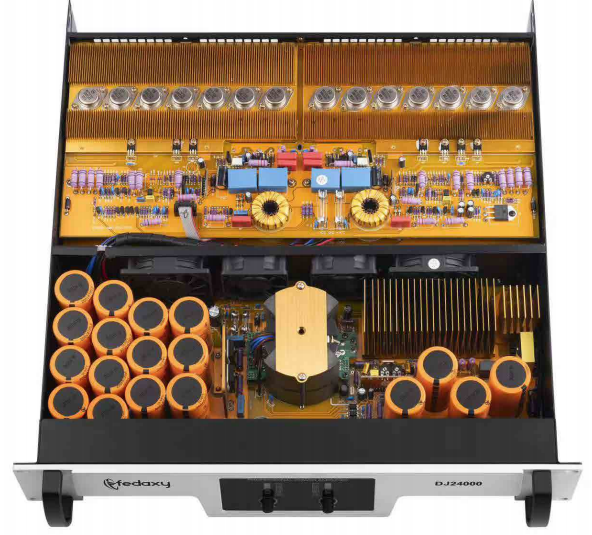
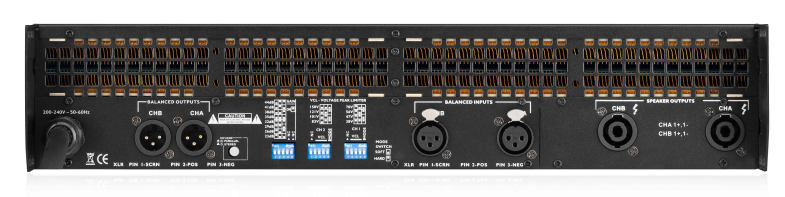
| DJ24000 | 2U, 2-channel Class TD | 2 x 2400 W | Touring, KTV, concerts and high-output professional audio. |
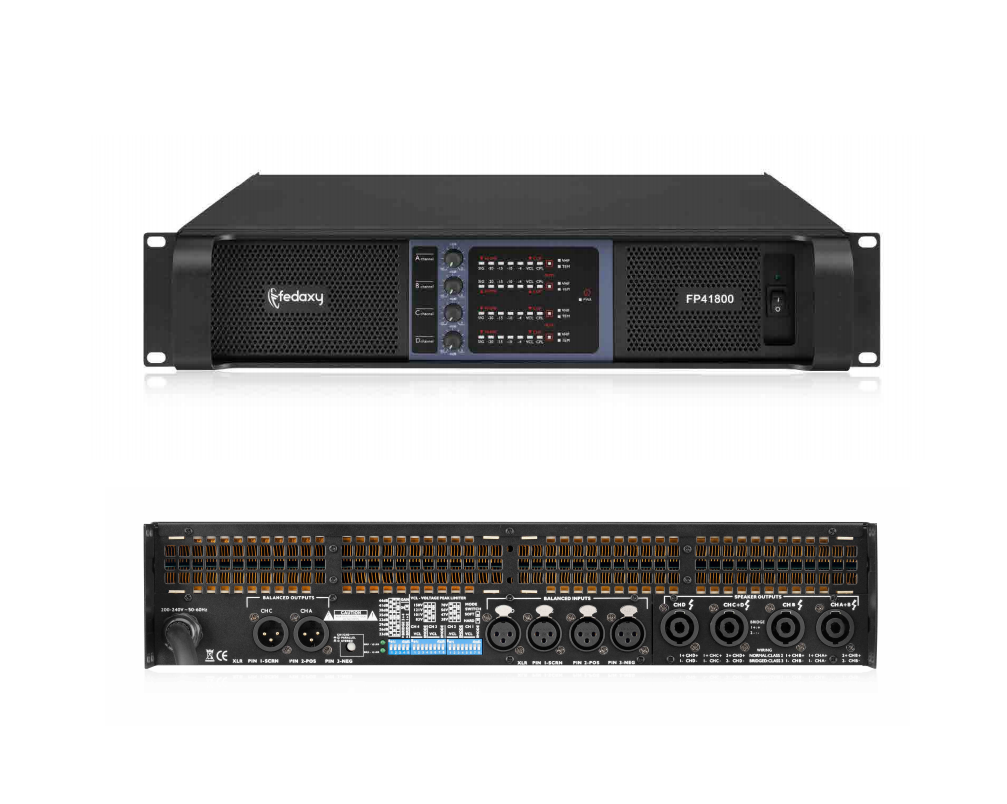
| FP41800 | 2U, 4-channel Class TD | 4 x 1800 W | Four-channel touring and fixed-installation systems. |
| LS3000 | 3U, 2-channel Class TD | 2 x 3000 W | Subwoofer systems and large-scale low-frequency reinforcement. |
| FH41500 | 3U, 4-channel Class H | 4 x 1500 W | High-current systems where headroom and physical energy storage matter. |
| HT42000 | 3U, 4-channel Class H | 4 x 2000 W | Large venues and high-output professional sound reinforcement. |
Notice that the list includes both compact and large chassis. That is intentional. A touring amplifier manufacturer should be able to explain why a 1U Class D model, a 2U Class TD model or a 3U Class H model is appropriate for a particular loudspeaker system. The recommendation should include the expected rack load, cooling plan, transport requirements and backup strategy.
8. How to Evaluate a Touring Amplifier Manufacturer
Product specifications are only one part of a supplier evaluation. A reliable touring amplifier manufacturer should demonstrate that the same specification can be produced consistently across repeat orders. This is especially important for audio brands and rental companies that need spare units to behave like the original batch.
Manufacturing and engineering questions
- Does the company design, assemble, test and support the amplifier under one organization?
- Can it provide the BOM or controlled component list for the approved configuration?
- How are incoming materials, PCB assembly, wiring and final assembly inspected?
- How are output power, frequency response, distortion and protection verified?
- Can it reproduce the same DSP presets, panel design and firmware version?
- What changes require customer approval before a repeat order?
- Are spare parts, service instructions and repair support available?
Fedaxy states that it integrates R&D, production, sales and technical service in Panyu, Guangzhou, and that it uses 6S on-site management. It also describes ISO9001, CE, RoHS and CB-related quality and compliance claims. Buyers should request the current certificate files and confirm whether each certificate applies to the exact model, voltage version and target market.
9. OEM, ODM and Private-Label Touring Amplifiers
A professional brand may not need a completely new amplifier from the ground up. In many cases, the faster route is to start with a proven platform and customize the elements that matter to the market. A touring amplifier manufacturer with OEM and ODM capability can support brand identity, packaging, front-panel design, connector layouts, voltage versions, DSP presets and project-specific output configurations.
Before requesting an OEM quotation, define the product brief. Include the target country, brand position, channel count, output range, loudspeaker applications, input and output connectors, rack height, logo treatment, packaging, manuals, required compliance documents, sample quantity and expected annual volume. A clear brief reduces unnecessary prototype cycles and makes it easier to compare suppliers.
| Customization level | Typical scope | Best for |
|---|---|---|
| Private label | Logo, model name, label, carton, manual and standard accessories. | Distributors launching a branded product line quickly. |
| Configured OEM | Panel design, connector options, voltage, DSP preset and protection configuration. | Audio brands with a defined system or regional requirement. |
| ODM project | Platform adaptation, mechanical changes, electronics, firmware and validation. | Brands that need a differentiated amplifier or powered-speaker platform. |
10. Cost and Risk: The Lowest Unit Price Is Rarely the Lowest Project Cost
The purchase price of a touring amplifier is only one part of total cost. Add the rack space, transport weight, power consumption, spare-unit requirement, setup time, service, replacement fans, warranty handling and cost of a failed show. A compact high-efficiency amplifier may lower transport and power costs, while a larger high-current model may be justified by the loudspeaker load and required headroom.
Risk also appears in data quality. If a supplier publishes different power ratings in its title, meta description and parameter table, stop and request a controlled data sheet before publishing or ordering. If a product page uses the wrong image or copies the text from another model, ask for an engineering-approved specification. Clear documentation is a commercial advantage because it reduces misquoting and protects both the buyer and the manufacturer.
11. A Practical Supplier Comparison Checklist
| Area | What to verify | Red flag |
|---|---|---|
| Output | 8Ω/4Ω/2Ω, bridge, all-channel drive and test conditions. | Only one large wattage number with no impedance. |
| System match | Speaker model, cabinet count, minimum impedance and application. | Recommendation made without asking about loudspeakers. |
| Thermal | Airflow, fan control, ambient test and rack clearance. | “No heat” or “never overheats” claims without data. |
| Protection | Thermal, short, overcurrent, DC and power-on behavior. | Protection listed but never tested or documented. |
| DSP/network | Functions, presets, software, firmware and Dante network plan. | DSP/Dante used as interchangeable buzzwords. |
| Quality | Incoming inspection, assembly, aging, performance and final inspection. | Generic QC claim with no process or record. |
| Compliance | Certificate number, model scope, voltage and market. | “CE certified” with no document or model mapping. |
| Delivery | Sample, MOQ, production lead time, packaging and shipping terms. | Fixed promises before the configuration is frozen. |
| After-sales | Warranty, spare parts, repair instructions and response path. | Warranty length with no terms. |
12. Testing a Sample Before a Bulk Order
A sample should be tested with the same speakers, cables, rack orientation and signal chain used in the project. Start with safe gain settings and verify channel routing, polarity, input sensitivity, mute behavior, clip indicators, fan behavior and protection recovery. Then measure output at the intended impedance and compare the result with the approved data sheet.
For a rental or touring fleet, repeat the test after transport vibration and a realistic operating cycle. Check connector retention, fan noise, front-panel readability and whether settings remain locked or recover after power cycling. For an OEM project, freeze the approved sample with photographs, serial number, firmware version, panel drawing and test record. The sample becomes the reference for future production.
13. Why Factory Support Matters After Delivery
Live-sound projects do not finish when the shipment leaves the factory. Engineers may need wiring clarification, DSP guidance, replacement parts, firmware information or a fast answer about an unusual protect condition. A factory-direct relationship can shorten the path between the technical question and the person who understands the product.
Fedaxy presents technical support, product manuals, data sheets, software updates, video tutorials and after-sales service as part of its broader support offer. The exact support scope should be agreed in the quotation and purchase contract. For international buyers, also confirm time-zone coverage, language support, spare-parts availability and the procedure for warranty returns.
14. Final Recommendation
The best touring sound system amplifier is the one that is electrically matched, thermally realistic, documented and supportable. Use the loudspeaker system as the starting point. Compare output by impedance, not by headline watts. Select the channel count and rack height around the real system architecture. Treat DSP and Dante as tools with specific jobs. Ask for evidence of aging, performance and protection tests. Then evaluate the supplier’s ability to reproduce the approved configuration through repeat orders.
If you are comparing a touring power amplifier manufacturer for a live-sound project, send the loudspeaker model, nominal and minimum impedance, cabinet quantity, target application, rack requirements, voltage, desired channels and DSP/Dante needs. Fedaxy’s engineering team can use that information to recommend a suitable Class D, Class TD, Class H, Class AB, DSP or active-module platform and clarify whether a standard, OEM or ODM route is the right fit.
Frequently Asked Questions
1. What is a touring power amplifier manufacturer?
A touring power amplifier manufacturer develops and produces amplifiers intended for mobile live-sound systems, rental fleets, concerts and demanding professional installations. The evaluation should include engineering, testing, repeatability, service and logistics, not only the product label.
2. How many watts do I need for a touring amplifier?
The answer depends on the loudspeaker’s impedance, program power, cabinet count, desired headroom and system design. Provide those details to the supplier instead of selecting a number from a general wattage chart.
3. Is Class D or Class TD better for touring?
Neither is universally better. Class D is often attractive for efficiency and compact rack density, while Class TD models may provide a useful balance of output, dynamics and application flexibility. The correct choice depends on the loudspeaker load and tour requirements.
4. Should I choose a 2-channel or 4-channel professional touring amplifier?
Choose two channels for simple left/right, monitor or subwoofer roles. Choose four channels when the system is multi-way, multi-zone or needs more output channels in a limited rack. Check total current demand and cooling before deciding.
5. Do I need DSP in the amplifier?
DSP is valuable when you need crossover, EQ, delay, limiting, routing or repeatable loudspeaker presets. A simple system may not need integrated DSP, while a line array, multi-zone or branded system can benefit substantially from it.
6. What is the difference between DSP and Dante?
DSP processes the audio signal inside the amplifier. Dante transports digital audio over a network. Some amplifiers include both, but they should be planned and tested as separate system functions.
7. Can a high power touring amplifier run at 2 ohms?
Some models publish 2-ohm output ratings, but the actual wiring, duration, ambient temperature and all-channel drive condition must be checked. Do not assume that every model is intended for continuous full-power 2-ohm operation.
8. What should I ask a touring amplifier manufacturer about quality?
Ask for incoming-material inspection, PCB and assembly checks, aging-test conditions, output measurements, protection tests, final inspection, certificate scope and repeat-order controls. Specific records are more useful than general quality slogans.
9. Can Fedaxy provide OEM or private-label touring amplifiers?
Fedaxy’s website describes OEM, ODM, OBM, OIM and SKD cooperation, including logo, front-panel, packaging, configuration and project-based customization. Confirm the available customization level, MOQ, sample process and approval documents for your project.
10. What information should I include in an RFQ?
Include the target country, loudspeaker model, power, impedance, cabinet quantity, application, channel count, rack height, voltage, DSP/Dante requirements, brand and packaging needs, sample quantity, expected volume and target delivery window.
Request a touring amplifier recommendation: Send your venue or tour profile, loudspeaker parameters, impedance, channel plan and branding requirements to Fedaxy for a project-specific review.